
When Is Peak Moving Season? Dates by Month and Move Type
Peak moving season runs from late May through August, and June is the busiest single month of the year, carrying about 12% of all annual moves. May, July and August each sit close behind at roughly 9% to 10%, so the window is wide rather than one sharp spike, and a sensible plan starts in early May instead of the week school lets out.
Nearly 40% of domestic household-goods moves fall between May 1 and August 31, according to the United Van Lines peak-season release, which means advice to "book in summer" arrives roughly a month too late. Ask when is peak moving season and most answers stop at the summer label, without saying which weeks fill first or how the pattern bends by route.
The calendar also isn't one rule for everyone. A three-mile apartment move and a 2,000-mile interstate move don't compete for the same trucks, and the summer concentration has been thinning at the back while housing activity creeps earlier into spring. What follows is the month-by-month shape of demand, where it shifts by distance and climate, and how to pick a date you can reliably hold.
Table of Contents
Peak Moving Season by Month at a Glance
Demand peaks from late May through August, with June the clear leader. A U.S. Census Bureau working paper reported that more than 40% of all moves occurred from May through August, with June the leading individual month at 12%, followed by August at approximately 10%, July at 10%, and May at 9%.
Here's how the year breaks down when you line those monthly shares up against the quieter stretches on either side.
Period | Share of annual moves | Demand level | What it means for booking |
|---|---|---|---|
December to February | Lowest of any period | Low | Most availability; weather risk |
March and April | About 8-9% each | Shoulder | Demand starts rising |
May | About 9% | High | Window opens May 1; start planning |
June | About 12% | Peak | Busiest single month |
July | About 10% | Peak | Book early for preferred dates |
August | About 10% | Peak | Last peak month; school-timed moves |
September | About 8-9% | Elevated | Demand eases but stays high |
October and November | About 8-9% each | Shoulder | Often more scheduling flexibility |
The shape matters more than any single decimal. June alone holds roughly one in eight annual moves, and August is the last month when crews, trucks, storage bays and elevator reservations are all committed at once.
Practical rule: If your date falls in June, July or August, treat it as peak and lock the crew early. If it falls in December, January or February, you'll have the widest choice of dates and the most room to move a booking to a weekday.
Read the table as a statistical pattern, not a fixed calendar. School districts set their own start dates, universities run different lease cycles, and one large employer relocation can tighten a single suburb for a fortnight while the rest of the metro stays open. The shares describe the country, not your street.
What carries forward is where the crowd goes. The weekends inside the summer block and the last few days of each month are the slots that vanish first, so a Tuesday in mid-June is a far easier booking than the final Saturday of July.
Why Demand Peaks in Summer
About 30% of people in most demographic groups made their most recent move in June, July, or August, according to a Census Bureau analysis of 2009 Survey of Income and Program Participation data. Households never pick one national moving day. The same three months still fill because school calendars, weather, and housing dates press on everyone at once.
The Bureau ties that concentration to school schedules, favorable weather, and household timing. Those three forces do not hit every market on the same Monday. A hotter climate, a university lease cycle, or an earlier school start can pull demand forward of the classic June-to-August block. The summer share is a national average, not a date every city follows.
Seasonal load is not unique to moving trucks. The graphic below shows the same summer concentration in another system, for the same structural reason: several ordinary constraints land together.

Three constraints that land in the same weeks
School calendars: Families with children time a move between school years, which funnels decisions into a ten to twelve week band. A family that misses the window usually waits a full year.
Weather: Dry roads, clear driveways, and lighter handling make summer easier. That convenience pulls people who have no school deadline into the same weeks.
Household timing: Job starts, lease turnover, and closing dates cluster in the same months, so a relocation that begins with a new job offer tends to land in July or August by default.
What this changes for you: the same three-bedroom move takes more coordination in July than in January, because crews, trucks, and storage bays are already promised to someone else that week.
Booked capacity is what narrows the options once those three constraints stack.
Local Versus Long-Distance Moves and the Comfort Peak
Distance changes how tightly summer grips a move. A same-county job can spread across the year. An interstate or international haul bunches far more of its annual volume into the warm months, because those jobs compete for the same tractors, drivers, and delivery windows inside one short season.
Move type | June to August concentration | Through September |
|---|---|---|
Same county | Lowest of the three | Most room left outside summer |
Same state, between counties | A step higher | Closer to an even split |
Interstate or international | Highest of the three | Widest bunching, and September stays inside it |
The right-hand column is the one that changes a plan. On long-distance moves, September sits in the busy block, not after it. A local move across Round Rock can still land in October with ordinary lead time. A Texas-to-Oregon move that month is bidding for a driver who may already be committed to another cross-country run.
Recent housing timing has been sliding some of that demand forward into spring. The shoulder is still quieter than July, but it is no longer an empty lane, especially on routes that already run long.
Where the demand peak and the comfort peak split
Greater Austin stacks a climate calendar on the demand calendar. Midsummer heat pushes loading toward morning starts, shade where the site allows it, and a pace built around water and breaks. The same inventory then takes more hours.
Heat also changes which goods can sit in a closed trailer. Wine, electronics, plants, and furniture with wax or oil finishes soften or degrade faster after a driveway bake starting at noon. Those pieces go last, or they ride in a climate-controlled vehicle.
Apartment buildings add a third constraint. Summer turnover fills elevator slots and loading zones, so a midday Saturday in July can be closed in a building that is open in February. For apartment moves, Webster Moving Co. asks customers to flag stairs, elevators, loading areas, gate codes, and parking restrictions at booking so the crew plan matches the building.
Three situations, three different right answers
A family tied to the school year has the least room and the strongest reason to book in May for a June or July date. If the district calendar allows a mid-June weekday instead of the last Saturday of the month, take the weekday.
An apartment renter whose lease ends July 31 is aiming at one of the most contested weeks of the year. Reserve the elevator and the crew together, and ask whether the building allows an early-morning load-in before other tenants start.
A small business that needs a downtime window should weigh storage and route distance, not only the calendar date. Splitting an office move into two phases, with equipment held in storage between them, often beats forcing the whole job onto one peak weekend.
Long-haul price follows the same seasonal squeeze. Crew size, volume, time on the job, travel between stops, and specialty items all move the number, and summer tightens the scarce inputs first. Read how much long-distance moving costs before you lock a date.
Rule of thumb: pick the date that fits your constraints first, then adjust for cost and comfort. When the calendar is yours to choose, late March through April, or October through November, usually gives you both.
Is the Peak Shifting Toward Spring
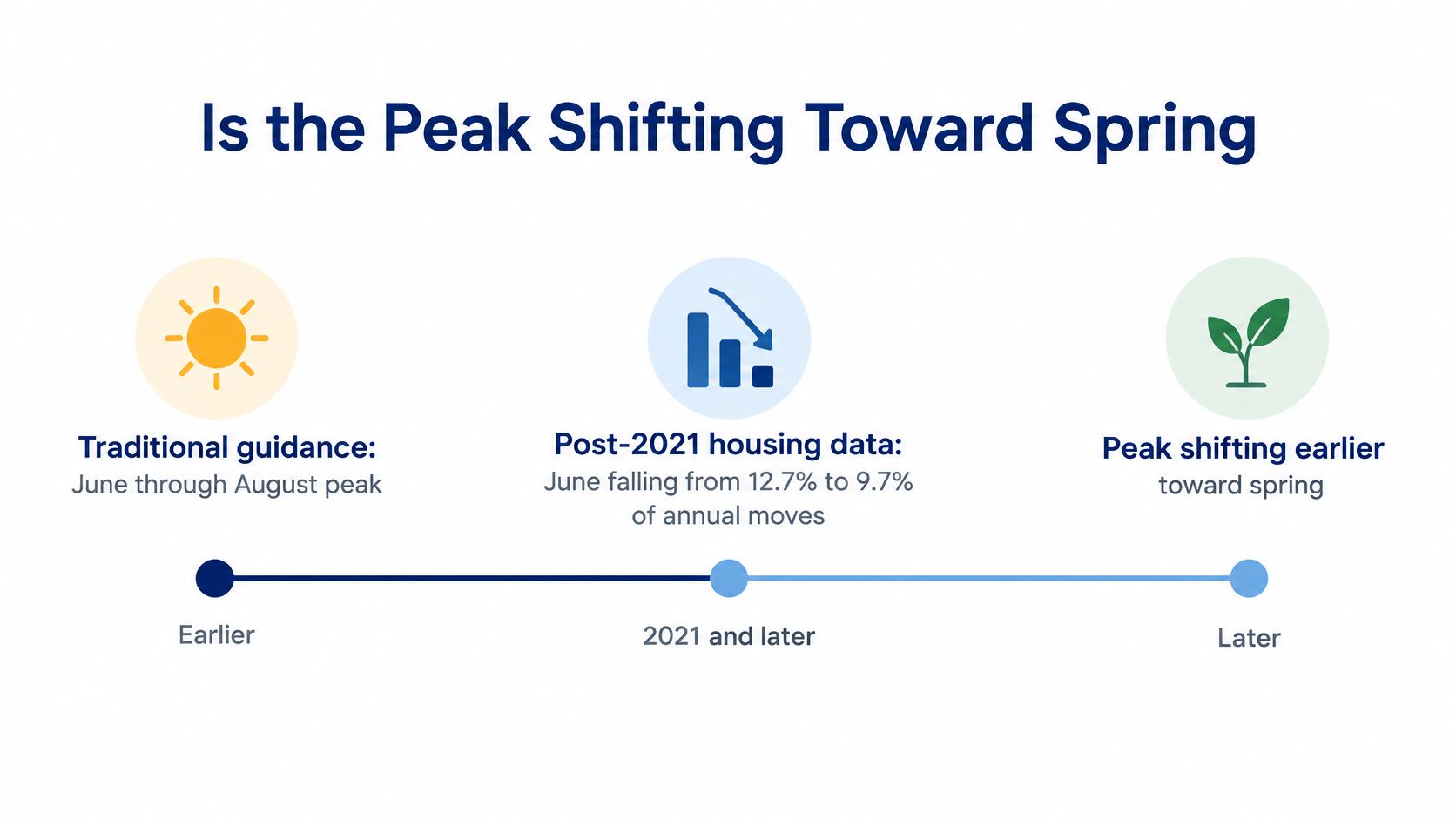
The standard advice has said the same thing for two decades. June through August is busy, August is the crush, so book early. Recent housing data loosens that at the back end and tightens it at the front.
Post-2021, June's share of annual moves fell from 12.7% to 9.7%, while the spring quarter's share rose from 24.1% to 28.2% and the summer quarter's fell from 35.3% to 30.5%, according to an analysis of post-2021 move timing.
Period | Share before 2021 | Share after 2021 |
|---|---|---|
June | 12.7% | 9.7% |
Spring quarter | 24.1% | 28.2% |
Summer quarter | 35.3% | 30.5% |
The right reading isn't that summer stopped being busy. Housing transactions, job changes and household relocations are starting earlier, which makes March through May more competitive in some markets and takes some weight off August. Treating August as automatically the worst month is now a guess rather than a rule.
What to check in your own market
National shares describe a country, and a fast-growing metro can run ahead of them. Ask local agents when listings in your target neighborhoods go under contract, watch how quickly rentals near you turn over, and ask your mover which weeks are already filling. In a market where spring closings bunch up, April can be tighter than July.
Walk the year once as a timeline. Late winter is planning season, when dates are cheap and calendars are open. Spring is when paperwork starts moving and competition builds. Summer still carries the heaviest volume. Fall recovers, with more room to negotiate.
If your deadline allows it, spring deserves a serious look as an alternative to summer, with one caveat: you'll be competing against closings rather than school holidays.
How to Plan a Move Around the Busy Weeks
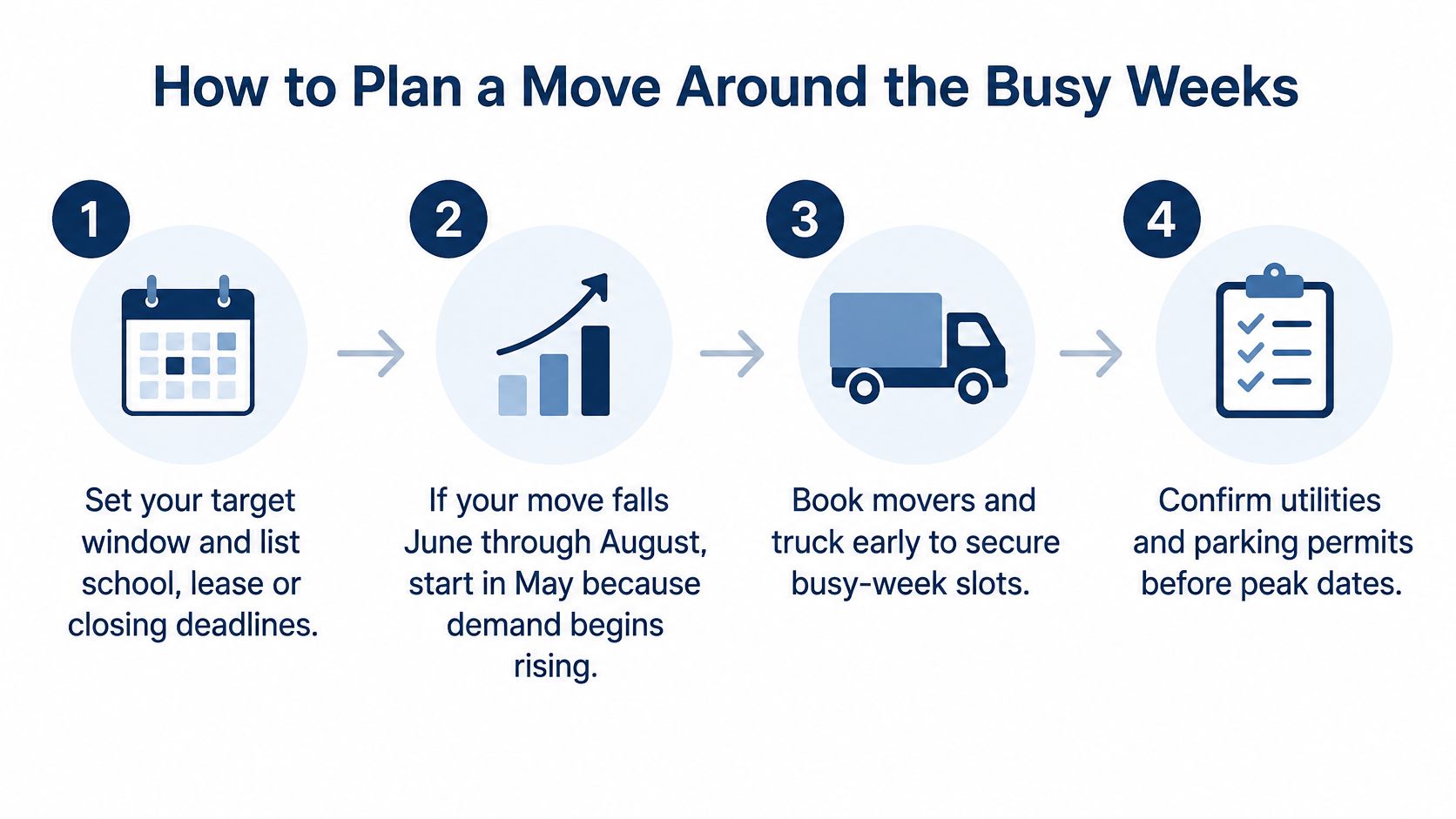
Set your target window and list every fixed deadline. School start dates, lease end dates and closing dates define the box you're working inside, and everything else follows from them. The common mistake is picking a date first and discovering the lease conflict a week later.
If your move falls June through August, start in May. Demand rises before the statistical peak, so the last week of May is already crowded. Waiting until the first week of June to call costs you the good slots.
Send the access details with your first inquiry. Stairs, elevators, gate codes, parking restrictions and the distance from truck to door change crew size and time. Leaving them out produces an estimate that grows on moving day.
Get the written estimate, then book the crew. We recommend booking as early as possible, particularly for weekends, the end of the month, and the busy summer moving season, because those are the slots that fill first. A verbal hold isn't a reservation.
Hold a backup date. Pick a second weekday in the same week and ask what it would take to switch. Households that book a month-end Saturday with no fallback often accept a worse crew window instead.
Decide packing scope early. Full and partial packing both change the schedule, so settle it before the crew is assigned. If you're packing yourself, this guide on when to start packing for a move sets a realistic timeline.
Confirm day-of requirements. Driveways, entrances and elevators need to be accessible, boxes need to be packed and labeled before the crew arrives, and someone over 18 must be present at both pickup and delivery. Plan who that person is before the week gets busy.
Short-notice requests can often be accommodated depending on crew availability, but a booked date is always cheaper than an emergency one.
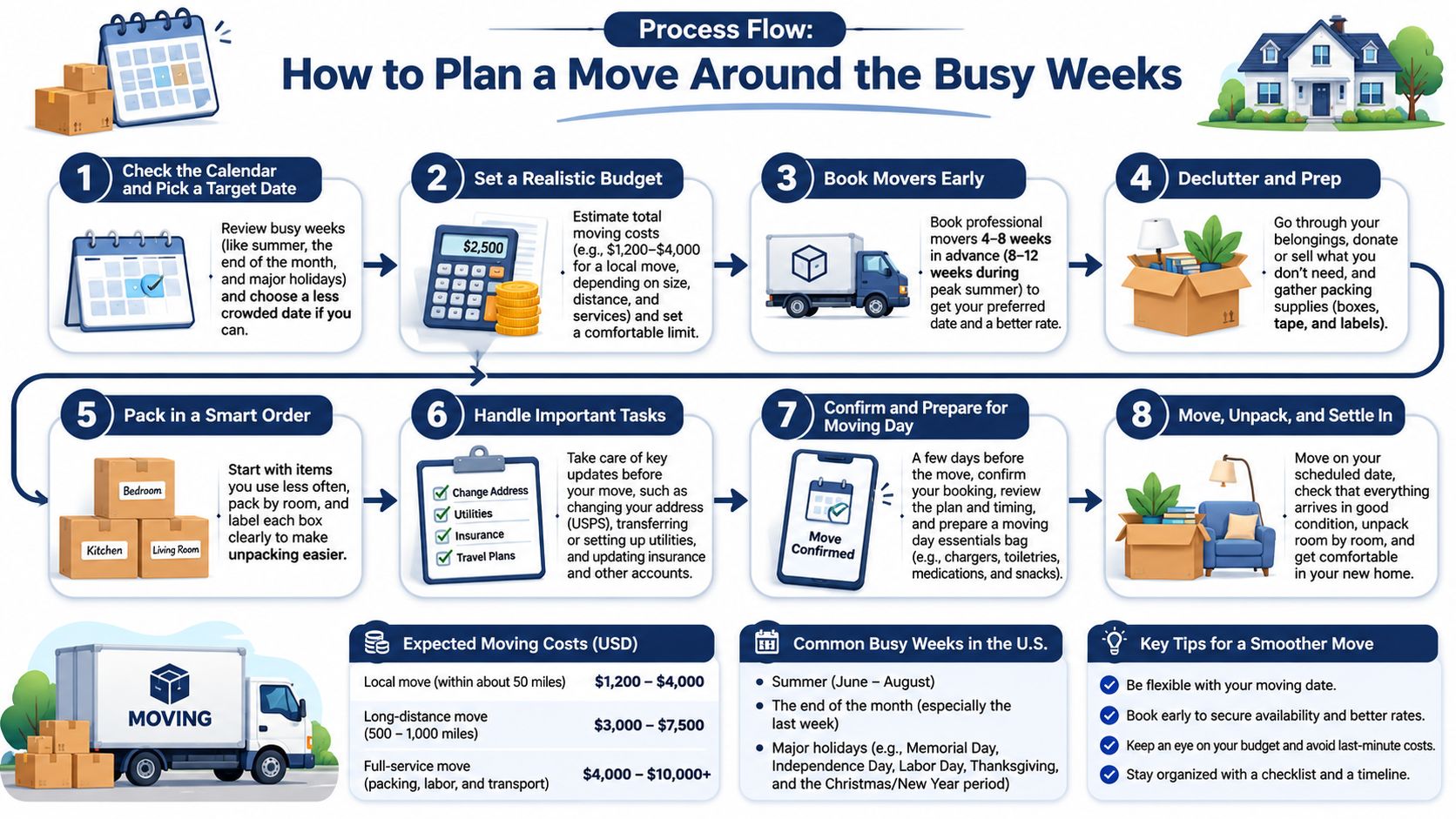
On-track checklist: date confirmed in writing, estimate reviewed, access details sent, packing scope decided, backup date noted, and a named adult committed to both ends of the move.
Lock In Your Move Date Before the Surge
Three decisions settle the date. First, the month you can move. Second, how many weeks of flexibility you have around it. Third, who you call first.
For a June through August move, lock the date and the written estimate as early as you can. A long-distance job piles into fewer workable weeks than a local one, and a spring date often sits outside the hardest demand. If the month can slide, May and the shoulder months on either side of summer usually mean the same crew quality at a lower-pressure point on the schedule.
Peak demand still clusters from late May through August, and June is the heaviest month of that run. Distance, climate and housing timing change how hard that cluster hits. A local apartment move and a long-haul house move do not share one summer rule, and in many markets the busy window has been drifting earlier into spring.
Webster Moving Co. can turn the month you chose into a confirmed date. Call 512-751-0893 or use the online quote form for a no-obligation estimate that scopes timing, crew size and materials for the day you have in mind. If you're still comparing transport options, read what shapes a moving truck quote first. Hours are Monday through Friday from 8:30am to 5pm, and Saturday and Sunday from 9am to 3pm.
Webster Moving Co. serves Round Rock, Austin and surrounding Central Texas communities, and we'll walk you through the dates and time windows we can offer based on crew availability. Tell us your month and your deadlines, and we'll match a crew size, truck and packing plan to the window you have, whether that's a June Saturday or a quiet Tuesday in October. Visit Webster Moving Co. to request your no-obligation estimate and get your date on the calendar before the surge takes it.
Comments