
Moving Truck Quote: How to Get an Accurate Price
The usual advice is to compare truck rates and book the cheapest one. That's how you end up with a bargain vehicle and an expensive move. A daily rental rate doesn't tell you what you'll pay after mileage, fuel, equipment, elevator delays, and the furniture you forgot to list.
A useful moving truck quote prices the whole job, not just the truck. For Central Texas households, the right comparison is a completed DIY move versus a written crew-and-transport estimate with the same inventory and access conditions. Start with realistic spending benchmarks, then demand paperwork you can check before loading begins.
Table of Contents
What Local and Long-Distance Moves Actually Cost - Match the household before judging the price
How Movers Price a Move and Its Common Fees - Separate work from access charges - Compare equivalent services
Request a Written Estimate That Locks the Price - What each quote type actually locks - Run the delivery-payment check
DIY Truck Rental Versus a Crew Estimate - Quote-to-final-cost worksheet - Find your actual break-even point
Questions That Keep a Quote From Falling Apart - Get written answers to the failure points - Plan around the deadline, not just the distance
Lower the Estimate and Book the Written Total - Cut work without cutting essential protection - Verify the carrier before committing
What Local and Long-Distance Moves Actually Cost
National moving-cost surveys provide a useful starting point before you call anyone. They're sanity checks, not Austin-area rate cards, and their averages aren't minimums or maximums.
Recent U.S. moving cost bands
Move snapshot | Figure | Year and source | How to use it |
|---|---|---|---|
Average local move | $1,692 | 2025, Angi moving-cost data | Starting benchmark for a local household move, not a price floor |
Average long-distance move | $4,401 | 2025, Angi, same dataset | Check a long-haul total, not a price ceiling |
Average local move, second survey | $1,489 | Cross-check the local benchmark | |
Average long-distance move, second survey | $3,124 | 2025, This Old House, same survey | Compare another long-distance average |
Two-bedroom move under 400 miles | $2,750 median | Check a move with matching home size and distance | |
Renters' average spend | $1,334 | Broad apartment and condo spending benchmark | |
Homeowners' average spend | $2,907 | 2024, Anytime Estimate, same survey | Broad homeowner spending benchmark |
These figures describe moving expenditures, not a truck's advertised daily rate. Don't combine the rows into a single average: the surveys cover different respondents and move types, and a median isn't the same measure as an average.
Match the household before judging the price
Say you're leaving a one-bedroom Round Rock apartment with elevator access. The renter and local-move rows are more relevant starting points than the long-distance rows, but elevator availability and the distance from the loading area still matter. Our apartment moving cost guide helps you examine those apartment-specific inputs.
A furnished three-bedroom house with a piano calls for a different comparison. The homeowner row is a broader reference, but it doesn't establish what piano handling, packing, or a difficult driveway should cost. Bedroom count alone won't produce a defensible estimate.
At Webster Moving Co., our costs depend on crew size, the amount being moved, how long the move takes, travel between locations, and specialty items. Neighbors moving from similar houses can therefore receive different estimates without either estimate being wrong.
Price-check rule: Treat a quote far below the relevant benchmark as unproven until the inventory, access conditions, and fees are documented.
A low total can be legitimate when the job is small. It becomes suspicious when the estimator hasn't asked about the garage, upstairs furniture, packing needs, or destination access. Judge the scope before you judge the savings.
How Movers Price a Move and Its Common Fees
Ask for the arithmetic behind the total. An hourly rate without a crew size, estimated duration, and explanation of travel charges isn't enough to compare providers.
For an hourly local move, the basic calculation is the quoted crew rate multiplied by billable time, plus separately stated charges. Confirm whether the rate covers the entire crew or each mover. Don't multiply by crew size again if the company has already quoted a crew rate.
Billable time also needs a clear starting and stopping point. Loading, driving, unloading, furniture placement, and travel to or from the mover's facility may be treated differently under the agreement. Get that treatment in writing rather than assuming the clock runs only while someone carries a box.
Separate work from access charges
Use the estimate to identify which tasks are included and which trigger an additional charge:
Access: Stair carries, long carries, elevator waiting, parking permits, and tolls.
Packing: Boxes, specialty cartons, wrapping materials, and packing labor.
Furniture preparation: Disassembly, reassembly, and any agreed appliance handling.
Transport complications: Shuttle service, storage in transit, and additional handling.
Vehicle expenses: Truck charges, mileage, fuel, or fuel adjustments.
Protection: The selected valuation or coverage terms, including exclusions and claim procedures.
Not every move incurs every fee. The important distinction is included, excluded, or chargeable under a stated condition. A blank line doesn't tell you which applies.
For interstate household-goods moves, the tariff and the estimate's weight, distance, and service assumptions require particular attention. The inventory is a pricing input, not a formality.
Compare equivalent services
A transport estimate isn't comparable to labor-only help. If you already have a rental truck or container, use our loading and unloading service guide to distinguish the work you need from vehicle costs you'll pay separately.
Then test the estimate against the actual job. A sofa carried directly through a front door requires a different handling plan from the same sofa taken around a tight landing. The written scope should explain that difference before the crew arrives.
Request a Written Estimate That Locks the Price
Start with complete inputs, not a request for the cheapest hourly rate. The FMCSA estimate guidance distinguishes a marketing rate quote from an official estimate and requires interstate household-goods estimates to identify whether they're binding or non-binding.
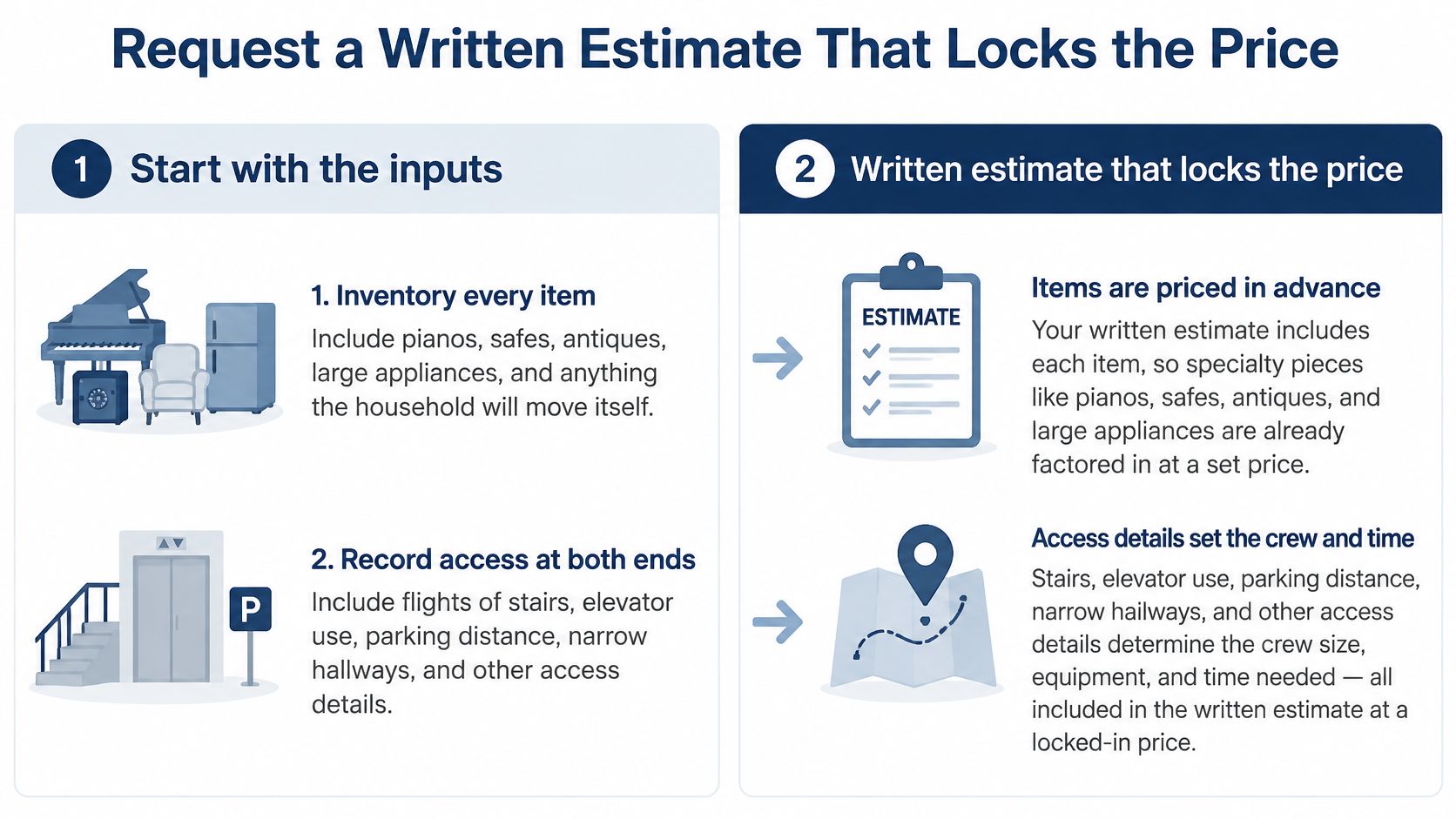
Inventory every item. Include closets, garage shelving, patio furniture, and boxed belongings. Flag pianos, safes, antiques, large appliances, and anything you'll transport yourself.
Record access at both ends. Describe stairs, elevator windows, parking distance, narrow hallways, loading-zone restrictions, and steep driveways. Photos or a walkthrough video help clarify awkward turns.
Separate transportation from extra work. Identify packing, disassembly, storage, POD loading, and appliance services rather than burying them inside a vague total.
Identify the estimate type. Ask whether the document is binding or non-binding. An hourly advertisement isn't a substitute.
Get the complete written total before loading. Require transportation, accessorial services, and advance charges to be identified, with the document dated and signed.
For federally regulated interstate household-goods moves, the federal household-goods regulations require an on-site or virtual physical survey unless you waive it in writing, along with a dated estimate signed by both parties. Those federal interstate requirements shouldn't be presented as universal rules for local Texas moves.
The inventory and access details should feed directly into the written scope.
What each quote type actually locks
Quote type | What it locks | At delivery | When it must change |
|---|---|---|---|
Binding interstate estimate | Price for listed quantities and services | Stated amount when the shipment remains within scope, subject to applicable rules | Revise before loading when changed inventory, services, or access requires it |
Non-binding interstate estimate | No final price guarantee; estimated weight and services | Generally subject to the federal delivery-payment limit | Document scope changes; lawful remaining charges may follow |
Verbal or marketing rate quote | No official estimate | Doesn't establish an estimate-based payment limit by itself | Replace it with the required written estimate |
Local hourly labor quote | Written rate, crew, billing terms, and described work | Amount determined by the agreement, not automatically a fixed total | Record added work and any applicable time or charge changes |
Run the delivery-payment check
Under FMCSA's binding and non-binding estimate guidance, a mover generally can't demand more than 110% of a non-binding interstate estimate at delivery: $4,000 × 1.10 = $4,400, not a guaranteed final bill of $4,000.
That's a delivery-payment protection, not permission to ignore the scope. Actual shipment weight, performed services, tariff provisions, and lawful later charges can still affect what you owe. A binding estimate provides stronger certainty for the quantities and services listed.
Keep the inventory, access notes, signed estimate, and written changes together. Don't leave the only copy inside a packed box.
Our website offers free, no-obligation quotes through a short form. For larger household moves, we help determine crew size, equipment, and estimated time from the home and belongings. Short-notice scheduling may be available depending on crew availability, but it doesn't remove the need to document the job.
DIY Truck Rental Versus a Crew Estimate
A compact apartment move can still favor DIY. If you can safely handle the furniture, have dependable helpers, can park close to both doors, and don't have specialty items, renting a truck may be a sensible choice.
A furnished house with stairs, a safe, and a hard lease deadline is another proposition. Extra trips, unavailable helpers, and an approaching return deadline can erase the apparent saving. Don't choose DIY just because the truck advertisement is the smallest number on the page.
ConsumerAffairs' moving-truck cost guide identifies rental costs such as mileage surcharges, fuel adjustments, taxes, environmental fees, and charges tied to the truck's return condition. Price those obligations before comparing rental with professional help.
Quote-to-final-cost worksheet
Cost line | DIY truck rental | Hired crew quote |
|---|---|---|
Base charge | Daily rental rate and rental period | Written labor and transportation scope |
Distance | Included mileage, excess-mileage rate, and return route | Identify travel charges and included driving |
Fuel | Refill obligation and any fuel adjustment | Confirm whether included or separately charged |
Taxes and extra fees | Itemized taxes, environmental, or licensing fees | Named applicable charges |
Equipment and protection | Dollies, pads, straps, and selected protection plan | Confirm equipment and protection terms; our process includes standard furniture-protection equipment |
Deposit and payment | Record deposit, hold, release terms, and amount due | Our payment is due at completion unless otherwise agreed in writing |
Access mistakes | Potential additional trips or late return | Apply the written labor and change terms |
Labor and damage risk | Your time, helpers, safe lifting ability, and coverage gaps | Verify trained personnel, licensing, insurance, and the actual claims terms |
A refundable deposit isn't automatically an expense, but it affects the cash or credit you need available. Keep cash required upfront separate from the final cost so you don't count the same money twice.
Find your actual break-even point
Write down the DIY total using the rental agreement, not the advertisement. Then add the value of time you'd otherwise spend working, collecting helpers, picking up equipment, loading, driving, unloading, refueling, and returning the vehicle.
Don't invent a universal damage allowance. Instead, decide whether you can safely move the heaviest piece and whether the coverage you selected addresses the risks you're taking. A truck protection plan shouldn't be assumed to protect every belonging or the building's hallway.
For a townhome, narrow stairs may make loading help more valuable than full transport. For a nearly empty apartment, our small-load moving guide can help you separate a limited furniture job from a full-household service request.
At Webster Moving Co., moving pads, stretch wrap, and other standard furniture-protection equipment are included in our moving process. We provide straightforward pricing with no hidden fees, so compare the documented scope rather than an isolated hourly lure.
The cheaper option is the one you can complete safely, within the deadline, for the lower complete cost.
Questions That Keep a Quote From Falling Apart
Does the reservation guarantee a vehicle or crew, or only a rate? Get a written answer before treating a confirmation email as a workable moving plan. ConsumerAffairs' U-Haul complaint coverage includes accounts from customers who understood too late that a reservation didn't ensure the vehicle they expected.
Availability is only part of the problem. The truck must also fit the inventory, the route, and the loading area.
Use the quote discussion to settle the operational details before moving day.

Get written answers to the failure points
Availability: What exactly is reserved, and what happens if the truck or crew isn't available?
Delayed arrival: Who contacts you, what substitute arrangements apply, and what happens to your building reservation?
Restricted access: Who pays for time lost when an elevator is unavailable or a loading zone is blocked?
Property protection: What protection applies to belongings, floors, walls, doors, and common areas?
Overruns: What are the late-return, overtime, and additional-time terms?
Changes: Which changes require approval, and how will revised charges be documented?
A North Austin apartment illustrates why these answers matter. Say the unit sits at the end of a long hallway, the freight elevator is available only during a reserved window, and street parking is well away from the entrance. The estimator needs the entire carrying route, not just the apartment number.
An undersized truck could force another trip after the elevator window closes. An oversized vehicle might not fit the loading area or garage approach. We handle North Austin apartment moves with coordination for elevators, long hallways, parking restrictions, and limited loading areas, so include those details in the quote request.
Plan around the deadline, not just the distance
An office relocation or POD load with a hard move-out time needs a fallback plan. Confirm the arrival window, the person authorized to approve changes, and what happens if the container or building isn't ready. A short drive won't recover time lost waiting for access.
Your preparation matters, too. Our customer requirements are to keep driveways, entrances, and elevators accessible, have boxes properly packed and labeled before the move, and have someone over 18 present at pickup and delivery.
Assign that person responsibility for walkthroughs, questions, and approvals. If the person who knows what stays behind leaves before loading, the crew shouldn't have to guess.
Federal delivery-payment protections don't resolve a missing access plan or make omitted services free. Keep changes visible and approved rather than expecting the original paperwork to cover a different job.
Lower the Estimate and Book the Written Total
The best way to reduce a moving estimate is to reduce the work. Hiding furniture, understating box counts, or leaving stairs out of the request creates an inaccurate estimate, not a cheaper move.
Make the household ready to price before you negotiate. Use a room-by-room inventory, attach access photos, and identify work you'll finish yourself.
Cut work without cutting essential protection
Remove what won't move. Sell, donate, or dispose of unwanted belongings before the final inventory. Don't pay to transport furniture you already intend to replace.
Offer date flexibility. Request a midweek or mid-month alternative and compare the actual written offers. Don't assume a particular date guarantees a discount.
Pack selectively. Handle ordinary rooms yourself if you can finish them properly. We offer full or partial packing before moving day, allowing you to reserve help for fragile kitchenware, art, or other demanding items.
Resolve building access early. Reserve the elevator and arrange legal parking before the estimator has to allow for uncertainty. Obtain building instructions and share them with everyone involved.
Compare matching written scopes. Give each bidder the same inventory and service request. Reject comparisons that mix labor-only help with transport or leave accessorial services unexplained.
Preserve every approved change. Keep the signed estimate and amendments in an accessible folder. Confirm which version governs the work before loading.
Partial packing only saves money if the self-packed portion is ready when promised. An unfinished kitchen can disrupt loading and leave you choosing between rushed packing and additional work.
Likewise, don't discard a necessary protection task just to lower the displayed total. Furniture wrapping and safe handling belong in the plan, not on a last-minute wish list.
Verify the carrier before committing
Check the carrier's identity, authority, and insurance through the appropriate official state or federal records. Match the business name and identifying numbers to the estimate rather than relying on a logo, review, or referral.
Our published credentials are TxDMV No. 010210868C and USDOT# 4470107, and we're fully licensed and insured. A referral incentive isn't a substitute for checking those details.
Before booking, place the complete written total beside the relevant household benchmark and your DIY worksheet. Investigate unexplained differences rather than demanding that every provider match a national average. Confirm payment terms as well: our payment is due when the move is completed unless otherwise agreed in writing.
Keep your inventory, access notes, proposed dates, and packing choices together. That package gives an estimator something concrete to price and gives you a clear basis for accepting the work.
Webster Moving Co. offers free, no-obligation quotes for Central Texas moves, with crew planning, furniture protection, transportation, and packing options matched to the job. Visit Webster Moving Co. and send your inventory, access details, and preferred dates so you can compare a properly scoped moving estimate with the complete cost of renting a truck.
Comments