
How to Pack Mirrors Safely: Materials, Steps and Labels
You're in the hallway with a bathroom mirror that will not fit the picture carton from the hardware store, and the truck arrives Saturday. The face looks clean. The corners already show chips from the last time it leaned on a dresser. Learning how to pack mirrors means closing the gap between a soft wrap and a pane that survives the ride, because a fluffy layer does not stop glass from sliding, tipping, or taking the hit on one corner.
A mirror is a sheet of glass with a reflective coating on the back. Abrasion, moisture, or a rough surface against that backing can spoil the silvering even when the face never cracks. Sort the piece in front of you first, then build a carton that can take a knock without letting the glass move inside it.
Table of Contents
Match the Packing Method to Your Mirror - Sort the piece before you buy materials - Pack it yourself or hand it off
Cushioning and Box Sizes That Protect the Glass - Three ways a thick wrap still fails - Run one trial before you pack the rest
Carry Mirrors Safely Through Stairs and Doorways - Who carries and how it rides - Tell the crew the route before moving day
Label and Store Packed Mirrors Before Pickup - After the wrap, the room can still ruin it
Match the Packing Method to Your Mirror
Bubble wrap is not the main control. The break that shows up after a "careful" pack is point loading, a hard corner cap or carton edge pressing on one spot, or a shift that dumps the whole force onto a corner or a long edge. Saint-Gobain Glass processing guidance says panes should stay vertical, avoid violent or repeated shocks, and never touch one another or unsuitable transport materials. Padding on every side only works when empty space is gone, so the mirror can't slide and meet the wall of the box.
One wrap recipe fails because size, frame, backing, and trip length change the risk. A small hallway mirror and a frameless bath panel do not fail the same way.
Sort the piece before you buy materials
Mirror type | Main risk | Protection | Box or crate |
|---|---|---|---|
Small framed mirror, one person can carry | Corner impacts and sliding inside a carton | Corner protection, tissue, fitted foam | Snug mirror carton |
Large framed wall mirror | Point loading and weight resting on glass or hardware | Fitted foam, frame-supported padding, vertical transport | Purpose-made double box |
Frameless or beveled mirror | Edge chips and face scratches | Rigid face protection, edge guards, controlled cushioning | Custom crate or professional handling |
Antique or heavy wood frame | Frame cracks, glass movement, damage to mounting points | Frame-supported padding, hardware removed and photographed | Double box, specialist for high-value pieces |
Wall-mounted mirror or medicine cabinet | Snapped brackets and shifting glass | Brackets removed or protected, mounting points photographed | Carton sized to the unit |
A small framed piece gets cardboard corner caps, a non-abrasive wrap, and a carton that fits with almost no play. A large framed wall mirror needs fitted foam and padding that carries weight on the frame, not on the glass or the hanging wire, inside a purpose-made double box. Frameless and beveled glass needs a rigid sheet over the face, edge guards, and a custom crate. I would not put that pane in a standard picture box.
Antique and heavy wood frames crack at the joints if the glass is free to rattle. Remove hardware when it's safe, photograph the mounting points, and support the frame. On a wall mirror or medicine cabinet, bag the brackets or pad any bracket you must leave on, and photograph how it hung before you take it apart.
Pack it yourself or hand it off
Pack it yourself when the mirror is small and framed, one person can carry it, and the route has no stairs or tight turns. Hire help when it's frameless, oversized, antique, or irreplaceable, when it must pass stairs or a narrow hallway, or when it's one fragile piece inside a larger move.
Practical rule: If you can't keep the pane upright and still through the whole path from wall to truck, don't treat generic packing materials as enough.
When you book, state the size, the frame type, and the access limits. Ask whether the mirror will be crated or boxed, whether it will ride upright, and whether mirror packing sits inside the packing scope. We offer full or partial packing before moving day. Moving pads, stretch wrap, and other standard furniture protection are part of the move, and unpacking can place items, pull the materials, and leave the home ready to live in.
Cushioning and Box Sizes That Protect the Glass
Use this as a lookup before you cut foam. The outer box has to leave that cushion on every side. The inner package has to hold the mirror still without pressing the glass.
Mirror case | Cushioning per side | Box construction |
|---|---|---|
Standard framed mirror | 50 mm minimum | Single rigid carton with fitted foam |
Very fragile or antique glass | 75 to 100 mm | Rigid double box or purpose-made mirror carton |
Mirror packed near heavy objects | 75 to 100 mm | Rigid double box, separated from heavy items |
Large frameless or oversized mirror | 75 to 100 mm inside the crate | Custom crate, not a standard carton |
National Park Service museum guidance recommends at least 50 mm of cushioning between a fragile object and the container walls, rising to 75 to 100 mm around very fragile glass or near heavy objects. A large frameless mirror almost never fits a stock carton, so that row is a crate with the thicker cushion inside it, not a single off-the-shelf size. If you're still guessing carton counts for the rest of the house, the notes on how many moving boxes you need keep the mirror carton from getting squeezed into a leftover pile.
Three ways a thick wrap still fails
Corner-only protection. Caps that stab one point of the glass, instead of spreading load along the frame edge, crack the pane under a modest bump.
Voids. Any gap lets the mirror walk. On a rough road that walk becomes a repeated tap against cardboard.
A soft carton. A flimsy box collapses when something is stacked on it. Double-wall board, or a real double box, resists that compression. The inner pack immobilizes the mirror. The outer pack supplies the cushion gap.
Run one trial before you pack the rest
Build one finished package and weigh it so you know what two people will lift.
Tilt it and shake it gently. Any knock means add fill or a tighter restraint.
Take a short loaded drive over rough pavement, unwrap, and look at the glass and the frame.
If anything moved or chipped, change the restraint and repeat before you pack the other mirrors.
For a long-distance or commercial shipment, benchmark that design against distribution hazards. ISTA names shock, vibration, compression, and atmospheric exposure as the four basic categories, and parcel-style protocols use repeated free-fall drops and random vibration, including an overview that specifies nine drops and vibration levels of 0.53 and 0.46 Grms. Treat the driveway trial as the minimum for a local move, not as a stand-in for that benchmark. The tilt check on every later carton is a separate, quicker test.
How to Pack a Mirror Step by Step
Work in this order. Each step exists because a common shortcut fails in a specific way.
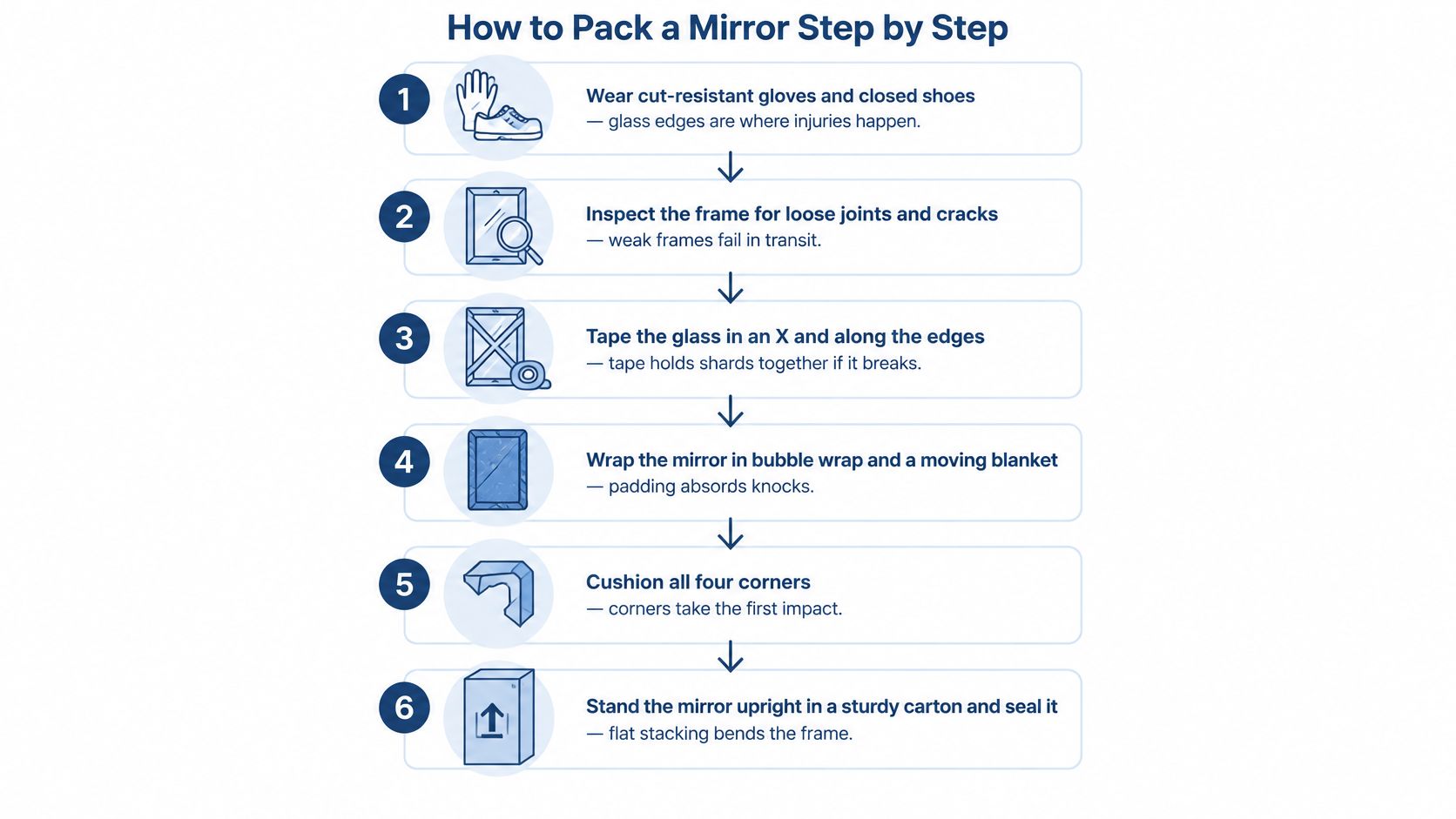
Put on cut-resistant gloves and closed shoes before you touch the glass. Cuts happen on the edges, not on the polished face, and a dropped corner is worse in sandals.
Inspect the frame, the glazing, the corners, and the hanging hardware. Photograph chips and cracks now so a pre-existing mark isn't argued about after delivery. A loose joint in the frame will open further once the carton flexes.
Remove detachable hardware. Bag the screws and brackets, label the bag, and tape it to the back of the mirror. Leaving a wire or a D-ring proud is how the glass gets a scratch from its own hardware.
On ordinary glass only, lay low-tack glass tape in a cross or a grid. The tape helps hold shards if the pane breaks. Skip Perspex and safety glass. Adhesive can scratch those surfaces, and the tape doesn't buy you the same benefit.
Wrap the face in acid-free tissue or another non-abrasive layer while the mirror is upright. Rough paper and dusty blankets scuff the face and can mark the reflective backing.
Add a fitted layer of closed-cell polyethylene foam or bubble wrap, with extra thickness at the corners and frame edges. Use the per-side thickness from the lookup for this mirror, not a random extra roll. Skip rigid corner protectors that concentrate force on one spot of glass. Spread the pad along the frame edge instead.
Set the wrapped mirror in a rigid carton with no pressure on the glass. Fill every void with foam sheet or crumpled kraft, using the box type from that same lookup. The mirror should not be able to touch cardboard.
Close the carton and run a movement check. Gently tilt and rotate it. If anything shifts, open it and add fill or a strap around the inner pack. Do this on every finished carton, not only on the trial piece.
Mark the carton for fragile glass and this-side-up so the next person knows how to hold it. The same care you use on shades and bases in a lamp packing routine applies here. Small parts stay bagged and attached, not loose in the bottom of the box.
A finished package moves as one solid unit. No part of the mirror can meet the walls of the box, and the weight sits on padding and the frame, not on a screw or a bare edge.
If you can hear the glass when you tip the carton, the pack isn't finished.
Carry Mirrors Safely Through Stairs and Doorways
Say the carton clears the bedroom and then swings as you turn into a narrow apartment door. One carrier has the top, the other loses the bottom corner on the jamb, and the whole pane wants to fall across the person underneath. That swing is why the handling plan matters as much as the wrap.
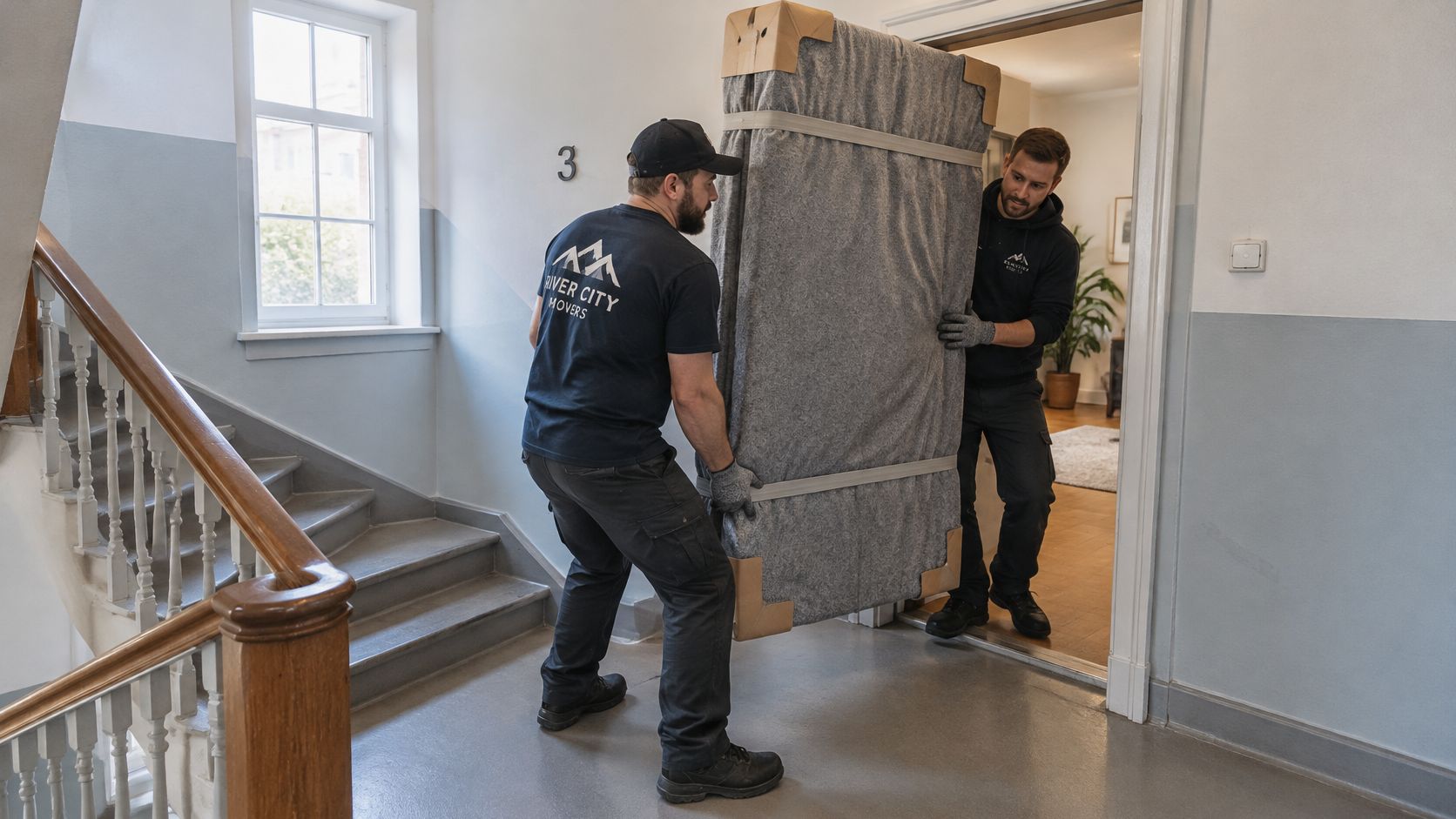
Guardian Glass identifies the two principal handling risks as lacerations from cut or broken glass and injuries from falling glass, and warns that improper handling and transportation of float glass can result in serious injuries or fatalities. The company recommends cut-resistant gear, including gloves, cuffs, protective jackets, hard hats, and steel-toed footwear. For a household move I would at least wear cut-resistant gloves, cuffs, and closed-toe shoes, and I would not carry a large mirror alone.
Who carries and how it rides
Use two people on any large mirror, one guiding each end. Keep the package upright while you load and while it rides. Don't carry it flat. A heavy framed piece should be supported by the frame and the padding, never by the hanging hardware.
In the vehicle, stand the carton against a padded vertical surface. Stop it sliding with straps or blocking that touch the carton, never the glass. Keep sofas, book boxes, and appliances off that face. The same upright habit you want for a television move applies. A screen or a pane laid under other freight is taking weight it was never built to take.
On stairs, move slowly and let the lower carrier take the weight while the upper carrier steers. In an elevator, stand the carton upright in a corner with pads between it and the walls so a bump doesn't chip an edge. On a loading dock or in a tight hallway, clear the swing path before you lift.
Tell the crew the route before moving day
For an apartment, we ask you to tell us about stairs, elevators, loading areas, gate codes, and parking restrictions so the route is planned before anyone picks up the mirror. A surprise flight of stairs with a crated pane is how a careful pack still ends on the landing.
Label and Store Packed Mirrors Before Pickup
A mark on the carton tells a handler what's inside. It does not keep the box upright, and it does not stop the mirror moving inside.
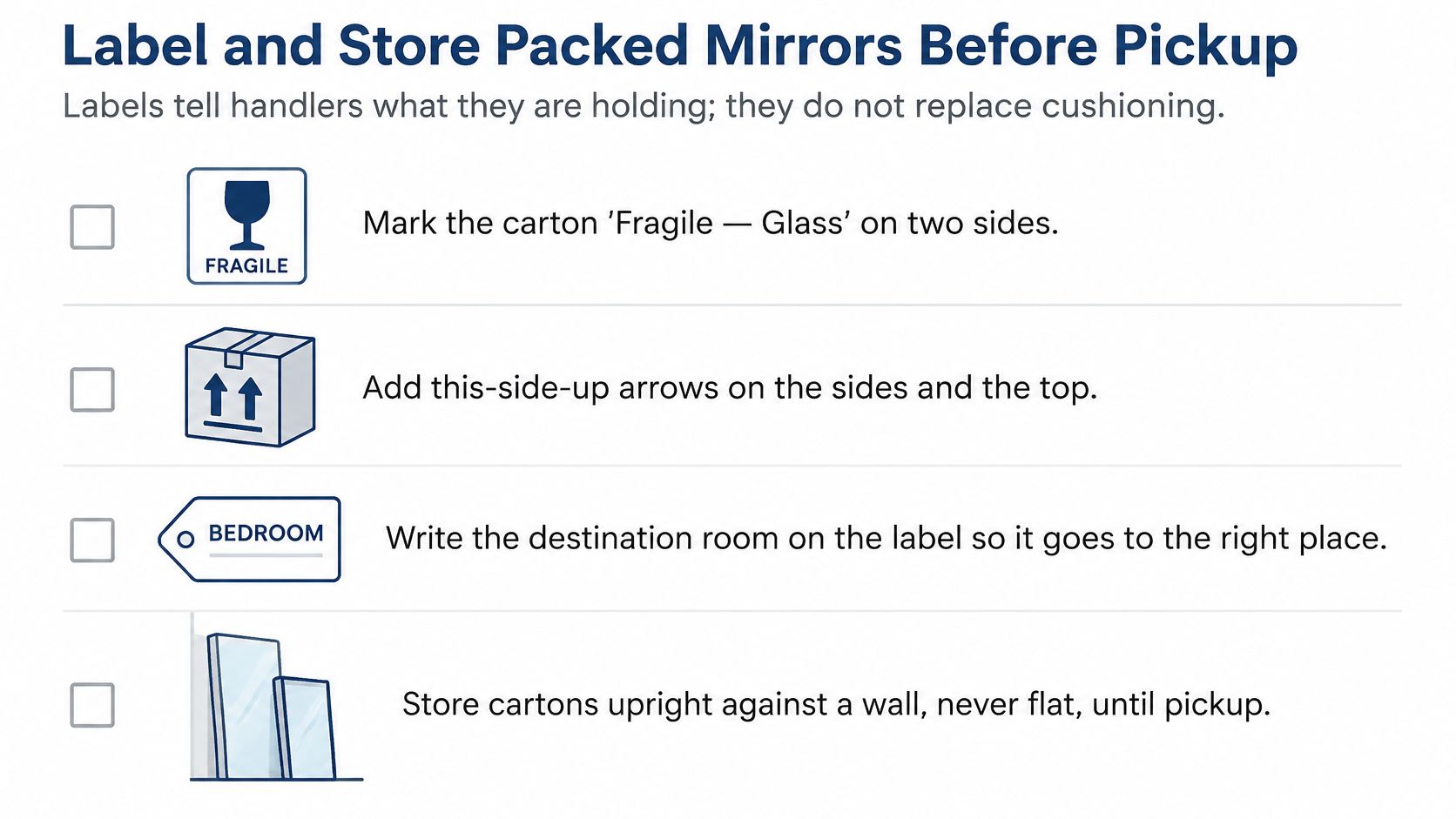
Write fragile glass on the carton, add this-side-up arrows on the sides and the top, and name the destination room so the piece isn't set flat in the wrong space. Boxes need to be packed and labeled before the crew arrives. Driveways, entrances, and elevators have to be clear, and someone over 18 needs to be present at pickup and delivery.
After the wrap, the room can still ruin it
Glass Association of North America guidance recommends keeping mirrors vertical rather than flat, avoiding uneven surfaces, and preventing movement inside the case. It also warns that humidity, chemical fumes, and heat can deteriorate mirror edges, backing, and surface quality. A short local haul cares most about staying upright and strapped. A multi-day or multi-week wait in a garage, a storage unit, a POD, or a parked truck cares just as much about the air around the carton. In Central Texas, summer garages and closed vehicle interiors get hot and damp enough to attack the backing of a mirror that was packed perfectly.
Before you reseal anything, run this check:
Three-face labels: Fragile glass and this-side-up marks are on the sides and the top, plus the room name.
Upright on a broad support: The carton stands on its designed edge, on a flat surface, not balanced on a lump in the floor.
Dry and off the wall: No contact with a damp slab or an exterior wall. Vent the space.
Condensation look: Open enough to check for moisture before you tape it shut again.
Nothing leaning on the glazing: Heavy items stay off the face.
The most common storage mistake is a well-cushioned box laid flat in a hot, humid garage. The wrap never gets a chance to matter.
A local trip can go from wall to truck the same day. A week in a container cannot. Position, airflow, and a dry floor are part of how to pack mirrors, not an afterthought once the tape is on.
If the pane is large, frameless, or has to come down a stairwell, our crews can pack it before moving day and move it with the rest of the household. We plan apartment access, keep delicate pieces upright, and can unpack at the other end. Visit Webster Moving Co. to tell us the mirror size, the frame, and the stairs or elevator on your route.
Comments