
How Many Moving Boxes Do I Need by Home Size
If you're standing in a hallway in Round Rock with a half-packed kitchen, two open Amazon boxes, and a sinking feeling that you bought the wrong supplies, you're in the right problem. How many moving boxes do I need is not a trivia question. It's a packing control question, and the wrong answer costs time, damage, and a second trip to the store.
Austin moves go sideways for the same reason over and over, people trust bedroom-count charts that ignore what's in the home. A downtown condo packed with books and glassware needs a very different mix than a lightly furnished house in Cedar Park with a nearly empty guest room. The reliable answer starts with the home size, then gets adjusted for density, storage areas, and what you really own.
Table of Contents
Why the Usual Box Estimate Charts Get Austin Moves Wrong - Room count is only part of the picture - What a real estimate needs to include
The Five Box Types You Will Use on Move Day - Small and medium boxes do the heavy lifting - Large boxes are for light, bulky items only
Room-by-Room Box Baseline for Studios Through Four Bedrooms - Use the baseline as the floor, not the forecast - Know when the baseline breaks
Adjusting the Estimate for Kitchens, Garages, Attics, and Long-Term Homes - Add cartons for storage-heavy rooms - Long-term occupancy changes the math
Run a Packing Quality Check Before You Buy the Rest - Use one test box per category - Label for destination, not just contents
Stage the Purchase and Plan for the Boxes You Will Have Left Over - Don't overbuy cardboard on day one - Plan the exit for the extra boxes
Why the Usual Box Estimate Charts Get Austin Moves Wrong
The internet loves tidy box charts. They are easy to paste into a blog, and they fall apart the moment a home has a full pantry, a garage, or a home office.

A bedroom count is only the starting point because it ignores density. One one-bedroom apartment can be sparse and easy to pack, while another one-bedroom can hide shelves of books, seasonal décor, and a kitchen that needs far more cartons than the living room. Flat charts keep missing real moves in places like downtown Austin, Round Rock, and Cedar Park.
Room count is only part of the picture
Start with the residence size, then adjust for household density and storage areas. The U.S. housing stock also has plenty of variation in building type, and that matters because apartments, condos, and detached homes do not pack the same way U.S. Census housing data. A move estimate built only on bedrooms ignores how much stuff is in the home.
The market includes a wide spread of housing types. From 2005 to 2024, U.S. housing in buildings with 50 or more units nearly doubled to 10.2 million units, a 77.4% increase. That is exactly why a one-size-fits-all chart breaks down for Austin households split between apartments, condos, and detached homes. A dense condo needs a different box mix than a lightly furnished house, even if both have the same bedroom count.
Practical rule: stop asking for a magic number first. Ask whether the home is lightly furnished, normally furnished, or dense enough to need a larger box mix.
What a real estimate needs to include
Use three inputs, not one. Count the rooms, account for household density, and add separate space for closets, garages, attics, offices, and kitchens. A lightly furnished apartment may need far fewer cartons than a three-bedroom home stuffed with books and kitchen gear, even if the floor plans look similar.
The first pass should be a room count plus an inventory check. Count the packed rooms, then add allowance for storage spaces and the items people always underestimate, like cables, pantry goods, office supplies, and holiday bins. That is the difference between a move that stays organized and one that turns into a cardboard scramble on the sidewalk.
The Five Box Types You Will Use on Move Day
Start with the wrong box mix and the whole move gets harder. People buy big cartons because they look efficient, then fill them with dishes, books, and canned food until the box turns into a lifting problem.
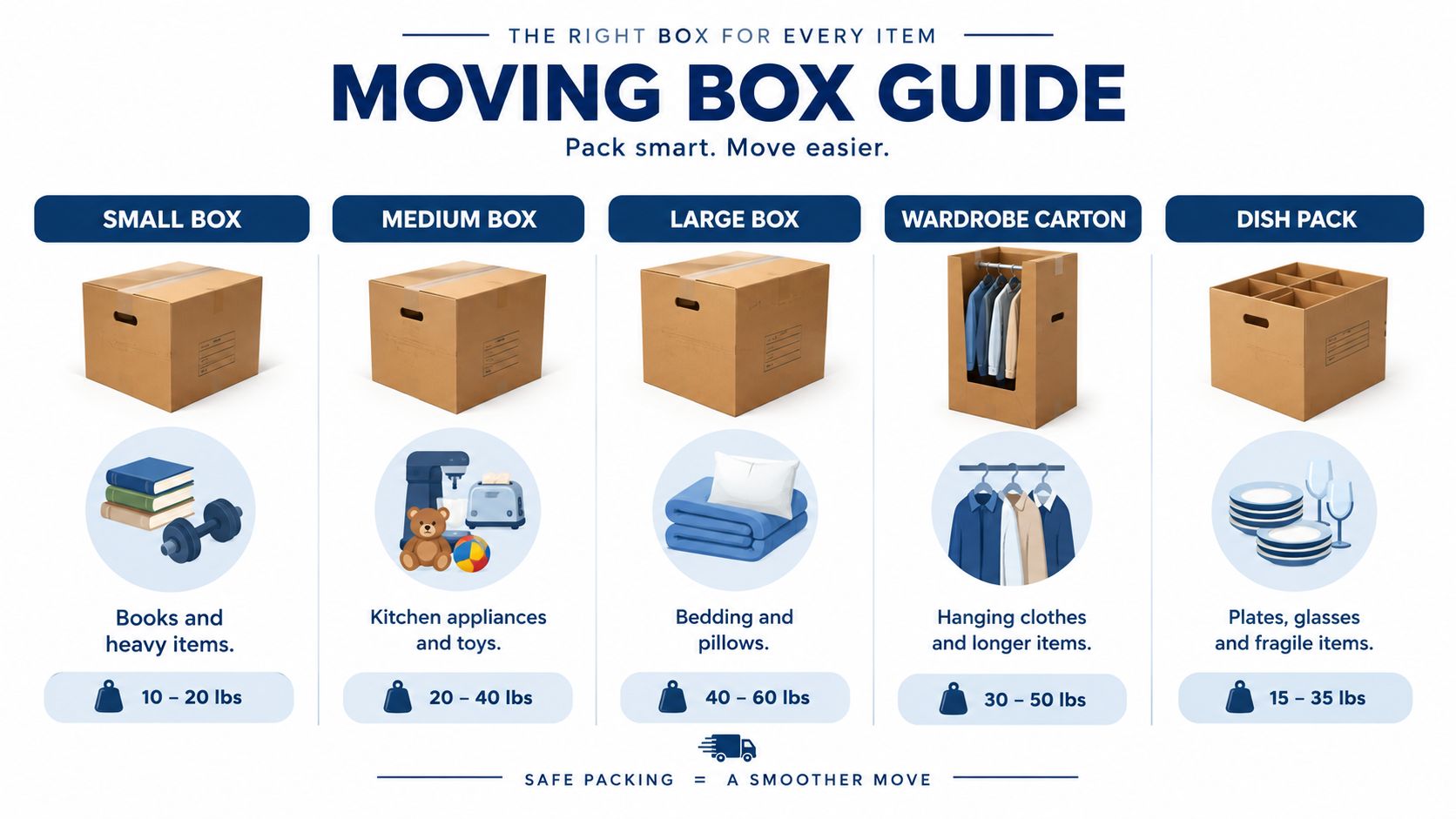
Build the mix around small, medium, large, wardrobe, and dish pack cartons. Keep the count heavier on small and medium boxes, because dense household weight belongs there. Third-party guides like moving box breakdown put a three-bedroom home at 40 to 60 small boxes, 30 to 40 medium boxes, and 10 to 15 large boxes. That conflicts with the conservative floor used in the baseline table below, so use the range as a check, not a target.
Small and medium boxes do the heavy lifting
Small boxes are for books, canned goods, tools, spices, and other dense items. Use them whenever the contents get heavy fast, because the smaller footprint keeps the carton manageable.
Medium boxes handle general household goods, kitchen items, toys, and mixed-room packing. They are the workhorse of a move. If a carton feels fine on the first lift but starts sagging after a stair run, it was packed like a large box when it should have stayed in the medium lane.
Large boxes are for light, bulky items only
Large cartons belong to bedding, pillows, comforters, and other light, bulky items. They should never be your default box. Fill one with books or pantry goods and you have created your own problem.
Wardrobe cartons hold hanging clothes, and dish packs protect fragile kitchenware. When crews handle both loading and settling in, a packing and unpacking service often brings those specialty cartons into the process to control weight and cut breakage. Use the right box for the job, not the biggest one on the shelf.
Room-by-Room Box Baseline for Studios Through Four Bedrooms
Start with a baseline that matches a normally furnished home. Then adjust upward or downward based on what's inside it.
Home Size | Small Boxes | Medium Boxes | Large Boxes | Wardrobe Boxes |
|---|---|---|---|---|
Studio | 8 | 10 | 4 | 0 to 1 |
One-bedroom | 12 | 14 | 6 | 1 to 2 |
Two-bedroom | 20 | 24 | 8 | 2 to 3 |
Three-bedroom | 30 | 35 | 10 | 3 to 4 |
Four-bedroom | 40 | 45 | 12 | 4 to 6 |
These are baseline counts, not a ceiling. A bare apartment with minimal furniture may come in below the table, while a packed family house can climb well above it. For a broader local move comparison, a written estimate usually matters more than any online chart, and that's why some movers publish room-based guidance like average cost of a local three-bedroom move.
Use the baseline as the floor, not the forecast
A studio with a tidy kitchen and few storage items can stay close to the low end. A studio with a serious wardrobe, books, and hobby gear can behave like a much larger home.
The same is true in reverse for bigger homes. A three-bedroom with spare rooms that barely got used won't need the same volume as a three-bedroom filled with kids' gear, office files, and a garage full of tools. If you want a useful estimate, ask two questions, how dense is the home, and how much storage lives outside the main rooms?
Rule of thumb: if the closets are full, the garage matters, or one bedroom is really a home office, your baseline is already too low.
Know when the baseline breaks
The baseline breaks when the house has heavy storage, long occupancy, or a lot of household clutter. It also breaks when a family has already started decluttering and half the categories are gone before packing begins.
For Austin households, that usually means the room chart should be treated like a floor plan, not a final order sheet. If the place is furnished lightly, keep it tight. If the place has lived-in accumulation, add cartons before the move starts, not after you've run out.
Adjusting the Estimate for Kitchens, Garages, Attics, and Long-Term Homes
Certain rooms lie. A bedroom can look simple, then a closet spills into three categories of clothing, two bins of shoes, and a shelf of seasonal décor. A kitchen can look small and still eat boxes faster than the rest of the house.
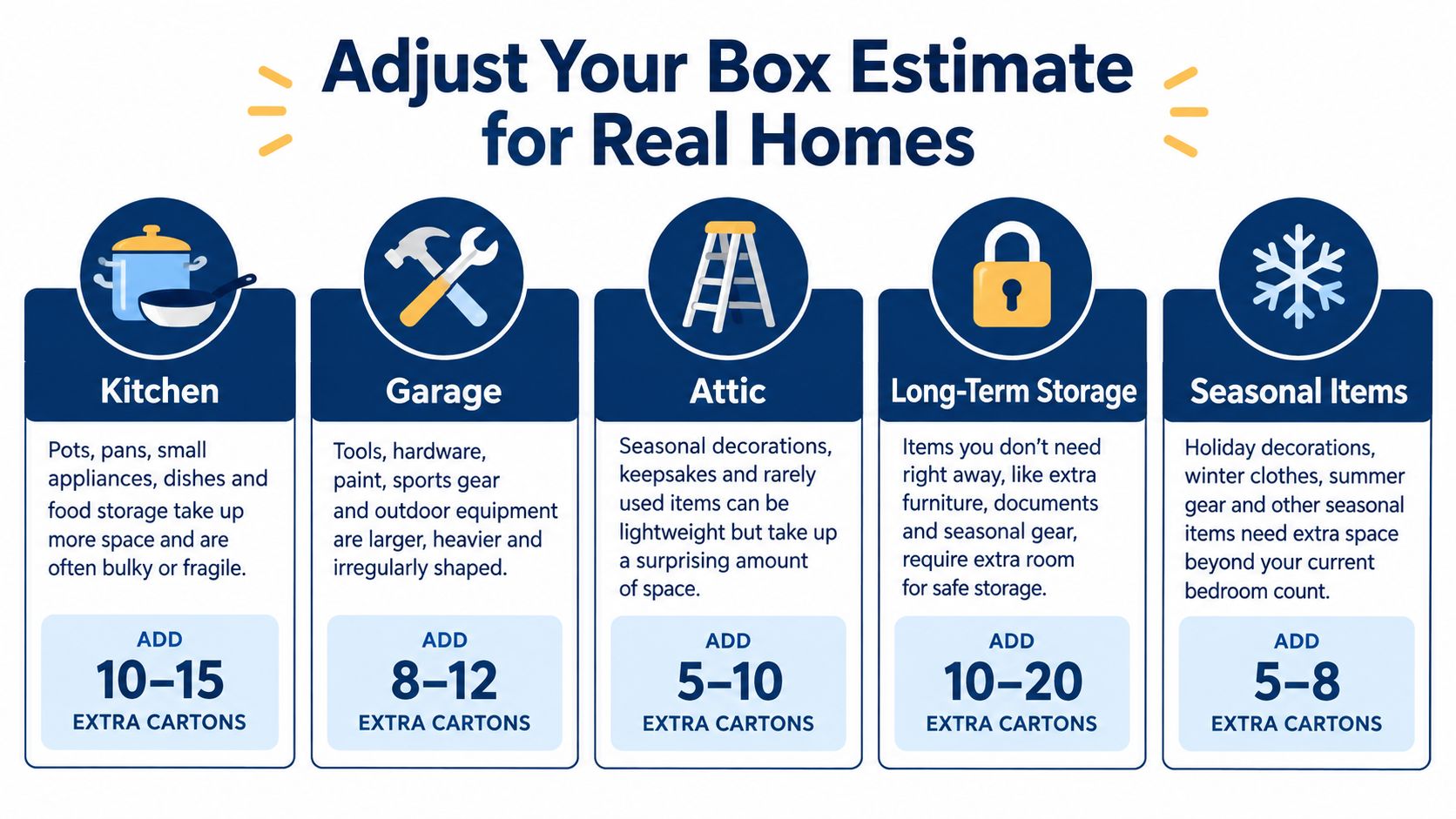
The cleanest way to adjust the count is to add by category, not by mood. A packed kitchen, a home office, a garage, and an attic each change the math in a different way. Homes occupied for more than ten years can increase the box estimate by 20–30%, and garages, storage rooms, attics, and holiday decorations may each add 10–20 boxes on top of the room baseline home-age and storage adjustment.
Add cartons for storage-heavy rooms
Kitchens need extra cartons because they hold many small, dense objects. Bookshelves and home offices do the same thing, just with paper, binders, cables, and equipment instead of cookware.
Garages and attics are the silent box killers. They're not glamorous, but they're full of awkward, overlooked items that don't fit into a standard room count. If you keep holiday décor, hobby supplies, or long-stored gear up there, your box total rises quickly.
Long-term occupancy changes the math
A home lived in for a decade or more tends to carry more accumulated items than a recently occupied space. That's not a flaw, it's normal. People keep extra cookware, extra towels, backup printer paper, extra cords, and boxes of things they meant to sort out later.
Direct rule: if you've lived somewhere a long time, do not use a fresh-move chart. Use the baseline plus an accumulation adjustment.
Hobbies can also distort the estimate. Vinyl records, model collections, sewing materials, and craft supplies are box-hungry because they create a lot of small, fragile, or oddly shaped items. The right move is to count those separately instead of hiding them inside a generic bedroom total.
Run a Packing Quality Check Before You Buy the Rest
Buy in stages. Pack one representative carton from each major category, then adjust the rest of the order based on what fits. That catches a weak estimate before your garage turns into a warehouse of unused cardboard.
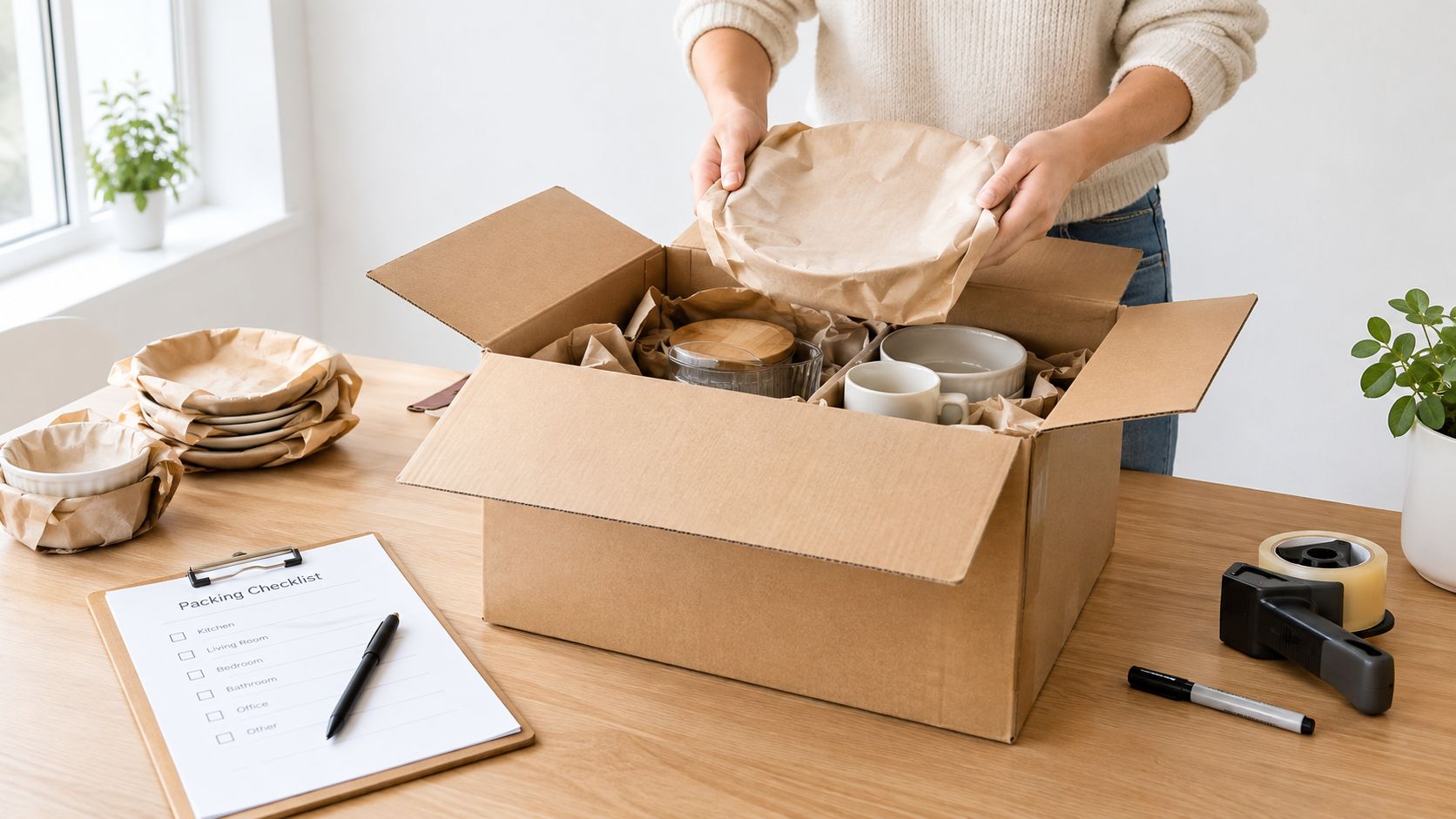
Measure the outside of the box, but do not treat the full exterior as usable space. The interior is smaller, and cushioning takes room. USPS packing guidance says to leave enough space for padding and avoid overstuffing, because dense cartons can split while loose cartons let items shift and break USPS packing guidance.
Use one test box per category
Pack one small box, one medium box, and one large box before you finish the order. Weigh them if you can. If the large box turns into a brick, the size mix is wrong.
Before you run the test pack, it helps to know when to start packing for a move so the check happens early enough to change your order. A kitchen carton that already strains the lift tells you to buy more small boxes and fewer large ones. The same logic applies to books, office items, and garage odds and ends.
Label for destination, not just contents
Label every carton by room and contents. Write “kitchen,” “primary bedroom,” “office,” or the room it belongs to, then add a quick note on what is inside. That speeds up unloading and keeps partial boxes from wandering into the wrong room.
Reinforce the seams with tape, keep heavy items on the bottom, and do not let boxes bulge. Overfilled cartons split. Under-filled cartons shift. If a box feels wrong when you lift it, it probably is.
Stage the Purchase and Plan for the Boxes You Will Have Left Over
Buying double “just in case” is lazy advice. It creates waste, clutters the home, and turns a simple move into a cardboard storage problem.
A staged purchase works better. Buy the baseline plus a modest reserve, then pack a room or two before topping up. That keeps the order tied to actual usage instead of an internet guess. In 2018, U.S. corrugated boxes had a 96.5% recycling rate, up from 67.3% in 2000, so buying a modest reserve and recycling the surplus is a more responsible move than doubling the order out of fear EPA paper and paperboard data.
Don't overbuy cardboard on day one
A reserve of roughly 10 to 15 percent is enough for most moves, especially when you're still sorting fragile items and last-minute extras. That buffer covers damaged cartons, pantry overflow, and a few odd-shaped items that refuse to fit the first pass.
For short local moves, reusable plastic bins can make sense because they reduce cardboard handling. Rental crates can also work well in apartments where you don't want stacks of boxes sitting in the hallway. The point is simple, stage the supply so you can adjust before the move turns into clutter.
Plan the exit for the extra boxes
Clean, dry corrugated cardboard should go into recycling after unpacking. Keep it dry, flatten it when you can, and separate it from food-soiled packaging. If your mover offers pickup or packing support, ask how they handle post-move materials before move day, not after you're staring at a pile in the driveway.
A move should not end with half a garage full of untouched cartons. The right number is the number you use, plus a small cushion, not a mountain of boxes you hope will someday disappear.
Putting It All Together for Your Central Texas Move
The answer to how many moving boxes do i need is not one number. It's a sequence. Start with the room baseline, adjust for density and storage, run a test pack, then place the rest of the order in stages.
Write down three totals, small boxes, medium boxes, and specialty cartons. That's the inventory that matters on move day. Large boxes should stay limited and purposeful, not dominate the order.
If your home has a packed garage, a serious kitchen, a home office, or enough storage to make the estimate shaky, stop guessing and get a written quote from a licensed, insured mover who handles packing and materials clearly. Webster Moving Co. provides residential and commercial moves, packing services, storage and POD moves, and specialty item handling across Central Texas, so if you want a box count tied to the contents of your home, start there.
If you want your move planned by people who deal with Austin homes, apartments, and storage-heavy households every week, Webster Moving Co. can help with packing, materials, and full-service moving. Visit Webster Moving Co. to request a written quote and get a box estimate that matches what is in your home.
Comments