
Hiring a Pack and Unpack Service
The boxes always seem to multiply in the last week. One room still has closet items on the floor, the kitchen is half-empty, and every roll of tape looks more expensive than the last one. That's usually the moment people decide they don't need more cardboard, they need a plan, and a pack and unpack service can be the difference between a controlled move and a chaotic one.
Table of Contents
Why Professional Packing Changes Your Move - What that means on move day
What Professional Packing Actually Includes - Cartons are chosen by load, not by wishful thinking - Protection is about movement control
Defining the Tiers of Unpacking Services - Basic unboxing is only the first tier - Placement changes the pace of move-in - Full setup takes more coordination
Evaluating the Costs and Trade-Offs - Labor is the cost you're really buying - DIY and professional service solve different problems
Understanding Damage Liability and Protection - Packing quality and liability are separate issues - What to verify before the move starts
How to Prepare Your Home for the Packing Crew - Start with the week before the move - Clear the path before anyone arrives - Make the instructions easy to follow
Why Professional Packing Changes Your Move
A move feels simpler when someone else is the one opening cabinets, wrapping glassware, and labeling boxes by room. That isn't just convenience. Professional packing turns a deadline-driven scramble into a managed workflow, with trained labor handling the part of the move that creates the most friction.
The labor behind packing is real and measurable. The U.S. Bureau of Labor Statistics reported 645,210 jobs for packers and packagers, hand in May 2023, with a mean annual wage of $35,450 and a median hourly wage of $16.74 in the occupation profile. That scale matters because it shows packing is not a casual side task, it's a labor category with its own methods, wages, and expectations.
What that means on move day
A professional crew doesn't just “box things up.” The work includes choosing containers, wrapping and cushioning contents, labeling packages, and preparing items for handling and transport, all under a workflow built to reduce damage and wasted motion. In a home, that translates into fewer half-packed boxes and less guesswork when the truck arrives.
Practical rule: If packing starts to spill across rooms, the job has already become an operations problem, not a storage problem.
For Greater Austin households, that difference shows up fast in apartments, townhomes, and office moves where elevator windows, parking access, and move-out deadlines leave little room for mistakes. A professional pack and unpack service is useful when you need the move to keep moving, not when you want to spend three nights deciding where the dishware goes.
What Professional Packing Actually Includes
Packing done well looks ordinary from the outside because the results are neat boxes and clear labels. The work underneath is more technical. Carton choice, load balance, cushioning, and handling discipline all matter because a packed box is really a transport package, not just a container.
Cartons are chosen by load, not by wishful thinking
NIOSH says the maximum two-handed lift under ideal conditions is 51 pounds, and the Recommended Weight Limit drops when reach, twisting, frequency, asymmetry, or poor hand coupling get worse NIOSH ergonomic guidelines. That is why experienced crews don't use one box size for everything. Dense items like books, files, tools, and kitchenware belong in smaller cartons, while lighter goods like linens can fill larger ones without creating unsafe loads.
That same guideline explains why crews keep boxes balanced and stable. If contents shift, the load becomes harder to carry and more likely to fail during handling. A good crew checks for bulging, reinforces weak seams, and repacks anything that doesn't stay stable before it goes onto a truck.
Protection is about movement control
ASTM D6344 evaluates filled packages against concentrated, low-level impacts that reflect real distribution and handling conditions ASTM D6344. In practical terms, that means the packing goal is not just “survive a lift,” it's “limit what happens when the box is set down, nudged, or stacked.” Void fill, edge protection, and rigid cartons help stop contents from slamming into one another.
That is especially relevant for fragile, dense, or protruding items. An antique frame, a lamp with a long stem, or a kitchen box with mixed contents needs more than a blanket wrap and a prayer. A crew that understands transport behavior will use stronger cartons or extra reinforcement where the package shape calls for it.
For readers comparing service options, Webster Moving Co. describes packing support and move preparation in more detail on its packing and moving overview. The useful point is not the marketing language. It's that professional packing includes materials, handling choices, and labor discipline that you don't get from a stack of boxes in the garage.
Defining the Tiers of Unpacking Services
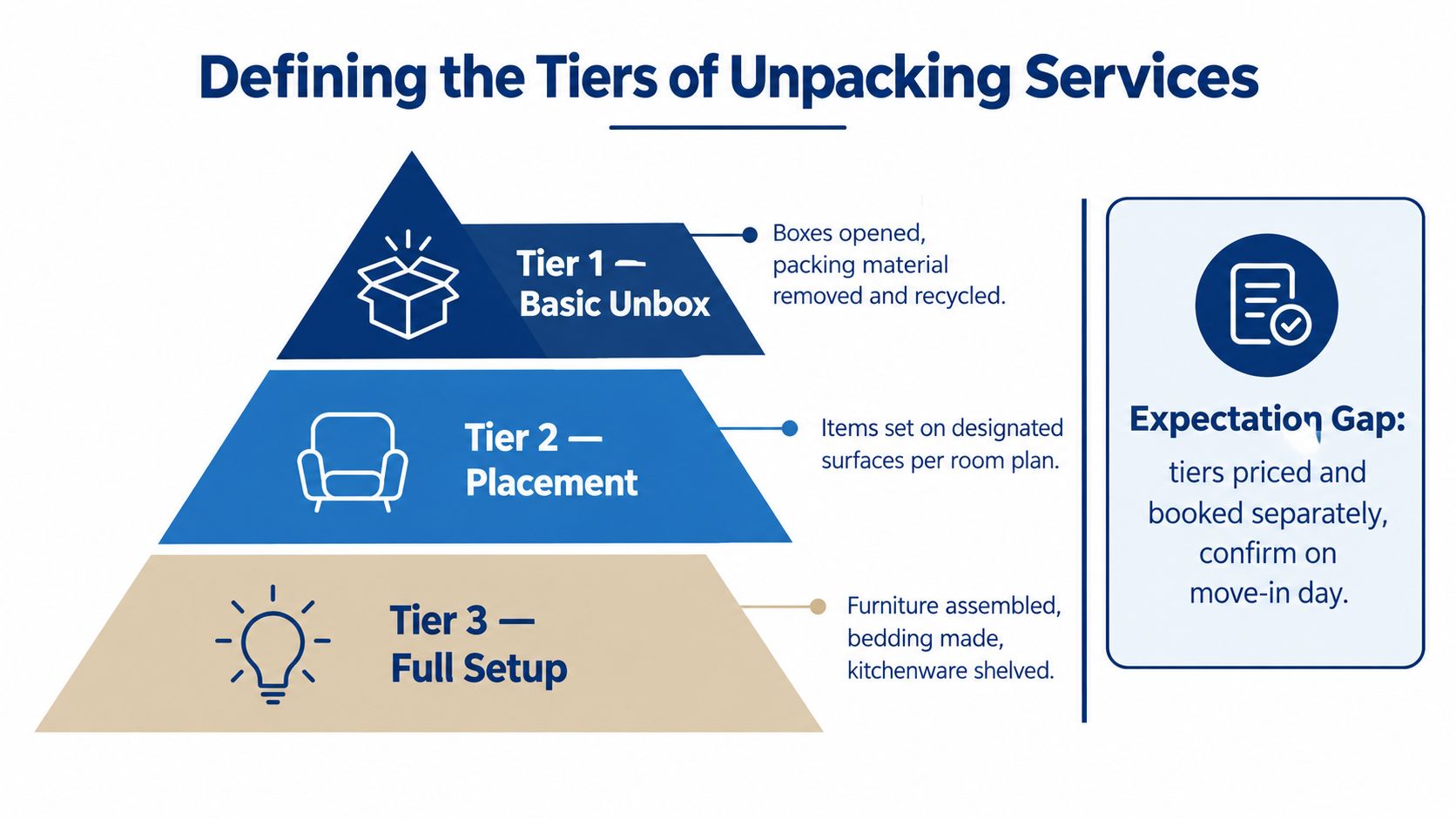
Unpacking is where expectations get messy. Many customers picture a crew opening boxes and leaving the home fully settled, then discover the service they booked was narrower than that. The fix is to think in tiers, because unpacking is rarely one single task.
Basic unboxing is only the first tier
The lightest version of unpacking is opening boxes, removing packing material, and placing items in the right room or on a nearby surface. That's helpful, but it's not the same as making a home functional. If someone needs to get back to work the same day, this tier gets the clutter off the floor, but it won't finish the job.
Placement changes the pace of move-in
The next tier is furniture placement and room-specific staging. Crews place items where they belong, organize key surfaces, and remove visible packing debris as they go. That level is often the sweet spot for apartments, families with short move-in windows, and anyone trying to restore order fast without paying for a full home setup.
Full setup takes more coordination
The most complete version includes furniture assembly, bedding setup, and putting kitchenware away in usable places. It takes more time because the crew has to interpret the space, not just empty cartons. In practice, that usually works best for high-priority rooms first, especially kitchens, bedrooms, and areas with bulky items.
A hybrid model often works better than an all-or-nothing booking. Professionals handle the rooms that create the most friction, while residents keep control of personal papers, valuables, and items that need individual judgment.
That tiered approach also fits the mover-survey pattern noted by This Old House, where unpacking is purchased less often than packing and packing supplies, which suggests that customers still need clearer scope definitions. A smarter booking conversation asks what the crew will finish before leaving, what stays for the homeowner, and whether debris removal is included. For a service that can be shaped around the move, the real question is not “Do I need unpacking?” It's “Which parts of unpacking should I stop doing myself?”
Evaluating the Costs and Trade-Offs
People usually compare packing services to the price of buying their own boxes and tape. That comparison is too narrow. The choice to make is between spending your time, your energy, and your risk tolerance on the packing process, or paying trained labor to do the same work under a managed system.
Labor is the cost you're really buying
BLS data show how much labor has changed over time. In May 2017, the occupation included 700,560 workers, with a mean annual wage of $25,410 and a median hourly wage of $11.27. By May 2023, employment was 645,210, the mean annual wage had risen to $35,450, and the median hourly wage had risen to $16.74 in the BLS occupation profile and the earlier BLS record. That is a meaningful shift in labor cost and a good reason packing quotes reflect real crew time, not just material handling.
For a closer local planning lens, Webster Moving Co. discusses pricing context in its average cost of a local move for a 3-bedroom house. Even if your move is smaller, the logic is the same. If the crew is doing detailed packing, the quote has to cover labor, materials, and the time needed to work carefully.
DIY and professional service solve different problems
Factor | DIY Packing | Professional Packing |
|---|---|---|
Time | You supply the evenings and weekends | Crew compresses the schedule |
Materials | You source and judge what's needed | Materials and methods are matched to the job |
Risk | You control every choice, but also every mistake | Trained handling lowers avoidable packing errors |
Physical strain | You carry, bend, and lift throughout | Crew uses workflow and equipment more efficiently |
Unpacking | You decide the pace, but also live with the clutter | Placement and setup can be staged by priority |
DIY makes sense when the move is small, the timeline is flexible, and the household can absorb the labor. Professional packing makes more sense when time is tight, the property has stairs or access issues, or fragile items need careful handling. The premium is easiest to justify when the alternative is lost work time, injury risk, or a last-minute pile of poorly packed cartons.
Understanding Damage Liability and Protection
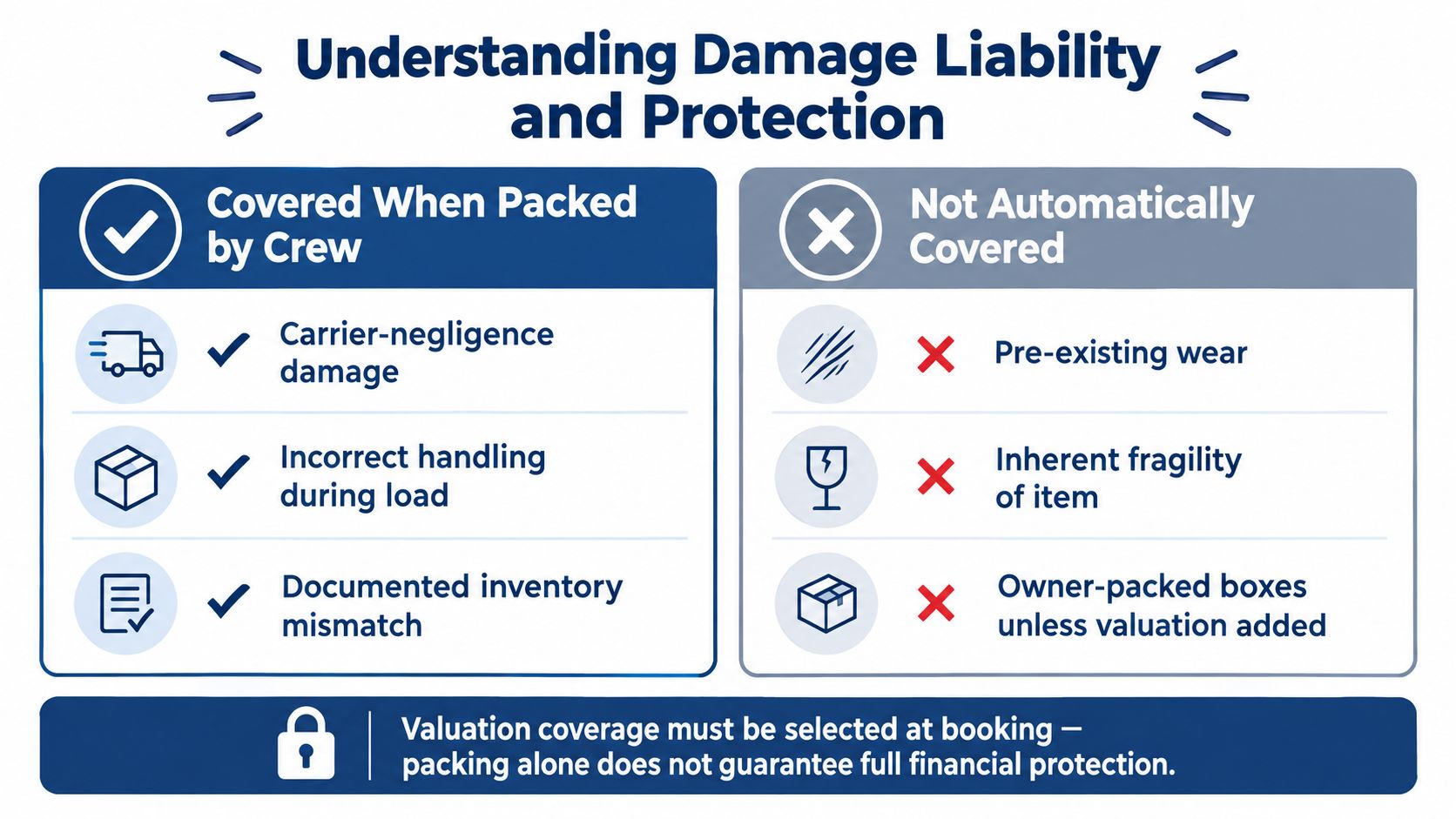
A well-packed box can still run into a claims issue. That's the part most customers miss. Careful wrapping and smart loading reduce damage risk, but they do not automatically create full financial protection if something goes wrong.
Packing quality and liability are separate issues
For interstate moves, the FMCSA says movers must offer Full Value Protection and Released Value coverage, and under Released Value liability is generally limited to 60 cents per pound per item in its consumer advisory on loss and damage FMCSA consumer advisory. That means a carefully wrapped item can still have limited reimbursement if the customer chose the lighter coverage.
This is why packing pages need to explain who documented the shipment, how high-value items were described, and whether owner-packed boxes are treated differently in claims review. The physical service and the valuation choice are related, but they're not the same thing.
What to verify before the move starts
Inventory details: Make sure high-value pieces are listed clearly before loading.
Documentation: Photograph fragile or expensive items and keep receipts or appraisals where possible.
Coverage choice: Review the valuation section before signing, especially for long-distance moves.
Box condition: Note crushed, opened, or damaged cartons at delivery, not days later.
Local versus interstate rules: Don't assume one policy covers every type of move.
For Central Texas customers, that distinction matters because local moves and interstate relocations don't follow the same federal framework. A good moving company should be willing to explain what is covered, what is not, and where owner-packed boxes create a different claims path. If the answer stays vague, the risk stays yours.
How to Prepare Your Home for the Packing Crew
The best packing crew still loses time if the house isn't ready for them. A little prep makes the day smoother, reduces confusion, and keeps the crew focused on packing rather than making decisions about what stays and what goes.
Start with the week before the move
First, remove obvious clutter and separate what you're keeping from what you're donating or discarding. That keeps crews from spending time wrapping items you already intended to leave behind. Then set aside one clearly labeled essentials area for medications, documents, chargers, and the things you'll want immediately after move-in.
Clear the path before anyone arrives
Walk every hallway, stair, and doorway the crew will use. If you live in an apartment or condo, confirm elevator access, parking instructions, and any building rules ahead of time. Webster Moving Co. outlines the broader process in its full service move overview, which is useful because packing, loading, and access planning all affect each other.
Good prep saves labor hours. It also lowers the odds that a crew has to stop and ask where something belongs while carrying a box.
Make the instructions easy to follow
Label anything fragile, point out items that need special handling, and tell the crew which rooms should be packed first. Keep pets contained, keep walkways open, and leave parking space if the truck needs it. If you want a hybrid unpacking result, say that before the first box is sealed, not after the truck has already left.
If you want a pack and unpack service that's built around careful labor, organized loading, and practical move-in support, Webster Moving Co. can help with packing, placement, and full-service moving across Greater Austin and Central Texas. Visit Webster Moving Co. to request a quote and talk through the right level of packing and unpacking for your move.
Comments