
How to Plan a Full Service Move: Step-by-Step Guide
A full-service move can take a day or several days for a local relocation, while a long-distance move may require a much longer scheduling window. The total cost depends on distance, the volume of belongings, access conditions, packing requirements, storage, and other services you add.
The hardest part often starts before the truck arrives. Boxes fill the living room, furniture blocks hallways, the rental truck still needs loading, and every fragile item raises the same concern: will it arrive without damage? A professional full-service crew takes responsibility for the connected sequence, from preparing belongings and protecting the property to loading, transporting, unloading, and placing items at the destination.
That support matters because moving is less familiar to many households than it once was. The U.S. Census Bureau's mobility data shows that the 2024 mover rate was 11.8%, down from 12.1% in 2023, and far below the annual mobility rates of 20% or more recorded during the 1950s and 1960s. A move may be a routine operation for a trained crew, but it can be an unfamiliar, high-consequence project for the household.
Table of Contents
What Is a Full Service Move and Why It Matters - Full service compared with DIY and hybrid moves
Getting an Accurate Moving Quote - Give the mover the access details - Use a quote audit before booking
Pre-Move Preparation and Planning - Build the plan around the actual home
Move Day and What Actually Happens - How crews manage difficult routes - Loading for the trip
Understanding Move Timelines and Scheduling - Schedule for the constraints you know
Common Add-On Services and When to Use Them - Packing and unpacking - Storage and container moves - Specialty handling and protection
Choosing the Right Moving Company for Your Full Service Move - Compare operations, not slogans
What Is a Full Service Move and Why It Matters
By late afternoon, a do-it-yourself move can leave a homeowner managing three jobs at once. Someone is still wrapping dishes, another person is trying to lift a dresser into a truck, and the front door keeps opening while unprotected furniture passes through it. The moving plan breaks down because packing, carrying, loading, driving, and directing traffic all compete for attention.
A full-service move removes that division of labor from the customer. The movers pack some or all belongings, prepare furniture, protect floors and walls, carry items from the home, load the vehicle, transport the shipment, unload it, and place items in the rooms where they belong. Depending on the scope, they may also unpack cartons, remove packing materials, load or unload storage containers, and handle specialty pieces.
Full service compared with DIY and hybrid moves
A DIY move usually leaves the homeowner responsible for purchasing materials, packing, finding help, renting or driving equipment, deciding how to distribute weight, and resolving access problems in real time. A hybrid move can reduce the workload by adding labor for loading or unloading, but the customer still manages the parts excluded from the estimate.
The trade-off is straightforward:
DIY moving: More control over the process, but more physical work, coordination, and exposure to avoidable handling mistakes.
Hybrid moving: A useful middle ground when the household can pack or drive but needs help with heavy lifting.
Full service: A higher level of professional involvement, with the crew coordinating the physical workflow from preparation through placement.
Practical rule: If the move includes stairs, elevators, long carries, heavy appliances, fragile collections, or a strict lease deadline, treat it as a logistics project rather than a truck rental.
Full-service moving also depends on a broad labor system. The Bureau of Labor Statistics overview of transportation and warehousing reported approximately 6.6 million transportation and warehousing jobs in June 2024, representing about 5% of private-sector employment. That scale reflects the coordination involved in material handling, vehicle transport, scheduling, storage interfaces, and safe delivery. The customer is paying for organized execution, not merely space inside a truck.

Getting an Accurate Moving Quote
A quote is only as reliable as the information behind it. If the mover sees a standard ground-level home on the phone but encounters a fourth-floor apartment, a long parking carry, a piano, and packed closets on move day, the original scope was incomplete.
Start by preparing a usable inventory. List the rooms, major furniture, appliances, unusually heavy pieces, fragile belongings, and anything that needs disassembly or special protection. Include pianos, safes, large artwork, antiques, oversized sectionals, exercise equipment, and dense book collections. Send photographs or a video walkthrough when an in-person estimate isn't practical.
Give the mover the access details
Access can change labor requirements more than room count. Tell the estimator about:
Stairs and elevators: Identify floors, stair turns, elevator dimensions, reservation rules, and service-elevator restrictions.
Parking and carrying distance: Explain loading-zone limits, gated access, narrow driveways, street restrictions, and whether a smaller vehicle or shuttle may be needed.
Packing scope: State whether the crew will pack everything, only fragile items, or nothing. Packing materials and labor should appear in writing.
Special handling: Identify items that need crating, hoisting, appliance preparation, extra wrapping, or a specific placement plan.
Storage and timing: Provide the expected storage duration, pickup and delivery addresses, lease deadlines, and any gap between homes.
A binding estimate generally establishes a specified price based on the agreed scope and conditions. A nonbinding estimate is an initial projection that may be adjusted according to the actual services, time, or shipment details permitted by the agreement. Ask the mover to explain the exact terms instead of assuming that “estimate” means a guaranteed final price.
For planning context, review this guide to the average cost of a local move for a three-bedroom house, then request an estimate based on your own inventory and access conditions.
Use a quote audit before booking
Ask these questions in writing:
Is the estimate binding, nonbinding, or not-to-exceed?
Which rooms and items are included in the inventory?
Are stairs, elevators, long carries, parking restrictions, or shuttle service priced separately?
How are packing materials, repacking, storage, travel, and overtime handled?
What valuation coverage applies, and what exclusions should I understand?
What process must be followed before extra labor or materials are authorized?
What crew size, equipment, and arrival window does the quote assume?
The need for this audit is practical, not cosmetic. Survey data cited by This Old House's moving survey reports that 63% of homeowners said their final cost matched the original estimate, while 16% paid more. Another survey referenced there found that 78% of movers experienced unexpected expenses. A detailed, written scope gives both sides a way to identify changes before they become bill shock.
Pre-Move Preparation and Planning
Good crews begin working before move day by turning the home into an inventory and access plan. The estimator or move coordinator records what is being moved, notes existing condition where relevant, identifies specialty items, and confirms which services the household has selected.
The customer should not wait until the last week to reveal a safe, a narrow stairwell, or a building with strict loading hours. Those details affect crew size, equipment, route planning, and the order in which items can leave the property.
Build the plan around the actual home
A practical preparation sequence looks like this:
Document the inventory: Walk room by room and identify what is moving, what is staying, and what needs special protection.
Choose the packing scope: Full packing works when time is limited or the household wants the crew to manage materials and carton organization. Partial packing suits customers who can handle ordinary items but want help with fragile or difficult pieces.
Resolve access early: Reserve elevators, confirm parking rules, check gate codes, measure tight turns, and ask whether building management requires certificates or protective coverings.
Confirm the destination layout: Mark rooms clearly and prepare a simple floor plan so the crew can place furniture without repeatedly moving it later.
The packing service information from Webster Moving Co. describes the kind of scope customers should clarify before booking, including whether the crew will prepare the entire home or selected belongings.
A crew may also identify obstacles that aren't obvious from a room list. Low branches can interfere with vehicle positioning. A narrow landing may require furniture to be turned vertically. An apartment corridor may need floor and wall protection before the first item moves. A building elevator may be available in theory but unusable during a specific move window.
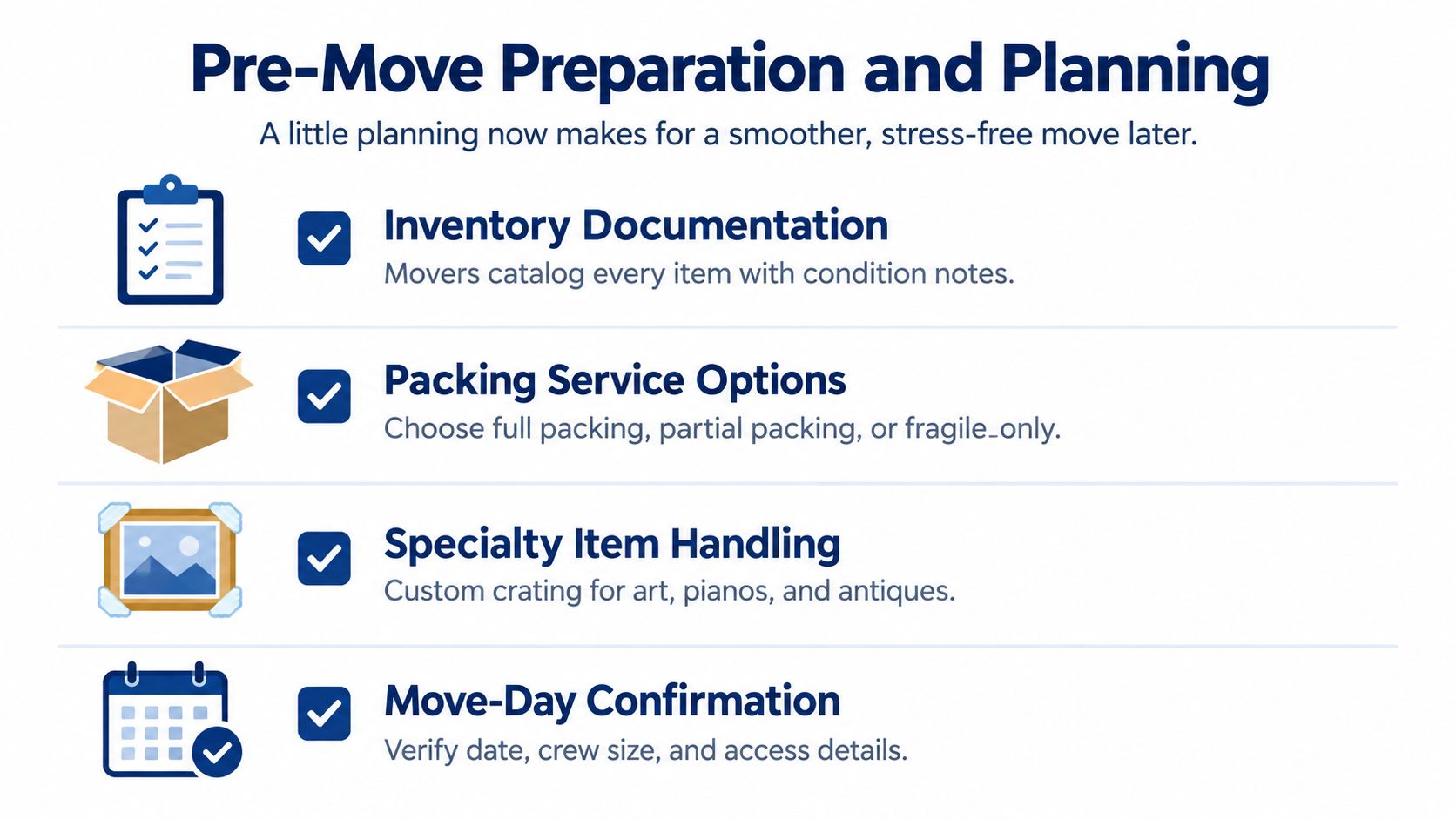
Separate passports, medications, jewelry, critical documents, and other personal essentials before the crew arrives. Keep them with you rather than placing them into the shipment. Label cartons by destination, but don't rely on labels alone for high-value or fragile items. Tell the crew what must remain accessible during the first evening, such as bedding, chargers, basic cookware, or office equipment.
Move Day and What Actually Happens
The first minutes on site determine whether the crew can work cleanly. Movers confirm the inventory and access conditions, inspect the route from the rooms to the vehicle, and establish a staging area. They lay down runners where needed, protect door frames and flooring, and position wrapping materials and equipment so the crew doesn't repeatedly cross through finished spaces.
Furniture is wrapped before it enters a tight route. Drawers are secured or removed when appropriate, doors are protected, and fragile pieces receive materials suited to their surfaces. The team then creates a workflow, often moving packed cartons and straightforward furniture while reserving awkward or heavy items for a controlled sequence.

How crews manage difficult routes
A narrow stairwell isn't solved by adding force alone. Movers measure the turn, remove obstacles, protect the walls, and choose an angle that keeps the item stable. If a sofa won't pass through a doorway, they may remove a door from its hinges, change the orientation, disassemble a detachable section, or reassess the route. Experienced crews don't keep pushing until the wall, item, or people become the weak point.
Limited parking changes the loading pattern. The crew may stage items closer to the vehicle, coordinate with building management, or use equipment that reduces repeated carrying. In an apartment, they also account for residents, common-area protection, elevator traffic, and the need to keep exit paths usable.
The NIOSH manual-materials-handling guidance identifies unstable loads, poor grips, slippery footing, confined areas, awkward postures, frequent lifting, and extended carries as warning conditions. Those hazards explain why professional loading is a sequence rather than a race.
Loading for the trip
Inside the vehicle, dense and stable items are placed low, weight is distributed, and contents are secured so they can't shift. Cartons are grouped by destination where the loading plan allows, while furniture and protective materials help create stable layers. The crew records exceptions, visible condition concerns, and items that need special attention at delivery.
At the destination, the process reverses. Movers protect the entry route, unload in an order that supports room placement, assemble agreed furniture, and ask for direction before placing large pieces. A full-service scope is valuable here because the job doesn't end when the truck doors open. It ends when the household can use the space.
Understanding Move Timelines and Scheduling
A realistic timeline starts with scope, not with the size of the truck. A local apartment with elevator restrictions may take longer to load than a larger ground-level home with clear access. A long-distance relocation adds transportation coordination, delivery scheduling, route conditions, and possible storage interfaces.
For a Central Texas household, plan around the work included in the estimate:
Move element | What affects the schedule |
|---|---|
Local loading | Inventory size, stairs, elevator access, parking, and crew size |
Packing | Whether the crew packs the full home, selected rooms, or fragile items |
Transportation | Distance, route planning, vehicle availability, and delivery coordination |
Unloading and placement | Destination access, room labeling, assembly, and specialty items |
The move can extend when an elevator is delayed, a loading zone becomes unavailable, weather affects safe handling, or a specialty item needs a different procedure. A crowded hallway also slows the operation because the crew has fewer safe places to stage cartons and furniture.
Schedule for the constraints you know
Avoid treating the date as the only scheduling decision. Confirm lease start and end dates, building booking windows, utility availability, parking permissions, and any time when the destination must be cleared. If the move has little flexibility, tell the mover early so the estimate accounts for the required sequence rather than assuming unrestricted access.
Packing can take place before departure, while unloading and placement occur after arrival. Commercial moves require a separate coordination layer because desks, files, equipment, and workstations must arrive in an order that supports business continuity.
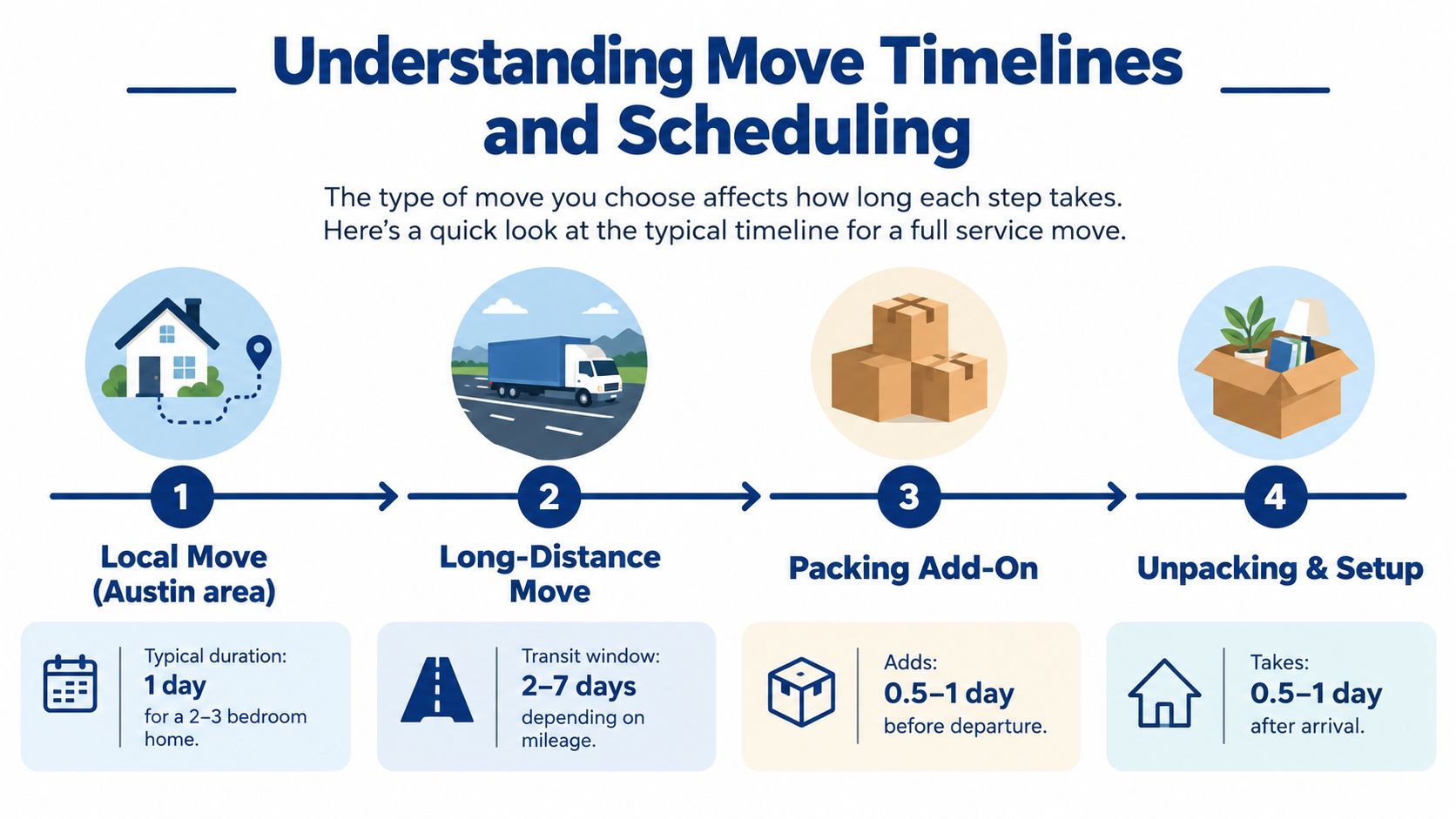
Central Texas weather can make heat, storms, and wet surfaces relevant to the work plan. The practical response is not to guess at a universal duration. It is to build a schedule with access buffers, communicate changes promptly, and make sure the crew has the people and equipment needed for the actual inventory.
Common Add-On Services and When to Use Them
Add-ons make sense when they remove a specific bottleneck. They don't make sense when they duplicate work the household can complete safely and comfortably. Compare each service against the time available, the difficulty of the items, and the consequences of a mistake.
Packing and unpacking
Full packing suits families facing a short move-out window, households with extensive fragile contents, or customers who can't spend days sorting and wrapping. The crew supplies materials, protects items, labels cartons, and organizes the shipment by destination.
Partial packing is more selective. A customer may pack clothing and ordinary books while assigning kitchens, artwork, glassware, or a home office to the movers. This approach can reduce the service scope without leaving the most failure-prone items to rushed packing.
Unpacking is useful when the customer needs beds, desks, kitchens, or other essential spaces functioning quickly. It may include placing items where they belong and removing packing materials, depending on the written scope.
Storage and container moves
Short-term storage helps when the old home must be vacated before the new home is ready. It can also support renovation, staging, delayed construction, or a closing gap. Ask how the inventory will be tracked, how access works, and whether delivery from storage is priced separately.
A POD or similar container offers a different arrangement. The customer has possession of the container for loading, while movers can provide professional loading, unloading, or local repositioning. It may work well when timing is flexible, but it requires a suitable placement area and careful weight distribution inside the container.
Specialty handling and protection
Pianos, safes, antiques, art, and large appliances require more than ordinary carrying. Their weight, shape, center of gravity, surface sensitivity, or limited handholds can make an improvised lift unsafe. Request a specific handling plan that covers equipment, route, protection, disassembly, crating, and placement.
Valuation coverage also deserves direct attention. Ask what protection is included, what exclusions apply, and whether the declared value reflects the shipment. Don't assume a general statement about insurance answers the question. The right add-on is the one that addresses a known risk in your move, not the one added without explanation.
Choosing the Right Moving Company for Your Full Service Move
The company you hire should be able to explain the work, not just provide a low opening figure. Ask for a written inventory, clear service inclusions, access assumptions, packing responsibilities, valuation terms, and a process for approving changes. A professional estimate should make it easier to compare companies because each proposal describes the same operational reality.
Verify licensing and insurance before booking. For a Texas move, look for the mover's TxDMV number. For interstate transportation, check the USDOT number and confirm that the company can explain its operating authority and coverage. Reviews and references can reveal communication patterns, but they should support, not replace, questions about the actual scope.
Compare operations, not slogans
Use a simple evaluation grid:
Pricing: Does the estimate identify labor, materials, travel, storage, and possible adjustments?
Communication: Can one person answer questions about access, timing, and change orders?
Crew preparation: Does the company discuss runners, furniture wrapping, dollies, ramps, hoists, or specialty procedures?
Local knowledge: Does the team understand apartment reservations, parking constraints, traffic patterns, and building rules in Greater Austin?
Delivery process: Will movers place furniture by room, document exceptions, and explain what happens if access changes?
A local operator may be familiar with the practical differences between a suburban driveway, a downtown apartment loading zone, and a narrow older home. That familiarity doesn't guarantee a successful move, but it can improve the questions asked during estimating and preparation.
The guide to working with packers and movers is useful as a comparison point because it focuses attention on the division of responsibilities between the customer and the crew. The strongest full-service experience combines reduced household workload with disciplined handling, realistic scheduling, and written expectations.
A well-executed move doesn't eliminate every obstacle. It gives the crew a method for handling those obstacles without turning each one into a crisis, allowing the household to focus on settling in rather than directing every lift.
Webster Moving Co. provides residential and commercial moving, full and partial packing, storage and POD loading, and specialty item handling for customers in Greater Austin and Central Texas. Visit Webster Moving Co. to request a no-obligation estimate and discuss your inventory, access conditions, timing, and move-day requirements.
Comments