%20copy-01_edited.jpg)
Packers and Movers Guide: Costs, Services, and Hiring Tips
For a typical local move, packers and movers often land around $80–$150 per hour for a two-person crew handling 3 to 5 rooms, and the final price depends on hours, distance, and the services you select. The key question isn't just what the truck costs, it's whether the quote covers the work you need.
Most homeowners start by comparing price, then discover too late that the contract matters more than the headline number. A low estimate can still turn into a bad move if it leaves out packing, stairs, long carries, storage, or the valuation terms that decide who pays when something breaks.
Table of Contents
What Packers and Movers Services Actually Cover - The moving workflow most people underestimate
Service Tiers From Packing Only To Full-Service Moves - A practical way to read the tiers
DIY Versus Labor-Only Versus Full-Service Moving - Three ways the same move can play out
How To Hire Local Movers Without Surprises - Start with identity, not price - Audit the estimate before you sign
Real Moving Scenarios And What They Change - A house move with furniture and fragile items - An apartment move with stairs or elevators - A commercial or office relocation - Storage and specialty handling
Valuation Protection, Liability, And What Low Quotes Hide - Why valuation changes the meaning of the price - What to put in writing before loading starts
What Packers and Movers Services Actually Cover
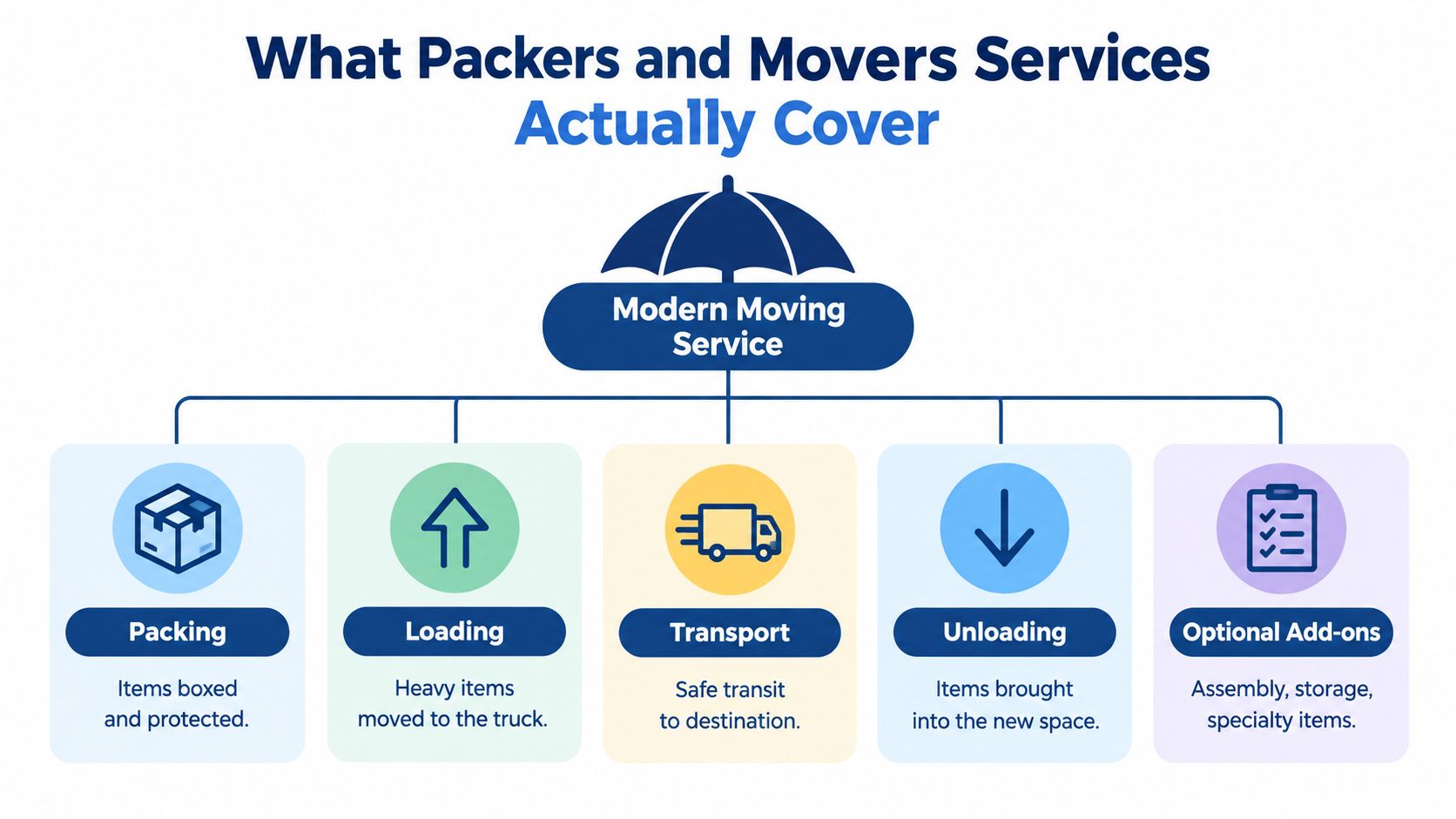
For packers and movers, the choice is usually not about buying a truck but about how much of the move to hand off. The service can be as narrow as labor for lifting boxes or as broad as full packing, transport, unloading, and setup. If you don't define the scope early, the quote won't mean much.
The moving workflow most people underestimate
A clean move has a chain of responsibilities. Packing protects the items, loading gets them safely to the truck, transport moves them to the destination, unloading places them inside the new space, and add-ons fill the gaps that standard service doesn't cover.
Practical rule: if one company says “full service,” ask what happens with boxes, materials, furniture assembly, storage, and specialty items. That's where hidden scope differences usually show up.
Residential moves, apartment moves, office relocations, and specialty item moves all look similar on paper, but the access problems are different. A house move may revolve around volume, while an apartment move often revolves around stairs, elevators, and parking access. Specialty items like pianos, safes, or antique furniture change the job again because handling risk matters as much as weight.
If you want a service that clearly separates packing from transport and storage, it helps to look at a mover's dedicated packing scope, such as Webster Moving Co.’s packing services. The point isn't to buy more than you need, it's to match the service to the actual workload.
Service Tiers From Packing Only To Full-Service Moves
The biggest pricing mistake is treating every mover's offer as the same product. It isn't. A labor-only crew, a packing-only crew, and a full-service team each shift responsibility in a different way, and that changes both cost and risk.
A practical way to read the tiers
Labor-only means you still own the planning. You pack, label, stage, and often rent or arrange the truck yourself, while the crew handles lifting and transport support. This can work if you're organized and your move is simple.
Packing-only is narrower but useful when the timeline is tight and fragile items need better protection. The crew brings materials, wraps, boxes, and labels, but you still manage transport or coordinate a separate carrier.
Full-service is the broadest option. The mover handles packing, loading, transport, unloading, and often placement, which is where the actual value shows up for larger homes, office moves, and moves with bulky furniture.
Service Tier | What It Covers | Best For | Responsibility Boundaries |
|---|---|---|---|
DIY only | You pack, load, move, and unload everything | Small, simple moves | You own all labor, timing, and damage risk |
Labor-only | Crew helps with lifting or truck loading | People with a rental truck or container | You still manage packing and logistics |
Packing only | Boxes, wrapping, and prep | Fragile homes or compressed timelines | Transport is separate |
Full-service move | Packing, loading, transport, unloading | Larger homes and time-sensitive moves | Crew owns execution, you still approve scope |
Storage or POD move | Loading or unloading containers, storage handling | Delayed closings or staggered dates | Access dates and storage terms matter |
Apartment and condo moves deserve separate planning because access can dominate the job. If the elevator is booked, the parking is tight, or the loading path is long, the right tier isn't just about hands, it's about coordination. Office moves add another layer, since downtime and file or equipment handling matter as much as furniture.
DIY Versus Labor-Only Versus Full-Service Moving
A cheap truck rental looks smart until you add packing supplies, fuel, time off work, and the actual risk that heavy lifting becomes your problem. The question isn't whether you can do it. It's whether the savings survive the full cost of doing it yourself.
Three ways the same move can play out
DIY gives you the most control and the most work. It makes sense for light loads, short distances, and people who already have help, tools, and a flexible schedule.
Labor-only reduces the lifting without taking over the whole move. You still coordinate timing, loading order, transport, and delivery, which means you're buying muscle, not simplicity.
Full-service costs more, but it also compresses the mess into one coordinated job. That usually matters most when you're moving a family home, replacing tight closing dates, or protecting items that don't tolerate improvisation.

If your schedule is tight, the cheapest option is often the one that prevents a second trip.
The hidden trade-off is stress. DIY and labor-only both leave you with more decisions on move day, and move day is when delays compound. Full-service isn't automatically the right answer, but it's often the right answer when time pressure is high or the home has stairs, long carries, or large furniture.
For readers comparing a standard household move against a more detailed cost breakdown, Webster Moving Co.’s 3-bedroom local move guide is a useful reference point. The right choice still depends on how much coordination you want to own yourself.
How To Hire Local Movers Without Surprises
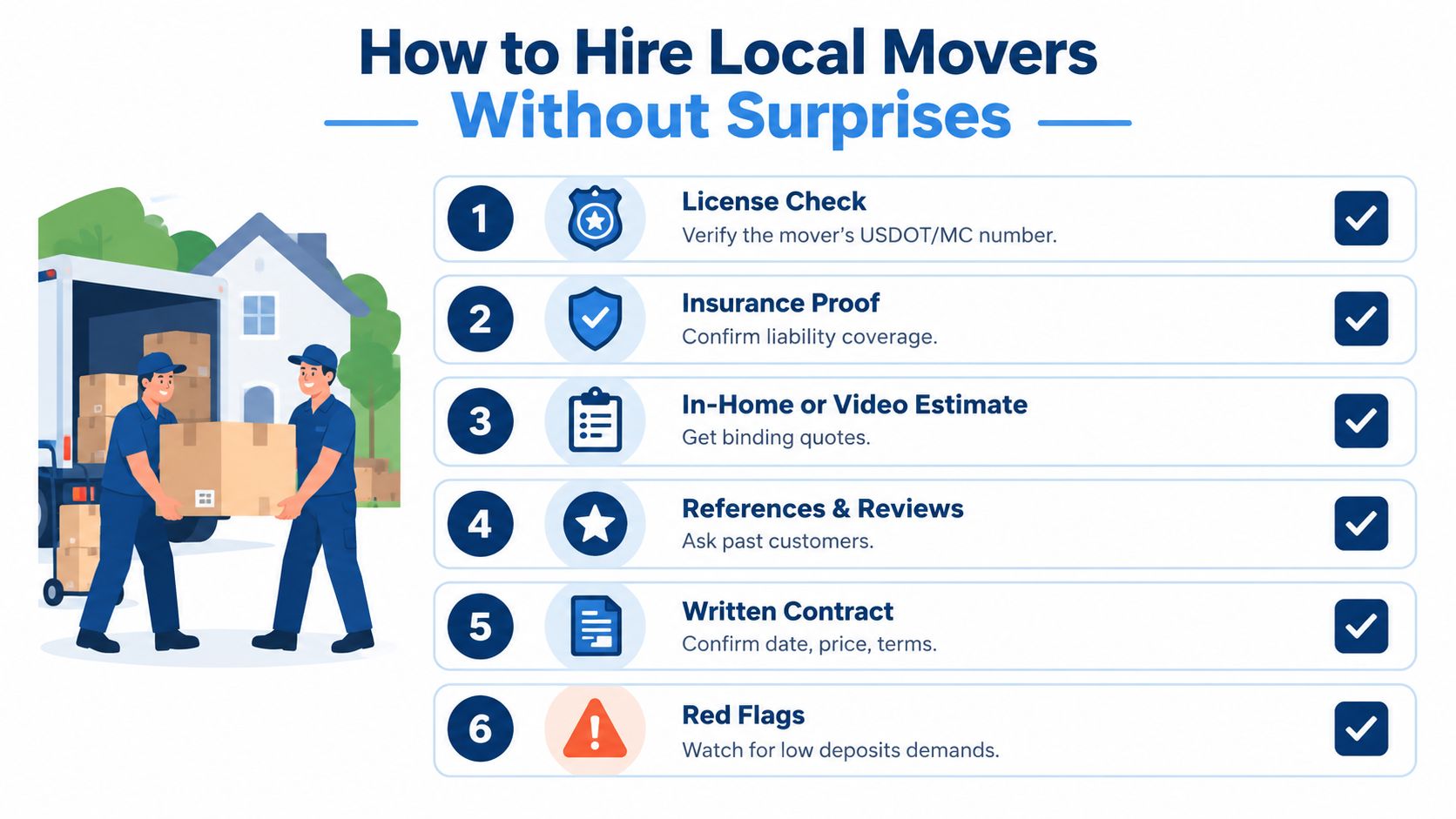
Would you book a mover based on a low price before confirming who holds the contract and who will handle your belongings? Hiring movers requires the same checks you would use for a contractor. Reviews can reveal patterns, but they cannot confirm whether the quote is accurate, whether the crew is the actual carrier, or whether the contract allows surprise charges.
Start with identity, not price
The mover should identify the legal business name and the party responsible for your shipment. Check the registration information, then confirm whether the company is the carrier or a broker arranging your move through another company. A low quote means little if the booking company and the crew operate under different responsibilities.
Reviews still matter, but they should confirm behavior rather than replace verification. Read Webster Moving Co. reviews to see whether the company explains quotes clearly and whether the booking entity matches the crew that arrives.
Audit the estimate before you sign
A usable written estimate answers practical questions instead of presenting one unexplained total. Check each point before accepting it:
What exactly is covered? Confirm packing, loading, transport, unloading, and placement.
Who is responsible? Identify the booking company, the carrier, and any third party.
What changes the price? Look for stairs, elevator access, long carries, packing materials, storage, and special handling.
What happens if the scope changes? Require the adjustment rule in writing rather than accepting a new charge at the curb.
The contract should also state the valuation terms and payment terms. Those details determine what protection applies if an item is damaged and when the company can require payment. A cheap quote may protect you when these terms are clear, or trap you when they are vague.
Rule of thumb: if the company will not put the valuation terms and payment terms in writing, do not assume they favor you.
That audit protects against bill shock more effectively than a star rating alone.
Real Moving Scenarios And What They Change
The right service tier depends on the shape of the move, not just the address. A three-bedroom house, a second-floor apartment, and a small office all need different planning even if they all use the word “moving.”
A house move with furniture and fragile items
A full-house move usually benefits from packing help because the problem is volume, not just transportation. The more rooms you have, the more likely you are to need labels, material coordination, and a team that can move furniture without improvising at the door.
In a larger home, the quote needs to account for the time spent protecting furniture, wrapping fragile items, and loading in the right order. That's where full-service starts to make sense, because the crew can work through the whole chain without pausing for homeowner decisions every ten minutes.
An apartment move with stairs or elevators
Apartment moves often look small until access gets involved. Stairs, elevator reservations, parking distance, and common-area protection can make a short move feel complicated fast.
If the moving team doesn't ask about access during the estimate, they're probably not pricing the job carefully. That usually leads to friction on move day, when the crew arrives and discovers the building is harder to work in than the quote assumed.
A commercial or office relocation
Office relocations are a different category because downtime matters. Desks, computers, files, and shared equipment need sequencing, and the move has to fit the business schedule instead of disrupting it.
That's why office moves often need coordinated packing, labeled placement, and a tighter unloading plan. A mover that can stage the work and reset the space quickly is usually more useful than one that only quotes the lowest transport rate.
Storage and specialty handling
Storage becomes useful when closing dates don't line up or when the destination isn't ready yet. Specialty items like pianos, safes, and large appliances also change the job because they require handling that goes beyond standard hauling.
If your move has any of those variables, don't compare only the truck price. Compare the plan. The plan is what keeps a cheap quote from becoming an expensive problem.
Valuation Protection, Liability, And What Low Quotes Hide
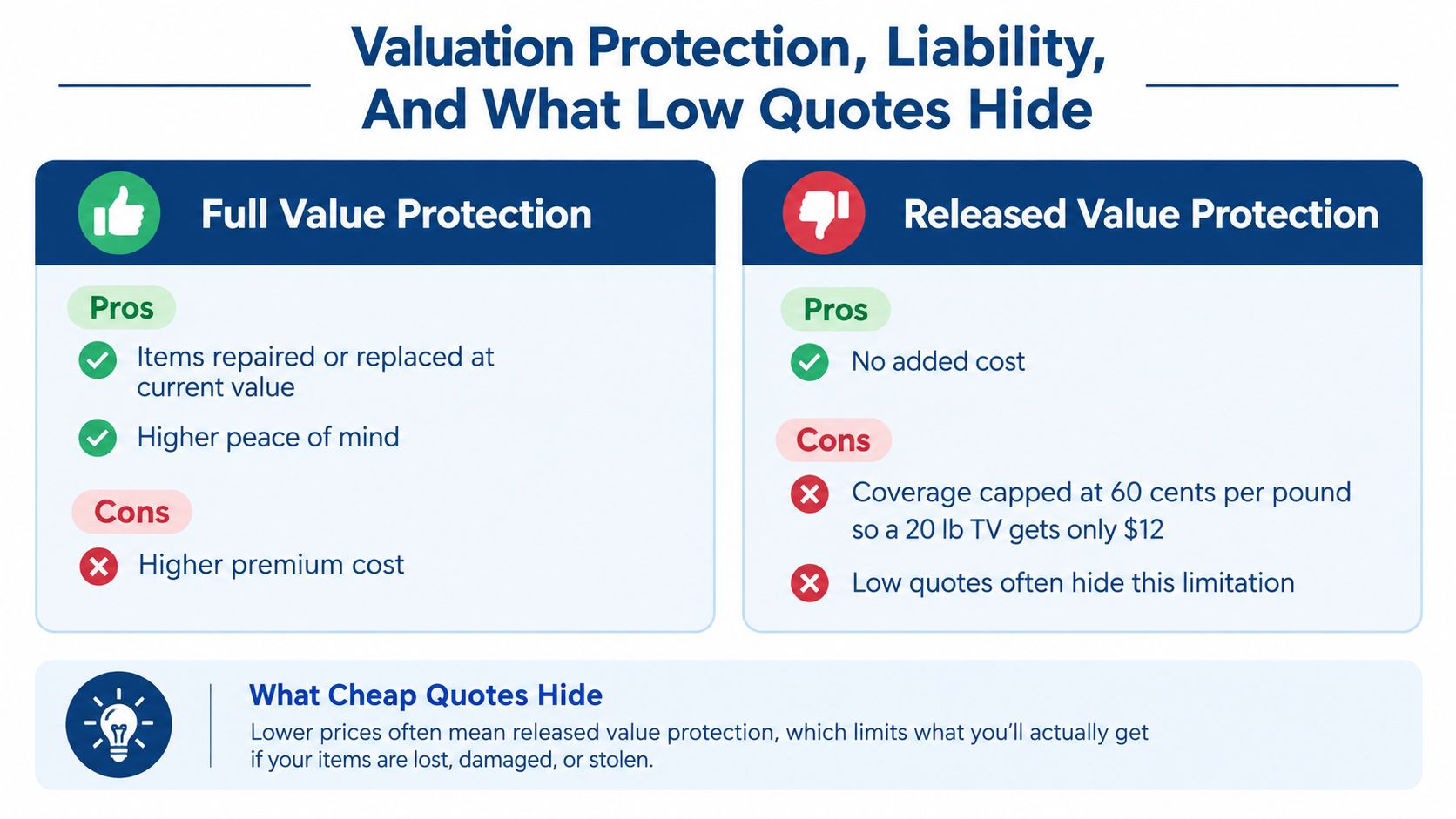
A low quote can hide more than labor. It can hide the liability terms that decide what happens when something is damaged, and that's the part many homeowners never read closely enough.
Why valuation changes the meaning of the price
For interstate household-goods transportation, Full Value Protection means the mover is generally responsible for repairing, replacing, or paying the current replacement value of damaged or lost items, subject to the shipment terms. Under Released Value protection, liability is much lower, capped at 60 cents per pound per article according to federal guidance from the Federal Motor Carrier Safety Administration (FMCSA liability protection).
That difference matters most for light, high-value items. A television, laptop, or specialty device can weigh very little and still be expensive to replace, so the low-liability option can leave you badly undercompensated.
What to put in writing before loading starts
The safest approach is simple. Create a room-by-room inventory, photograph the condition of valuable items before loading, and keep the valuation terms in writing. If the mover won't confirm those terms clearly, assume they're leaving room for later disputes.
Practical insight: the cheapest quote is often the one that leaves the most responsibility with the customer.
You should also pay attention to the booking relationship. If a broker sells the move to a carrier, the party that quoted you may not be the party responsible for the shipment. That's why a low number on paper doesn't tell you much on its own. The contract language tells you whether the price is real protection or just a starting point.
Quick Decision Guide To Choosing Your Moving Service
The right choice usually comes from three questions, not ten. How much stuff do you have, how much time do you have, and how much risk are you willing to carry yourself?
If the move is small, the timeline is flexible, and you're comfortable managing the logistics, DIY or labor-only can be enough. If the move includes stairs, fragile items, or a hard deadline, full-service usually makes more sense because the crew absorbs more of the complexity.
Before signing, run a short verification check:
Confirm the company's role. Carrier or broker, and who is moving the goods.
Get the scope in writing. Packing, loading, transport, unloading, and any add-ons.
Check the valuation terms. Know what protection you're buying before the truck is loaded.
Look for specific extras. Stairs, elevators, long carries, materials, storage, and specialty handling.
Match the quote to the job. If the estimate doesn't reflect your access and inventory, it's not a usable quote.
The cleanest decision is the one where the price and the responsibility line up. That's what keeps a move from turning into a negotiation on the sidewalk.
If you want a move handled with clear scope, written pricing, packing support, storage or POD coordination, and specialty item handling, Webster Moving Co. offers those services for homes and businesses across Central Texas. Visit Webster Moving Co. to request a no-obligation estimate and compare your move against the actual work it needs.
Comments