
Storage Container Set Guide: Sizes, Loading and Moves
Your move date is booked, the garage is filling with boxes, and you're trying to decide whether everything will fit in the container sitting in the driveway. Meanwhile, the plastic bins you planned to stack are already flexing under the weight of books. Buying more space won't necessarily fix either problem.
A storage container set works only when its dimensions, material, stacking strength, and storage conditions suit the load. That applies to a steel freight container holding furniture and to household containers packed inside it. Plan both together, and you'll avoid the expensive mistake of having enough volume but nowhere safe to put the last heavy box.
Table of Contents
Standard Container Sizes at a Glance - Measure the opening, not just the box
Choosing a Household Storage Container Set - Buy for fit and handling
Matching Container Size to Your Load - Build an inventory that can be loaded
How to Load a Container Set Safely - Build the load from the floor upward - Read the rating, not the marketing
Storage Conditions That Change Container Performance - Choose for the hottest storage space
When Professional Loading or Local Repositioning Pays Off - Separate moving contents from moving the container - Decide by the difficult lift
Confirm Your Container Plan Before Move Day - Bring a finished inventory
Standard Container Sizes at a Glance
Standard storage container dimensions
Container | External length | External width | External height | TEU value |
|---|---|---|---|---|
20-foot standard | 20 ft (6.1 m) | 8 ft (2.44 m) | 8 ft 6 in (2.59 m) | 1 TEU |
40-foot standard | 40 ft (12.19 m) | 8 ft (2.44 m) | 8 ft 6 in (2.59 m) | 2 TEU |
40-foot high cube | 40 ft (12.19 m) | 8 ft (2.44 m) | 9 ft 6 in (2.89 m) | 2 TEU |
These standard dimensions and capacity relationships follow FreightAmigo's explanation of container standardization, which identifies ISO 668, published in 1968, as the Series 1 framework for standardized external lengths, widths, and heights. That consistency lets cranes, trucks, railcars, and container-handling equipment work with compatible footprints. Portable-storage products still need their own specifications checked.
TEU means twenty-foot equivalent unit, a capacity measure rather than a count of physical boxes. It describes freight capacity, not whether your sectional sofa will pass through a particular container's doors. Treat each unit as a load-bearing, climate-exposed box: the external size tells you the footprint, not the stack limit, interior clearance, or how the contents will fare in heat, cold, or damp.
Measure the opening, not just the box
External dimensions aren't usable interior dimensions. Walls, flooring, door frames, and internal fittings reduce the space available, so compare your furniture measurements against the provider's clear interior dimensions and door opening.
Don't subtract an assumed allowance from the furniture itself. Subtract construction allowances from the container's outside dimensions, then check the actual clearances against your largest pieces.
Practical rule: A container that can hold an item isn't necessarily a container you can load that item into.
Ask for the supplied unit's specification sheet before arranging delivery. Confirm its permitted contents weight and loading restrictions separately from its dimensions. A large empty space isn't permission to fill every corner with dense equipment, books, or files.
Choosing a Household Storage Container Set
Which material fits the job? Glass is useful for food storage and reheating, while plastic is easier to carry and less vulnerable to drops. The Homes and Kitchens container comparison describes the trade-off clearly: glass is durable and non-porous but heavier and more breakable; plastic is lighter but can scratch, stain, and retain odors.
BPA-free doesn't mean heat-safe, microwave-safe, or chemically inert. A 2025 peer-reviewed study in Environmental Science Advances detected polycyclic aromatic compounds migrating from several food-contact plastics under refrigeration and microwave simulations, with polyethylene producing the highest estimated exposure in that experiment, while the authors assessed cancer risk as negligible at current exposure levels.
That finding supports precise use instructions, not a blanket warning against plastic. Check the base and lid separately: a microwave-compatible glass base doesn't automatically make its plastic lid suitable for heating.
Buy for fit and handling
Use these checks before adding another matching set to the cart:
Measure with lids attached. Check cabinet depth, refrigerator shelves, freezer drawers, and the moving carton you'll use.
Choose by task. Use appropriately rated glass for reheating and lightweight plastic for lunches, transport, or drop-prone situations.
Confirm heating instructions. Look for written limits covering the container, lid, vent position, and condition of the product.
Count usable containers. A generous piece count is less helpful when much of it consists of lids you can't match.
Check replacement parts. Interchangeable or replaceable lids can keep a useful set from becoming a collection of mismatched bases.
For moving, cushion glass pieces individually and separate nested surfaces so they can't knock together. Pack lids together in a labeled bag rather than wedging them between fragile rims.
If the set will spend time in portable storage, understand how POD storage works before deciding what to pack for immediate use. Keep everyday food containers accessible rather than burying them inside a sealed kitchen carton.
Matching Container Size to Your Load
How many containers do you need, and what size should they be? Start with the furniture inventory, the packed-box count, and the way you'll use storage. Room names alone won't answer the question: a sparsely furnished house and a home with a workshop can have very different loading requirements.
The scenarios below are starting points to test during an inventory, not established room-to-container capacity guarantees. Don't reserve a unit solely because your home matches a row.
Typical container need by home or office size
Home or office | Typical contents | Likely container setup |
|---|---|---|
Studio or one-bedroom apartment | Bed, sofa, small table, boxes | Test a smaller portable unit or a partial standard-container allocation against the inventory |
Two- to three-bedroom house | Full furniture set, appliances, boxes | Assess a standard container against measured furniture and packed cartons |
Four-bedroom house or small office | Furniture, equipment, file boxes | Compare a larger container with a multiple-unit arrangement after inventory |
Whole-home long-term storage | Full contents, large appliances, mattresses | Select units after inventory, including retrieval space and storage restrictions |
Build an inventory that can be loaded
Measure the sofa, bed components, dining table, cabinets, and appliances. Record whether legs, shelves, or frames can be removed, and photograph awkward shapes. A sofa's overall length tells you little about the maneuver needed to get it through a doorway.
Count cartons room by room, separating dense boxes from bulky, lightweight ones. If packing hasn't started, use the moving-box planning guide to organize your estimate, then update it with the actual packed count.
Volume calculations are useful, but furniture doesn't behave like loose material poured into a box. Mattresses create broad vertical surfaces, upholstered furniture needs protection, and fragile pieces may leave spaces that can't safely carry another carton.
Reserve access space intentionally. Don't assume you'll be able to reach a document box after every gap has been filled.
A move-only load can prioritize unloading order. Long-term storage needs a retrieval plan: place frequently needed items near the entrance and decide whether a clear aisle is worth the space it consumes.
We build the crew and moving plan around the size of the move, from packing the current home to protecting furniture and delivering everything to the new home. Bring the inventory to the estimate so that planning reflects the actual load, not just the bedroom count.
How to Load a Container Set Safely
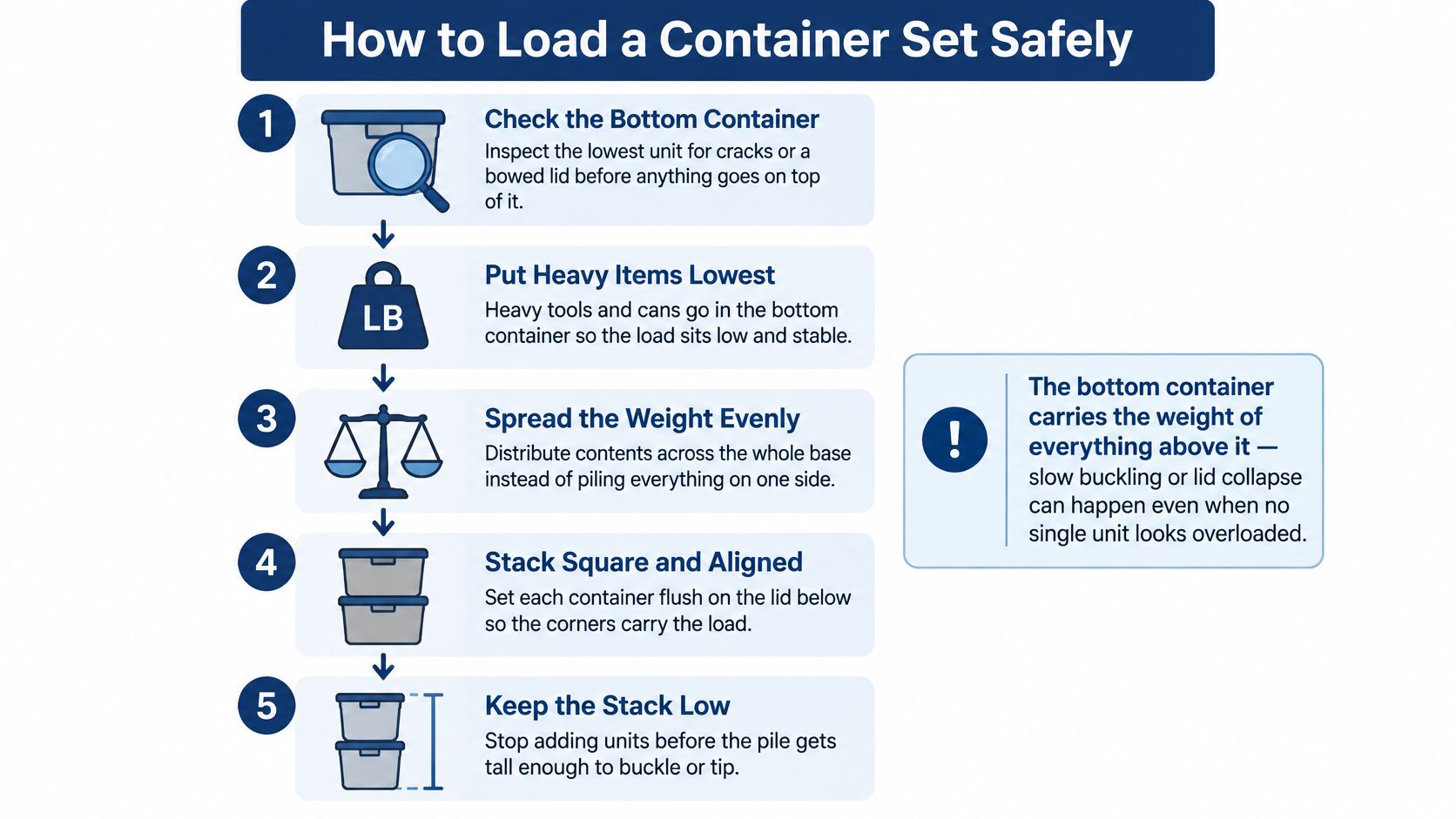
The bottom container carries the combined weight of everything above it. Failure can happen through gradual wall buckling or lid collapse even when each individual container seems reasonably filled.
Safe Load Testing's overview of ASTM D642 explains compression testing for shipping containers and unit loads. Stacking strength, not nominal volume alone, determines whether a container is suitable for the load above it.
Build the load from the floor upward
Inventory and label before lifting. Mark heavy cartons clearly and identify fragile contents. You need to know what belongs underneath before the stack blocks your view.
Check the base and placement. Have the portable-container operator position the unit on suitable, firm, level ground; don't attempt to level a loaded freight container yourself. Inspect household bins for cracks, damaged corners, and bowed lids before using them as stack bases.
Load dense contents low. Keep books, tools, cartoned dishes, and other concentrated weight near floor level. Distribute weight across the floor according to the provider's instructions rather than putting every heavy item against the same wall.
Match footprints and spread pressure. Use sound cartons or bins that align cleanly. Don't bridge a large box across unsupported lid centers or let an upper bin overhang the one below it.
Stop at the permitted stacking limit. Follow the container manufacturer's tested top-load limit and allowable stack height, not the height you can physically reach. Ask whether the compression rating applies to empty or filled units and get the applicable conditions in writing.
Restrain the load for movement. Use suitable straps attached to approved restraint points, plus protective blocking where needed. Don't rely on a tightly shut door to hold back furniture when the truck brakes or turns.
Preserve a safe unloading route. Keep planned access clear and avoid leaving unstable items immediately behind the doors. Nobody should have to pull a supporting carton out to reach something else.
Recheck before transport. If the load sits overnight, inspect it the following morning for leaning stacks, bowed walls, or lids pulling away. Rebuild a failing stack rather than adding a strap around damaged containers.
Read the rating, not the marketing
Stackable is not proof of transport suitability. Geometry, material, lid engagement, temperature, and time under load all affect performance, so a household bin's label isn't enough to establish a safe moving stack.
Our loading process includes furniture protection, transportation, and unloading. The result to aim for is the same whether you load yourself or use a crew: a level, restrained, accessible load that can be unloaded without dismantling an unstable pile.
Storage Conditions That Change Container Performance
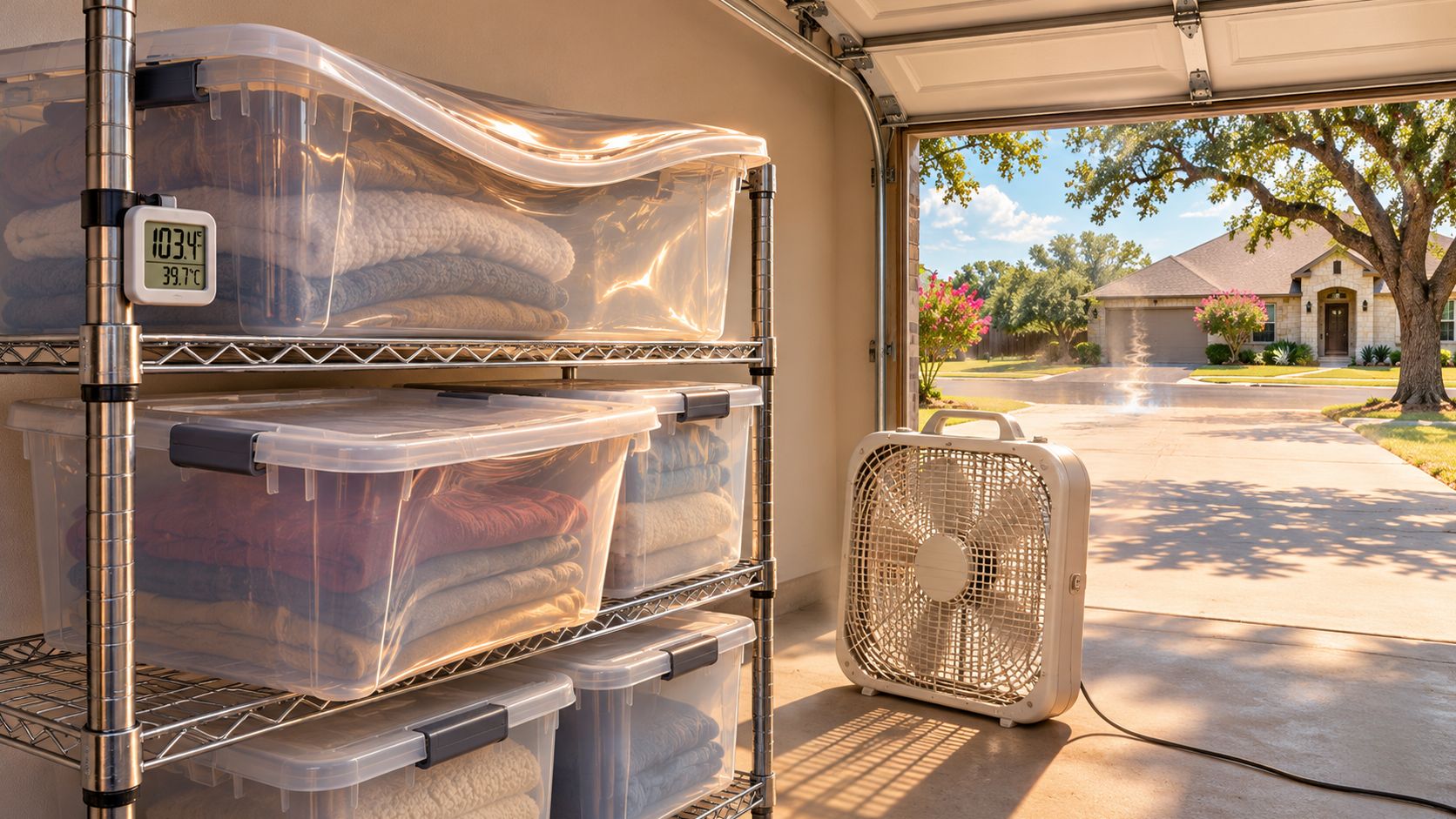
A bin rated for a closet can fail in a summer garage even when the load stays the same. Heat softens plastic, lids lose shape, and a stack that looked stable in a cool room begins to lean. In Central Texas, a garage, driveway, or unconditioned POD can expose a container set to that cycle for weeks. Treat each set as a load-bearing, climate-exposed box.
Heat-deflection temperature describes when plastic begins to deform under a specified load. The TestingLab explanation of thermal-property testing covers how thermal properties in storage plastics are measured, which gives context for that limit. Brief handling strength does not establish long-term storage performance. A tote that carries fine for ten minutes can creep under sustained heat and weight.
Storage environment risks and responses
Storage environment | Main risk | Practical response |
|---|---|---|
Garage or driveway in summer | Heat softens plastic and distorts lids | Use temperature-rated, UV-resistant units and reduce stack height |
Unconditioned POD, trailer or metal container | Heat buildup and condensation | Choose temperature-rated units, seal inner bags and add suitable desiccant |
Humid or damp location | Moisture damage, odor and mildew | Raise contents off the floor and keep lids sealed |
Fuels, solvents or paint thinner | Vapor buildup and fire or explosion risk | Don't store in closed containers without an approved system |
Warped or cracked container | Weakened walls and lids | Remove from stacks and don't use for heavy loads |
Choose for the hottest storage space
UV resistance and temperature resistance aren't interchangeable. Outdoor exposure demands both suitable temperature limits and UV-resistant construction. A clear tote made for an indoor closet should not become outdoor storage because its lid clips shut.
Check the test conditions behind a temperature rating, especially whether it was measured under load or on an empty unit. A rating without those conditions says little about a filled container in a hot garage. Pull damaged bins from structural use, and leave clearance to inspect neighboring containers.
Direct sun raises interior temperature, and the overnight cooldown drives condensation inside an unconditioned trailer or metal container. Seal fabrics and paper in inner bags, add suitable desiccant where it helps, and keep contents off the floor. Desiccant will not rescue wet contents or fix a leaking unit.
Never store fuels, solvents, or other vapor-forming flammables in closed containers without an approved, purpose-designed system. Enclosed vapors can create an explosive atmosphere when exposed to ignition or extreme heat.
Before you agree to a storage location, compare the manufacturer's limits with the hottest conditions the containers will face. If that environment is uncertain, choose a more controlled location. A stronger lid does not solve a hot, damp, or vapor-heavy space.
When Professional Loading or Local Repositioning Pays Off
Factor | DIY loading | Professional loading |
|---|---|---|
Heavy furniture and tight access | Relies on your lifting ability and equipment | Trained crews use protective equipment and planned handling |
Stacking and weight placement | Relies on your planning and experience | Loading plan built around the load |
Time for a full load | Must fit around your available labor and schedule | Dedicated labor for the scheduled work |
Local repositioning | Requires transport arrangements and labor for each stage | Loading and unloading can be coordinated for the relocation |
Cost risk | Rental, fuel, your time, and possible damage | Quoted work weighed against handling and damage risks |
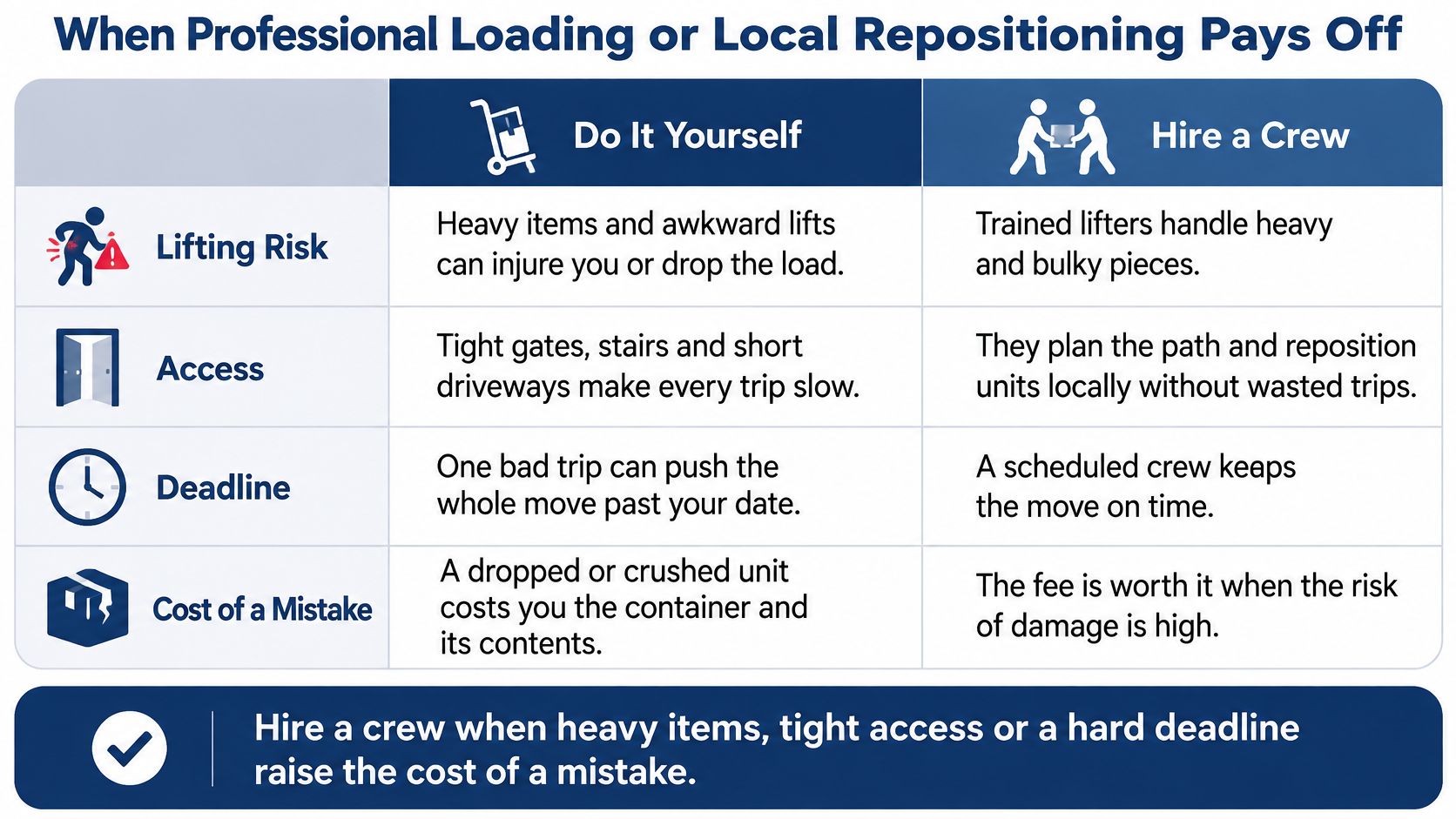
A crew becomes worthwhile when heavy items, restricted access, or a hard deadline increase the cost of a mistake. Compare the whole job, not just the lifting: removing furniture legs, protecting doorways, carrying cartons, securing the load, and clearing the property all take work.
Separate moving contents from moving the container
Local repositioning can mean transferring belongings from a driveway container into a garage, or coordinating a move between storage locations. Moving the loaded container itself is a different operation and requires the container operator's suitable transport equipment.
For a contents transfer, plan the receiving space before opening the first stack. Otherwise, you may pay for repeated handling because the garage fills before the largest furniture arrives.
Our loading and unloading service information helps define the work to discuss when arranging storage-related labor. Specify whether the job involves contents, container transport, or both so the responsibilities are clear.
One customer described packing, unpacking, and storing a four-bedroom house with study furniture in six hours. That's an individual customer account, not a promised completion time; preparation, access, load, and the work requested determine the schedule.
Decide by the difficult lift
For an apartment move, confirm stair turns, elevator availability, loading restrictions, and parking before booking labor. A hand truck won't solve a sofa that can't make the landing, and an elevator reservation won't help if the delivery vehicle has nowhere to stop.
DIY is reasonable for a small, light load with straightforward ground-level access and adequate handling equipment. Hire help for heavy furniture, multi-stage transfers, demanding stacks, or a move where damage to flooring, doorways, or belongings could outweigh the labor savings.
Base the decision on the hardest item and narrowest access point, not on how easy the first few cartons look.
Confirm Your Container Plan Before Move Day
A good container plan should survive a final check against the property, the schedule, and the actual packed inventory. Resolve anything that could prevent delivery or stop loading before the truck is dispatched.
Use this checklist to turn the plan into confirmed arrangements:
Walk the access route. Check driveway width, entrance doors, stair landings, and the route between the home and container. Confirm elevator bookings and legal truck parking, and keep that route free of loose packing materials.
Finish packing before arrival. Our customers must have boxes properly packed and labeled before the move. Mark heavy cartons clearly and close them securely so the crew can handle them as finished packages.
Arrange an authorized adult's presence. Our policy requires someone over 18 years of age at both pickup and delivery. Make sure that person knows the destination arrangements and can answer questions about the load.
Allow scheduling room. Set delivery with buffer time before your lease or move-out deadline. Confirm who to contact if access, key collection, or the receiving location changes.
Bring the specifications. Obtain the container's permitted contents weight, stacking requirements, and relevant temperature limits in writing. Include them with the inventory used for the estimate.
Bring a finished inventory
Separate items going into storage from those traveling directly to the new address. Flag unusually heavy pieces, fragile furniture, and anything you'll need to retrieve during storage.
The inventory should describe the load you'll move, not everything you owned before sorting. With that information ready, the crew, handling method, and container arrangement can be matched before move day instead of improvised beside a full driveway.
Webster Moving Co. offers professional loading, unloading, and local repositioning for storage and POD moves across Greater Austin and Central Texas. Visit Webster Moving Co. to request an estimate, and bring your finished inventory and container specifications so we can plan around the actual load.
Comments