
How Does POD Storage Work and What Does It Cost?
You've sold one place, haven't closed on the next, and the couch, dresser, and boxes need to be stored temporarily. Or you're clearing rooms for a remodel and want to avoid multiple trips across town. That's when people often ask how does POD storage work, and whether it's simpler or cheaper than a truck and a storage unit.
The short answer is that a portable container turns moving into stages you can spread out. The longer answer matters more. You're responsible for the site, the packing, the lock and the clock, even though the provider handles the driving. Once you see who does what at each stage, the costs and the limits stop being surprises.
Table of Contents
How a POD Move Works From Delivery to Pickup - The Five Stages in Order - How to Load So Nothing Shifts
Container Sizes and Placement Requirements - Can the Truck Actually Reach Your Spot
Storing Belongings Safely in Heat and Humidity - Why the Distinction Matters in Central Texas - What Should Not Go in the Container
What a POD Really Costs and Who Pays for What - The Cost Checklist to Confirm in Writing - Responsibilities That Can Change the Bill
Rental Length, Delays and Booking Steps - Book in This Order
Pros, Cons and Insurance Gaps in POD Storage - Advantages Worth Paying For - Drawbacks You Must Plan Around - Insurance and Security Checks
Choose a POD, Storage Unit or Full-Service Move - A Verdict by Situation
How a POD Move Works From Delivery to Pickup
POD storage means a company delivers a portable container to your home or business, you load it on site, and the provider later retrieves it to store it or move it to another address. It's a different model from conventional self-storage, where you transport belongings to a fixed facility yourself. Here, the container travels to you, then travels again with your things still inside.
The idea isn't new. The concept was pioneered in 1998 by PODS founder Pete Warhurst, who designed the first portable-container prototype after identifying a need to bring storage directly to customers, and by 2018 the PODS announcement on reaching nearly 4 million deliveries reported nearly 4 million deliveries, more than 900,000 long-distance moves, and over 200,000 containers in service. That scale helps explain why the process feels standardized. You're booking a piece of freight equipment, not renting an empty room.
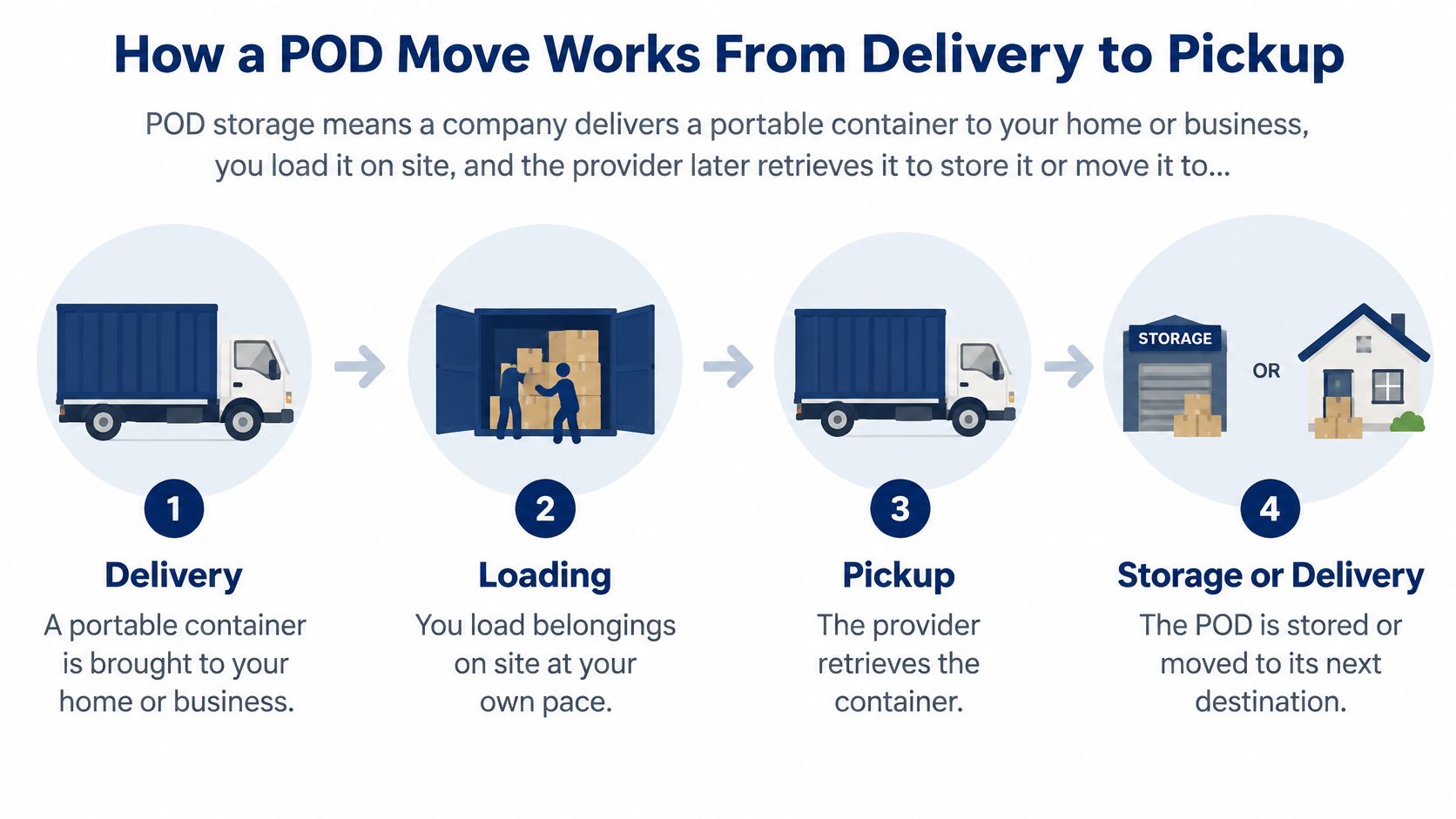
The Five Stages in Order
Think of the move as a handoff that switches back and forth between the provider and you. The provider moves the box. You control what's inside it and whether the site is ready.
Stage | What the Provider Does | What You Do |
|---|---|---|
Delivery | Drops the container on a prepared driveway or site | Clear access and confirm the placement spot |
Loading | Leaves the container in place with no stairs or ramp | Load over days or weeks; hire movers for heavy items |
Transport | Lifts the container onto a truck with hydraulic equipment | Make sure contents are secured and the door is closed |
Storage | Holds the container on site or at a secure facility | Keep a written list of contents and plan access timing |
Pickup or unloading | Retrieves the container and delivers it to the new address | Confirm placement and unload or store at the destination |
That table hides one mechanical detail worth understanding. A hydraulic lift system places the container on and off a truck and keeps it substantially level during the transfer, and by 2012 the Franchising.com report on PODS passing 2 million deliveries noted the network had exceeded 2 million deliveries and had more than 144,000 containers in service. Level handling matters because tilting shifts stacked contents and increases impact loads on furniture, cartons and appliances.
The lift protects your load only if you packed it to stay put. A level container with loose, top-heavy boxes can still arrive damaged.
How to Load So Nothing Shifts
Load the container like you're building a low, tight wall from back to front. Don't treat it like a garage where you'll sort things later.
Place dense, heavy items low and near the centre. A dresser belongs on the floor, not stacked on boxes that can crush.
Spread weight evenly across the floor. Don't put every book box and appliance on one side.
Fill gaps so nothing slides sideways. Use soft items, padding or empty cartons as void fill.
Wrap furniture in padding. Moving blankets protect corners, legs and finished wood during vibration.
Run straps to the interior tie-down points. Straps hold the final wall of items in place when the container is lifted and driven.
Say you load that dresser on the floor, drawers taped, with lighter boxes secured on top. It travels as a stable base. Put the same dresser on top of soft boxes instead, and its weight compresses them during transport, the stack leans, and the next braking or turn does the damage.
A household sequence is simple once those pieces are clear. Reserve a container, prepare the placement spot, load over days or weeks, then choose on-site storage, facility storage or transport to the new address. Professional help adds the most value at the heavy and fragile end, and at unloading, when you're tired and the house is unfamiliar.
If you want the container without doing the lifting yourself, a loading and unloading service lets movers handle the concentrated work while you keep the flexible timeline. That's often the practical middle ground. You pack at your pace, and a crew does the carrying, padding and stacking in a few focused hours.
Container Sizes and Placement Requirements
Choose size from what you own, not from a room count on a listing. Two three-bedroom homes can hold very different amounts of furniture, and a container that's too small forces a second unit or a rushed second trip. Start with an inventory, then match it to usable space.
Size | Outside Dimensions | Usable Space | Typical Fit |
|---|---|---|---|
8-foot | about 7 × 7 × 8 ft | up to about 402 cubic feet | Studio or a partial move |
12-foot | about 12 × 8 × 8 ft | about 689 cubic feet | One- or two-bedroom home |
16-foot | about 16 × 8 × 8 ft | about 827-835 cubic feet | Three-bedroom home or larger |
Those figures come from the PODS guide to portable container sizes, which lists a 16-foot unit at approximately 16 × 8 × 8 feet and roughly 827-835 cubic feet, a 12-foot unit at about 689 cubic feet, and an 8-foot unit at up to roughly 402 cubic feet of usable space. Read them as capacity for well-stacked contents, not as permission to leave half the height empty. Bulky, awkward pieces waste space fast.
Can the Truck Actually Reach Your Spot
Size is only half the decision. The container must physically reach your site and leave again while loaded.
Site rule: Measure the approach, not just the parking spot. A container that fits on the driveway still fails if the truck can't get straight enough to lift it.
Typical delivery planning requires approximately 12 feet of width, 15 feet of vertical clearance, and 40 feet of unobstructed length. Check that full path for:
Tree limbs and utility lines: Look up, not just ahead, especially where the lift will operate.
Parked vehicles: Clear your cars and ask neighbours not to block the approach on delivery day.
Steep grades: A slope can make placement unsafe or leave the container sitting unevenly.
Narrow access roads: Tight turns, gates and shared lanes can rule out a larger unit.
Walk the route with a tape measure and your phone. Photograph the placement spot, the street approach and anything overhead, then send those details to the provider before booking. That's cheaper than a failed delivery.
A steep slope or shared lane can change the container size or the delivery date, not just the driver's mood. Confirm the surface too, because the placement area needs to support a loaded container without sinking or cracking. If the site won't work, it's better to learn that during booking than with a truck idling at the curb.
Storing Belongings Safely in Heat and Humidity
A driveway POD is not climate-controlled unless the provider explicitly says it is. That's the point readers most often get wrong, and it's where Central Texas heat turns a small misunderstanding into warped wood or ruined photographs.
Three terms get blurred in sales material. Weather-resistant means the container is built to keep out rain under normal conditions. Sealed doesn't mean waterproof, and it doesn't mean conditioned. Climate control means active management of temperature and humidity, which a standard container sitting outside doesn't provide.
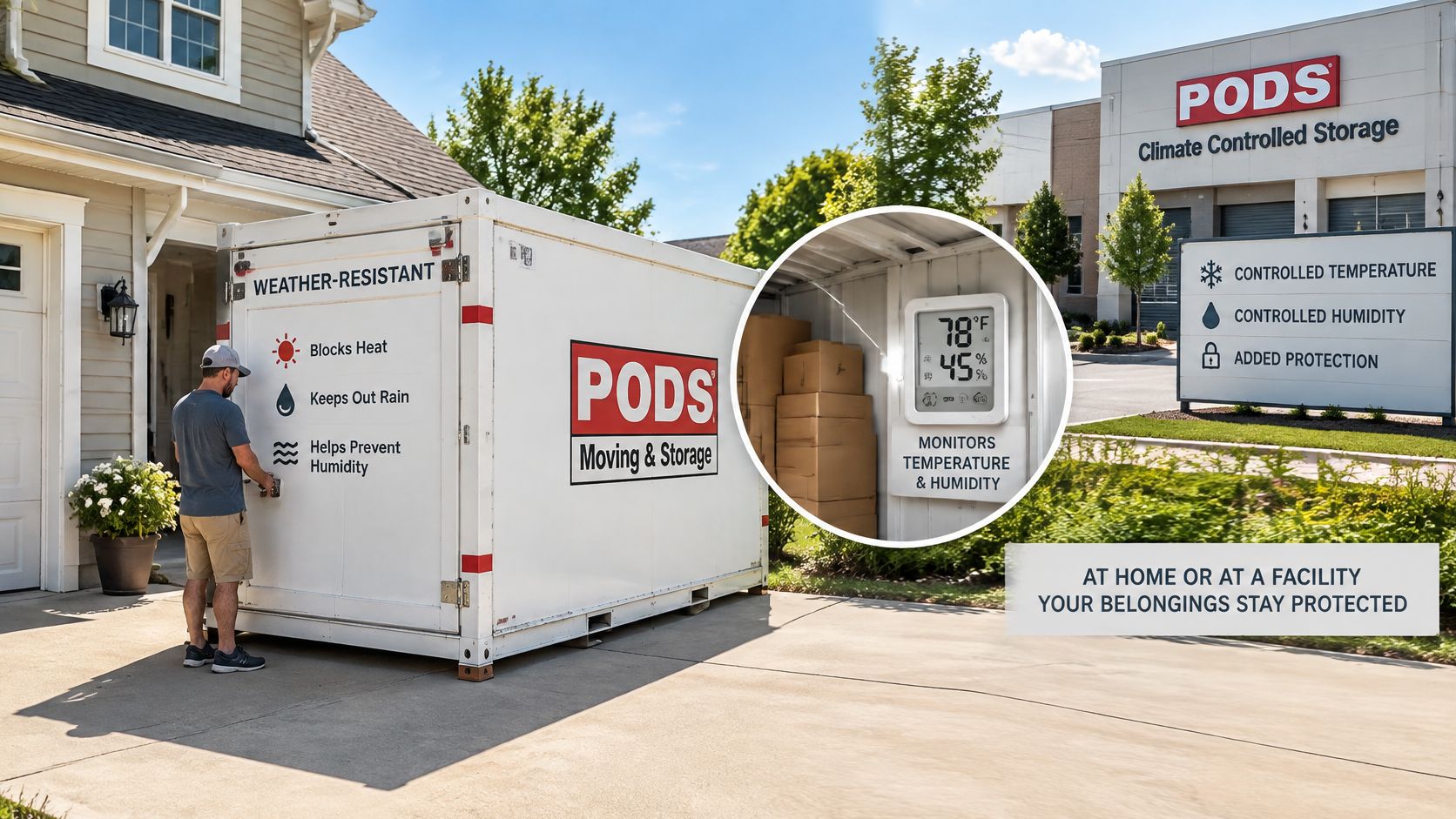
Why the Distinction Matters in Central Texas
Heat and moisture can affect wood furniture, electronics, photographs, mattresses, documents and musical instruments during extended storage. The risk grows with time, poor packing and items loaded damp. Conditioned storage is no longer a niche upgrade, since the Mordor Intelligence self-storage market report found climate-controlled units represented about 54.64% of self-storage capacity in 2025 and were forecast to grow at 6.71% annually through 2031. Read that forecast as a market signal, not a guarantee about any one facility.
You can reduce risk in a container, but you can't turn mitigation into air conditioning. These steps help for short stays:
Pack everything dry: Don't load damp towels, mops, rugs or appliances with trapped water.
Use pallets or barriers: Keep cartons off direct contact where condensation could collect.
Add desiccants: Moisture absorbers help in sealed boxes and furniture cavities.
Leave small airflow gaps: Don't pack so tightly that humid air is trapped around sensitive items.
Seal moisture-sensitive goods: Use plastic bins or sealed wrapping for items that shouldn't breathe damp air.
What Should Not Go in the Container
Keep certain things out or store them separately in a monitored indoor space. That includes irreplaceable papers, artwork, temperature-sensitive materials and valuables whose insurance requires particular conditions. Family photographs and original documents belong with you, not at the back of a hot container.
Use this decision rule. Ordinary, dry household goods for a short stay can suit a portable container. Long-duration storage or humidity-sensitive contents call for a monitored indoor unit.
Loading order matters here too. Put items you may need to retrieve near the door, keep sensitive items away from the hottest walls where possible, and don't bury anything fragile under heavy boxes that trap heat and weight. If your timeline slips from weeks into months, revisit the decision instead of assuming the original plan still fits.
What a POD Really Costs and Who Pays for What
POD pricing usually combines monthly rent with delivery, pickup and ancillary fees. Portable-container market research in the Dataintelo global portable storage container rental market report describes that model and notes North America accounted for 41.0% of global rental revenue in 2025. For you, the useful point is simpler. The monthly rate is only the starting line.
Convenience doesn't always mean lower total cost. A container reduces repeated handling because you load once and unload once. Extra months, repositioning trips, difficult access, a second container, hired labour or a failed delivery site can erase that saving.
Say your closing moves and you keep a container three months beyond the planned move, then pay for another trip to reposition it. You haven't bought one move anymore. You've bought rent, multiple transport events and possibly another round of labour, which can cost more than a single full-service move done on the original date.
The Cost Checklist to Confirm in Writing
Ask for each line before you book, not after the container is on your driveway. Written terms beat a friendly phone estimate.
Cost Component | When It Applies | What to Confirm |
|---|---|---|
Container rent | Every month the container is kept | Monthly rate and any minimum rental term |
Initial delivery | Every booking | Delivery fee and how far the container must travel |
Retrieval or transport | At pickup or when moving to another address | Whether the fee is one-way or round trip |
Extensions | When storage runs past the booked period | Extension rate and notice required |
Loading labor | Heavy, bulky or fragile items | Hourly rate or flat fee, and whether movers or you load |
Packing materials | Boxes, padding and straps | Whether materials are included or charged extra |
Access or parking fees | Tight, restricted or permit-required sites | Any site, permit or access charges that apply |
Compare that full list with a moving truck quote or a mover's estimate on the same dates and the same inventory. Apples-to-apples means the same number of months, the same labour and the same protection for your belongings. A low first-month figure doesn't help if month three is where your move happens.
Responsibilities That Can Change the Bill
You're usually responsible for packing stability, weight distribution, lock security, access timing and driveway suitability. If the container can't be placed, or the load isn't ready at pickup, the schedule and the charges can change. Confirm who supplies the lock, what happens after a missed window, and whether there's a fee to access a stored container.
Apartment and condo residents have an extra question. Can a container legally and safely sit on the property, and for how long? Get property approval first, including parking rules and any limit on days. If the answer is no, loading at a neutral facility with movers may be more reliable than hoping enforcement looks the other way.
Rental Length, Delays and Booking Steps
A container is billed monthly while it stays with you. That rental clock is the detail to respect, because every extra month, repositioning trip or extension adds cost even if nothing inside the container changes. Confirm whether notice is required before extending, and how much notice the provider needs for pickup.
A worked example makes the risk concrete. You plan one month between homes, but keep the container for three extra months and pay for a second trip to reposition it at the new address. The move you priced as a short bridge can end up costing more than hiring movers once and finishing on schedule.
Delays usually start with access, not paperwork. A blocked driveway, a failed delivery or a rescheduled pickup pushes every later step back, including cleaners, contractors and your own unloading help. Confirm the delivery window and the rule for missed appointments in writing before you commit.
Book in This Order
Measure the approach path and placement spot. Include width, length, overhead clearance and slope.
Choose the container size from your inventory. List large furniture first, then boxes.
Confirm delivery and pickup windows. Ask whether retrieval pricing is one-way or round trip.
Get the extension rate and notice period in writing. Don't assume another month costs the same as the first.
Schedule the load date with a spare day or two built in. Weather, helpers and closings rarely cooperate perfectly.
Build buffer into the calendar, not into hopeful thinking. A spare day before pickup is cheaper than an urgent change after the truck is dispatched.
A clear timeline makes your earlier cost check trustworthy. When the dates are firm, you can compare options and decide where paid labour saves time instead of adding another surprise.
Pros, Cons and Insurance Gaps in POD Storage
POD storage trades labour and control for flexibility. Whether that's a good trade depends on your site, your timeline and how much packing responsibility you want to carry.
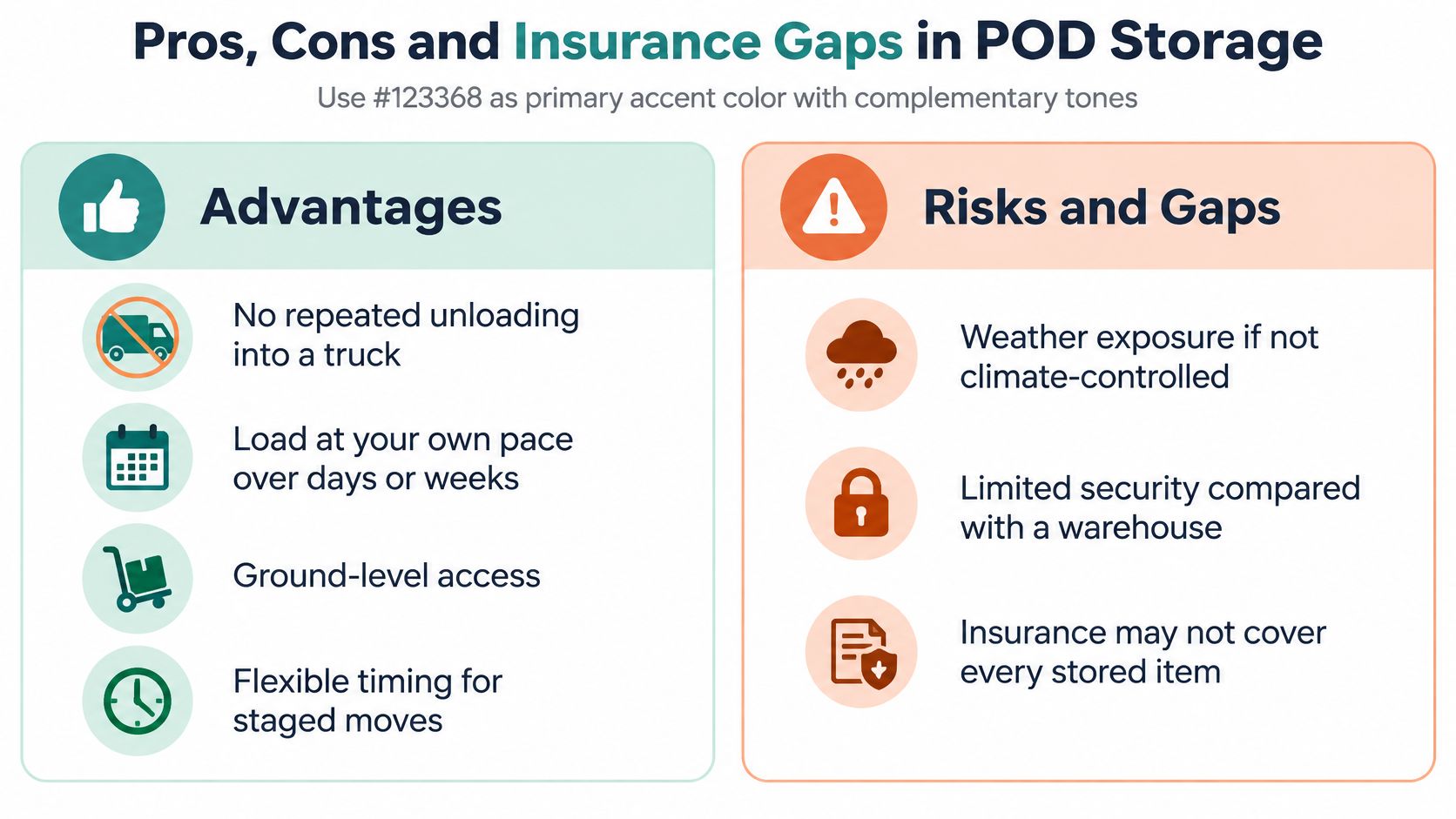
Advantages Worth Paying For
No repeated unloading into a truck: Contents stay in the container between addresses or storage.
Loading at your own pace: You can spread packing and loading over days or weeks.
Ground-level access: You walk items in without stairs or a steep ramp.
Flexible timing for staged moves: The container can bridge a gap between move-out and move-in.
Size choice up to 16 feet: Larger households can keep a move in one unit when the inventory fits.
Drawbacks You Must Plan Around
Packing stability is your job: Poor stacking and loose items are not fixed by careful driving.
The site must accept delivery: Access, slope, permits and property rules can stop the plan.
Weather and humidity exposure: A standard driveway container doesn't give you conditioned storage.
Access can be limited in storage: Getting one box back may require scheduling and possibly a fee.
Insurance and Security Checks
Don't assume your belongings are fully covered because they're locked in steel. Confirm whether your homeowners or renters policy covers property in a container off site, and read the limits for high-value items such as jewellery, instruments and electronics. Then ask the provider what valuation or protection options it offers and what those options exclude.
Photograph each item and keep a written inventory before loading. Note condition, serial numbers where relevant, and which box holds what. If you need to make a claim, that record moves the conversation from memory to evidence.
Ask about security at the same time. Find out what lock options fit the container, who can access it, and where it will be kept during facility storage. A strong lock helps on a driveway, but it doesn't replace knowing the storage location and access rules.
Closing test: If a coverage gap would matter after a loss, close it before loading. After loading, your options are fewer and more expensive.
Choose a POD, Storage Unit or Full-Service Move
The right option depends on who should do the work and how long your belongings need to sit. Put the three choices side by side before you book any of them.
Option | Who Handles Loading | How Belongings Move | Best When |
|---|---|---|---|
POD storage | You load at your site; movers are optional | The container moves; contents stay inside it | Staged moves, driveway access and flexible timing |
Traditional self-storage | You load and transport everything yourself | You haul every load to a fixed facility | Long-term storage near home, with climate-controlled units if needed |
Full-service moving | Movers pack, load and unload | Movers transport everything in their truck | Stairs, tight deadlines, or heavy and fragile pieces |
A Verdict by Situation
Choose a POD for a staged move with driveway access, flexible timing and mostly ordinary household goods. It's strongest when you want days to load and don't want to unload into storage and load again later.
Choose a self-storage unit for long-term storage or when climate control is essential. You'll do more driving and handling, but sensitive items get a more controlled indoor environment.
Choose full-service movers for stairs, tight timelines or heavy and fragile pieces. A full-service move puts packing, carrying, transport and unloading on one crew with one schedule.
Before booking, confirm three things from your own checks. First, the site can receive the container or truck. Second, the size fits a real inventory. Third, the storage conditions match the most sensitive item you're storing, not the average box.
For Greater Austin households, Webster Moving Co. is a locally owned company in Round Rock, Texas, that offers POD moves, storage moves, packing and no-obligation estimates. We use high-quality materials and proven techniques to keep belongings secure, organized and protected during packing. That matters in a container, where padding, stacking and straps do the work that a mover's hands would otherwise do during a second load.
Call 512-751-0893 for a scoped quote based on your inventory, access and dates. Bring your placement photos, your target pickup day and a short list of heavy or fragile pieces. With those details, you can decide in one conversation whether a POD, a storage unit or a full crew is the cleaner fit.
If you're planning a POD move in Greater Austin and want help loading, unloading or deciding whether a container fits your site and timeline, Webster Moving Co. offers POD and storage moves, packing support and no-obligation estimates from Round Rock. Visit Webster Moving Co. or call 512-751-0893 to scope your dates, access and inventory before you book.
Comments