
Cost to Move a House in Texas: Ranges by Move Type
The 2025 survey average for a U.S. household move is $3,020, with local moves averaging $1,489, while physically relocating a whole house is benchmarked at roughly $12-$16 per square foot before foundation and site work. Those prices describe different jobs, and neither represents every expense involved in settling into the destination.
For homeowners in Greater Austin and Central Texas, the useful question isn't how far the move goes. It's what you're moving, what the quoted contractor will do, and what must happen before the property is usable again.
Table of Contents
Two Different Jobs Behind a House Move - Identify the job before comparing prices
Household Move Costs and What Changes the Quote - What changes the transportation price - Build a household budget beyond the truck
Costs of Relocating a Whole House Structure - Why construction and destination matter
Texas Permits and Route Rules That Change the Price - Check the route before treating mileage as a price
How Movers Build a Structure Estimate - Build the total in the order work happens - Apply the calculation without double-counting
Test Any Estimate Before You Book - Check the scope before accepting the total - Confirm the finish point and payment terms
Two Different Jobs Behind a House Move
A household move means transporting the contents of a home. Movers protect furniture, load boxes and appliances, drive to the destination, and unload them. The building stays where it is.
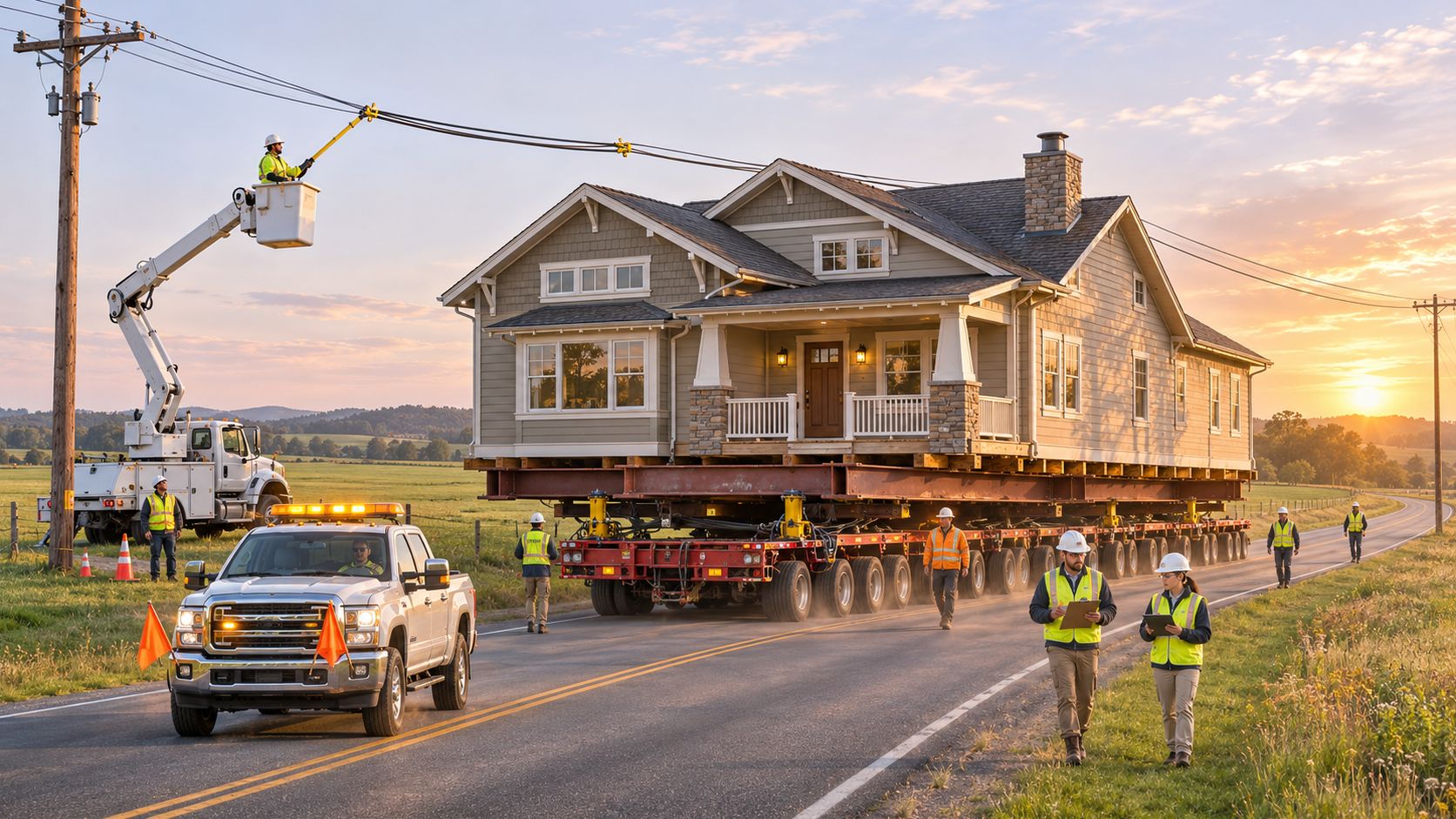
A whole-house relocation means lifting and transporting the building itself. That requires structural preparation, specialized hauling equipment, a workable route, and a destination capable of receiving the structure. Moving furniture is like moving a suitcase. Moving the house is like moving the hotel.

Identify the job before comparing prices
Use these questions to sort your project:
What will leave the property? If it's furniture, boxes, and appliances, you need a household-moving estimate. If the walls and roof are leaving, you need a structural-relocation assessment.
What kind of home is involved? Record whether it's site-built, manufactured, or historic. Bedrooms help describe a household shipment, while floor area and construction type help describe a building.
What's ready at the destination? An available address isn't the same as a prepared site. Establish whether a suitable foundation, access, and utility connections already exist.
Manufactured homes belong on the building-relocation side of this distinction, but their transport and installation estimates shouldn't be treated as interchangeable with those for site-built homes. Historic status also calls for project-specific review rather than a generic moving allowance.
Practical rule: Compare quotes only after you've confirmed that they cover the same object and the same finish point.
A quote ending with delivery to the property isn't equivalent to one ending with a building installed and services reconnected. Identify the job first, then use its matching cost category. Otherwise, even an accurate published price can lead you toward the wrong budget.
Household Move Costs and What Changes the Quote
Household move averages by move type
Move type | Average cost | Scope |
|---|---|---|
All U.S. household moves | $3,020 | Professional moving services |
Local move | $1,489 | Professional moving services |
200-500 miles | $2,703 | Professional moving services |
Over 1,700 miles | $3,945 | Professional moving services |
Four-bedroom home, over 1,700 miles | $9,228 | Professional moving services |
These national professional-moving averages come from the 2025 survey summarized by This Old House, including the overall $3,020 average, the $1,489 local average, and the distance and home-size categories shown in the table.
The overall average combines different kinds of jobs, so it isn't the best starting point for every household. A local apartment move belongs with the local category, while a large interstate shipment needs a comparison that reflects both distance and the amount being transported.
None of these figures establishes a separate Austin, Round Rock, or Central Texas rate. Use the closest category as a planning baseline, then replace it with a written estimate based on your inventory and access conditions.
What changes the transportation price
Start with the amount being moved. Furniture, packed boxes, garage contents, outdoor equipment, and stored belongings determine the loading task more accurately than bedroom count alone. A sparsely furnished home and a heavily furnished home can have the same floor plan but require different equipment and labor.
At Webster Moving Co., we determine crew size, equipment, and estimated time for larger household moves from the home's size and belongings. We handle full-house moves for 3-bedroom, 4-bedroom, and 5+ bedroom homes, but the room count starts the assessment rather than completing it.
Time and travel come next. Our costs reflect crew size, the amount being moved, how long the move takes, travel between locations, and specialty items. Loading and unloading are part of that work, so a short drive doesn't necessarily mean a short job.
Access can change the labor requirement. Stairs, elevator reservations, long hallways, restricted parking, and distant loading areas affect how belongings reach the truck. Say an apartment has several flights of stairs and a piano, while a larger house has level access beside a driveway. The apartment could require more handling effort despite having fewer rooms.
Packing changes the scope. We offer packing services when customers need additional help, while moving pads, stretch wrap, and standard furniture-protection equipment are included in our moving process. Keep packing boxes and wrapping loose household contents separate from protecting furniture for transport.
Build a household budget beyond the truck
Professional-moving averages aren't a complete relocation allowance. Your own budget should also account for:
Preparation purchases: Boxes, tape, cushioning, and other materials you buy separately.
Between-home expenses: Storage, travel, fuel, and temporary lodging.
Address-change expenses: Utility transfers, deposits, and cleaning.
Personal time: Time away from work and time spent coordinating the move.
Don't assume each expense is excluded from every quote. Instead, identify which contractor charges cover it and which costs you'll pay yourself.
For a more focused local comparison, our guide to the average cost of a local three-bedroom house move addresses that household category. When requesting an estimate, provide rooms, furniture and box inventory, floors, elevator access, parking conditions, packing needs, and specialty items rather than bedroom count alone.
Costs of Relocating a Whole House Structure
Published estimates put the physical move of a wood-frame building at $12-$16 per square foot. At that rate, moving a 2,000-square-foot house would cost $24,000-$32,000, before foundation, site, utility, or compliance work, according to Engineers Ireland's explanation of building relocation. This is a planning benchmark, not a Texas contractor's quote. Whether a specific building and route are feasible requires project-specific assessment.
Whole-structure relocation cost scopes
Cost scope | Typical range | Notes |
|---|---|---|
Manufactured single-wide home transport | $4,000-$8,000 | Transport only |
Manufactured double-wide home transport | $8,000-$15,000 | Transport only |
Manufactured triple-wide home transport | $12,000-$25,000 or more | Transport only |
Setup fees | $3,000-$4,000 | Manufactured homes |
Physical move, 2,000 sq ft wood frame | $24,000-$32,000 | Benchmark at $12-$16 per sq ft |
New foundation | $20,000-$50,000 or more | Site work |
Combined site preparation | Up to $30,000 | Clearing, leveling, utilities |
LegalClarity's manufactured-home cost estimates list transport at $4,000-$8,000 for single-wide homes, $8,000-$15,000 for double-wide homes, and $12,000-$25,000 or more for triple-wide homes. The same source estimates setup at approximately $3,000-$4,000 and combined site preparation at up to $30,000. Yahoo Lifestyle reports a new-foundation estimate of $20,000-$50,000 or more. A new foundation is a project-specific cost, not an automatic addition to every move.
Why construction and destination matter
Masonry is generally heavier and less tolerant of lifting and transport stresses than timber framing, so floor area alone cannot establish a reliable comparison between buildings.
The destination foundation is a separate design decision. Learn about slab and pier-and-beam foundation systems; the appropriate foundation for a relocated building depends on project-specific structural design.
Ask for separate scopes covering structural lifting and hauling, route engineering and traffic control, placement on a prepared foundation, and utility reconnection. Clarify who handles inspections and any code-related repairs.
Delivery does not mean the house is ready for occupancy. Foundation work, utility reconnection, and other site tasks may remain.
Treat the table as a set of cost categories, not a list to add together automatically. Site preparation, foundation construction, and installation may overlap across proposals. Each contractor should specify where its work begins and ends.
Texas Permits and Route Rules That Change the Price
Texas regulates oversized house transportation as a route-specific movement. The Texas Department of Motor Vehicles house-move guide identifies the permit pathway for houses over 20 feet wide and a highway-maintenance fee for permitted loads over 80,000 pounds, alongside oversize and overweight requirements.
Texas house move permit and route triggers
Trigger | Threshold | Cost effect |
|---|---|---|
House width | Over 20 feet | Oversize permit pathway and route review |
Gross permitted weight | Over 80,000 pounds | Highway-maintenance fee |
Manufactured house exceeding legal limits | Any load over legal limits | Department-issued permit naming dimensions, origin, destination, and owner |
Overhead utilities on route | Load clearance conflicts with lines | Temporary lifting or removal of lines |
Route and engineering study | Required to establish safe passage | Engineering review and possible escorts |
A manufactured house exceeding legal limits must move under a department-issued permit identifying its dimensions, origin, destination, and owner. Route and engineering studies may also be required to establish whether the movement can be completed safely.
Check the route before treating mileage as a price
Start with the building's transport dimensions and gross load weight, not just its occupied floor area. The hauling arrangement matters because the load must clear the route in its actual transport configuration.
Next, have the structural mover identify road geometry, bridges, overhead utilities, and other obstructions. A route that works for an ordinary moving truck doesn't establish that a house can pass through it.
Engineering review: Establishes whether the proposed movement can use the relevant roads and structures safely.
Permit administration and surveying: Turn the proposed journey into an authorized, workable movement.
Escorts and traffic management: Address the conditions attached to moving the load along the approved route.
Utility coordination: Covers arrangements to lift or temporarily remove conflicting overhead lines.
Travel scheduling: Accounts for restrictions that can affect when the movement occurs.
The distinction matters when comparing nearby properties. A shorter route with difficult clearances may require more coordination than a longer, unobstructed route.
Don't treat every listed requirement as inevitable. Require the structural mover to distinguish confirmed requirements, allowances awaiting review, and items not included. For a Central Texas project, the estimate should record width, height, length, gross weight, origin, and destination so the quoted scope can be checked against the proposed movement.
How Movers Build a Structure Estimate
A structural-relocation budget should explain how the contractor gets from a building assessment to a completed project. A total without that explanation doesn't tell you whether the house will merely arrive or be installed and ready for the next stage of work.
Use a spreadsheet with columns for scope, contractor, quoted amount, included work, exclusions, and approval status. Keep estimates awaiting inspection separate from firm written prices.
Build the total in the order work happens
Begin with the structural mover's lifting and transport proposal. For a manufactured home, identify transport and installation separately rather than assuming that the hauling price includes setup.
Then establish what the destination requires. A foundation contractor's proposal should identify excavation, foundation construction, and the interface with the relocated building. Site-work proposals should distinguish clearing, grading, drainage, and utility-related excavation.
A useful calculation is:
Project budget = lifting and transport + route work + destination construction + installation and reconnection + compliance work + unresolved-cost reserve.
This isn't a published pricing formula. It's a way to make omissions visible without pretending that a national benchmark is a local bid.
Apply the calculation without double-counting
Say you're relocating a wood-frame house to an undeveloped property. The mover supplies a hauling proposal, the foundation contractor supplies a construction proposal, and the site contractor supplies a clearing and grading proposal.
Before adding them, compare their boundaries:
Foundation interface: Does placement on the completed foundation belong to the mover or installation contractor?
Excavation: Does the foundation price already include work appearing in the site contractor's proposal?
Utilities: Who covers trenching, who makes connections, and who arranges inspections?
Route work: Are escorts and utility coordination included, estimated, or excluded?
Only add non-overlapping work. A broad site-preparation allowance shouldn't be stacked on top of separately priced work that it already contains.
The meaningful comparison is therefore completed scope against completed scope, not one mover's transportation price against another contractor's broader project total. A lower bid may still be the better choice, but only after differences in responsibilities are resolved.
Keep uncertain items visible rather than hiding them inside a single contingency line. Assign each open issue to a responsible party and record what must happen before it can be priced. Household moves use a different estimating process based on inventory, crew requirements, travel, access, and requested services, so a building-relocation calculation shouldn't be applied to a shipment of belongings.
Test Any Estimate Before You Book
Consumer reporting published by Yahoo Lifestyle found that 78% of Americans underestimated moving costs, commonly overlooking miscellaneous purchases, fuel and travel, cleaning, and utility setup; the same coverage includes a 2026 foundation estimate of $20,000-$50,000 or more.
These are different kinds of evidence: a consumer finding about underestimated budgets and a construction-cost allowance. Neither establishes the final cost of your Central Texas project. Both show why transportation alone is an incomplete budgeting target.
Check the scope before accepting the total
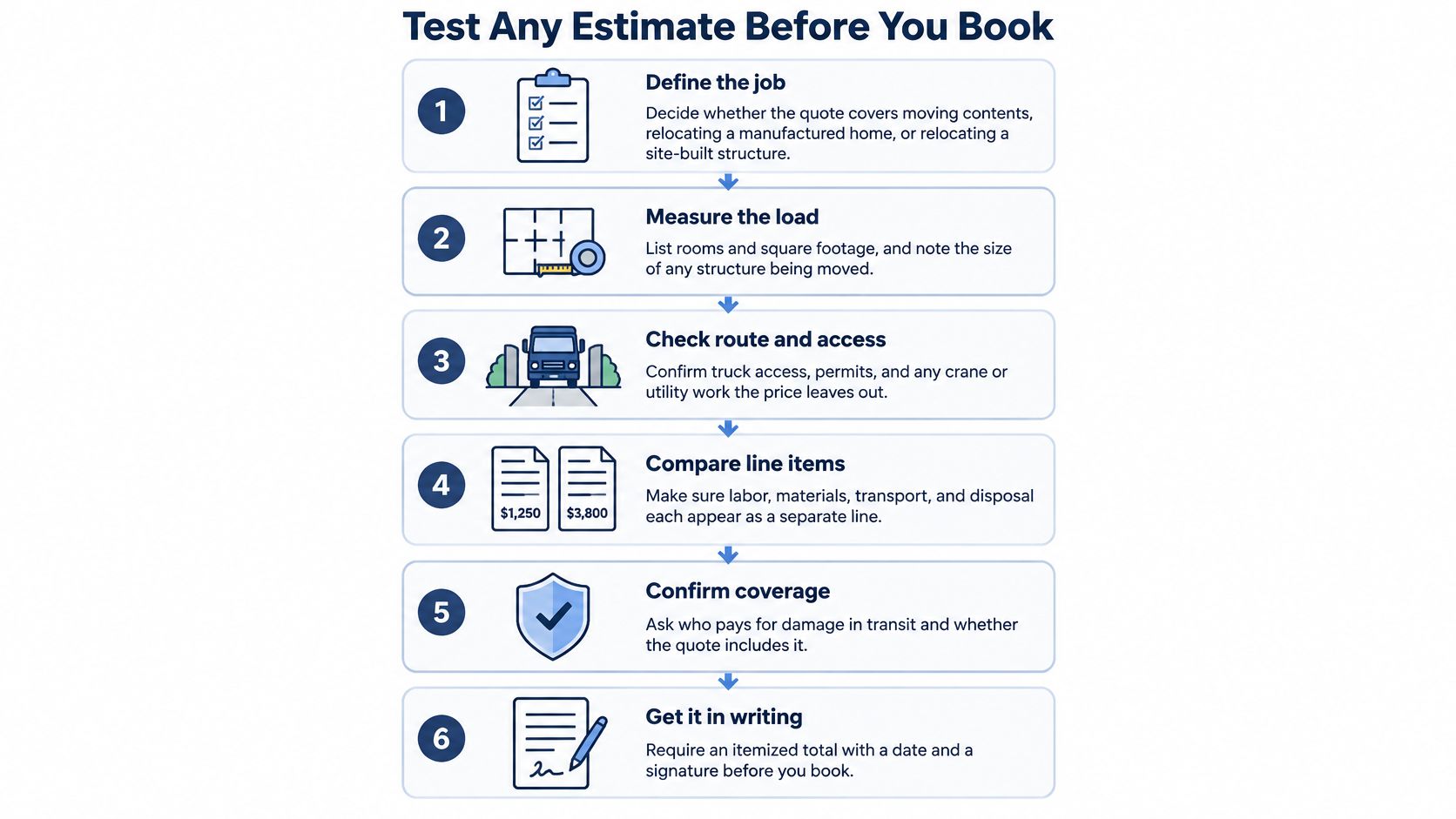
Define the job. State whether you're moving household contents, relocating a manufactured home, or relocating a site-built structure. For a building move, confirm that the proposed contractor provides structural relocation. A household-moving quote isn't a quote to transport the building.
Measure the load. For belongings, prepare a room-by-room inventory, including storage areas and outdoor items. For structures, obtain the dimensions and load information the specialist needs rather than substituting bedroom count.
Describe access accurately. Give us the stairs, elevator arrangements, loading areas, gate codes, and parking restrictions affecting your household move. Include destination access as well as pickup conditions. Photos can help explain an awkward entrance or loading position.
Compare written line items. We provide an upfront estimate based on the move details. Confirm which requested services it includes, such as packing, furniture disassembly, protection, and unpacking. Our moving truck quote guide provides a focused starting point for reviewing the transportation scope.
Review exclusions and coverage. For a structural project, identify who pays for permits, engineering, insurance, foundation work, reconnection, route preparation, and site restoration. Resolve damage responsibility and any utility-line work, tree trimming, or police escorts before accepting the relevant contract.
Reserve for unresolved work. Keep funds available for items that can't yet be firmly priced. Connect the reserve to identified uncertainties rather than choosing an unsupported percentage, and establish how additional work will be approved in writing.
Confirm the finish point and payment terms
For a household move, specify whether completion means unloading, furniture reassembly, unpacking, or another agreed endpoint. For a structural relocation, require the contracts to identify the handoffs between hauling, foundation placement, service reconnection, and inspection.
Our payment is due upon completion of the move unless otherwise agreed in writing. We accept major credit cards, checks, and electronic payments, so payment arrangements can be settled alongside the written scope rather than left until moving day.
The strongest final check is simple: Can you point to what each dollar covers, and to what the total leaves out?
Webster Moving Co. offers free, no-obligation household-moving quotes through a short online form, with estimates based on the details of your move. Visit Webster Moving Co. with your bedroom count, belongings, access conditions, specialty items, and packing needs so we can scope the crew, equipment, and work involved. If you're moving the building itself, confirm structural-relocation capability before treating any household-moving estimate as your project budget.
Comments