
How to Move Out of State: A Practical Plan for 2026
Three quotes sit in your inbox and they don't agree on a single line. One is a per-hour rate, one is a flat number with a fuel surcharge buried at the bottom, and one arrived as a phone call with nothing in writing. Meanwhile your lease ends on the last Saturday of the month, the new job starts eleven days later, and someone in the house keeps asking which company you're supposed to trust.
That's what an out-of-state move looks like from the inside. The moves that go well aren't the ones with the biggest truck or the cheapest quote. They're the ones where three workstreams stay on separate calendars: the logistics of getting belongings from one address to another, the legal identity change that happens in the destination state, and the household money that has to cover all of it.
A late step in any one of them breaks the other two. A mover booked before you've measured the stairwell turns into a rescheduled pickup. A driver license appointment missed because you were still unpacking turns into a second trip. A health plan that lapses for three weeks costs more than the difference between two quotes. Here's the order that keeps all three moving.
Table of Contents
An Eight-Week Timeline for Your Interstate Move
Window | Core tasks | Why it matters |
|---|---|---|
8 weeks out | Confirm move-out date, measure access points, book the mover | Peak weekends and month-end dates fill first |
6 weeks out | Inventory and photograph high-value items; sell or donate | Reduces volume before final quotes |
4 weeks out | USPS change of address; schedule utilities at destination | Mail and services keep following you if skipped |
2 weeks out | Pack documents, medications and valuables separately | Keeps essentials with you, not on the truck |
1 week out | Confirm crew arrival window, parking and access plan | Prevents delays on moving day |
Moving day | Adult over 18 present; check inventory at delivery | Lets you record exceptions immediately |
First 30 days | Driver license, vehicle registration, voter registration | Deadlines vary by state |
Copy that table into your calendar and put a real date against every row before you request a single quote. Eight weeks is the minimum honest runway for a cross-state move, and it's the window where the expensive mistakes get avoided.
Eight weeks out is about access, not boxes. Walk both addresses with a tape measure: doorways, the turn at the top of the stairs, the inside dimensions of the elevator, the height of the garage opening, and how far a truck can legally park from the door. Apartment communities often restrict loading zones to certain hours, and gate codes and parking passes take a day or two to arrange. Then book. Weekends, the last week of the month and the summer season are the slots that disappear first, which is why we recommend booking as early as possible instead of waiting for a final box count.
Book before you know everything. A crew slot held six weeks out can always be adjusted upward. A crew slot you try to create six days out is a different, more expensive problem.
Six weeks out is for volume. Photograph and inventory high-value items with serial numbers, then sell or donate anything that would cost more to ship than to replace. Every cubic foot you cut now comes off the quote later. If you're packing yourself, start with the rooms you use least so the last week isn't a sprint through the kitchen.
Four weeks out is paperwork and utilities. File the change of address directly with USPS, because USAGov's address-change guidance notes that third-party services may charge $40 or more for something USPS does for $1.10. Schedule utility start dates for the day after you arrive, and write down the destination state's license and registration deadlines now, while you still have time to read them.
Where the plan usually slips
The two-week window is where people lose their essential bag, so pack it early and treat it as luggage. At one week out, confirm the arrival window, the permits and who will be on site. On moving day, an adult needs to be present at both pickup and delivery, and the inventory should be checked against the paperwork before the crew leaves. The first 30 days are where the license, registration and voter steps age past their deadlines.
What a Long-Distance Move Typically Costs
A 2025 Angi survey of moving costs put the average U.S. long-distance move at $4,401, compared with $1,692 for a local move. That is about 2.6 times the price, even when the moves look similar from the curb. Use the figures as a starting point, not a quote for your household.
A written estimate should make the main cost drivers clear. Crew size depends on the amount being moved and whether items need multiple movers. Volume determines how much trailer space your belongings take up. Job hours vary with access: a ground-floor house with a wide driveway loads noticeably faster than a third-floor walk-up with a shared lot. Distance and specialty items account for travel and any extra handling for items such as pianos, safes and large appliances. Webster Moving Co. bases moving costs on crew size, the amount being moved, time, travel between locations and specialty items.
DIY may cost less for a small load when your dates are flexible. A Move.org survey of 2,500 Americans in 2025 found that 62% completed a DIY move and 38% used a professional mover. Compare the entire budget, not just truck rental: fuel, tolls, lodging, packing supplies, meals and unpaid workdays can add up. Also account for responsibility if something breaks. A professional mover's valuation terms apply to a mover-handled claim; if a friend drops your table, you bear that loss.
Before comparing estimates, ask each company when payment is due and which payment methods it accepts. Webster Moving Co. requires payment upon completion unless a different arrangement is agreed in writing, and accepts major credit cards, checks and electronic payments. Ask every mover for its terms before booking, so you can compare the full cost and payment conditions.
The budget template
Fill out each line before requesting quotes. This helps compare the full cost of the move, rather than transport estimates alone.
Budget line | What drives the cost | How to price it |
|---|---|---|
Transport | Crew size, belongings volume, job length, distance | Written estimate from each mover |
Packing materials | Box count, specialty crating | Supply receipts for a DIY move |
Storage or POD | Months held, unit size | Storage quote |
Temporary housing | Nights needed around delivery | Lodging quotes |
Travel | Distance between addresses, lost workdays | Fuel or airfare estimate |
Pet transport | Species, route, required paperwork | Carrier quote |
Destination deposits | Security deposit, first month rent | Lease terms |
Contingency buffer | Delays, damage, unplanned costs | Set percentage of total |
For a more detailed breakdown of moving expenses, review this guide to long-distance moving costs before setting your spending limit.
Verify a Licensed Interstate Mover Before You Sign
Interstate household moves have been federally regulated for decades: the Department of Transportation took authority over interstate household-goods transportation in 1995, and the Federal Motor Carrier Safety Administration has enforced consumer-protection rules since 1999, as FMCSA's background on household-goods oversight sets out. A company that can't show federal registration shouldn't be trusted with your furniture.
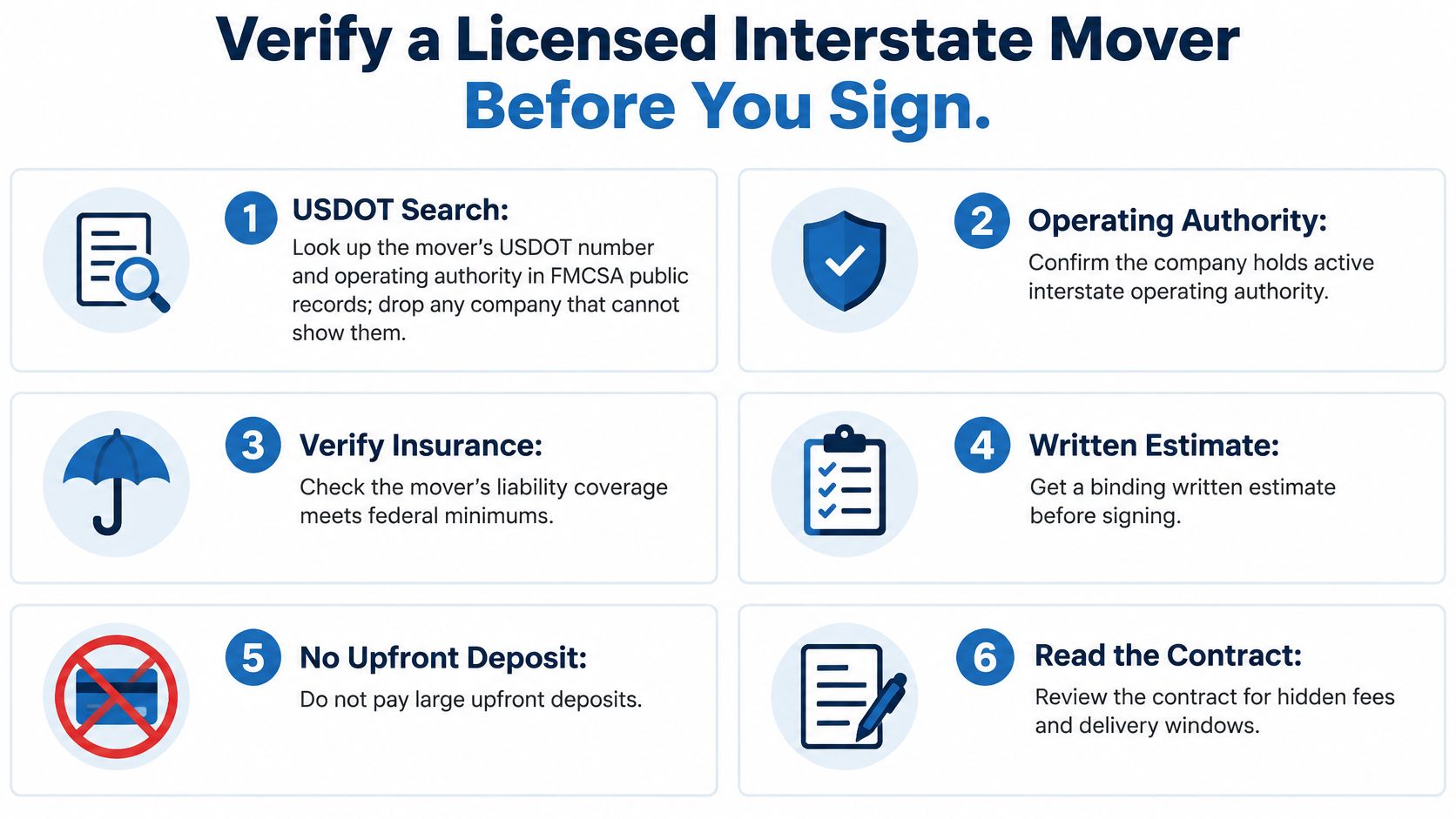
Run the same six checks on every company and score them the same way.
Look up the USDOT number. Search the mover's number and operating authority in FMCSA public records. If the number doesn't exist or belongs to another company, the conversation is over.
Ask for the insurance certificate. Confirm coverage for the states the truck will cross, and read the certificate rather than accepting a verbal assurance.
Request a written estimate built on one inventory. Give every mover the same room-by-room list so the numbers are comparable. A quote built on a different list tells you nothing.
Compare valuation, arbitration and dispute terms. Ask what the base coverage pays per pound and what the upgrade costs, then decide which you need.
Ask how damage gets documented. You want an answer that involves photos at pickup, a numbered inventory and a written exception report at delivery.
Confirm payment terms in writing. Method, timing and who is authorized to collect.
Walk away when the quote is only a number. A per-cubic-foot price given over the phone, with nothing in writing and no authority lookup, is a sales script rather than an estimate.
We're licensed and insured as a Texas moving company, and we give free, no-obligation quotes through a short form on our website. If you're comparing long-distance movers in Austin, hold every company to the same six checks and the same inventory list.
Pack, Document and Protect Essentials Before Moving Day
Packing is the stage where documents do the work. Photos, serial numbers and a numbered inventory are what turn a damage argument into a settled claim, and they take an afternoon to create.
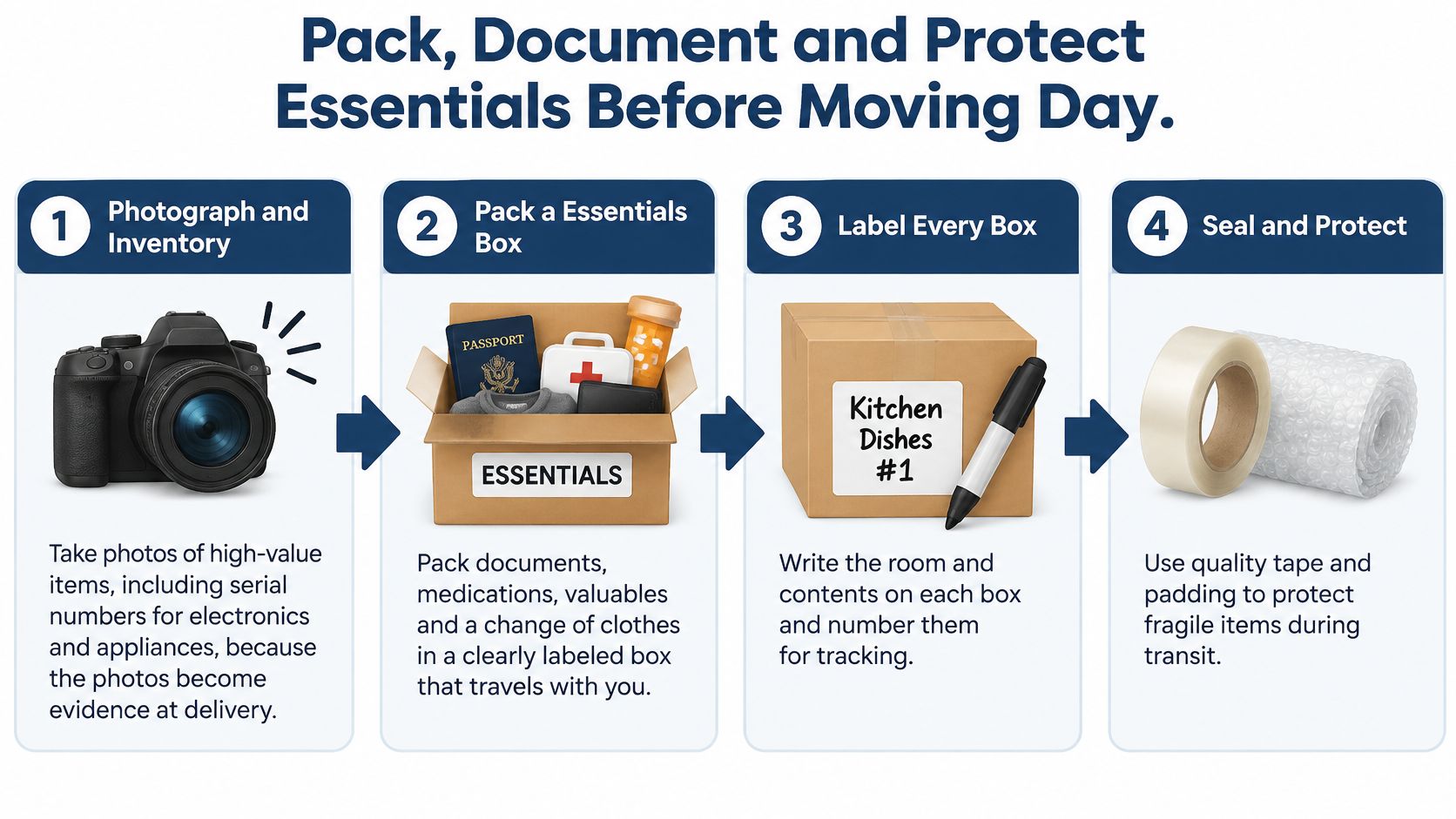
Photograph and inventory the high-value items. Electronics, appliances, art, instruments and anything with a serial number get a photo of the item and a photo of the label. This is evidence at delivery, not sentimentality.
Build the open-first kit. Documents, medications, valuables, chargers, a change of clothes and bedding for the first night. It travels with you, because a truck that arrives a day late shouldn't take your prescriptions with it.
Label every box by room and contents, then number it. Unlabeled boxes make the delivery check impossible, and the delivery check is your only clean chance to record a missing item.
Clear the path before the crew arrives. Driveways, entrances and elevators need to be accessible, boxes need to be packed and labeled before the move, and an adult over 18 needs to be present at both pickup and delivery. Crews lose more time to blocked loading areas than to heavy furniture.
Keep one file, digital and paper. The estimate, the bill of lading, the inventory, payment records and condition photos belong in the same folder, scanned the same day.
Reconcile at delivery before the crew leaves. Walk the inventory against the signed bill of lading, open the boxes marked fragile, and write exceptions down while the truck is still in the driveway. If damage appears later, note it on the paperwork, photograph it from several angles, and keep the original packaging for the claim.
The test of a good moving day: you end it holding a signed, reconciled inventory and a folder that could settle a dispute without a single phone call.
Make the Move Official in Your New State
The most common mistake in this stage is assuming that a mailing address change completes a legal relocation. It doesn't. USPS forwarding keeps your mail coming, and that's all it does. The records that define where you live have to be updated one agency at a time.
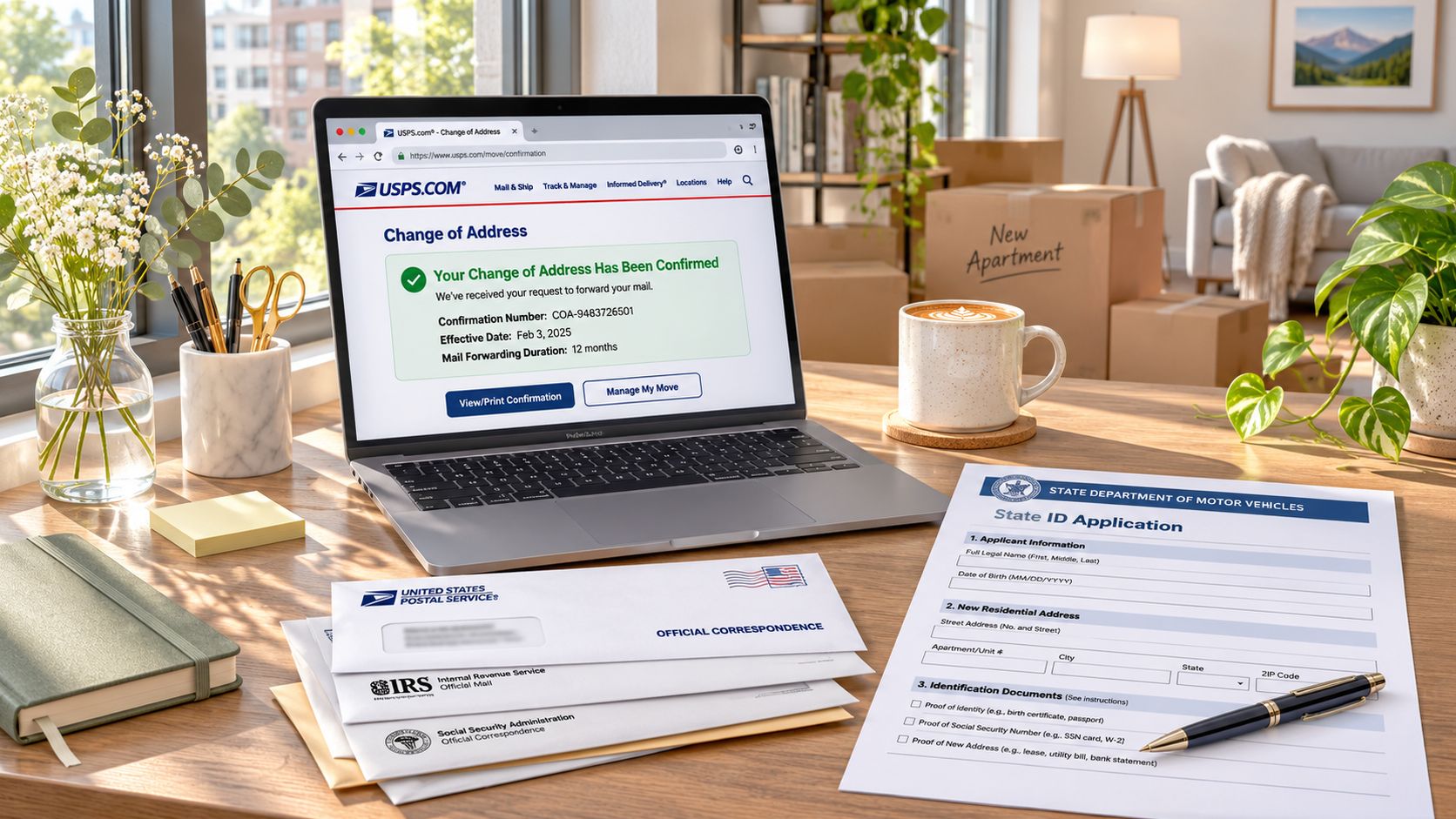
USAGov's guidance on state and local taxes is blunt about this: forwarding has to be supplemented by direct updates to tax, Social Security, veterans, immigration, licensing, registration and voter records. For voting, you register in the new state and check its deadline, because the rules differ.
The order that saves you a second trip
Start with the driver license. Most destination states set a deadline measured from the day you establish residency, and some require a written test or proof of address you won't have until the lease starts. Book the appointment as soon as you have a document with the new address on it.
Vehicle registration and insurance come next, and they're linked. Confirm the destination state's registration rules and tell your insurer the garaging address before the car crosses the line, because a claim filed at an address the policy doesn't list is a conversation you don't want.
Voter registration takes ten minutes and has a hard cutoff before the next election. The remaining records, tax, Social Security, veterans, immigration and licensing, each get updated directly with the agency that holds them.
Then there's the cost side, which belongs in your decision, not your first week. State and local governments may impose income, personal-property, real-estate and sales taxes, and personal-property tax can apply to vehicles, boats, recreational vehicles or business machinery. Run those numbers before you choose a destination, not after.
Update | Where to file |
|---|---|
USPS change of address | USPS |
Driver license | Destination state motor vehicle agency |
Vehicle registration and insurance | Destination state |
Voter registration | Destination state election office |
Tax, Social Security, veterans, immigration and licensing records | Each agency directly |
Local taxes on vehicles, boats or business equipment | Destination county assessor |
Keep Health Coverage Active Through the Move
Updating your address does not move your health plan. Marketplace plans and provider networks are state-specific, and an interstate move generally means starting a new application and enrolling in a plan in the destination state. Healthcare.gov's guidance for movers is to report the move immediately, to avoid a coverage gap or paying for coverage that doesn't apply where you now live.
That single fact reorders the whole project for anyone with ongoing prescriptions, a specialist, or a child mid-treatment. Work in this sequence.
Fix the move date. Everything downstream depends on it.
Check whether the move triggers a Special Enrollment Period. Moving across state lines or into a new coverage area is the event that opens the window, and the window has an end date.
Verify the network, not just the plan name. Confirm that your doctors, the nearest hospital and the pharmacy you'll use are in the destination network.
Keep proof of the move. A lease, a utility bill or a mortgage document establishes the date if you're asked for it.
Schedule refills and checkups before the old plan ends. A 90-day fill on a maintenance medication buys you time to find a new prescriber.
Set the coverage start date first, then book the movers around it. Coverage gaps cause more expensive problems than a slightly less convenient pickup date.
There's a distinction worth making for anyone in Central Texas. Moving from Travis County to Williamson County is a local move with a new address. Leaving Texas entirely is a different event, with different enrollment and network consequences, and the plan you keep versus the plan you rebuild depends on which one you're doing.
A cheaper destination can raise your short-term risk if coverage, doctors or medications aren't available the week you arrive. Lower rent doesn't automatically mean a lower total cost.
Decide Whether to Move Now or Phase It Out
The housing market has been answering the "should I move" question for millions of households, and the answer has been "not yet." The Harvard Joint Center for Housing Studies reports that the U.S. residential mobility rate fell to a record-low 11.2% in 2024, driven largely by homeowners unwilling to give up below-market mortgage rates, with interstate moves declining too and slowing population gains in states such as Texas and Florida.
The national numbers show the same hesitation. The Census Bureau's American Community Survey puts interstate movement at 2.08% of people in the United States in 2025, down from 2.13% in 2024. Yet intent is rising: Redfin's fourth-quarter 2025 migration report found 18.8% of home-search users looking to move to a different part of the country, up from 17.9% a year earlier.
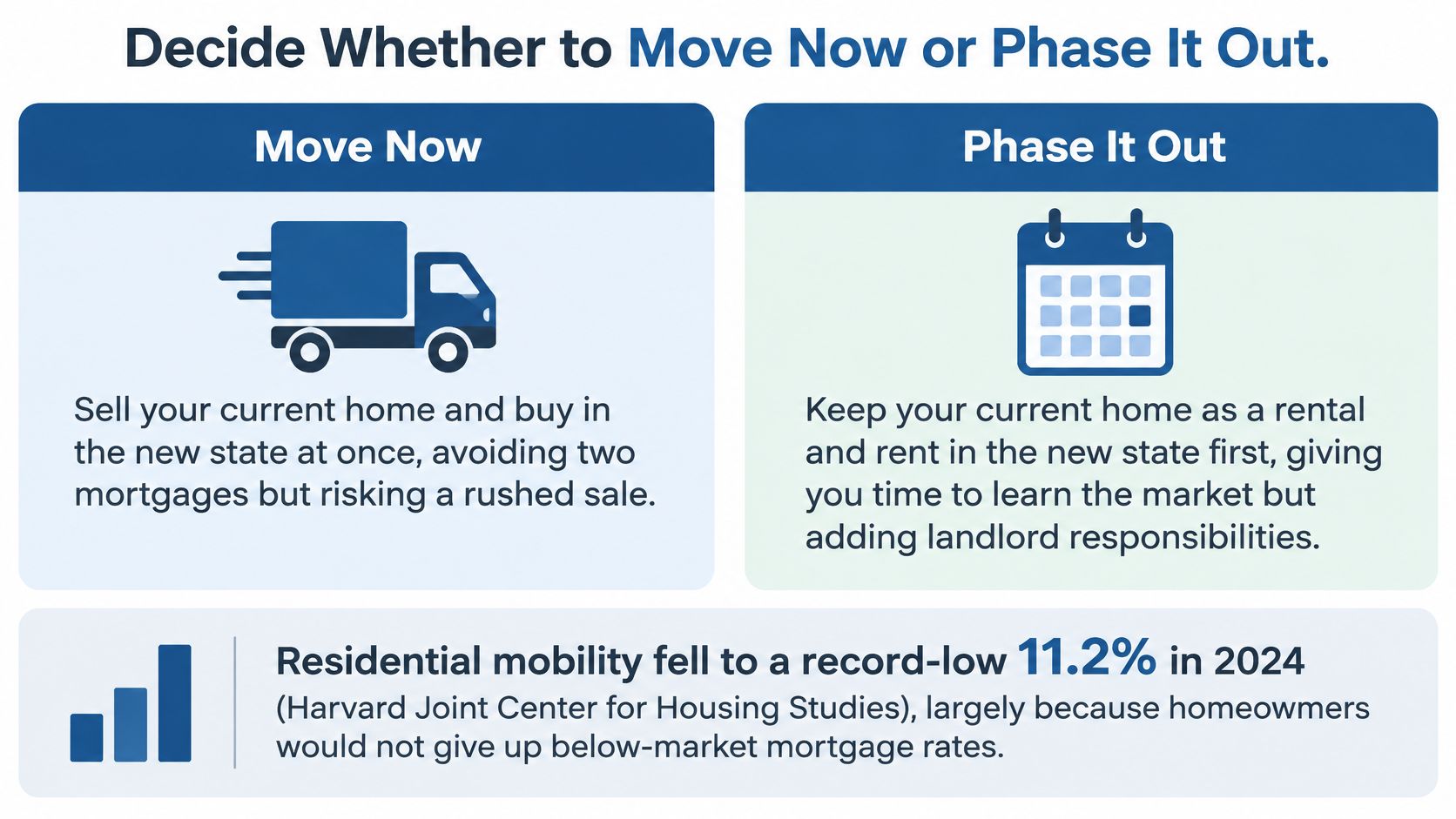
So the question isn't "how do I move" but "when does moving make financial sense if my current mortgage is unusually cheap." Compare the full transition cost, not the destination home price: selling costs, the replacement mortgage rate, property taxes, insurance, commuting, temporary housing, storage and any change in income. Then test the destination itself. IRS migration data covers filing years 1991 through 2023 and breaks movement down by state and county, which tells you whether a place has historically gained or lost residents and how its counties behave. Keep in mind those records count reported address changes on tax returns, not every relocation.
Path | Best when | Main cost | Main risk |
|---|---|---|---|
Move now | Mortgage rate is not below market and timing is fixed | Full transition cost paid up front | Higher monthly costs if the new mortgage rate is worse |
Phase the move | Current home needs time to sell or no destination rental is yet found | Storage or POD plus temporary housing | Paying two housing costs at once |
Stay | Below-market mortgage and short commute favor the current home | Ongoing cost of current home | Missed destination opportunity |
The rule I'd apply: move now when the transition cost is recovered within the years you plan to stay. Phase it when you need time to sell, or when no rental has surfaced, and use storage or a POD to bridge the gap. Stay when the current mortgage and commute outweigh what the destination offers. A phased move is also a reasonable answer for a household that can't move in one day, and short-notice moves are often possible depending on crew availability when the decision comes together late.
Webster Moving Co. handles long-distance moves to and from Central Texas with licensed, insured crews, door-to-door transport and coordinated scheduling, so the timeline, the paperwork and the budget sit on one plan instead of three. We're based in Round Rock and work with homeowners, renters and families across Greater Austin, including packing, storage and POD moves and specialty items. Get a free, no-obligation quote at Webster Moving Co. and we'll build the crew and schedule around your dates.
Comments