
Long Distance Movers Austin: A Practical Buyer's Guide
You're looking at three quotes for a move out of Austin, and none of them agree on price, delivery, or what happens if a lamp breaks. One company wants a deposit this week. The closing, or the new lease, still might slip. That gap is where the bill grows, not on the mileage.
Long distance movers in Austin sell the truck and the crew. The decision that sets your risk is the estimate type and the valuation you accept before anyone loads a box. A low number that hides stairs, a shuttle, or thin coverage isn't a bargain. It's an open invoice.
I would treat the paperwork as the job and the truck as the last step. Lock the windows, the liability choice, and a backup if the new place isn't ready. Then compare crews.
Table of Contents
How Long a Long Distance Move From Austin Takes - Why the clock isn't the miles - Three dates to pin down
Full Value vs Released Value Protection Explained - One television, two outcomes
How to Compare Long Distance Movers on Real Criteria - How to test a claim
Reading Estimates and Booking a Comparable Quote - A quote sequence that stays comparable
How Long a Long Distance Move From Austin Takes
These windows are typical, not guaranteed. A clean load can beat them. A late elevator reservation or a full truck can push them out.
Destination | Drive time | Typical transit window |
|---|---|---|
San Antonio | about 1.25 hours | same day to 1 day |
Houston | about 2.5 to 3 hours | 1 day |
Dallas | about 3 hours | 1 day |
Oklahoma City | about 8 hours | 1-2 days |
Denver | about 15 hours | 2-4 days |
Atlanta | about 15 to 16 hours | 2-4 days |
Chicago | about 16 hours | 2-4 days |
Los Angeles | about 20 hours | 4-7 days |
New York | about 25 hours | 4-7 days |
San Antonio, Houston, and Dallas can finish inside a day when the building cooperates. Denver, Atlanta, and Chicago usually need two to four days on the road. Los Angeles and New York often land in a four-to-seven-day spread. Treat every cell as a planning band, not a promise printed on the truck.
Why the clock isn't the miles
Federal hours-of-service rules set the ceiling, not the GPS estimate. Interstate commercial drivers may drive no more than 11 hours after 10 consecutive hours off duty, and they may not drive beyond the 14th consecutive on-duty hour. That 14-hour window keeps running while the driver does non-driving work. They also take a 30-minute break after eight cumulative hours of driving. Weekly on-duty limits generally cap work at 60 or 70 hours over seven or eight consecutive days.
A delayed elevator reservation, a long packing session, or a hard stair carry eats that duty window even if the truck barely moves. Split the job into an origin loading window, a line-haul date, and a destination unloading window, and confirm parking and building access before load day. Reading the drive time as the whole schedule is how people end up paying for a second delivery attempt.
Intrastate Texas moves run on a shorter clock. We handle those jobs ourselves, including relocations from Leander to Dallas, Houston, San Antonio, and other destinations throughout Texas. The same loading, line-haul, and unloading windows still apply; the line-haul leg is just measured in hours instead of days.
Three dates to pin down
Ask these before you accept a quote:
Origin loading window. When does the crew start, and what happens if the elevator is late or the truck can't stage near the door?
Line-haul date. Which day does the truck leave Austin?
Destination unloading window. Is delivery one day or a spread of days?
The delivery spread is the one people underestimate. If the new address or closing date is still open, a wide window decides whether your goods sit on the truck, go into storage, or get unloaded twice at your expense. The written estimate should name every service and charge tied to that window, and both sides should sign the itemized inventory after the truck is loaded.
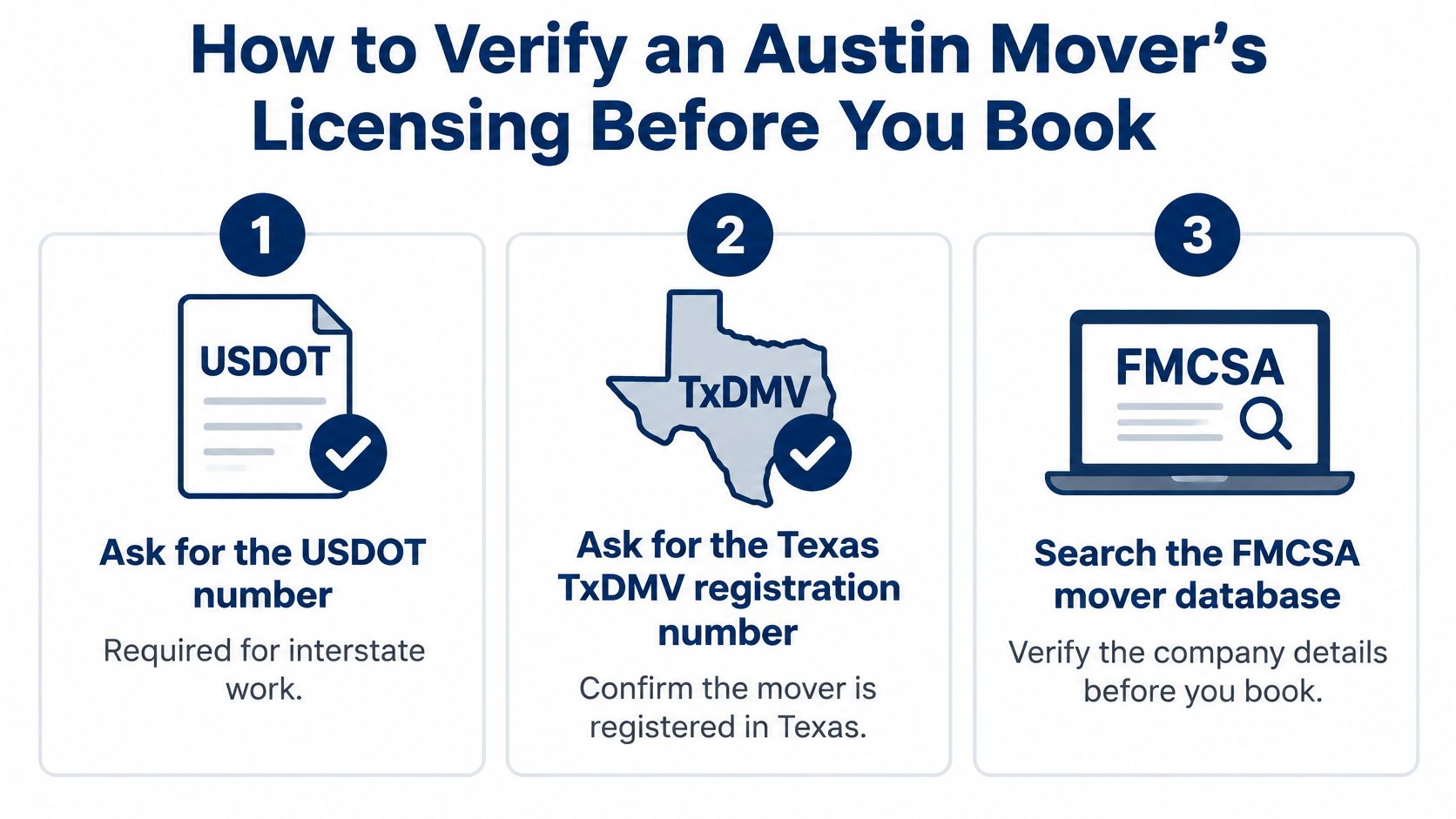
How to Verify an Austin Mover's Licensing Before You Book
A long-distance quote with no license numbers is a guess. Check the company before you compare prices.
We're based in Round Rock, and we publish TxDMV No. 010210868C and USDOT 4470107. We're licensed and insured as a Texas moving company. Use that same paper trail on any carrier you consider, including us.
Ask for the USDOT number, which interstate work requires, and for the Texas TxDMV registration number. A long-distance quote with neither number is the red flag, because you can't confirm who would haul the load.
Search the mover in the FMCSA mover database and read the complaint history, not just the authorization line. A name that doesn't match the quote, or a record you can't find, means you stop.
Confirm the Texas registration with TxDMV and match the legal name on the quote to the registered name. A "doing business as" that doesn't appear on the registration is a reason to walk away.
Ask for the FMCSA consumer handbook and the Ready to Move brochure before any interstate transport. A mover that won't hand them over is telling you the federal rules won't be in the file.
Request written proof of insurance and a plain list of what it covers, including cargo and liability. A verbal "we're fully insured" with nothing you can file is not coverage.
Confirm the local office is a real address you can visit. We keep an office at 309 W Main St, Suite 118, Round Rock, TX 78664. A mailbox with no staff, or an address that doesn't open, doesn't count.
Save the database printout, the registration match, the insurance letter, and the signed quote in one folder. If a charge or a claim comes up later, that packet is what you argue from. Packing choices change weight and access time, so it helps to read how packers and movers scope a job before you lock a date.
Practical rule: If the legal name, the USDOT number, and the name on the estimate don't match, don't send a deposit.
What to Expect on Moving Day
Say you're leaving a North Austin apartment for a house outside the metro. The useful version of moving day is five checks, not a single "they'll be there sometime."
The survey comes first. The mover walks the inventory, stairs, elevator, and parking, then states the estimate type in writing. If the walkthrough skips a long carry or a reserved dock, the number you signed isn't the number you'll see.
Loading has a start time. The crew should begin inside the origin window you agreed to. They check items as they go, and both of you sign the inventory after the last piece is on the truck. Don't sign a blank list because someone is in a hurry.
Line-haul is not a straight drive. The truck moves inside the driver's legal duty limits, so a slow morning at your building can push the departure even when the map looks short. Ask for the leave date in writing if that morning runs long.
The destination window is its own appointment. Unloading should fall inside the dates on the estimate. Book the elevator and the parking spot at the new building before the truck is close, not when it is idling outside.
Inspection happens before you sign the delivery receipt. Match each piece to the signed inventory. Note damage on the delivery paperwork first. A clean signature with blank exception lines is hard to unwind.
If a window slips
Ask for a named dispatcher and a short update at survey, load, departure, and delivery. If a window moves, get two answers in writing the same day. What changes on the bill, and what is the new delivery date. Don't accept a text that only says "running behind."
Full Value vs Released Value Protection Explained
On an interstate move from or to Austin, valuation is a cost decision, not a footnote. FMCSA liability rules require household-goods movers to offer Full Value Protection and Released Value protection.
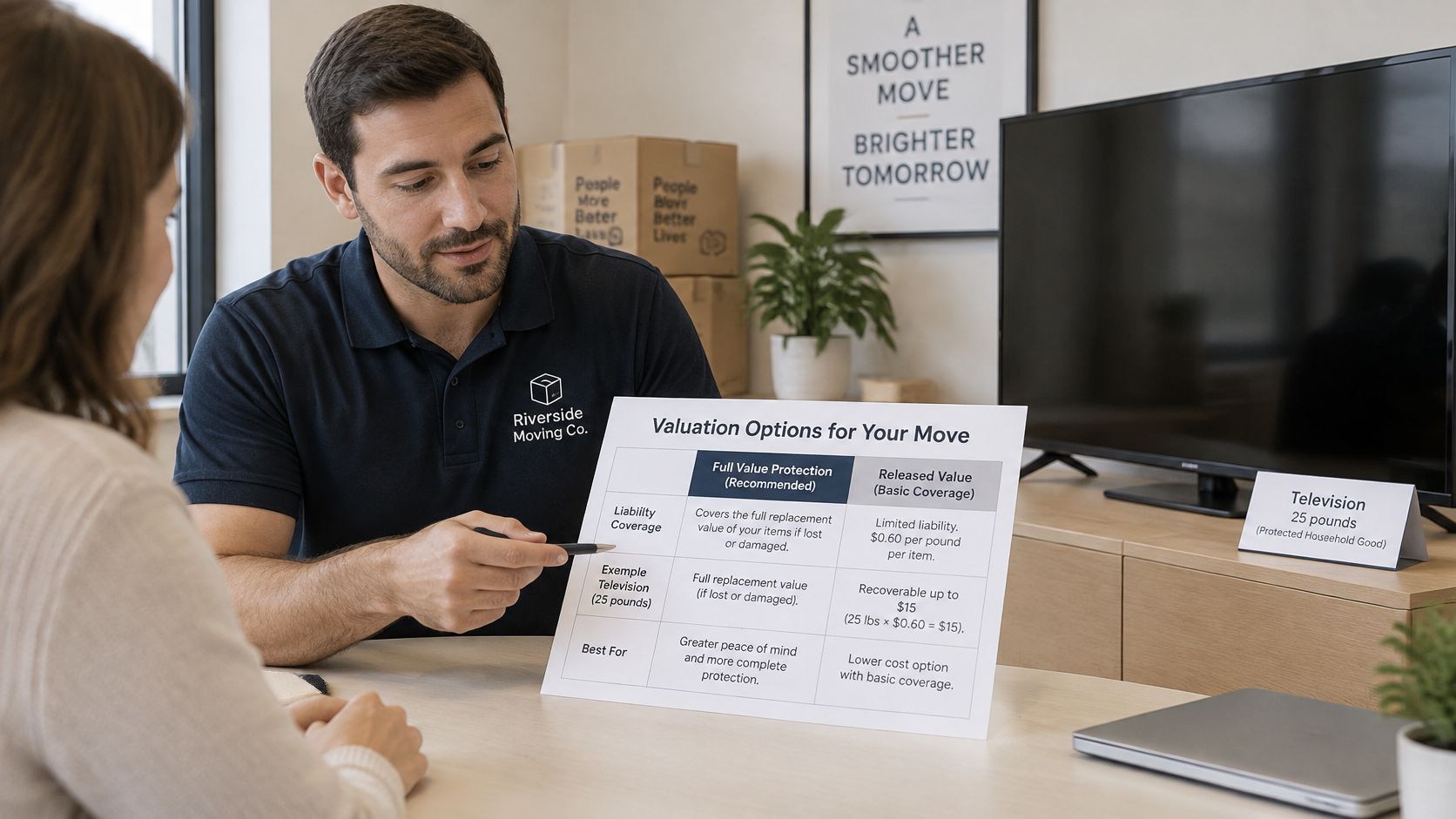
Option | Liability basis | Example |
|---|---|---|
Released Value | maximum 0.60 dollars per pound per article | 25-pound TV recovers at most 15 dollars |
Full Value Protection | replacement value of lost or damaged goods, subject to terms | 2,000-dollar TV replaced at its replacement value |
Extraordinary value items over 100 dollars per pound | must be listed on shipping documents | jewelry, antiques, specialized electronics |
Released Value limits liability to $0.60 per pound per article. A 25-pound television therefore tops out at $15, no matter what you paid. Full Value Protection makes the mover responsible for the replacement value of lost or damaged goods, subject to the shipment terms and exclusions.
One television, two outcomes
Say a television worth about $2,000 is damaged in transit and weighs 25 pounds. Under Released Value the ceiling is that $15. Under Full Value Protection the claim is aimed at replacement value, still subject to the contract and any exclusion you accepted. Full Value costs more, so the quote should show it as its own line. A bundled "insurance included" line that doesn't name the option isn't a choice you can audit.
Items over $100 per pound, such as jewelry, antiques, or specialized electronics, are what FMCSA treats as "extraordinary value" articles. List them on the shipping documents or you can lose the special handling those pieces are allowed. Build the inventory before you request quotes. Record description, condition, and replacement cost, and photograph anything you'd fight over.
Keep the signed inventory, the bill of lading, the photos, and the delivery notes together. Written claims generally must be filed within nine months after delivery. These rules are for interstate shipments. On a move that stays inside Texas, ask which valuation rules govern that job before you sign, because the federal pair isn't automatic.
How to Compare Long Distance Movers on Real Criteria
Licensing should already be checked. What remains is whether the company can run your route without surprises. We're a locally owned company that has served Central Texas since 2011, with over 15 years of experience, and we put pricing in writing up front. Hold every carrier, including us, to the same signals.
Criterion | Strong signal | Weak signal |
|---|---|---|
Operating history | fixed local address and years on record | new registration or frequent name changes |
Review pattern | reviews spread over years, complaints answered | few reviews, all posted in one short window |
Written quote | itemized, names valuation option and accessorial fees | verbal quote, 'we will see on moving day' |
Crew and equipment | trained crew, protective materials, stair and elevator planning | crew arranged without disclosure |
Route coverage | serves origin and destination with clear service area | local only, no interstate experience mentioned |
Communication | named contact, written answers | hard to reach, verbal-only answers |
How to test a claim
A fixed address and years on record beat a fresh name. Ask for one reference from a recent interstate job of similar size, not a generic testimonial.
Read reviews for a pattern across years and for replies to complaints. A pile of five-star notes posted in one week doesn't tell you how a damage claim was handled.
The quote should be itemized and should name the valuation option plus stair, shuttle, and long-carry fees. "We'll see on moving day" means the number isn't comparable.
Ask who is on the crew and what pads, wraps, and stair or elevator gear they bring. A crew "arranged later" with no materials list is a weak plan.
Route coverage means they name both ends. Local-only experience with no interstate jobs mentioned is a mismatch for a cross-country load.
You want one named person who answers in writing. If you can't get a reply before you book, you won't get one when a window slips.
Drop any provider that looks weak on two or more of these, even when it posts the lowest price.
Reading Estimates and Booking a Comparable Quote
The estimate type decides how far the bill can move after your goods are already on the truck. FMCSA consumer rights guidance draws a hard line. A mover that fails to deliver after receiving 110% of a non-binding estimate or 100% of a binding estimate may violate federal protections.
A binding estimate fixes the price for the inventory you listed. A non-binding estimate is a projection that can change with the actual weight and services. Say the non-binding figure is $2,400. One hundred ten percent of that figure is $2,640. That is the point where those delivery obligations get tested, not a suggestion. The same guidance says interstate movers must give you the consumer handbook and the Ready to Move brochure before transport, and that you should check authorization and complaints in the mover database.
Full Value Protection and Released Value pay very different amounts. If the quote doesn't name which one is included, you're comparing unlike offers. The lowest advertised price is often the least comparable one, because valuation, accessorial charges, or a delivery window got left off.
A quote sequence that stays comparable
Build a room-by-room inventory and declare high-value items before anyone prices the job.
Request written estimates from two or three verified movers on that same list. Our take on what belongs in a long-distance moving cost breakdown is a useful cross-check while you line the numbers up.
Ask which estimate type each company offers and which valuation option is in the price.
Score the quotes on operating history, reviews, itemization, crew plan, route, and communication. Drop anyone weak on two or more.
Confirm origin and destination windows, plus elevator, parking, and stair access, in writing.
Sign only after the terms, the insurance proof, and the dispute steps are in the packet.
Before you sign, read stair, shuttle, and elevator charges, delivery-window language, cancellation terms, payment methods, and how you dispute a charge. Questions about those terms can go to info@webstermoving.com or to 309 W Main St, Suite 118, Round Rock, Texas 78664. You can also call 512-751-0893 or email sales@webstermoving.com and ask for a named contact on the policy, not a callback "sometime."
Planning a Move When Your New Home Is Not Settled
A lot of Austin households leave with the next address still open. Closings slip. Leases start late. Redfin's Q4 2025 migration report found that 18.8% of house hunters sought a move to another part of the country, up from 17.9% a year earlier and 15.9% about five years earlier. Bay Area-to-Austin searches fell from more than 20,000 in 2021 to about 2,900 in 2025, and Austin showed up among metros with notable outward movement. People are leaving for cheaper nearby towns as well as for other states. Treat that uncertainty as something you schedule, not as a hassle to ignore.

Three shapes cover most of these jobs.
A direct door-to-door move works when both dates are firm. One load, one unload, no second handling. It fails the moment the destination isn't ready and the truck has nowhere legal to wait.
Storage or a POD loaded at origin fits a delayed closing. Say a family is headed to a Denver lease and the closing slips ten days. A container held those ten days, then a second delivery appointment, adds storage time and an extra handling step. It also keeps you from paying for a hotel full of furniture. If that's the path, sort long-distance movers with storage before you pick a leave date.
A partial shipment sends essentials first and holds the rest. It costs a second trip, and it helps when you can live light for a week but can't store a whole house.
Book elevators and parking at both buildings even if the delivery day might move. If the window shifts, ask in writing what the new date does to the bill. The same choices run in reverse for a household moving into Austin. The delivery window, storage, and container decisions sit here, and the origin questions sit with the mover at the far end. Ask which estimate type and which valuation option apply before you commit to a destination date.
Webster Moving Co. runs long-distance moves to and from Central Texas, including door-to-door transport, packing, storage and POD loading, and specialty items, with licensed crews based in Round Rock. If your dates are still open, or you want the estimate type and valuation spelled out before you book, start with a written quote. Visit Webster Moving Co. and tell us the origin, the destination, and whether the new place is ready.
Comments