
How Much Does Long Distance Moving Cost in 2026?
An average U.S. long-distance move costs about $4,700, with a typical rate near $1.24 per mile. Treat that figure as a budgeting anchor rather than a flat price, because your inventory, route, services, and access conditions can move the final bill well above or below it.
That gap between an average and a real quote confuses many homeowners. Two families can leave Central Texas on the same weekend, travel a similar distance, and receive very different totals because one ships a small apartment and the other ships a full house with packing and storage.
Think of the estimate as a recipe, not a sticker. Once you understand which ingredients movers price, you can ask better questions, spot risky quotes, and decide what is worth moving.
Table of Contents
What Long Distance Moving Typically Costs - Why the Average Rarely Matches Your Quote - The Four Levers Behind the Total
How Weight and Distance Shape the Bill - How Movers Confirm Shipment Weight - Where You Have Control
Services and Access Conditions That Add Charges - Common Add-Ons to Identify Early - Crew Size Changes With the Home
Sample Quote Scenarios for Different Household Sizes - Three Profiles to Compare - Sample Quote Scenarios by Move Profile
Binding and Non-Binding Estimates Explained - The 110 Percent Rule at Delivery - Warning Signs in a Low Quote
Cost-Saving Strategies to Weigh Before You Book - Four Options Worth Pricing
Getting an Accurate Quote Before Moving Day - What to Prepare
What Long Distance Moving Typically Costs
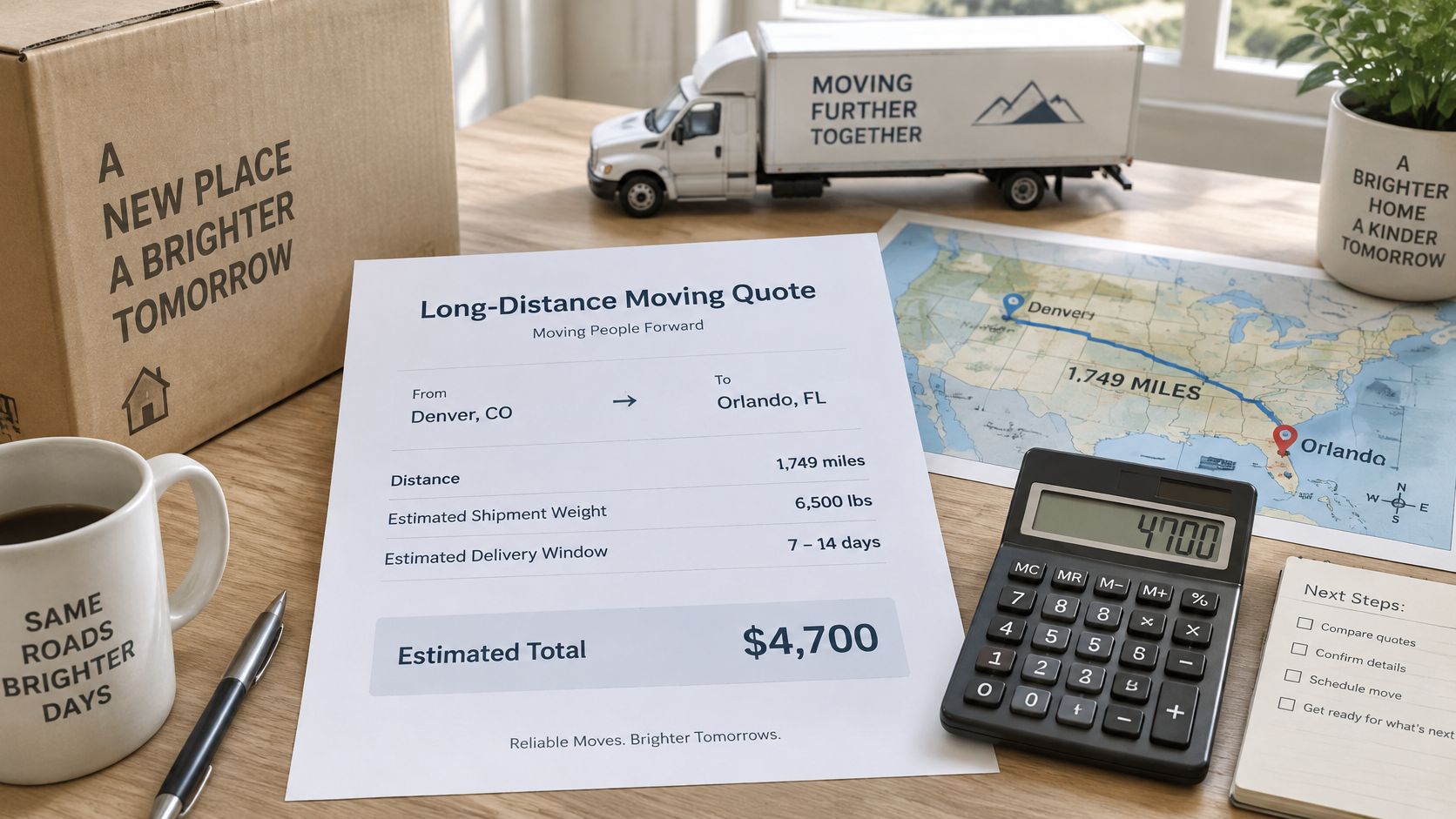
A commonly reported 2024 benchmark of approximately $4,700, with a typical rate near $1.24 per mile, gives you a starting point for the reported average long-distance moving benchmark. On that basis, a 1,000-mile relocation can land around that average before unusually large inventories or added services enter the picture.
That does not mean movers multiply miles by a rate. Interstate pricing can combine the volume or weight of goods, transportation distance, labor, fuel, packing materials, valuation coverage, storage, and pickup and delivery timing.
Why the Average Rarely Matches Your Quote
An average blends small and large households into one number. A lean apartment shipment may fall below the benchmark, while a three-bedroom or larger household, full-service packing, piano or safe handling, stairs, or storage can push the total well above it.
That is why asking how much does long distance moving cost only helps if you compare quotes with the same scope. One estimate may assume you pack everything, while another includes materials, extra crew members, and a shuttle because a large truck cannot reach your building.
Practical rule: Use the benchmark to judge whether a quote deserves questions, not to decide whether it is automatically fair.
The Four Levers Behind the Total
Distance: The route affects transportation, fuel, crew time, and delivery scheduling.
Weight or volume: The amount you ship changes the transportation component and the labor needed at both ends.
Services and access: Packing, storage, stairs, elevators, long carries, and specialty handling add separate work.
Estimate type: A binding or non-binding estimate determines how much financial risk remains after pickup.
Your goal isn't to force your move to match the average. It's to learn which lever explains your quote, then adjust the shipment, services, or timing before you sign.
How Weight and Distance Shape the Bill
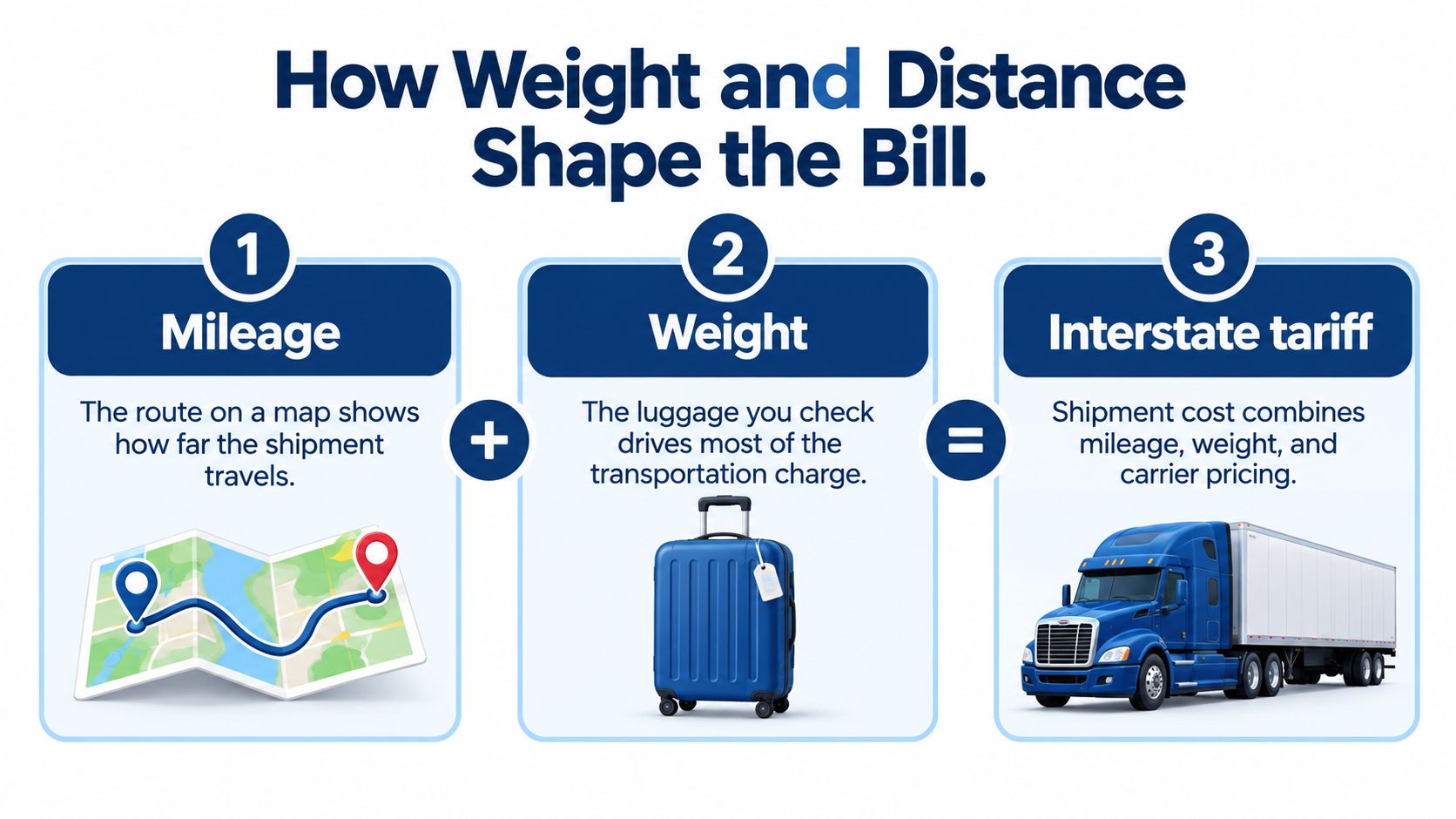
Mileage is the route on a map. Weight is the luggage you check, and that luggage often drives much of the transportation charge.
For an interstate household-goods move, a carrier's tariff can combine shipment weight, line-haul transportation, accessorial services, and advance charges, which is why mileage alone doesn't determine the price under the FMCSA guidance on written estimates and shipment weighing. A rate quote also isn't the same thing as a written estimate, so ask for the estimate to identify transportation, accessorial, and advance charges.
How Movers Confirm Shipment Weight
With a non-binding estimate, the mover must weigh the shipment on a certified scale and calculate the final lawful charge from actual weight. The origin-weigh method subtracts the loaded vehicle's tare weight from its gross weight.
The back-weigh method uses the loaded weight minus the vehicle's tare weight after unloading. In plain terms, the mover weighs the truck with and without your belongings, and the difference helps establish what you shipped.
Where You Have Control
Declutter before the inventory: Removing heavy books, worn furniture, and unused equipment can reduce the transportation component.
Sell or donate bulky pieces: Fewer large items can also reduce packing materials and handling time.
Pack with weight in mind: Smaller packing quantities help when you're deciding what needs to travel.
There's also a minimum-charge trap for small shipments. Many movers publish a minimum charge, so a very light apartment load may not cost proportionally less than a larger shipment if it falls below that threshold.
At Webster Moving Co., costs depend on factors such as crew size, the amount being moved, how long the move takes, travel between locations, and any specialty items involved. Ask every mover for the estimated weight or volume, minimum charge, mileage assumptions, and accessorial schedule before you compare totals.
Services and Access Conditions That Add Charges
Consider a fourth-floor apartment with a long hallway, a reserved elevator window, and a narrow loading zone. Even if the mileage is modest, the crew spends more time carrying, protecting common areas, and moving items between the unit and truck.
Those conditions create real labor, so they often appear as accessorial charges. The bill can rise even when the route doesn't change.
Common Add-Ons to Identify Early
Stairs and elevators: Extra vertical travel adds crew time, and elevator reservations can limit the work window.
Long carries: A truck parked far from the door turns every load into a longer trip.
Parking restrictions: Tight streets or loading rules may require extra coordination or a shuttle vehicle.
Packing and materials: Professional packing adds labor and supplies, but it can reduce your preparation time and handling risk.
Storage: A gap between move-out and move-in dates adds storage duration to the quote.
Specialty handling: Pianos, safes, antiques, and large appliances may need additional crew members or equipment.
If you're deciding whether to pack fragile rooms yourself or hand that work to a crew, review what professional packers and movers can handle before you lock the scope. Then ask which rooms, materials, and fragile items each quote covers.
We handle apartment moves and can work with stairs, elevators, parking restrictions, furniture disassembly and reassembly, and other apartment-moving logistics. Still, you should ask which furniture pieces a quote includes for disassembly and reassembly, because not every estimate assumes the same work.
Crew Size Changes With the Home
A compact apartment and a large house don't need the same plan. For larger household moves, we help determine the right crew size, equipment, and estimated time based on the home's size and belongings.
Walk both addresses before requesting a quote and write down stairs, hallway distance, elevator rules, parking limits, and gate or dock restrictions.
That simple checklist helps the estimate describe the actual job. It also reduces the chance that an access problem becomes a surprise charge on moving day.
Sample Quote Scenarios for Different Household Sizes
Scenario planning is more useful than forcing every household into one average. Your first task is to decide which profile looks most like your move, then request an inventory-based estimate built around that profile.
Demand is one reason generic averages fall short. More than 7.5 million people crossed state lines in 2023, equal to 18.9% of all movers, according to Census Bureau estimates on interstate movers in 2023.
Three Profiles to Compare
A small apartment shipment may land below the benchmark if the inventory is lean and access is simple. The exception is a published minimum charge, which can keep a very small interstate shipment from becoming proportionally cheap.
A three-bedroom or larger household usually creates more weight, packing, loading time, and equipment needs. With full-service packing, the total can move well above the benchmark. We handle full-house moves for 3 bedroom, 4 bedroom, and 5+ bedroom homes with experienced crews and equipment.
A move with a piano, safe, or storage stay adds another layer. Specialty handling and storage are separate cost pressures, and the delivery schedule may depend on when the new home is ready.
Sample Quote Scenarios by Move Profile
Move profile | Main cost pressure | What to request in writing |
|---|---|---|
Small apartment | Minimum charge and access conditions | Estimated weight or volume, minimum charge, stairs or elevator fees |
Three-bedroom or larger home | Shipment weight, packing scope, crew size, and loading time | Room inventory, packing inclusions, crew plan, valuation choice |
Specialty item or storage move | Extra handling, equipment, storage duration, and delivery timing | Item handling method, storage period, shuttle needs, delivery window |
Use the table as a quote checklist, not as a price promise. Two households in the same row can still receive different estimates because their inventories, access, and dates differ.
Binding and Non-Binding Estimates Explained
The lowest headline quote isn't always the safest deal. The question that matters is how much the price can change after your belongings are loaded.
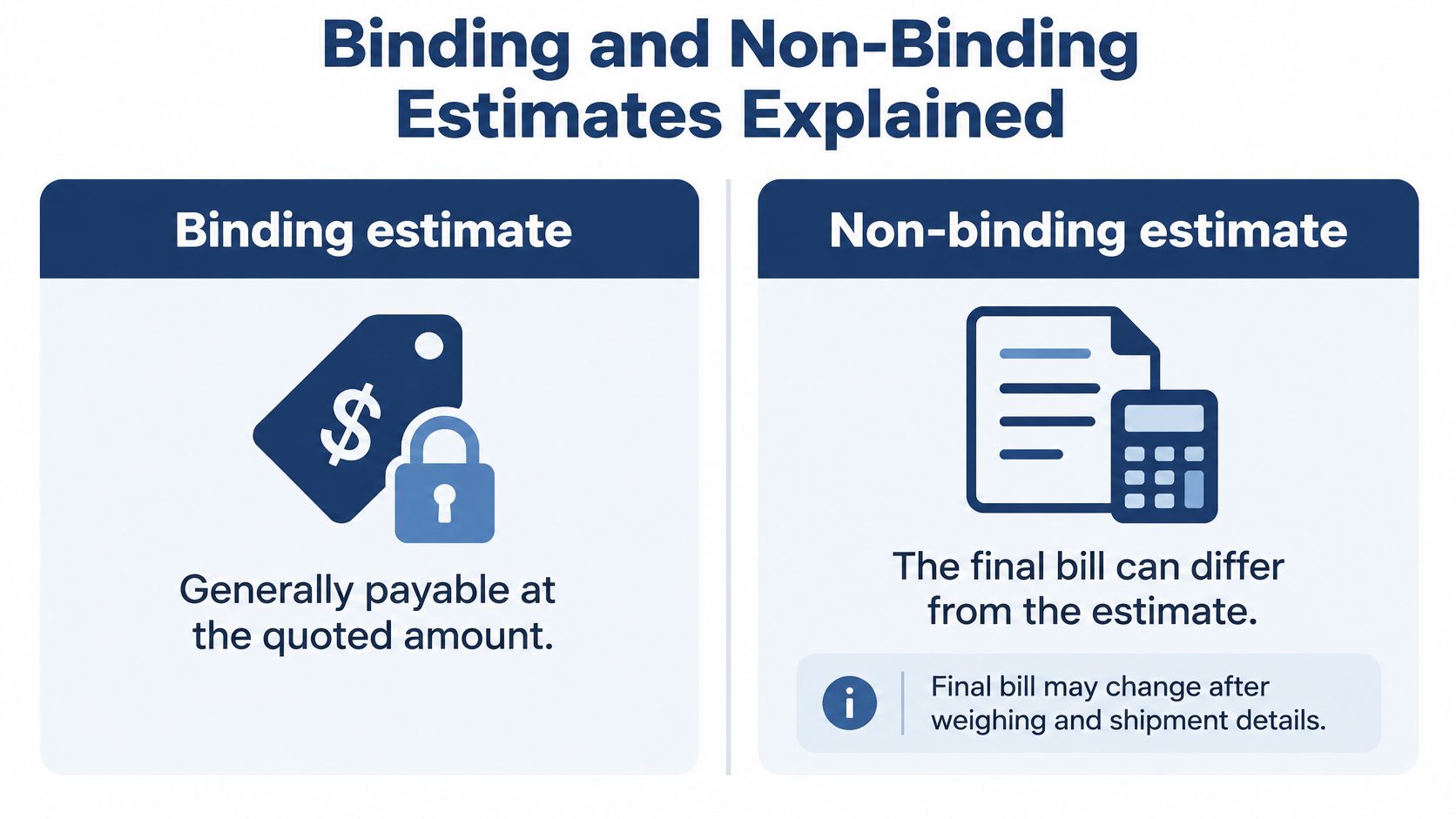
A binding estimate works like a locked price and is generally payable at the quoted amount. A non-binding estimate works more like a forecast, because the final lawful charge can reflect actual weight and services under the summary of the 110% delivery-payment rule and moving fraud warnings.
The 110 Percent Rule at Delivery
For a non-binding estimate, a mover generally cannot require payment above 110% of the estimate at delivery. That rule limits what you must pay to receive your goods at delivery, but it doesn't turn the original forecast into a guaranteed final price.
Ask this direct question before signing: What's the maximum amount I could legally be asked to pay at delivery, and which assumptions could increase the final bill? The answer should name estimated weight, access conditions, packing labor, storage, valuation coverage, shuttle fees, and the delivery window.
A quote that looks unusually low deserves more scrutiny, not faster approval.
Warning Signs in a Low Quote
Deliberate low-balling: A mover quotes low to win the job, then the price climbs after pickup.
False shipment weights: The weight used for billing doesn't reflect the actual shipment.
Belongings withheld for payment: A mover demands additional money before releasing goods.
Compare estimates only when they use the same inventory and services. If one omits packing, shuttle service, or storage that another includes, the lower total may reflect a smaller job.
We provide an upfront estimate based on the details of the move so customers know what to expect before moving day. Payment is due upon completion unless otherwise agreed in writing, and major credit cards, checks, and electronic payments are accepted.
Cost-Saving Strategies to Weigh Before You Book
The cheapest move may not come from finding a cheaper carrier. It may come from shipping less, choosing flexible timing, or replacing a bulky item after arrival.
Use an item-level break-even test for large furniture. Compare the added transportation cost with the replacement cost at your destination, then add packing, valuation, storage, stairs, elevators, and delivery-access charges before deciding.
Four Options Worth Pricing
Move everything when pieces are valuable, hard to replace, or already fit the new home. This option is simpler, but heavy or awkward items can increase weight and handling.
Sell bulky items when replacement is easy and the furniture has limited resale or sentimental value. You'll reduce the shipment, but you need time to sell, donate, or dispose of pieces responsibly.
Use POD storage or staged storage when your dates don't line up or you want to sort items after arrival. Compare the labor and storage involved by reviewing long-distance moving options that include storage against a direct move.
Replace after arrival when shipping, packing, and access charges approach the cost of buying at the destination. This works best for renters, downsizers, and families whose new rooms need different furniture sizes.
Recent migration patterns add useful context. Bank of America account data reports that the number of people moving has more than halved since 2021, while interstate or inter-MSA movers are increasingly likely to remain within the same Census region, according to Bank of America research on recent migration patterns. For a regional move, a smaller shipment or local move plus storage may beat shopping for another carrier.
We offer full or partial packing services available before moving day, so you can keep low-risk packing yourself and hand fragile rooms to the crew. Book as early as possible, particularly for weekends, month-end, and the busy summer moving season. Our referral program also lets customers earn $50 or $100 when a referred friend's move is completed.
Getting an Accurate Quote Before Moving Day
A good quote starts before you contact a mover. Gather the details that determine weight, labor, access, and timing, then give every company the same information.
What to Prepare
Rough inventory: List rooms, major furniture, boxes, appliances, and items you plan to sell or leave behind.
Weight or volume clues: Note unusually heavy collections, garage equipment, and packed storage areas.
Access at both addresses: Record stairs, elevators, hallway distance, parking, gates, and loading restrictions.
Preferred dates: Include pickup flexibility, closing or lease deadlines, and any storage gap.
Specialty items: Name pianos, safes, antiques, large appliances, and fragile pieces that need extra handling.
If you want the crew to handle packing, loading, transport, and unloading under one plan, compare that scope with the work described in a full-service move. Don't compare a full-service quote against a labor-only number and assume the difference is profit.
We offer free, no-obligation quotes through a short form on our website at webstermoving.com. You can also call 512-751-0893 or email sales@webstermoving.com.
Ask early about confirmation requirements. A valid credit card or deposit may be required to confirm large or long-distance jobs, and knowing that upfront helps you plan payment timing.
Finally, compare written estimates on the same scope: inventory, estimated weight, access conditions, packing, storage, and delivery window. Request the quote this week, while your room-by-room inventory is still fresh and you can correct assumptions before moving day.
If you're budgeting a long-distance move from Central Texas and want the estimate built around your actual inventory, access conditions, packing needs, and delivery timing, we can provide a free, no-obligation quote before you book. Visit Webster Moving Co. to request your estimate and compare the written scope with confidence.
Comments