
When to Start Packing for a Move: A Complete Timeline
You can feel the move getting close before the boxes appear. The lease notice is on the counter, the closing date keeps shifting, and one Saturday suddenly looks too small for everything in the hallway closet, the kitchen, and the garage. That's usually the moment people ask when to start packing for a move, and the honest answer is that the calendar matters less than the dependencies hiding around it.
Start too late, and packing turns into a scramble of half-labeled boxes, missing chargers, and a truck that arrives before the last room is clear. Start at the right time, and the move feels staged instead of chaotic. In Austin, that difference shows up fast, because apartment rules, elevator reservations, HOA windows, and closing dates can all move the starting date earlier than people expect.
Table of Contents
The Thursday-Night Moment: When Packing Becomes a Scheduling Problem
The Week-By-Week Packing Timeline - The early window - The middle stretch - The final week
Adjusting the Timeline for Apartment, House, and Office Moves
Room-By-Room Packing Priority Order - What to pack first and what to leave out
Lease Deadlines, Building Access, and Other Hidden Dependencies
The Thursday-Night Moment: When Packing Becomes a Scheduling Problem
A family in Round Rock opens the kitchen on a Thursday night and sees three untouched rooms, a garage full of overflow, and a move set for the following weekend. The boxes are not the problem. The issue is the work still waiting outside the boxes, sorting donations, checking building access, and deciding what cannot go on the truck. Packing at this stage is a scheduling issue first and a chore second.
A move goes better when it is broken into phases, because different items become movable at different times. A single strong weekend rarely covers everything. The 6 to 8 week window shows up so often because it leaves room for decluttering, room-by-room packing, and the approvals and reservations that cannot be rushed, especially in apartments and condos.
Practical rule: do not ask, “How fast can I pack?” Ask, “What has to be true before I can safely box this room?”
That shift matters in Austin. A start that looks early on paper can still fail if the service elevator is booked, the landlord needs notice, or the new place is not ready for key handoff. The goal is not to tape boxes quickly. It is to finish with the final 24 hours open for access, loading, and the last decisions that always seem to show up at the end.
The Week-By-Week Packing Timeline
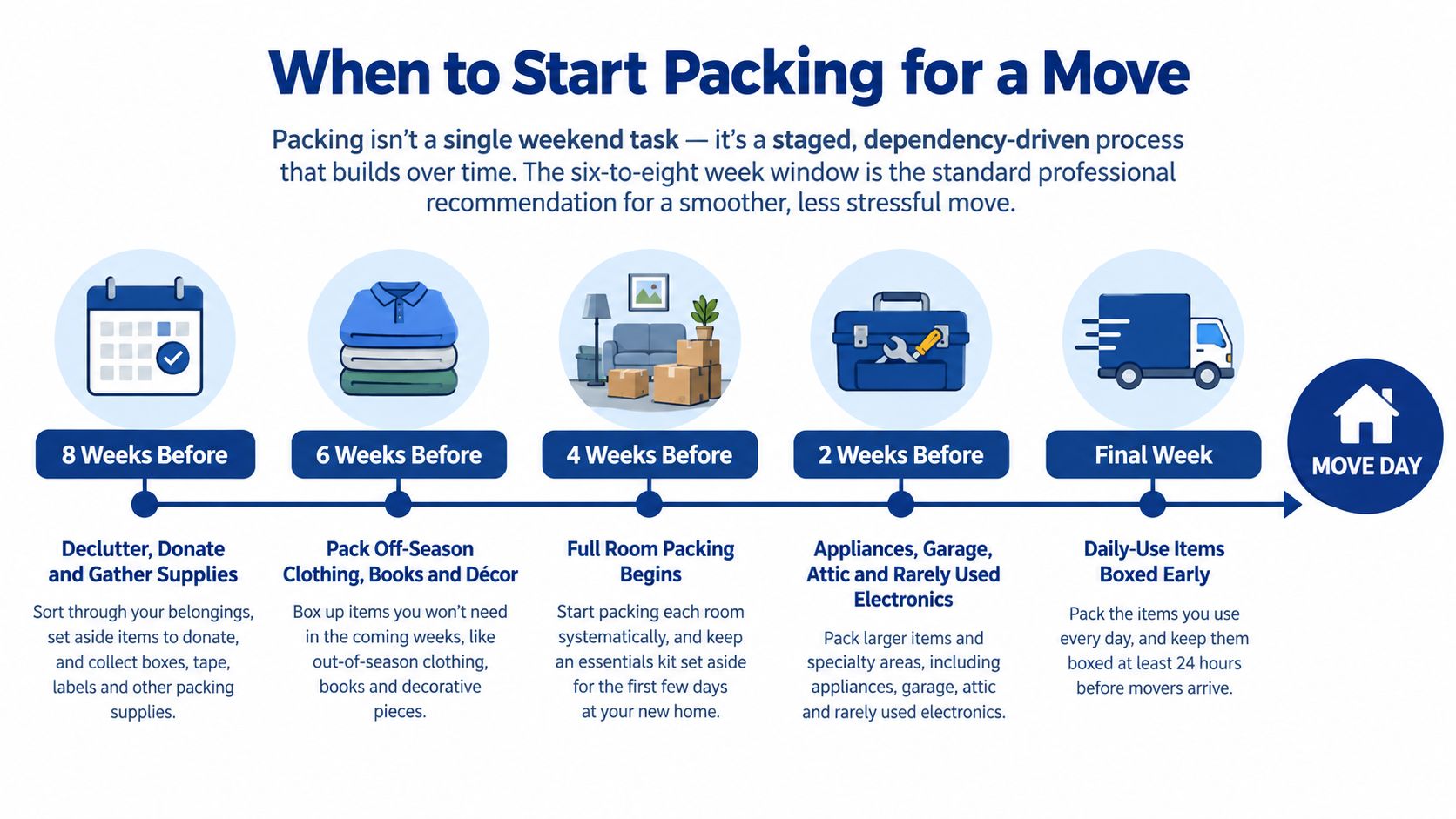
The strongest packing schedule starts with the work that can move early and ends with the items you rely on every day. It is a staged process, not a last-minute scramble for boxes.
The early window
At about 6 to 8 weeks out, inventory each room, separate nonessential items, and start boxing seasonal goods, décor, books, duplicate kitchenware, and equipment you rarely use. Use this same window to gather boxes, tape, labels, and padding so packing does not stop while you wait on supplies. If you are moving into an apartment, condo, or managed building, confirm loading access, elevator reservations, and any move-in rules now. Delays often start there, not with the boxes themselves.
The middle stretch
By 3 to 4 weeks out, most of the household should be boxed, but the essentials kit still needs to stay visible and easy to reach. Daily box targets work better here than a vague weekend goal. The count does not need to be perfect, it just needs to keep pace with the rooms still open and the labor you have available.
A move slips when every room is treated the same. Give each space its own deadline and the work gets more manageable.
The final week
During the final week, pack daily-use items except toiletries, medications, documents, basic cookware, and several changes of clothing. Seal every box at least 24 hours before loading so movers have clear walkways and enough room to work. Anything still loose at that point usually creates delays, confusion, or both.
A one-bedroom North Austin apartment can sometimes move faster because there are fewer rooms and fewer access issues. A Round Rock family home usually needs more breathing room, since closets, children's items, garage storage, and kitchen inventory all add sorting time.
Adjusting the Timeline for Apartment, House, and Office Moves
A studio with a clear move-out date doesn't need the same lead time as a three-bedroom house with a shed, attic, and specialty furniture. The right start date follows the move type, the amount of stuff, and the access rules around the building or property. That's why a flat answer never works as well as a decision based on constraints.
Move Type | Start Packing | Final Box Deadline | Notes |
|---|---|---|---|
Studio or one-bedroom apartment | About 4 weeks before | 24 hours before loading | Works best when the building access date is fixed and the contents are already fairly trimmed down. |
Two-bedroom apartment or condo | About 4 to 6 weeks before | 24 hours before loading | Needs more room-by-room sequencing, especially if there's elevator booking or parking coordination. |
Three-or-more-bedroom home | About 6 to 8 weeks before | 24 hours before loading | Specialty items, garages, and multiple closets create more dependencies, so the schedule should start earlier. |
Office or commercial move | Earlier than a home move | Before the scheduled shutdown window | Filing systems, equipment, and business downtime push packing into a tighter operational plan. |
The apartment and condo side of the market usually forces the earliest decisions, because the building rules can control the actual work window. This is why a move that feels “early” on paper can still be late in practice if the elevator reservation, loading-dock access, or key handoff hasn't been locked in. For apartment-specific planning, this apartment move resource is useful when you're comparing access and timing requirements.
A house move creates a different problem. There's usually more volume, more storage zones, and more items that don't get touched for months, which means the packing curve is longer even if the move date is stable. Offices add another layer, because business continuity matters as much as the boxes themselves.
Operational note: start dates should be based on the hardest dependency, not the easiest room.
Storage and POD moves sit somewhere in between. The move-out day may arrive long before the move-in day, so packing has to support a temporary staging phase, not just a single load-and-unload event. This storage and POD guide fits that kind of timeline well.
Room-By-Room Packing Priority Order
The cleanest order starts in the spaces you use least and ends in the rooms that keep daily life running. Guest closets, holiday décor, books, and off-season clothing go first because they don't affect the rest of the house. Wall art and mounted hardware also come down early, not because they're fragile, but because removal creates repair work that's easier to handle before move day.
What to pack first and what to leave out
Guest rooms and storage closets: Box bedding, spare towels, old paperwork, and any overflow you don't need before the move.
Living room décor: Wrap frames, lamps, and tabletop décor early so the room can empty out gradually instead of all at once.
Books and media: Use smaller boxes so the weight stays manageable, especially for hardcover books.
Garage and attic items: Sort tools, bins, and rarely used equipment before anything else because these spaces usually contain the most forgotten items.
Kitchen last: Leave out one pot, one plate set, basic utensils, and a small supply of daily cookware until the end.
Bathrooms and bedrooms should stay functional almost to the finish line. Toiletries in active use, medications, sleepwear, and a few changes of clothes belong in the essentials kit, not in the truck. Open food, cleaners, paint, propane, and other hazardous materials should be handled separately, since they don't belong in ordinary packed loads.
A TV deserves extra care because the screen can be damaged by pressure, not just impact. Remove cables, store them in a labeled bag, and keep the remote with the same room label so setup isn't guesswork later. Bookshelves packed with hardcovers should be treated like weight management, not just space management, because overfilled boxes slow everything down.
Lease Deadlines, Building Access, and Other Hidden Dependencies
Austin moves usually go sideways for one reason, the calendar is controlled by lease terms, building rules, and closing dates, not by packing enthusiasm. A landlord may need 30 to 60 days' notice. A condo tower may need an elevator reservation or a certificate of insurance before movers can roll a cart through the lobby. If that access window closes, the packing schedule stops mattering.
The practical order is simple. Lock the move date first, confirm lease notice next, then check building access, and only after that set the heavier packing work. I have seen people box half the house too early, then learn the truck cannot load at the hour they assumed. The same problem shows up in condo communities and subdivisions around Round Rock, Georgetown, and Cedar Park, where truck hours, loading zones, and staging areas can be restricted.
In Austin high-rises, elevator reservations are often the bottleneck. Some buildings want a weekday slot, a damage deposit, or proof of insurance before they will approve the move. On the condo side, COI paperwork can take longer than the packing itself, so that document belongs on the same calendar as lease notice and carrier paperwork. If the move involves a downtown tower or a managed community, the load-out window should be confirmed before anyone starts sealing kitchen boxes.
For long-distance moves, the timeline gets even tighter. The documentation steps covered earlier belong on the same calendar, because lease deadlines and carrier paperwork compete for the same weeks.
A move coordinator, carrier, or packing crew can help when the access rules are tight and the timing has little margin. Webster Moving Co. is one option for storage pod moves, packing services, and coordinated move timing when the schedule has to match building access, not just a free weekend.
If the move date is still unsettled, pack the nonessentials and keep daily-use items live. That gives you room if a closing date slips or a key handoff changes, without forcing a full repack or rush labor at the last minute.
Labeling Systems and the Essentials Kit That Saves Move Day
Early packing only works if the boxes can be trusted later. Each box should get a unique identifier, plus the room, broad contents, and any condition-sensitive note written on at least two adjacent sides and the top. Photographs of valuable or fragile items before sealing add a useful record if something is damaged or missing.
Practical rule: if a box can't be identified from across the room, it isn't labeled well enough.
FMCSA rules require a household-goods carrier to prepare a written, itemized inventory identifying every carton and uncartoned item, and the customer should accompany that process, verify descriptions, and note damage or missing items before signing delivery paperwork. That inventory matters because it's the receipt for the shipment and part of the evidence trail if a dispute comes up. FMCSA inventory guidance
The essentials kit should travel with you, not on the truck. It needs documents, medications, chargers, basic cookware, a change of clothes, and any work materials you'll need before the first full unpack. Anything you can't afford to lose or delay belongs in personal transport, not in a stacked hallway.
Common mistakes are easy to spot in the field. Mixed boxes without labels slow unloading, prohibited items create risk, and an inventory described only as “miscellaneous” weakens the record if you need it later. A good labeling system doesn't just organize the move, it protects it.
If you're planning a move in Austin, Round Rock, or anywhere in Central Texas, Webster Moving Co. can help with packing, loading, storage and POD moves, and specialty item handling. If your lease date, elevator reservation, or closing timeline is driving the schedule, visit Webster Moving Co. to line up the moving plan around the actual dependencies, not a guess.
Comments