
Apartment Movers Cost: A Practical Pricing Guide for 2026
A typical local apartment move in the United States runs from about $300 for a small studio to over $2,000 for a larger unit, with hourly crew rates between $120 and $200 for two movers, before stair, elevator, and access charges are added. You're probably staring at a lease end date, three tabs of quotes that don't match, and a building manager asking for an elevator reservation you haven't made yet.
That's exactly where apartment budgets break. One mover quotes labor like your truck will sit at the curb. Another assumes packing is done. Your building, meanwhile, controls fees neither quote mentions. As an operations lead, I'd tell you to stop comparing headline rates. Compare complete, written scopes. The cheapest hourly number often produces the most expensive day.
Table of Contents
What Apartment Movers Cost in 2026 - The Three Cost Layers - Why Published Prices Move
How Apartment Moving Prices Are Calculated - The Math Behind the Quote - What Starts and Stops the Clock
Stairs, Elevators, and Parking Access Fees - Stairs and Long Carries - Elevators Are Not Automatically Free
Binding Versus Non-Binding Estimates - What Federal Rules Require - Binding vs Non-Binding Estimate at a Glance
Example Estimates for Common Apartment Moves - Studio Walk-Up - One-Bedroom in an Elevator Building - Two-Bedroom With a Long Carry
The Real Cost of Moving Out of an Apartment - Cash You Need Beyond the Invoice - When the Cheaper Quote Costs More
How to Negotiate and Lock in Your Apartment Quote - Build Your Quote Packet - Questions That Expose a Weak Quote
What Apartment Movers Cost in 2026
Don't budget around a single advertised price. Your apartment movers cost has three layers, and only the first belongs fully to the moving company. If you miss either of the other two, your estimate is fiction even if the hourly rate is accurate.
The Three Cost Layers
Mover labor and transportation: Crew time, truck use, travel, loading, unloading, disassembly, and any packing or storage you request.
Access charges: Stairs, long carries, elevator waiting time, shuttle needs, parking arrangements, and extra handling caused by tight hallways or restricted docks.
Non-mover transition costs: Deposits, lease overlap, utilities, cleaning, application charges, and building fees that land in the same week but never appear on a mover's invoice.
Treat those layers separately on paper. A quote can look strong on labor and still leave you short on cash because the building requires a refundable deposit or your new landlord collects money before keys change hands. I've dispatched plenty of Central Texas jobs where the move itself went fine and the renter still felt blindsided by everything around it.
Why Published Prices Move
Prices also aren't static from year to year. The Bureau of Labor Statistics tracks moving, storage, and freight as its own household expense category, and the BLS Consumer Price Index supplemental table for moving, storage, and freight expense reported a 3.1% decrease over the measured 12-month period in its 2025 table, with that category carrying a 4.88% relative importance in the household-operations grouping.
Read that correctly. A national index moving down doesn't mean your specific quote drops by the same amount. Your building, floor, inventory, distance, and date still set your price. Labor, fuel, packing supplies, transportation, and storage can move independently, and a local crew prices the job in front of it, not a national average.
Budget for the address you're leaving and the address you're entering, not the bedroom count on your lease.
Use bedroom count only as a first sorting tool. A sparse ground-floor two-bedroom with close parking can run faster than a packed one-bedroom up several flights. Inventory volume, how well you're packed, and how far the crew carries every load matter more than square footage printed on a leasing brochure.
Get your range from the first layer, then immediately price access. That's the order that keeps you honest.
How Apartment Moving Prices Are Calculated
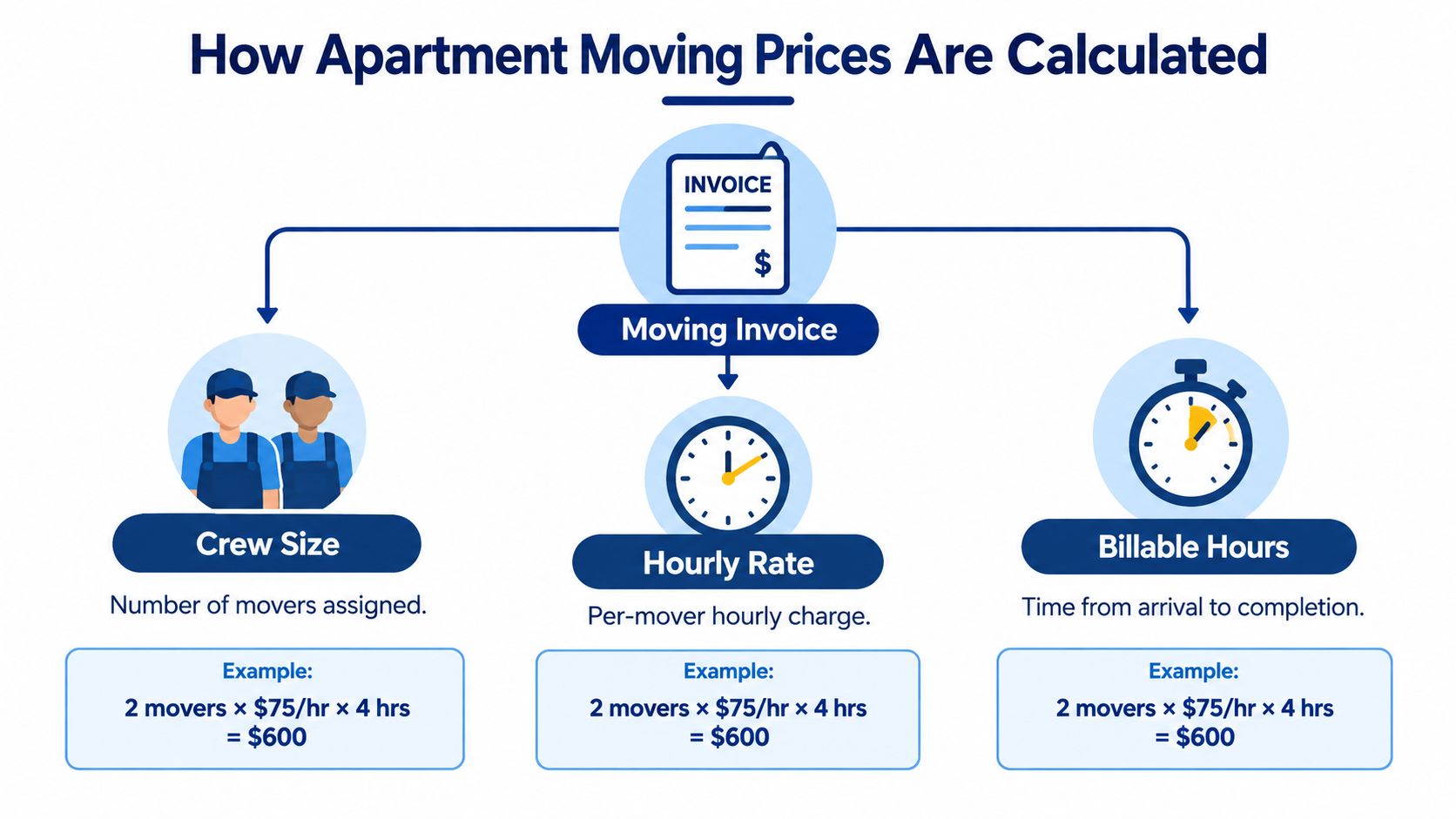
Your invoice is mostly a labor-time equation. The mover multiplies crew size by the hourly rate and the billable hours, then adds travel, truck charges, materials, and any accessorial services you've requested. Anything that stretches the clock stretches the bill.
The Math Behind the Quote
The baseline inputs: Labor-only pricing sits at approximately $60 to $100 per mover per hour, a two-person crew commonly costs $120 to $200 per hour, many providers impose a two- to three-hour minimum, a one-bedroom move commonly takes three to four hours, and a two-bedroom may require four to six hours, according to iMoving's breakdown of moving labor cost inputs.
That last point is where renters miscompare quotes. A third mover raises your hourly burn rate, but that person can keep furniture moving through hallways while two others load, which can cut total billable time. Don't ask only which crew is cheaper per hour. Ask which crew finishes your specific inventory and access route for fewer total crew-hours.
If you're supplying the truck or container yourself, a loading and unloading service follows the same logic. You're still buying skilled time, and poorly staged boxes or a long carry still slow the crew down.
What Starts and Stops the Clock
Get these assumptions in writing before you compare totals:
Minimum hours: Whether travel counts toward the minimum and how partial time is billed.
Travel time: When the clock starts, where it starts, and whether return travel is charged.
Materials: Whether blankets, wrap, tape, boxes, and wardrobe cartons are included or itemized.
Scope: Whether packing, disassembly, reassembly, and bulky items are inside the estimate or treated as add-ons.
Dispatch rule: If two quotes assume different crews, different packing scope, or different access, they aren't competing quotes. They're quotes for different jobs.
Inventory drives everything. Ten extra boxes are a nuisance. An undisclosed sectional, a solid wood dresser, or exercise equipment changes crew planning and the load sequence. Walk the estimator through closets, balconies, storage cages, and garages, not just the rooms you see every day.
A good estimate reads like a work order. You should be able to point to the crew, the expected hours, the services, and the conditions the price depends on. If you can't, you're not holding a price. You're holding a guess.
Stairs, Elevators, and Parking Access Fees
Access is where apartment quotes fall apart in the field. The furniture doesn't change between the sales call and move day. The route does. A reserved elevator that isn't reserved, a truck forced across a courtyard, or a third flight nobody mentioned will eat paid time fast.
Stairs and Long Carries
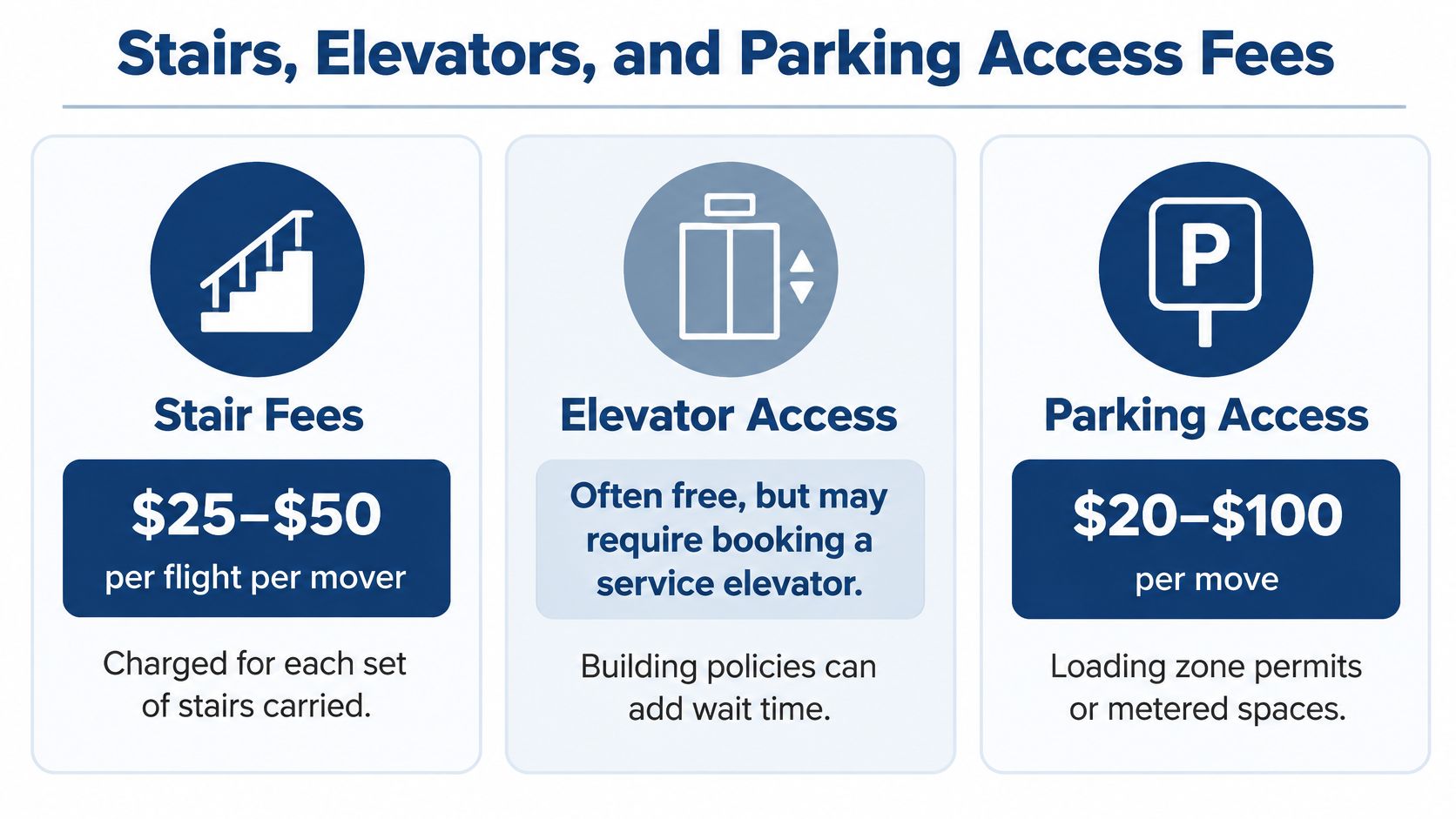
Published planning benchmarks: A studio generally requires two to three labor hours, a one-bedroom about three to four hours, a two-bedroom four to six hours, and a three-bedroom six to nine hours before possible charges for stairs, packing materials, and long carries, while stair fees are often quoted at approximately $25 to $75 per flight per mover and a third-floor walk-up can add roughly $150 to $450 for a two-mover crew, per Moving.homes apartment mover cost benchmarks for labor hours and stairs.
Stairs slow every trip and increase fatigue, which affects pace late in the job. Long carries do the same damage horizontally. When the truck can't park near the entrance, each piece travels farther, doors need managing, and the crew spends more time walking empty or loaded instead of wrapping and loading.
Tell the mover if a shuttle vehicle might be needed because a full truck can't reach the building. That's not a minor detail. It changes equipment, labor, and scheduling.
Elevators Are Not Automatically Free
An elevator removes stair labor but adds coordination. Shared cars mean waiting. Buildings may require padding, a reserved window, a certificate of insurance, or moves only during set hours. Miss your window and the crew can be standing by on your clock.
Building-controlled benchmarks to verify locally: Freight elevator reservation windows of roughly two to four hours, elevator deposits of $200 to $500, city parking permits of $35 to $150, and coordination lead times of three to fourteen days appear in MovingRated's apartment moving guide on elevator and parking logistics.
Don't treat those figures as your building's rates. Treat them as a prompt to call management today and get your rules in writing. Ask about elevator dimensions too. A king headboard or large sofa that won't fit can force a stair carry the crew didn't staff for.
Before requesting any quote, send both addresses, floor levels, elevator or stair details, truck-to-door distance, parking restrictions, loading dock rules, move-hour limits, and insurance certificate requirements. Photograph the parking area, entry, hall turns, and stairwell. Ten minutes of documentation beats an argument at the curb.
Binding Versus Non-Binding Estimates
A verbal number on a sales call is not protection. The paperwork determines what the mover can charge and what assumptions the price rests on. Read the estimate type before you read the total, because the same dollar figure means very different things under each format.
What Federal Rules Require
Written scope matters: The Federal Motor Carrier Safety Administration requires household-goods movers to provide a written estimate covering transportation, accessorial charges, and advance charges; a binding estimate caps what you must pay at delivery at the stated amount when quantities and services match the estimate; and for a non-binding estimate, the FMCSA explanation of binding move estimates and the 110% delivery payment limit states the mover cannot require more than 110% of the non-binding estimate at delivery, though additional amounts may still be due later under applicable rules.
That distinction matters. Binding means the price is locked for the shipment and services described. Add items or request extra packing later and you've changed the deal. Non-binding means the estimate is a projection, and final charges for interstate household goods can depend on actual weight and the mover's tariff.
Binding vs Non-Binding Estimate at a Glance
Estimate Type | What Is Locked In | Payment at Delivery | Best Use Case |
|---|---|---|---|
Binding | Price for listed items and services | Stated amount for the described scope | Inventories that are fully surveyed |
Non-binding | Pricing method, not final total | Capped at delivery, balance may follow | Shipments where final weight is uncertain |
For a local apartment job priced hourly, the practical test is simpler. Does the written quote state crew size, rate, minimum, travel, materials, access assumptions, valuation coverage, and every requested service? If it doesn't, ask for a revised document before you book.
Get the estimate from an actual or virtual inspection, not from a rushed description of your largest furniture.
Don't lowball your own inventory to win a better number. Crews plan trucks and staffing from what you disclose. When the full load appears, you pay in extra hours, a second trip, or a reschedule. Honesty during the survey is a cost control, not a courtesy.
Keep the signed estimate, inventory, and building instructions together. On move day, discrepancies get resolved with documents, not memory.
Example Estimates for Common Apartment Moves
Bedroom count gives you a starting lane. Access decides where you land inside it. Use the three scenarios below to position your own job before you call anyone, and notice how the route from door to truck changes the work more than the address on the lease does.
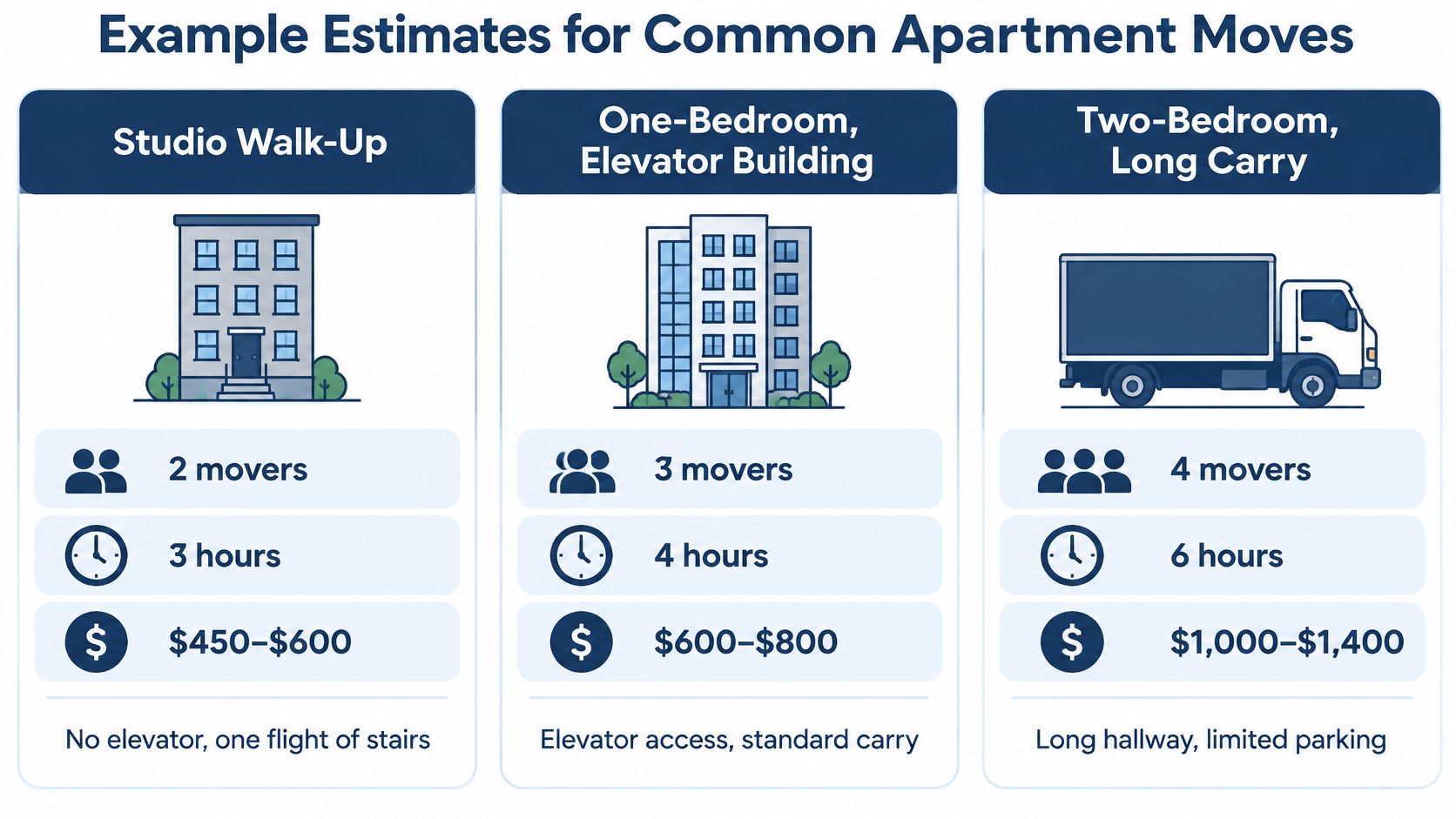
Studio Walk-Up
Your inventory is light, boxes are packed, and parking is close, but every load goes up and down stairs. A small crew can handle the volume, yet stair labor makes the job slower than the item count suggests. This is the budget end of professional moving only if you are fully packed and the stairwell turns accept your sofa and mattress without special handling.
Where this scenario blows up is preparation. Loose items, unboxed lamps, and a bed that still needs disassembly turn a short job into paid packing and handling time. Stage everything near the door and clear the stair route with neighbors and management.
One-Bedroom in an Elevator Building
Now take similar furniture and place it in a high-rise with a reserved service elevator. You avoid stair carries, but your day runs on the building's window. The crew has to protect the elevator, time trips around other users if the car is shared, and finish loading before the reservation expires.
This job can price higher than the walk-up despite easier vertical movement. Waiting is billable, and a narrow window may justify a larger crew so loading finishes inside the reservation. Confirm who books the elevator, who provides the insurance certificate, and where the truck stages while items come down.
Two-Bedroom With a Long Carry
The third scenario adds a second bedroom, heavier furniture, and parking far from the entrance. Even with an elevator, every trip includes a long hallway or courtyard carry, so a larger crew often makes economic sense to keep pieces flowing. An under-scoped low quote turns expensive here, because an undersized crew stays on the clock longer and fatigue compounds.
Ask yourself three questions to place your move:
Route: How far does each item travel before it reaches the truck, and what obstacles sit on that path?
Control: Who controls the elevator, dock, and parking, and have you secured them in writing?
Readiness: Will the crew spend its paid time moving, or packing and disassembling what should have been ready?
Match your answers to the closest scenario. That's your budget position, and it's far more useful than a generic online range.
The Real Cost of Moving Out of an Apartment
Stop asking only what the mover charges. Ask what cash the whole transition demands in the same week. Renters get squeezed because the moving invoice, the new landlord, the old landlord, utilities, and cleaning all come due while your old deposit is still sitting in someone else's account.

Cash You Need Beyond the Invoice
Security deposit exposure: The Federal Trade Commission cites 2025 survey data showing that 83% of renters paid a security deposit, with a median of $795, in the FTC rental housing fees advance notice of proposed rulemaking.
Put that figure next to your moving quotes. Arguing over a modest difference between two movers while ignoring a deposit, first month timing, lease overlap, utility activation, application charges, and cleaning is bad budgeting. Build two totals instead:
Mover total: Labor, transportation, materials, access charges, packing, storage, and valuation.
Transition total: Everything above plus deposits, building fees, permits, utilities, cleaning, and overlapping rent.
Label who controls each cost. Your mover can't waive a building deposit, and your landlord doesn't care that the crew ran long. Most of the options described for short-distance movers still leave those non-mover expenses on your side of the ledger, so plan for them separately rather than expecting a local quote to absorb them.
When the Cheaper Quote Costs More
A quote that ignores your elevator window isn't cheaper. It's unfinished.
An under-scoped crew that misses a reservation, can't park legally, or needs a second trip creates overtime and rescheduling risk. You may also face extra rent, another day of utilities, or a rushed cleaning bill because the old unit wasn't empty on time. A slightly higher quote that staffs access correctly and finishes inside the building window can be the lower-cost move in total.
Protect the old deposit too. Photograph walls, floors, and common areas before and after, and confirm how the crew will protect corners and door frames. Damage disputes with a building can cost you money no mover's discount will offset.
Budget the transition, not the truck. That's the number that determines whether move week feels controlled or chaotic.
How to Negotiate and Lock in Your Apartment Quote
Negotiation on an apartment move isn't haggling over the hourly rate. It's forcing every quote onto the same scope so a lower number means a lower price. Do the documentation work first, then negotiate from facts the dispatcher can price.
Build Your Quote Packet
Send every mover the same information:
Inventory: Room-by-room list plus closets, balcony, storage units, and items needing disassembly.
Access at origin: Floor, stairs or elevator, elevator dimensions, reservation rules, parking, and truck-to-door distance.
Access at destination: The same details again, because the second building prices half the job.
Building requirements: Move hours, insurance certificate rules, dock instructions, and protection requirements.
Photograph parking, entries, stair turns, tight halls, and oversized furniture next to doorways. Request an in-person or virtual walkthrough and open cabinets and closets on camera. Estimators can't price what you hide, intentionally or not.
Questions That Expose a Weak Quote
Ask what the minimum is, when the clock starts, whether travel is charged both ways, and how the crew bills partial hours. Confirm whether blankets, wrap, tape, boxes, and tools are included. Ask how stairs, long carries, waiting time, and a shuttle are priced before those conditions appear.
Then pin down coverage. Ask what valuation is included, what it pays for damage, and what upgraded coverage requires. Don't assume the word insured on a website answers that question. Get the option you've selected written into the estimate.
My requirement: Inventory, access, crew, rate, minimum, travel, materials, and coverage on one signed document before I'd release a truck.
Timing is your cleanest discount. If your lease allows it, ask about mid-week and mid-month dates instead of the weekend everyone else wants, and book once building reservations are confirmed rather than before. Flexibility gives dispatch options, and options are what produce better quotes.
Finally, reduce the job itself. Donate or sell furniture that won't fit the new floor plan, pack completely before the crew arrives, label rooms clearly, and disassemble simple items you're comfortable handling. Every task you remove from paid crew time is a negotiation you've already won.
Choosing the Right Apartment Mover for Your Budget
Pick the mover whose written scope survives contact with your building. Verify licensing and insurance, then read reviews specifically for stair jobs, elevator buildings, parking problems, and final invoices that matched estimates. Generic praise tells you little about apartment work.
Compare total estimated crew-hours, access assumptions, and what's excluded, not just totals. A higher quote that names your elevator window, long carry, and bulky items is usually the safer buy. Options like Webster Moving Co., which handles apartment and condo moves with stair, elevator, and parking planning across Greater Austin and Central Texas, belong on the same checklist as any competitor you vet against criteria for the best movers in Austin, TX.
Close with your three-layer budget in front of you. Labor priced, access priced, transition cash reserved. If a quote can't explain all three, don't book it.
Ready to price your apartment move with the access details included instead of discovered on move day? Visit Webster Moving Co. to request a no-obligation estimate for apartment moving, packing, and Central Texas relocation services, and bring your floor, elevator, and parking information so your crew is scoped correctly from the start.
Comments