
How to Prepare for Movers: A Room-by-Room Checklist
The U.S. Census Bureau counted 25.624 million movers aged one year and older in its 2023 data, the latest entry in an annual mobility series that runs back to 1999. That's an enormous number of households working through the same short list of tasks in roughly the same order. Which is why the moves that go smoothly tend to look alike: a fixed date, a written scope, a labelled inventory, and an access plan everyone agreed to before the truck was loaded.
Most move-day delays trace back to a decision made weeks earlier. An elevator nobody reserved. A quote that assumed free street parking outside a building with none. A box of passports and birth certificates that rode on the truck because no one was told to keep it out.
This guide builds the plan backward from your deadline, whether that's a lease end, a closing date or the first morning of a new job, and it treats access conditions, written estimates and item-level records as part of preparation rather than paperwork you fix later. Here's how to prepare for movers without discovering the gaps on moving morning.
Table of Contents
Eight-Week Timeline for a Stress-Free Move - The eight-week sequence - Why the eight-week window does the work - This week's action
Declutter, Inventory and Pack in the Right Order - The order that works - What a ready room looks like
Clear Access, Parking and Building Rules Early - Access checklist for each address
Get Written Estimates Without Hidden Fees - Two checks before you compare prices - What to bring to the estimate visit
Prepare Special Items and Accessibility Needs - Accessibility, medication and pets on loading day
Eight-Week Timeline for a Stress-Free Move
Start with the date you can't negotiate. A lease that ends on the 31st, a closing that funds on a Friday, a job that starts on a Monday. One of those is usually fixed, and it decides the order of every task that follows. Working backward from that date is the difference between a plan and a wish list.
The reasons people move follow a predictable pattern. In 2023, 10.589 million movers gave housing-related reasons, 41.3% of everyone who moved, and 5.372 million, or 21.0%, moved for employment reasons, according to the Census Bureau's Current Population Survey tables. Both categories come with a deadline set by somebody else: a landlord, a lender, a hiring manager. That's why the first line of any timeline is a booking, not a box.
The eight-week sequence
When | Task | Why it matters |
|---|---|---|
8 weeks out | Book the crew, request written estimates, confirm the move date | Weekends, month-end dates and summer fill first |
6 weeks out | Declutter each room and sort donation, sale and trash piles | Fewer boxes and items lower the quote and the load |
4 weeks out | Order packing supplies and pack seasonal or rarely used items | Keeps daily-use items accessible until the last days |
2 weeks out | Confirm parking, elevator bookings and building rules in writing | Access gaps add time and cost on the day |
1 week out | Pack the essentials kit, defrost the fridge, arrange pet care | Medications and documents stay off the truck |
Move day | Walk through with the crew, sign the inventory, keep copies | A signed record helps if damage or shortages appear |
Why the eight-week window does the work
Two useful things exist at eight weeks that have disappeared by two. The crew calendar still has options, and you still have enough weekends to declutter properly, which matters because a lighter load is a cheaper load whether the job is billed hourly or weighed at a certified scale.
Practical rule: if you can only protect one thing, protect the booking. Packing, elevators and utility transfers all adjust around it. A date that's already reserved doesn't move.
Webster Moving Co. recommends booking as early as possible once your date is confirmed, and there's no penalty in reserving before your inventory is final. Crew sizes and truck space get matched to the home closer to the day anyway.
If your packing schedule still feels abstract, when to start packing for a move breaks the weeks into room-level tasks. The working rule is simple: rarely used items at four weeks, daily essentials in the final three days, nothing that goes in your car loaded onto the truck.
This week's action
Put the move date on the calendar and send out requests for three written estimates, with your address, the number of flights of stairs and a rough item list attached. Comparison comes later. The call goes out now, while the calendar is still open.
Declutter, Inventory and Pack in the Right Order
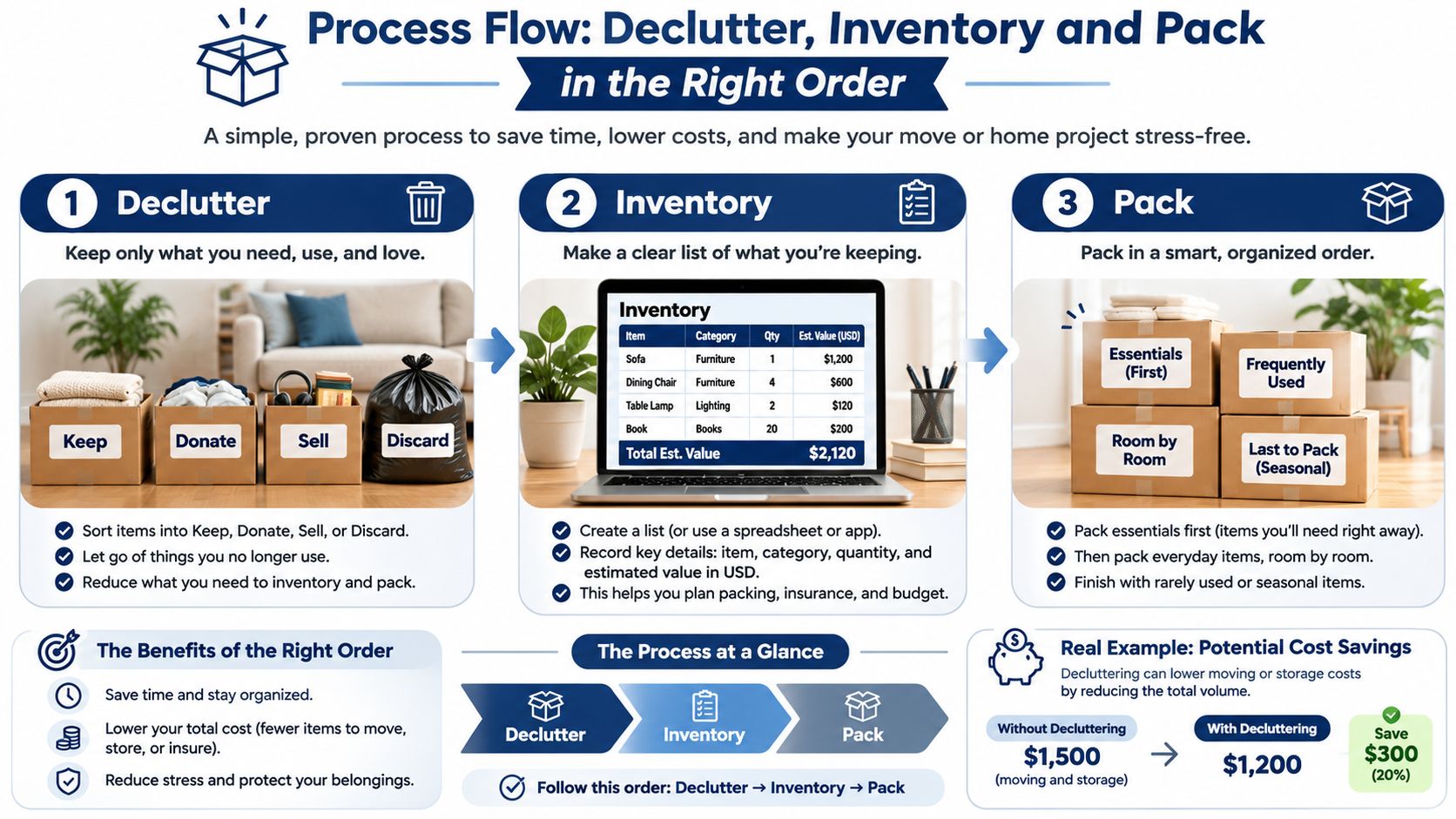
Boxes are the last thing that should arrive. Before packing supplies show up, walk each room with a notepad and decide what leaves the house at all. Four piles do the job: donate, sell or dispose, store, and transport. A local move is billed by the hour and a long-distance move by weight, so every item you cut is either time off the clock or pounds off the bill.
The order that works
Set the date and write the inventory. List large furniture, anything that needs disassembly, and anything you'd describe as fragile. This list becomes the document you compare quotes against and the document the crew works from.
Sort before you pack. A junk drawer packed intact is a junk drawer you'll unpack at the other end. Empty it, keep the two things you use, and move on.
Carry the valuables yourself. Passports, birth certificates, jewellery, cash, medications and the laptop you work from never go in a carton. Put them in one bag and keep that bag with you.
Pack from the least used to the most. Seasonal clothing, spare bedding, garage and storage closets first. Kitchen and bathroom daily items last, because packing your only kettle at four weeks out makes for a long month.
Label by destination and priority. Room name on the top and two sides, plus a number that tells the crew what to unload first. Beds and kitchen boxes are usually priority one.
Photograph the hardware. Take a picture of the cables behind the television and the brackets under the desk before you unplug anything, then bag and label every screw with the piece it came from.
The FMCSA moving checklist makes the same point in regulatory language: convert the home into a room-by-room asset register, photograph high-value and fragile items, and label cartons by destination and priority. Then, on loading day, walk the inventory with the crew and have every item's condition recorded, including scratches and dents that were there before they arrived.
What a ready room looks like
Clear floor, no rugs or cords in the path, cartons stacked and labelled near the doorway, and a sealed essentials bag set aside in a room the crew has been told to leave alone. Photographs on the wall and mirrors are down, and the closet doors are open so nobody has to guess.
Keep a carton log as you pack: number, room, priority, and a one-word contents note. It's the fastest way to find out at delivery whether a box is missing or simply in the wrong room.
Clear Access, Parking and Building Rules Early
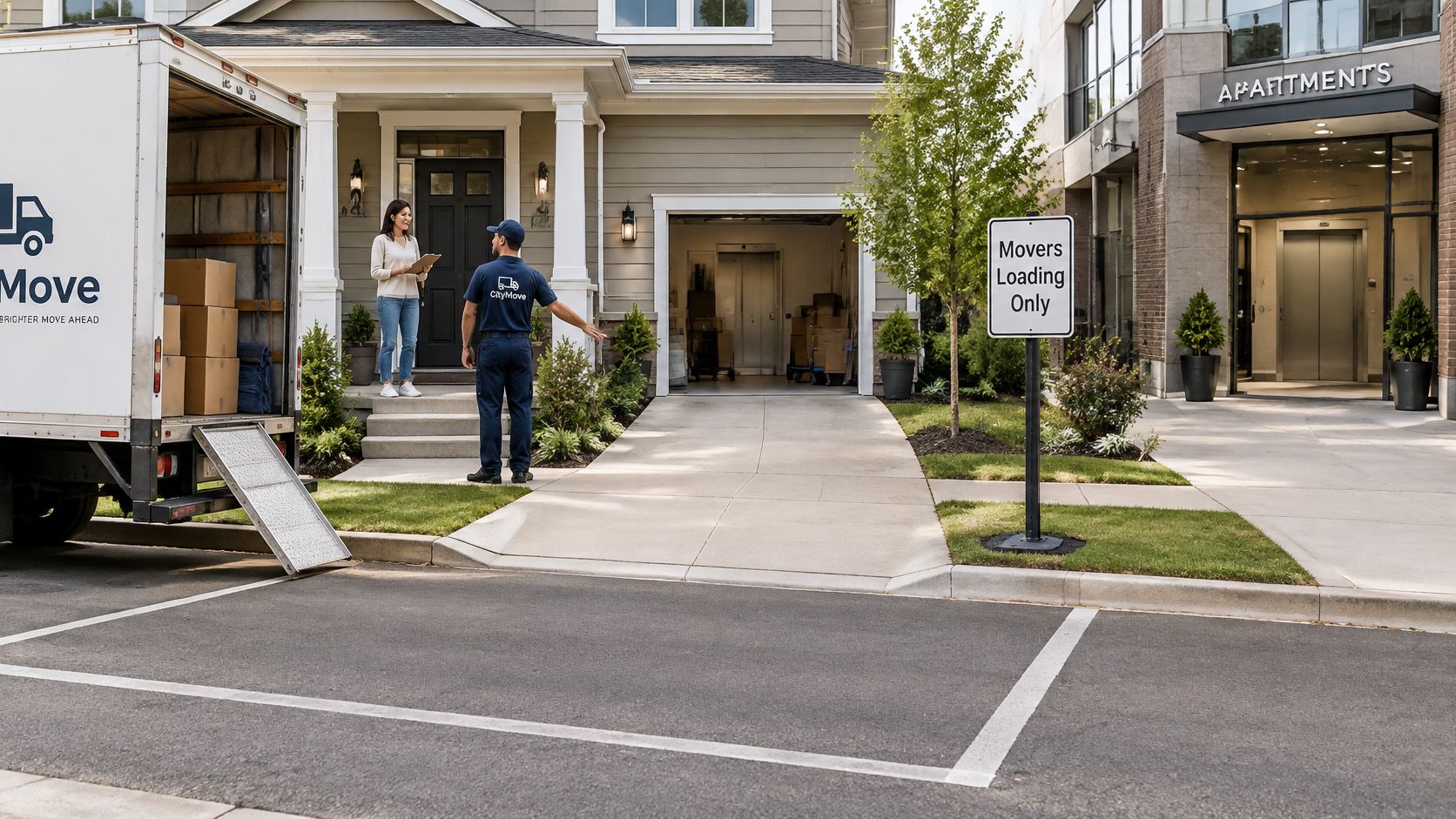
Access problems cost more time on moving day than heavy furniture does. A crew that has to carry a sofa 200 feet because the loading zone is permit-only will take longer than a crew moving a heavier sofa from a driveway, and you'll pay for the difference. Sort the route before the crew arrives.
Get the details settled with the building or property manager first, so the crew can plan truck position, carry distance and crew size.
Access checklist for each address
Confirm the path on the day. Driveways, entrances, service lifts and stairwells need to be usable during the agreed window, not just at some point that week.
Count the stairs and the carry. Note the number of flights at both ends and roughly how far the truck can park from each door.
Ask about elevator reservations, loading dock times and any certificate of insurance the building requires from the moving company.
Reserve parking for the truck or check the street restrictions on that specific day, including trash collection, street sweeping and school-hour zones.
Collect gate codes, key fob arrangements and the building office contact so nobody waits at a locked door at 8am.
Mark the protected path. Hallways, lobby floors and door frames in apartments with narrow corridors.
For apartment moves, Webster Moving Co. asks customers to share the stairs, elevators, loading areas, gate codes and parking restrictions in advance so the crew can plan accordingly. In dense parts of North Austin, one loading zone, a long hallway and a slow elevator can turn a four-hour job into a full day. Buildings with their own move-in rules often have more detail in apartment movers guidance, and it's worth reading before you call the building office.
If the building won't grant a reservation, you have three options: shift the start time to a window the building can support, reduce the number of trips by packing tighter, or split the move across two days.
Get Written Estimates Without Hidden Fees
The classic moving-day surprise is a quote that was never a quote. It was a number on the phone that assumed a driveway, no stairs, no packing and no long carry. When the crew arrives and finds three flights and a fourth-floor walk-up, the price changes and the argument starts.
Comparing at least three written estimates doesn't just find the cheapest number. It shows you which companies scoped the same work, because the one that came out lowest was probably pricing a different job.
Charge | When it applies | What to confirm in writing |
|---|---|---|
Stairs | Walk-ups or multi-flight buildings | Number of flights and whether the quote covers them |
Long carry | Truck parked far from the door | Approximate distance and where the truck can stop |
Packing services | Full or partial packing | Which rooms and which materials are included |
Shuttle service | Large truck cannot reach the home | Whether a smaller truck or shuttle adds a fee |
Specialty items | Pianos, safes, antiques | Whether these are priced separately or included |
Valuation coverage | Released value versus full value | Coverage amount and how claims are handled |
Minimum charge or travel time | Short jobs or travel between locations | Minimum hours and how travel is billed |
Two checks before you compare prices
Registration. For an interstate move, verify the company's FMCSA registration and USDOT number before you discuss money. For a Texas move, ask for the TxDMV household goods number.
Binding or non-binding. A non-binding estimate is adjusted to the actual weight of the shipment, weighed on a certified scale, so the final bill can land above or below the number you were given. A binding estimate fixes the price for the scope listed. Either way, the scope is what protects you.
What to bring to the estimate visit
Hand over the room-by-room item list, photos of tight corners and stairwells, the flight count at both addresses, and any specialty item by name. An estimate written from a five-minute phone call is a guess. One written from a list and photographs is a scope.
When you compare quotes, put them side by side against the table above and ask the same questions of each company. A quote that's silent on stairs, shuttle service or valuation isn't cheaper. It's incomplete. For a closer look at how truck size and crew hours feed into the number, moving truck quotes explains the moving parts.
Prepare Special Items and Accessibility Needs
Some items need a separate conversation, and so do some people. Both belong in the plan well before the crew pulls up, not in the ten minutes after they arrive.
Item | Prepare before the crew arrives | Tell the mover |
|---|---|---|
Piano | Keep the lid closed, clear the path and do not move it yourself | Upright or grand, and the floor level and stairs involved |
Safe | Empty the contents and note the approximate weight | Weight, location and whether it is bolted down |
Antiques and art | Wrap in your own protective materials and photograph the condition | Whether they need crating or separate handling |
Large appliances | Empty the fridge, drain washer hoses and book a professional for gas disconnection | Which appliances are moving, and whether any line needs capping before loading |
The FTC's alert on hiring a moving company makes the underlying point well: an estimate should reflect a full description or an inspection of the property, and consumers should compare several written estimates. A piano, a gun safe and a bolted-down workbench are exactly the details that turn a description into an accurate one. Photograph high-value and fragile goods, write down serial numbers, and get the claims process and valuation option acknowledged in writing before anyone lifts anything.
Accessibility, medication and pets on loading day
Access needs deserve their own plan, and the evidence says the search itself is often the harder half. Among renters with household accessibility needs who moved or considered moving within two years, 36.8% had difficulty finding housing with the required space or features, and 17.8% struggled to find a home that accepted a pet or service animal, according to the 2025 National Renter Survey.
The moving-day answer is continuity. Confirm elevator and parking access in writing, set aside a quiet room or off-site care for pets during loading, and keep medications, mobility aids and medical equipment in the bag that stays with you. Tell the crew early about anything that must not be loaded.
The question to ask: which items, and which people, need a separate arrangement before the crew arrives?
Move-Day Checklist for Crew and Customer
Move day is when the paper trail gets built, and the one rule that matters is simple: don't sign for anything you haven't checked. Everything else is sequencing.
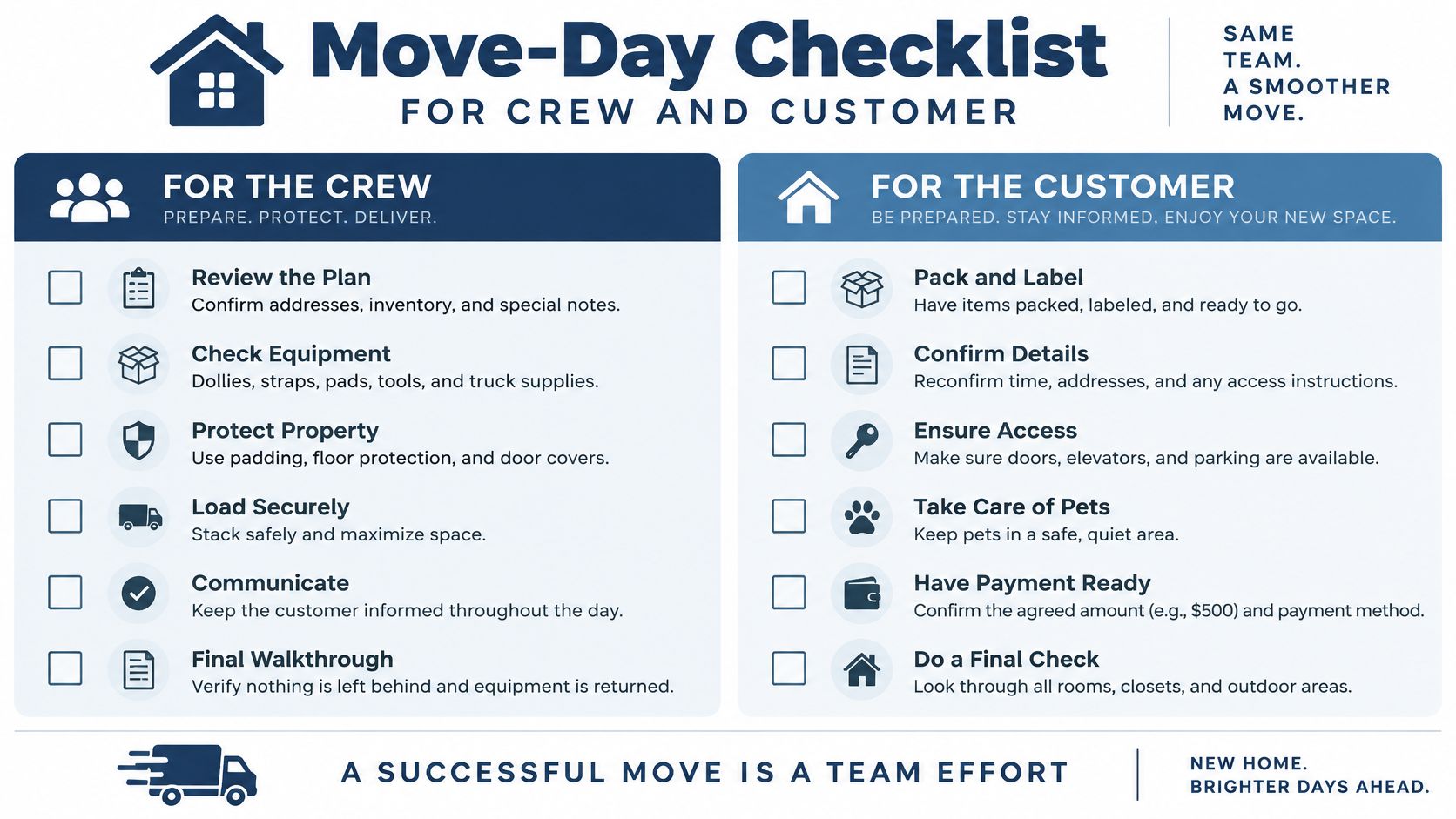
Have an adult on site for pickup and delivery. Webster Moving Co. asks that driveways, entrances and elevators be accessible, boxes be packed and labelled before the move, and someone over 18 be present at both ends.
Walk the crew through the home. Point out fragile pieces, high-value goods and the pile that stays behind. Five minutes of orientation prevents a wrongly loaded truck.
Keep the essentials bag out of the truck. Medications, identity documents, chargers, tools and a change of clothes. If it can't be replaced by a shopping trip, it doesn't ride in the trailer.
Watch the inventory as it's written. Pre-existing damage belongs on the sheet, not in an argument three weeks later.
Inspect high-risk items first at delivery. Compare every carton and piece against the inventory and record shortages or damage before you sign.
Keep the bill of lading and every copy until the claim, if there is one, is settled.
The FMCSA mover and consumer handbook sets out why those records matter. It defines an extraordinary-value article as one exceeding $100 per pound, against standard released-value protection that may provide only 60 cents per pound per article unless you select higher valuation. It also sets the claims clock: for an interstate shipment, submit a written claim within nine months of delivery, or of the date delivery should have occurred, rather than waiting on a verbal promise.
Self-packed cartons complicate claims, because proving whether the damage happened before or during transport is harder. Detailed pre-loading photographs are the practical fix.
Book Your Move and Confirm Payment Terms
Booking is a decision, not a formality, and it's the one decision that gets more expensive the longer it waits. Three actions, in this order.
Reserve the date against your real deadline. If the lease ends on the 31st, book for the 28th or 29th so there's a buffer for a slow elevator or a late closing. Pick the crew before you pick the paint colours.
Send the full scope. The item inventory, photos of tight stairwells, flight counts, parking and elevator details, and every specialty item by name. That's what turns a phone number into a written estimate that matches the job, and it's what you'll compare against the charges table when the quotes come back.
Sign only when three things are clear in writing. The scope, the valuation coverage and the payment terms. Payment is due on completion unless you've agreed otherwise in writing, and it's fair to ask up front whether a deposit is required, when the balance is due, and which payment methods are accepted.
Webster Moving Co. offers full or partial packing services before moving day and an upfront estimate based on the details of your move, so the expected cost is known before the crew arrives rather than settled at the curb.
Then make the call. Have the move date, both addresses, the flight counts and the specialty items in front of you when you do, because those four details are what a real estimate is built from.
Webster Moving Co. handles house, apartment and long-distance moves across Greater Austin and Central Texas, with full or partial packing, furniture protection and crews briefed on stairs, elevators and parking limits before they arrive. Send over your move date, both addresses and the access details, and you'll get an upfront estimate built from the details of your move rather than a number guessed over the phone. Visit Webster Moving Co. to request a no-obligation quote.
Comments