
Apartment Movers: Stairs, Elevators and Building Rules
In 2024, 18.3% of renter households moved within the previous year, down from 37.2% in 1981, according to U.S. Census historical housing data. That long decline doesn't make apartment moves simple. When a move has to fit a lease deadline, a reserved elevator and a building's loading rules, access can matter more than the hourly labor rate.
Table of Contents
Why Apartment Moves Need Their Own Plan
A renter on the fourth floor has to be out by the end of the day. The building has one shared elevator and allows moves only during a strict window. Across town, an older building's loading area sits behind a gate, and the truck can't reach the entrance without permission. The first move risks running out of time, the second adds carry distance, and the third may stall before the crew can unload.
Those problems don't disappear because renter mobility has declined. U.S. Census figures show that renters have historically moved more often than homeowners, and in 2024, 38.0% of renter householders aged 18 to 24 had moved within the previous year, compared with 7.8% of those aged 65 or older, according to the Census housing tables. Fewer renters moving overall still leaves plenty of households facing a short, tightly scheduled relocation.
An apartment move has two halves: the truck and the building. The job works when the elevator slot, loading permission and parking space line up. It's like a restaurant delivery that needs the service door, the lift and a place to stop at the same time. A crew can be ready to work, yet lose time if the building hasn't approved the route.
This guide focuses on the practical decisions that prevent those stalls: an access checklist, a comparison of carry methods, a move-day sequence that protects shared areas, an all-in cost audit, a plan for mobility needs and essentials, and a final confirmation list to complete before booking.
The Access Details to Collect Before Booking
Start with the building facts that determine how the crew and equipment will get from the apartment to the truck. Measure what you can and confirm building rules in writing. The OSHA materials-handling guidance recommends stair-climbing hand trucks for moving materials on stairs and using elevators or ramps where feasible to avoid stairs and uneven ground. For an apartment move, those choices depend on the route, not just the number of boxes.
Factor | What to measure or confirm | Why it changes the plan |
|---|---|---|
Elevator | Cab width, depth and height; door width; capacity; reservation rules and booking window | Determines whether carts and large furniture fit, and whether the elevator is available for the move |
Stairs | Number of flights, stair width, landing size and number of turns | Helps set crew size and whether a stair-climbing dolly is practical |
Loading zone | Distance from curb or lot to entrance; time limit for loading | Establishes the carry route and whether the truck can remain near the entrance |
Parking and gate access | Permit requirement, reserved spaces, gate code, truck height and length limits | Confirms that the truck can enter, park legally and stay for loading |
Hallways and doors | Hallway width, turns, door swing direction and threshold height | Shows whether furniture can pass intact or needs disassembly |
Floor level | Unit floor and whether the elevator stops on that floor | Determines the final carry method and how the route connects to the unit |
Building move rules | Move hours, deposit requirement and insurance certificate requirement | Sets the schedule and identifies paperwork or charges to arrange beforehand |
Get the information with a tape measure, clear photos of the entrance and loading area, and a short written request to building management. Ask for the elevator cab and door dimensions, reservation process, truck access rules, and any move-hour restrictions. One note from management may answer several checklist items at once.
The measurements affect more than convenience. They help the mover choose between two-wheel and four-wheel dollies, plan for protective materials, decide whether large items need to be taken apart, and assign a crew that can handle the route. Webster Moving Co. asks apartment customers to share details about stairs, elevators, loading areas, gate codes and parking restrictions so the move can be planned around the actual access conditions.
Practical rule: Treat every unknown as a question to settle before booking, not a detail the crew can guess on moving day.
How Stairs and Elevators Change the Crew Plan
An elevator move works like a conveyor belt: it carries weight between floors without asking workers to climb each flight. A stair move is more like a hand-passed relay. Every carrier, landing and turn becomes part of the route, and each additional lift adds effort and time.
The revised NIOSH Lifting Equation starts with a 51-pound load under ideal two-handed lifting conditions and reduces the recommended limit according to factors such as horizontal reach, lifting height, frequency, twisting and grip quality. That starting figure isn't a universal safe target for a moving carton. A floor-level pickup, an extended carry or a sofa turn on a narrow landing changes the lift.
Crews can adjust by packing dense contents in smaller cartons, keeping loads close to the body, staging items around waist height where possible, and using dollies or stair-climbing hand trucks for repeated trips. A bulky sofa that must pivot on a landing may need an extra helper to guide the turn and keep the carriers' movements coordinated.
The access conditions also change the schedule:
Access scenario | Carry method | Crew and equipment | Schedule effect |
|---|---|---|---|
Reserved service elevator | Dollies and carts from unit to lobby | Standard crew with floor and wall protection | Often the most direct route; total time still depends on the floor and amount being moved |
Shared elevator with residents | Stage loads and time trips around resident use | An extra helper can manage doors and coordinate the route | Slower than a dedicated reservation; ask whether off-peak hours are allowed |
Walk-up with no elevator | Stair-climbing dolly where suitable, plus controlled hand carries | Crew sized for the stairs, turns and items, with rest breaks planned | Adds work on each flight, especially for bulky pieces |
Elevator out of service | Reroute through stairs or reschedule | Confirm a workable backup plan with the crew | Without a confirmed alternative, furniture may need another trip |
A stair move may avoid elevator equipment or reservation complications, but it usually adds labor time. The difference grows as the route adds floors, narrow turns and awkward loads. Don't treat “stairs” as a note to mention in passing; make it part of the plan for crew size, equipment and timing.

Move-Day Sequence and Shared-Area Protection
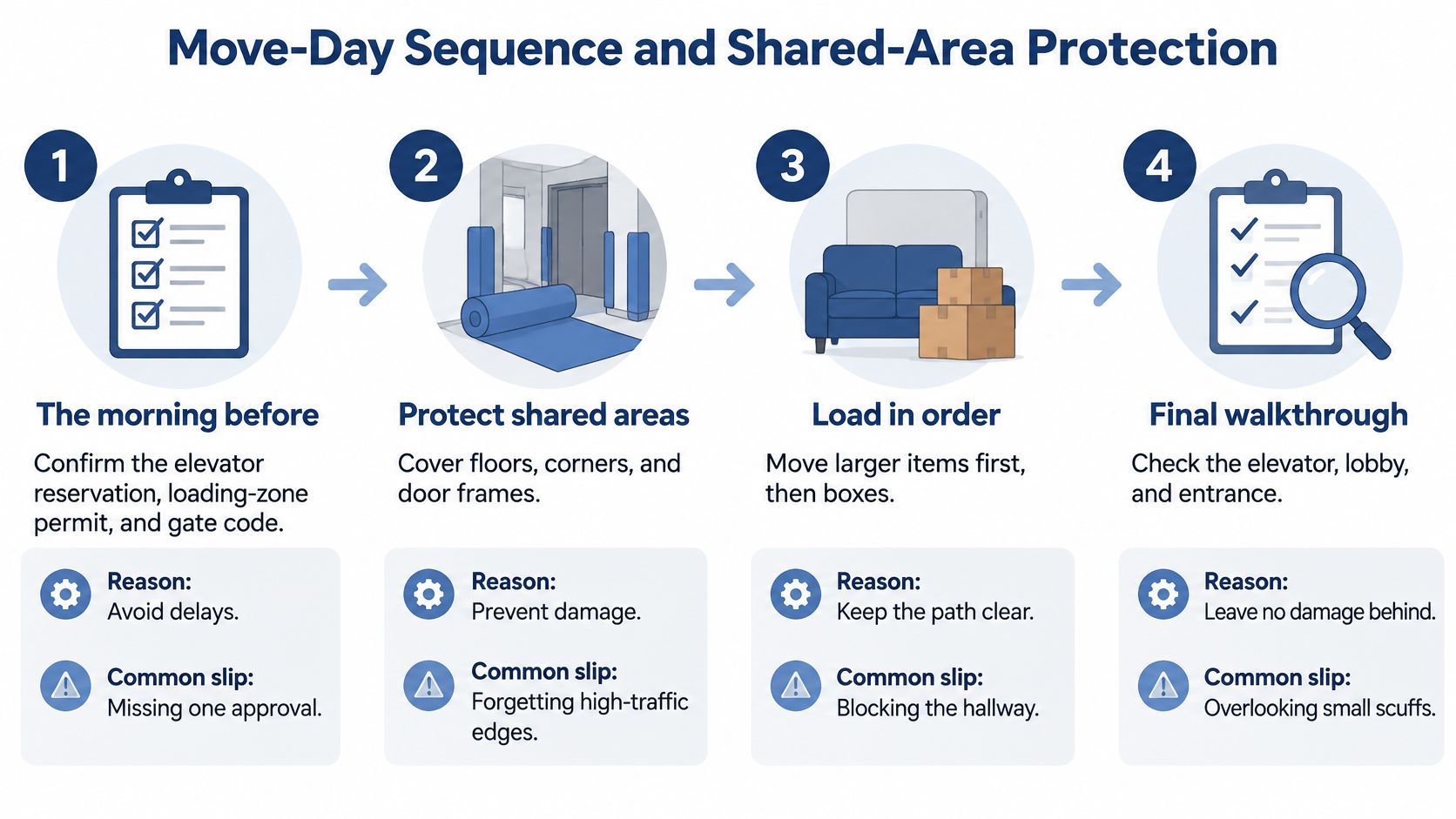
A clear order keeps the route usable and helps prevent damage to floors, walls and doors. Agree on who directs movement through tight spots, and don't let protection materials become an afterthought once the first cart is already rolling.
Confirm access the morning before. Recheck the elevator reservation, loading-zone permit and gate code with the relevant building contacts. A missing approval can hold up the crew before loading starts, so don't rely on a verbal confirmation from an earlier call.
Protect shared surfaces before carrying begins. Photograph the lobby, elevator, hallway and entrance, then lay runners across the travel path and install elevator pads or a cab cover. Add corner guards and threshold covers where carts turn; the common slip is protecting the middle of the floor while leaving high-traffic edges exposed.
Prepare large furniture upstairs. Disassemble beds, tables and other pieces that won't clear the elevator or turns intact, and keep the hardware together in a labeled bag. Taking furniture apart at the entrance can block the hallway and interfere with other residents.
Assign one route director. Have one person signal at doorways, elevator entries and tight turns while the carriers move the item. Without a clear director, people may push or pivot at the same time, increasing the chance of a collision or a dropped piece.
Load deliberately. Move the heaviest stable pieces in a controlled order and spread weight across the elevator cab floor. Keep the hallway clear between trips rather than stacking cartons where residents need to pass.
Walk and photograph the route at the end. Check the apartment, hall, elevator and entrance for items left behind or marks made during the move. A quick sweep and a record of any scuffs can prevent disagreements about when damage occurred.
Repeat the protection and route checks at the destination. Confirm that the new building's elevator slot is ready before the truck arrives, then protect the shared areas and keep the path open. Don't assume the destination has the same access rules as the departure building.
Building rules shape the sequence, too. Check for quiet hours, restricted move-in windows, blocked hallways, fire-door requirements and insurance paperwork due before arrival. If a rule conflicts with the schedule, request a written exception or change the start time rather than hoping staff will make an exception on the day.
Protection is usually simpler than repairing a dented door or chipped tile. Customers should make sure entrances and elevators are accessible, pack and label boxes before the move, and have someone over 18 present at pickup and delivery. For help planning the physical loading and unloading sequence, see Webster Moving Co.’s loading and unloading service.
Building Charges That Make a Cheap Move Expensive
A low hourly quote can still produce an expensive move. Building-side charges often determine the final total: fees tied to the lease, the payment method, the elevator reservation, the parking rule or the start date for utilities. In the Federal Trade Commission's rental housing fee report, the agency lists rental charges such as move-in fees, parking, trash, technology, utilities-related, payment-processing, roommate, guest and month-to-month fees, and cites a 2025 report finding that more than 70% of renters paid at least one mandatory fee beyond monthly rent.
The practical response is simple: get the charge list in writing before comparing moving prices. Ask each building or property office which fees are mandatory, which are optional, which are triggered by move day and which continue after the keys are returned. A quote can look cheaper while the household still owes administrative, disposal, parking or payment-related charges that never appear in a mover's estimate.
Charge type | Common trigger | What to confirm in writing |
|---|---|---|
Move-in or move-out fee | Lease terms and building policy | Whether it applies on moving day and the amount |
Lease overlap | Rent due on both units | Number of overlapping days and daily cost |
Utility activation | Utility provider start dates | Service start date at the new unit |
Mandatory rental fees | Parking, trash, technology or amenity charges in the lease | Which fees are mandatory and which are optional |
Convenience or service fees | Paying rent through a particular method | Whether the payment method carries a fee |
Delay turns small charges into larger ones. A missed elevator slot can force a second crew day, which can add lease overlap, extra coordination and more labor. A forgotten disposal charge or utility start date can leave the old unit active after the household has already moved. The savings from a lower hourly rate disappear when the calendar, not the carrying, creates the extra day.
Make a one-page cost audit for both buildings before comparing mover quotes. Put lease overlap, utility activation, cleaning, disposal, move-in or move-out fees, parking and administrative charges beside the moving estimate, then record the person or office that confirmed each amount. For a closer look at what may affect the moving portion of the budget, use Webster Moving Co.’s apartment moving cost guide.
Planning Around Mobility Needs and Essentials
The fastest possible move isn't always the safest or most useful one. A household may need a step-free route, a working elevator, rest points along the corridor or enough time to move essential equipment without interruption. Those details should shape the destination check and the loading order.
The 2025 National Renter Survey found that 65.0% of renters whose households needed mobility features lacked them in their current homes, and 77.1% of renters needing sensory features lacked those features. It also found that 43.7% said landlords were typically unwilling to add requested accessibility features, according to the National Low Income Housing Coalition survey findings. That makes it especially important to verify what the next building can provide before committing to a move.
Check the route from parking to the unit, not just the apartment doorway. Confirm whether there's a step-free path, where someone can pause to rest, how far the loading zone is from the entrance, and what happens if the elevator stops working. If an elevator outage would make the unit inaccessible, decide in advance whether to delay the move, use a different entrance or arrange another safe option.
Repeated moves add another reason to check accessibility carefully. In the same survey, 20.9% of renters with household incomes below $25,000 had moved three or more times in the previous two years, compared with 7.1% of renters earning at least $25,000. An inaccessible destination can turn the end of one move into the start of another.
The best move plan protects access to what the household needs, not just the furniture.
Pack medication, mobility devices, chargers, important documents, a change of clothes and bedding in a clearly marked essentials group. Load these items last so they can come off first, and keep anything needed during the move with the person who needs it. Tell the mover about medical equipment ahead of time, and have its owner present at both pickup and delivery so the equipment can be handled and placed with care.
The cost to avoid isn't only a longer move day. It's a second move caused by a home that doesn't work for the people living in it.
Confirm Building Access Before You Book
Send the same access questions for both the current and destination buildings. A mover can plan around stairs, elevators, furniture disassembly and parking restrictions, but only if those details are part of the quote request.
Confirm the elevator reservation and cab dimensions in writing. Ask management to verify the door opening, cab size, capacity and booking rules. This tells the crew whether furniture and carts will fit and whether the time slot is held.
Confirm the loading-zone permit and carry distance. Find out where the truck may park and measure the route from the curb or lot to the entrance. A short walk and a long carry require different staging and timing.
Check parking and gate access. Confirm permits, reserved spaces, gate codes and truck height or length limits. A truck that can't enter or park near the building can delay the move before the first item is carried.
Get the building rules and required paperwork. Ask about move hours, deposits and insurance certificates, and note who must receive each document. Share the requirements early enough to resolve any missing approval.
Verify destination access and a backup plan. Confirm the elevator slot, step-free route and what the building permits if the elevator is out of service. That helps you decide whether the scheduled move can proceed safely.
A mover who asks about stairs, elevators, loading areas, gate codes and parking restrictions is gathering the information needed to plan the work. Webster Moving Co. handles apartment logistics that include those access constraints, and its short-distance moving information can help you prepare details to share when requesting a quote.
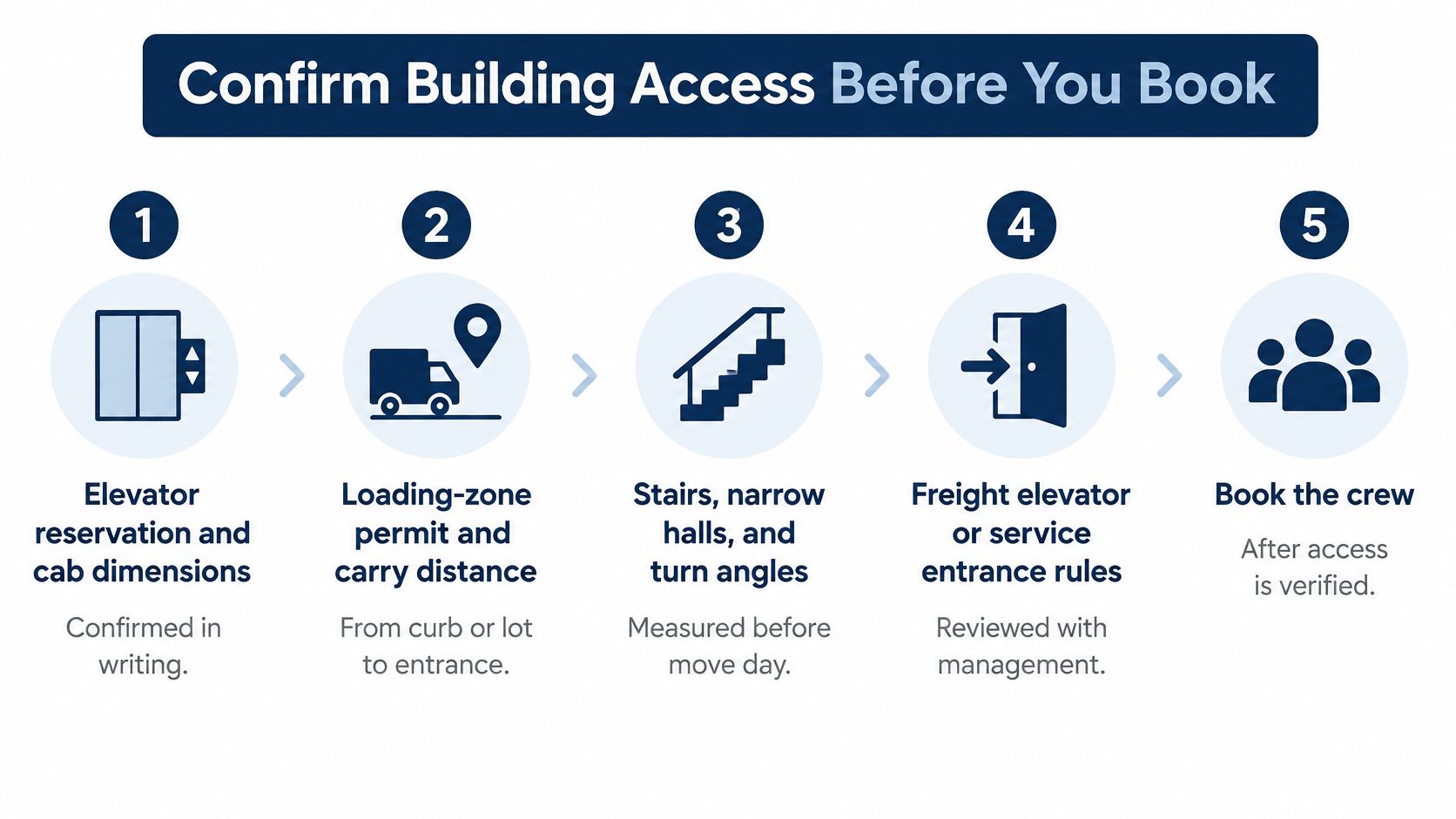
Book early enough to secure the elevator slot and loading permit, then send the completed access checklist with every quote request, including to Webster Moving Co., as one option to compare.
Webster Moving Co. handles apartment moves across Central Texas, including stairs, elevators, parking restrictions and furniture disassembly and reassembly. Share your building access details and request an estimate from Webster Moving Co. to discuss a move plan built around your buildings' rules.
Comments