
How to Pack Lamps for Moving Without Breaking Them
Your living room is down to boxes, tape, and one floor lamp you've been walking around all afternoon. The shade is wider than every carton in the house, the base is heavier than it looks, and there's a shoebox of spare bulbs you haven't decided about yet.
Lamps are the item that arrives cracked when nobody remembers dropping anything. The failure usually happens in the last hour of packing, when the shade gets wedged in beside the base and a bag of hardware goes loose in the bottom of the carton. Getting the sequence and the materials right takes about 15 minutes a lamp, and it's the difference between lighting the new place on night one and shopping for replacements.
Table of Contents
Lamp Parts, Boxes and Materials to Match - The shopping list
Bulb Types and Disposal Rules Before You Pack - The mercury reason the CFL row is different - Build a bulb inventory before moving day
Floor Lamps, Shades and Antiques in Two Boxes - The failure checklist
Decide Whether to Pack Lamps Yourself or Hire Help - This week's list
Lamp Parts, Boxes and Materials to Match
Buy the boxes before you handle a single fixture. Matching a carton to the tallest part of each lamp takes a few minutes and removes most of the improvisation that cracks glass later.
Lamp part | Wrap | Box | Main risk |
|---|---|---|---|
Table lamp base | Several layers of soft paper or bubble wrap, then a corrugated outer layer | Carton sized to the base with cushioning on all sides | Ceramic or metal touching the carton wall |
Shade (fabric or glass) | Rigid support around the rim and interior, then a separate wrap | Oversized separate box with nothing resting on it | Compression and cracked glass |
Harp, finial and small hardware | Labeled sealed bag | Taped to the base inside the carton | Loss during transit |
Floor lamp stem | Wrapped and immobilized along its length | Long rigid carton, such as a 12 by 12 by 40 inch lamp box | Shifting and bending of the stem |
Two rows there cause more breakage than the other two combined.
The shade is the part people try to save a box on. Fabric or glass needs support around the rim and something soft inside the opening, plus a carton wide enough that nothing presses the sides inward. Cram a shade into a box that just fits and the drum goes oval before the truck leaves the driveway.
The floor lamp stem is the other one. Long, thin and heavy at the bottom, it bends when it's allowed to lie diagonally in a carton built for a mattress. In 2026, U-Haul lists its lamp moving box at 12 × 12 × 40 inches, with a weight of 1.90 pounds and a maximum load of 65 pounds, dimensions that suit a stem and still leave room to fill around it, according to the U-Haul lamp box listing. A load rating tells you what the cardboard can carry. It says nothing about what happens to a lamp that slides inside it.
The shopping list
Boxes sized to the tallest part: a long rigid carton for floor lamps, a snug carton for each table base, and one oversized carton per shade.
Soft wrap: plain packing paper or bubble wrap, several layers per base. Keep newsprint for corners, since the ink transfers onto fabric shades.
Rigid layer: corrugated sleeves or double-wall offcuts so the soft wrap can't compress flat.
Sealable bags and tape: hardware goes in a bag, the bag goes onto the base.
Labels: room, contents, and which end is up.
Lamps reward the same thinking you use when you pack a kitchen for moving: dense items separated from fragile ones, nothing sharing a box that can crush what's under it.
Bulb Types and Disposal Rules Before You Pack
Bulbs need a decision before they need a box. The question is not how to wrap them, it is whether each bulb should travel at all and what happens to the ones that stay behind.
Bulb type | Move it? | Packing | Disposal |
|---|---|---|---|
LED | Yes, if intact | Each bulb wrapped and boxed separately | Generally no mercury, check local rules |
Incandescent | Yes, if intact | Each bulb wrapped and boxed separately | Check local rules before disposal |
CFL (spiral or tubular) | Only if intact | Sealed bag inside a carton, kept apart from other items | Mercury-containing, use a household hazardous-waste or recycling program |
Any damaged bulb | No | Do not pack | Dispose of by bulb type, following the rules above |
The mercury reason the CFL row is different
Compact fluorescent lamps contain mercury, so a broken one becomes a hazardous-waste problem rather than a simple glass cleanup. Treat CFLs as mercury-containing waste and send them through a household hazardous-waste or lamp-recycling program instead of the ordinary trash. You can spot them by shape: the spiral and tubular forms are the CFLs, while the standard pear-shaped bulb on a screw base usually is not. LEDs generally contain no mercury, which simplifies the decision for most modern fixtures.
Long-distance moves need one extra step. Disposal rules are set locally, so an option that works in Round Rock may not exist in the destination county.
Before you load the truck: confirm where household hazardous waste goes at the address you're moving to, not the one you're leaving.
Build a bulb inventory before moving day
Count each type, mark which bulbs are intact, and decide which spares earn a spot in the load. Intact bulbs move in a small padded carton of their own, never loose in a drawer and never screwed back into the lamp. A bulb that rolls against other glass can crack even when the carton never takes a hit.
Anything cracked, blackened at the base or already flickering stays behind and gets disposed of by type. Buying replacements after the move is cheaper than cleaning mercury off a truck floor.
Pack a Table Lamp in Nine Steps
The order is the method. Everything comes off before anything gets wrapped, because a harp left on the socket turns a soft bundle into a lever that snaps the fitting the moment the carton is set down. Work on one lamp at a time so the shade, cord, finial and hardware stay with the base they belong to.
Here's the sequence end to end.
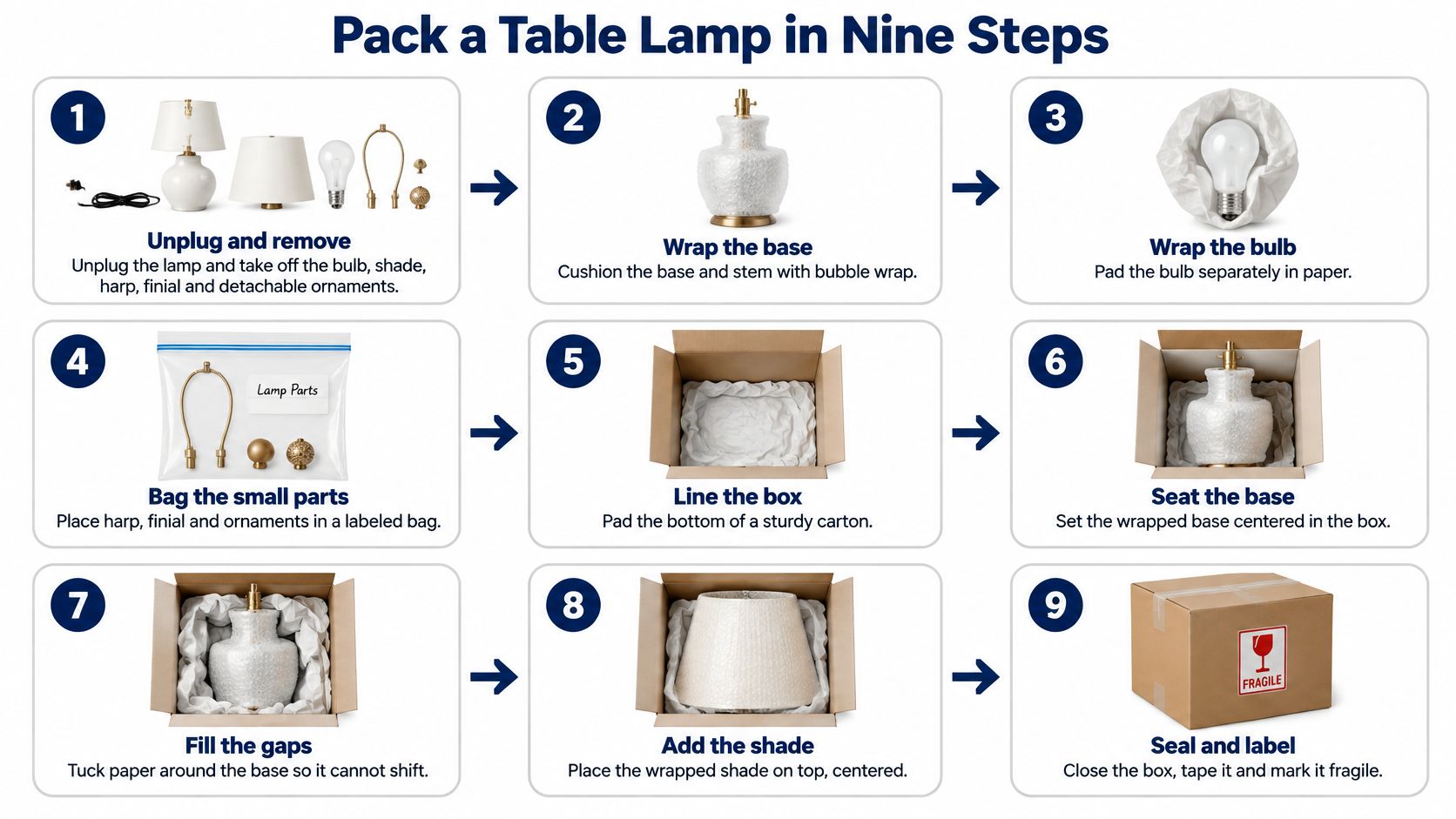
Unplug and strip the fixture. Remove the bulb, shade, harp, finial and any detachable ornaments. Set the bulb aside where it won't roll off the table.
Bag the small parts and tape the bag to the base. A finial in a loose bag at the bottom of a carton is a finial you'll be ordering again in a month. Tape the labeled bag to the base itself.
Wrap the base in soft layers. Several layers of packing paper or bubble wrap, with extra padding at the widest point and the foot.
Add a rigid outer layer. A corrugated sleeve or a sheet of double-wall cardboard over the wrap stops it from compressing when the box is stacked. Soft wrap alone flattens under load.
Handle the cord, switch and socket deliberately. Coil the cord loosely rather than wrapping it tight around the base, and tuck the switch and socket so nothing presses on them from the side.
Fill the voids. Every gap between the wrapped base and the carton wall gets paper, foam or a clean towel. Empty space is where the lamp builds speed.
Pack the shade in its own oversized box. Support the rim, cushion the inside of the opening, and put nothing on top, in the box or stacked above it in the truck.
Wrap each bulb separately. Individual wrap, then a small box, then that box inside a larger carton away from the base. Bulbs travel badly when they can touch each other.
Seal, label and name the room. Write the contents and the destination room on two sides. A "Fragile" sticker influences how a box is handled; it doesn't cushion anything.
None of that is fussiness. The ISTA packaging guidelines name shock, vibration, compression and atmospheric exposure as the four hazards a shipped package faces, and lamps are a worst case because they mix glass, ceramic or porcelain with thin protruding fittings that catch impact.
A crushed shade can't be repaired. A bent harp is a few dollars. Spend the padding where the loss is permanent.
Lift the sealed carton by opposite corners and tilt it slowly. Sliding or a rattle means the job isn't finished, so open it and add material before it goes on the truck.
Floor Lamps, Shades and Antiques in Two Boxes
A floor lamp won't go in a single carton the way a table lamp will. The proportions are wrong, and a tall piece packed vertically whips sideways every time the truck takes a corner. Two boxes solve both problems.
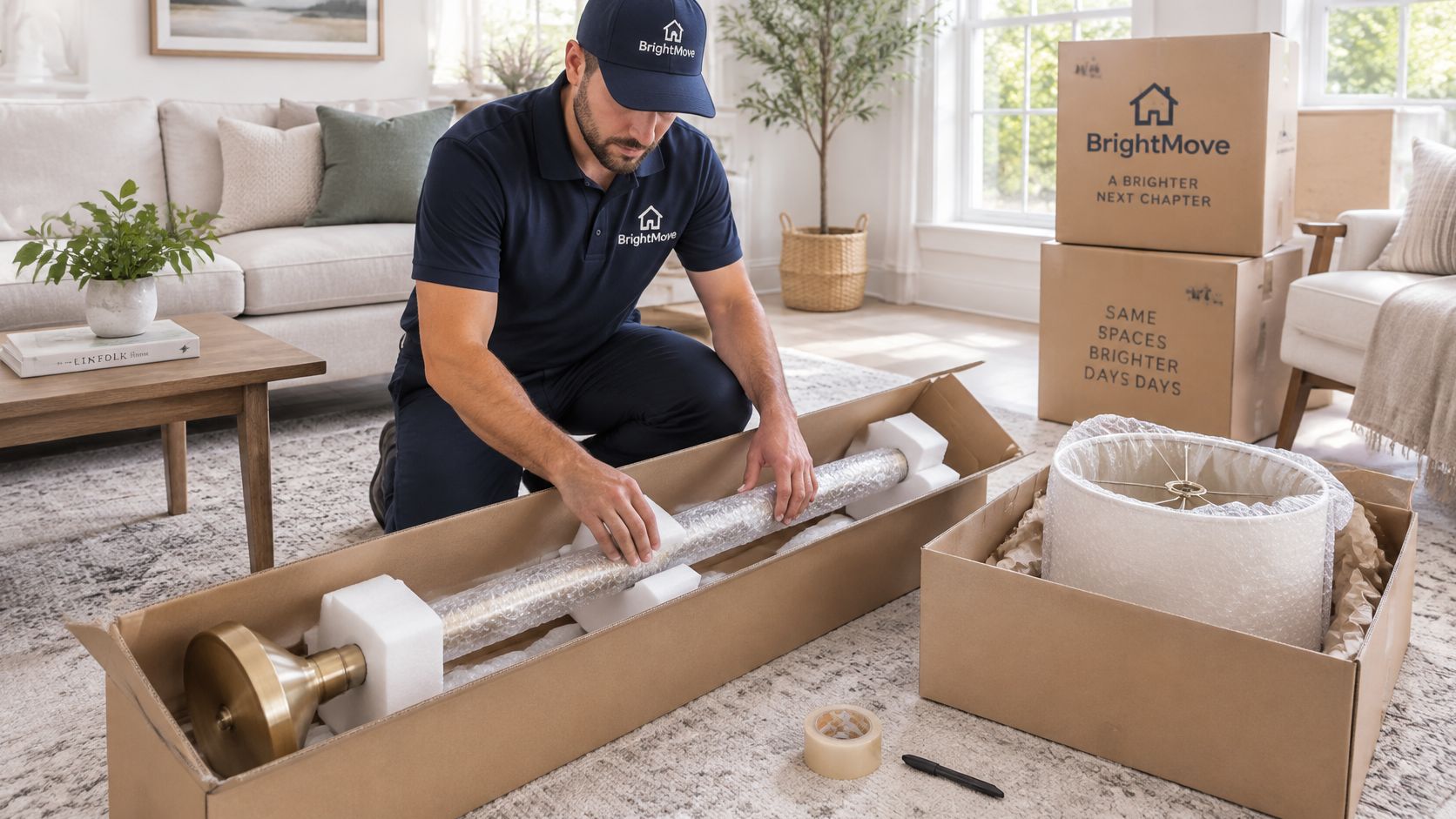
Start with the stem and base. Take the lamp apart at its threaded joints first: most floor lamps unscrew into two or three sections, and shorter sections flex less and wedge tighter in the carton. Wrap each piece, then immobilize the full length in a long rigid carton so the shaft can't bend, centered with cushioning on every side. The shade goes in a second carton with support around the rim and no weight pressing on the drum.
Close both boxes, shake each gently, and reopen anything that rattles.
The testing standard behind that shake test is worth knowing. ISTA's parcel-oriented Procedure 3A puts packaged products through a defined battery of drop and vibration tests, as the ISTA 3A overview describes. In the same testing family, packages face random vibration at levels of 0.53 and 0.46 Grms, per the ISTA 3L project overview. Your lamp won't run that exact sequence, but the benchmark exists because a carton that survives one drop can still fail under repeated impacts from several directions plus hours of shaking. One careful hand-carry doesn't replace a box that holds its contents still.
The failure checklist
Bulb left in the socket: the most common cause of a shattered shade, since the bulb becomes a hammer inside the drum.
Newspaper as the only cushioning: it compacts to nothing under a stacked carton.
Voids left open: space at the top of the box lets the lamp build momentum.
A shade under heavy cartons: fabric and glass deform under load even without an impact.
A ceramic base touching the carton wall: one knock and the corner chips.
An antique or a lamp with real value belongs in the family vehicle, wrapped and standing upright, rather than on the truck. Treat it with the same care you'd give transporting a grandfather clock: rigid support, nothing stacked on it, and one person responsible for it from door to door. If the piece can't ride in your car, hand it to movers with experience in items that need additional planning and care; Webster Moving Co.'s crews handle pianos, safes and large furniture in that category, and an irreplaceable lamp belongs on the same list.
Why Lamps Break Inside the Box, Not Just on Impact
A glass shade packed snugly beside a heavy bronze base survives the loading dock, the ramp and the highway. It cracks in the driveway when the driver brakes and the base slides six inches into it.
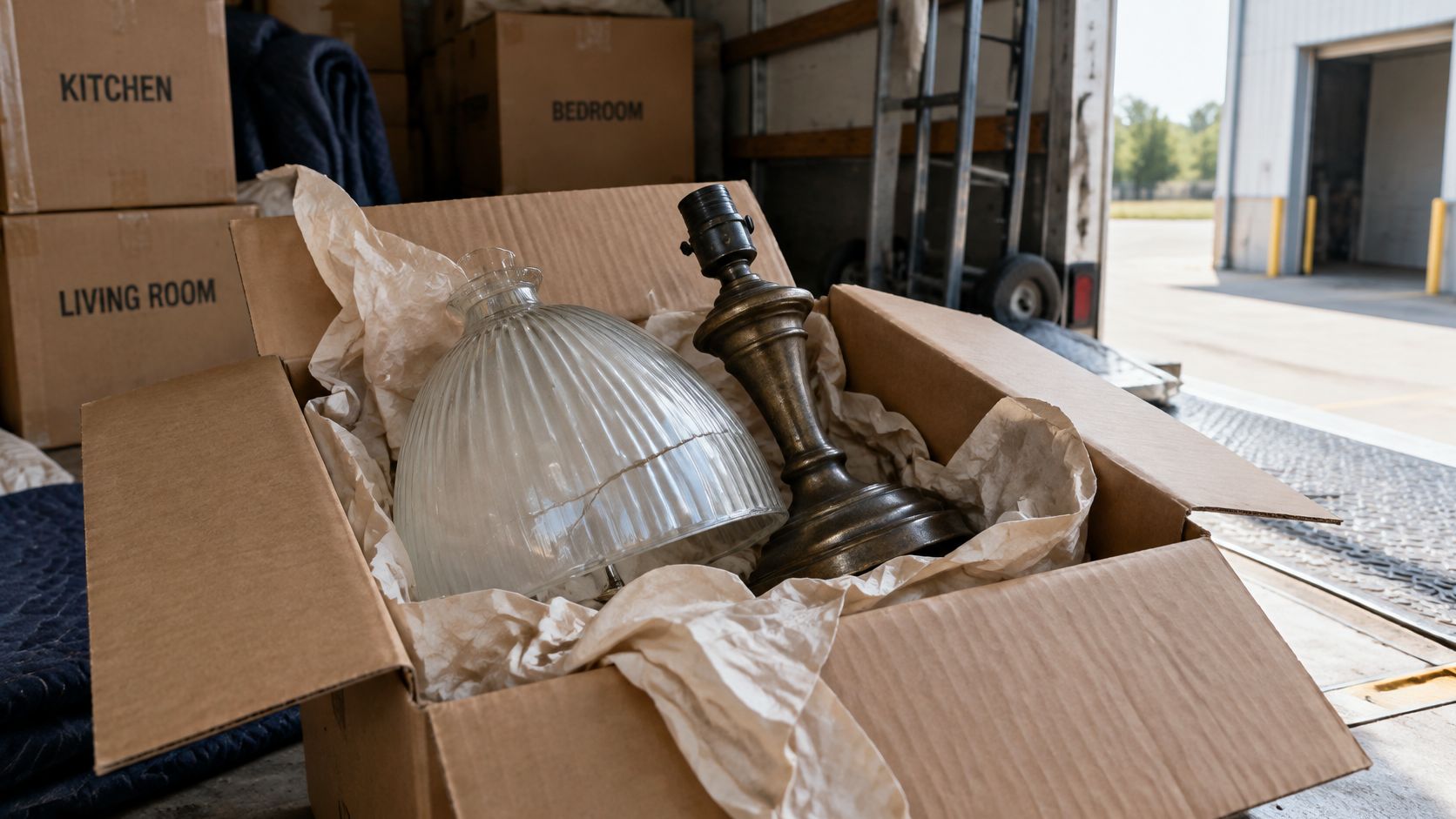
That's the part of the job that gets missed. Damage comes from movement inside the container as much as from a single fall, and the two failure modes need two different fixes. The U.S. Postal Service's packaging standards require fragile contents to be cushioned against normal processing, transportation and delivery, and separately require packers to stop contents from shifting inside the container, as the USPS mailing standards spell out. Cushioning absorbs the hits. Blocking stops the travel.
Lamp geometry makes it worse. Bases and shades are hollow or cavity-shaped, so they collapse or rub against their own interior surfaces unless the empty space inside gets filled too. A shade that feels snug on the bench can still flex against its own walls every time the truck rolls over a seam in the road.
The same standards warn that heavy items must be braced and cushioned, and that high-density objects shouldn't share a package with fragile ones unless they're carefully separated. On a moving truck that translates directly: a crate of books stacked on a shade carton is a real risk, and a loose base rolling beside a glass globe is worse, since every stop gives the dense piece a fresh run at the fragile one. Loose fill has to hold each item in place and keep it off the walls of the box.
If a lamp can move in its box, it will eventually break.
What saves the lamp is mechanical. Immobilize it, isolate the fragile pieces from anything dense, and fill every void before the tape goes on. Careful handling helps on the margins, but a box built right survives without special treatment.
Decide Whether to Pack Lamps Yourself or Hire Help
Pack them yourself if you're looking at a handful of standard table lamps, no antique glass, boxes on hand and a free evening. That's a two-hour job with a tape gun and a roll of bubble wrap.
Call in help when the inventory includes several floor lamps, a fragile antique, heavy ceramic bases, a staircase at either end, or a schedule that leaves no room for a second attempt. The judgment isn't about difficulty. It's about what a cracked shade costs you in replacements, delays and a week of lamps balanced on unpacked boxes.
Webster Moving Co. offers full or partial packing services before moving day, plus unpacking that puts items where they belong, removes the packing materials and leaves the home move-in ready. Partial is often the right fit for this job: you handle the kitchen and clothes, and the fragile lighting, mirrors and glassware go into the crew's hands. The difference shows up on the other end too, when the same crew handles the pack and unpack service and you're not the one digging finials out of a bin of paper.
A few logistics decide how smoothly that morning goes. Webster Moving Co. asks customers to make sure driveways, entrances and elevators are accessible, to have every box packed and labeled before the move, and to have someone over 18 on site during pickup and delivery. On an apartment move, pass along the stairs, elevator, gate codes and parking restrictions in advance so the crew plans the lamp boxes around them.
This week's list
Count the lamps by type so you know how many long cartons, shade cartons and small boxes to buy.
Pull the bulbs and sort them into LED, incandescent, CFL and damaged before anything gets wrapped.
Measure the tallest part of each fixture and buy boxes with two inches of cushioning room on every side.
Book packing help now if you're taking that route, since weekend and end-of-month slots fill first.
Check disposal options at the destination for any CFLs you're leaving behind.
Lamps are the one category where a small amount of professional packing removes most of the risk, and Webster Moving Co. handles that work across Round Rock, Austin and the surrounding Central Texas communities, wrapping shades and bases separately and loading them so nothing heavy rides on top. If you'd rather not spend your last evening before the move cutting cardboard sleeves, Webster Moving Co. can quote a partial or full packing plan and take the lighting off your list.
Comments