
Transporting Grandfather Clock Safely: A Step-by-Step Guide
The clock fits comfortably in your current hallway, but the stairwell at the new house has a tight turn and a low ceiling. Meanwhile, someone's suggesting you wrap the cabinet in a blanket and load it with the furniture. Before anyone lifts it, you need a plan for the mechanism inside, not just the wooden case around it.
Transporting a grandfather clock safely means separating mechanical preparation from physical moving. A capable moving crew can handle the cabinet and access route. A clock specialist should handle unfamiliar, damaged, or valuable mechanisms, especially when parts won't detach normally.
Table of Contents
Measure the Clock and Route Before You Move - Measure the whole carrying envelope
How to Prepare and Pack the Clock Step by Step - Document and remove the vulnerable parts - Finish with a readiness check
Load and Strap the Clock Upright for Transit - Control the lift and stair carry - Restrain the cabinet without crushing it
Protect the Clock From Heat, Humidity and Storage Swings - Plan the environmental transitions
Reinstall and Regulate the Clock After the Move - Inspect first, then reconnect - Separate beat adjustment from time regulation
Decide Whether to Move Your Clock Yourself - Make the specialist handoff explicit
Measure the Clock and Route Before You Move
Start with a tape measure, a phone camera, and access to both properties. A clear route out of the old house doesn't prove you have a workable route into the new one.
Pre-move checks for a grandfather clock
Check | Typical value | Why it matters |
|---|---|---|
Case height | Modern examples commonly stand 1.8–2.4 m, approximately 5.9–7.9 ft, within the longcase tradition described by The Metropolitan Museum of Art. | Sets stairway, doorway, and truck-height clearance. |
Pendulum length | About 39 inches, a traditional longcase reference, not a substitute for measuring yours. | Determines the length of its separate protective container. |
Internal weights | Count, measure, and identify every weight fitted to your model. | Weights may be unequal, so each needs an individual label and padding. |
Route clearance | Measure every doorway, turn, stair, gate, and low point. | Determines whether the prepared case can travel upright. |
Measure the whole carrying envelope
Record the case's width and depth, including projecting feet and decorative features. Allow room for moving blankets, the handling equipment, and the movers' hands. A cabinet that barely clears a doorway unwrapped may not clear it safely when protected.
At stairs, check the ceiling above the steps and the space available on landings. At the truck, measure the loading opening rather than assuming the interior height guarantees access.
The longcase cabinet developed to protect suspended precision components. Its tall shape isn't permission to handle it like a wardrobe.
Go or no-go: If the case can't pass upright through every doorway and turn, arrange a specialist assessment before loading day.
Movement removal may be necessary, but it doesn't make an oversized cabinet smaller. A blocked route may also require a different entrance, different equipment, or a revised delivery location.
How to Prepare and Pack the Clock Step by Step
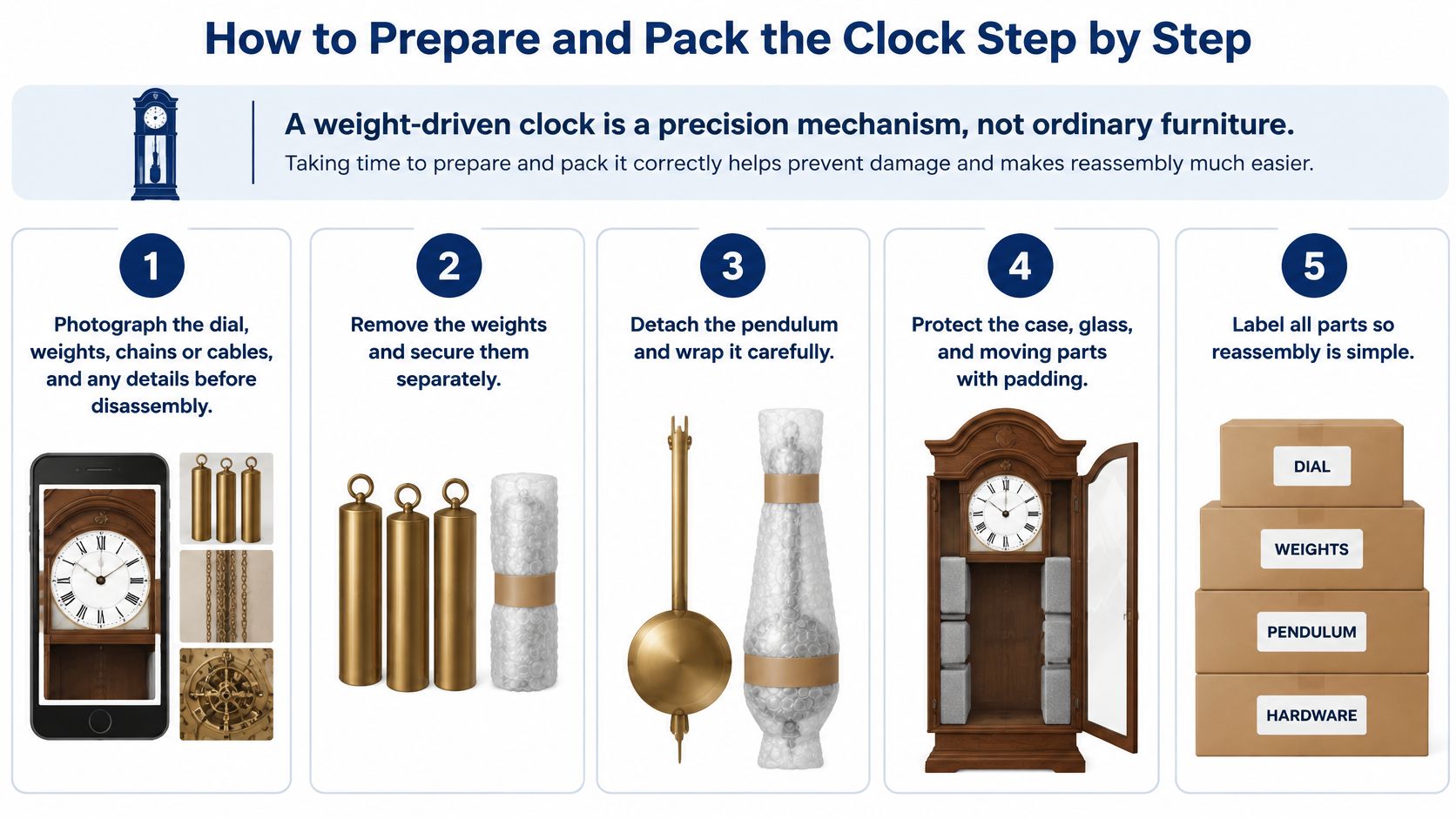
A weight-driven clock is a precision mechanism, not ordinary furniture. The preparation guidance from 1-800-4CLOCKS emphasizes removing vulnerable components, identifying weights correctly, and preventing uncontrolled movement during transport.
Have labels, packing paper, padded boxes, moving blankets, and the clock's instructions ready before disassembly. Use the manufacturer's procedure where it specifies a different sequence or a transport-lock arrangement.
Document and remove the vulnerable parts
Photograph before touching anything. Capture the dial, weight positions, chain or cable routing, suspension connection, and removable panels. A distant picture of the whole clock won't show which hook or pulley belongs where.
Let the clock run down before relocation. Build this into your schedule rather than trying to release stored power manually at the last minute. Don't pull chains, unwind cables, or force the mechanism to accelerate the process.
Detach the pendulum gently. Support it while carefully disengaging its upper connection without bending or loading the delicate suspension spring. If the connection isn't obvious or won't release normally, stop rather than twisting or pulling harder.
Remove weights individually and label their positions. Mark each as left, center, or right as viewed from the front, where applicable, and match that label to your photographs. Don't assume similar-looking weights are interchangeable, because incorrect placement can impair operation or cause damage.
Secure chains or cables using the model's transport procedure. Prevent loose lengths from tangling or falling into the movement without tugging them off their intended path. Cable-driven systems deserve particular caution, so leave unfamiliar drum and pulley arrangements to a specialist.
Pack the pendulum and weights separately from the cabinet. Cushion each weight individually so it can't strike another component, and support the pendulum along its length in a suitable box. Never tuck packed weights inside the clock case, where they could break free and hit the glass or mechanism.
The visual checklist reinforces the main preparation tasks; follow your clock's instructions for the exact disassembly order.
Finish with a readiness check
Protect removable panels separately and secure doors without applying packing tape directly to an old finish. Wrap the cabinet with moving blankets, fastening the wrapping to itself rather than to the wood.
Nothing inside should be free to swing, slide, or fall. That doesn't mean stuffing packing material into the movement. If chime rods or other internal parts need transport supports, use the proper supports or have a clock specialist fit them.
Before the truck arrives, confirm every detached part is labeled and the photographs are saved somewhere you can retrieve them at delivery.
Load and Strap the Clock Upright for Transit
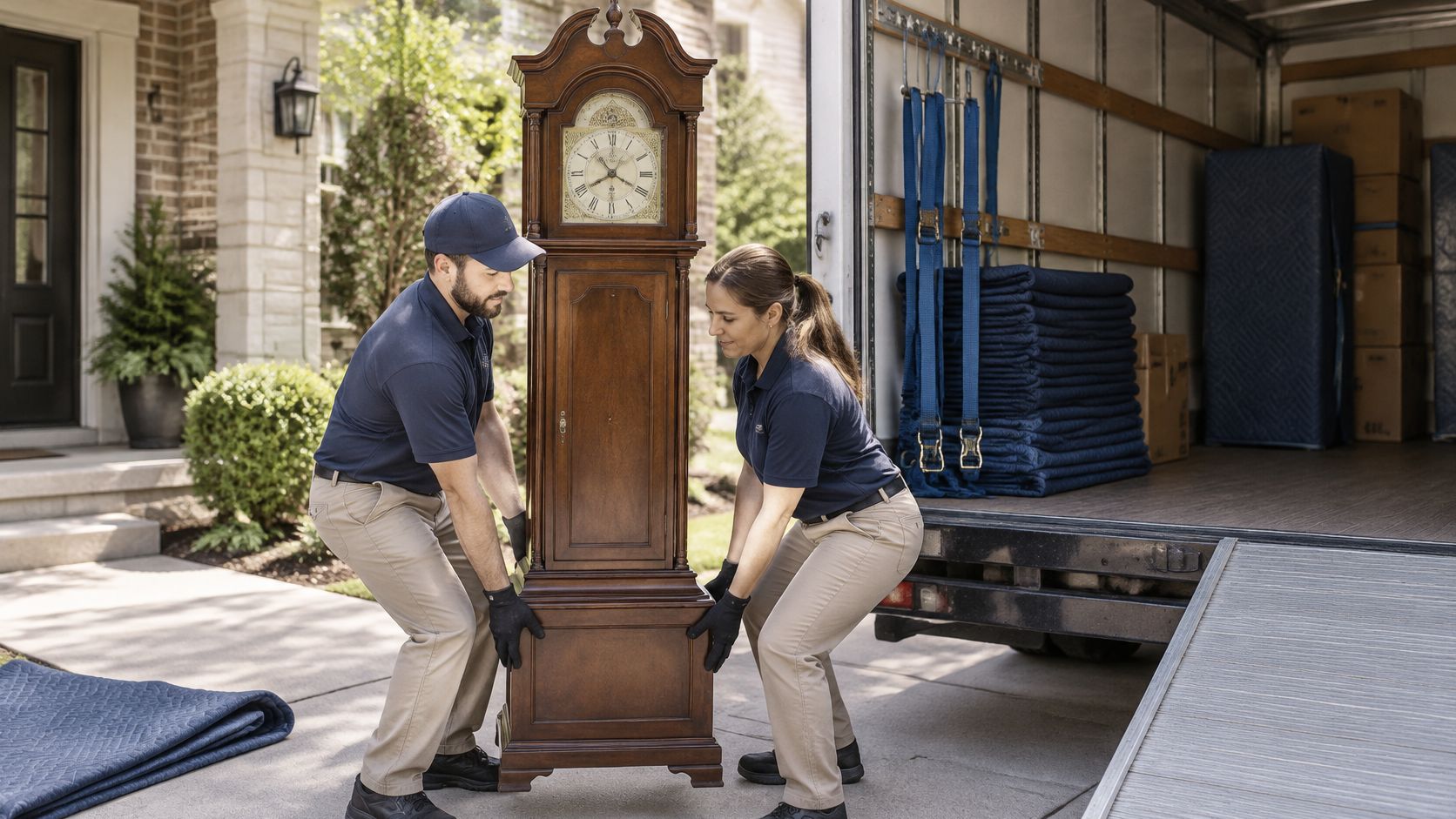
Someone reaches for the hood or a finial because it looks like a convenient handhold. That's how a decorative joint gets loaded with the weight of the cabinet below it. Lift from sound structural areas, never from the hood, handles, finials, or trim.
The carrying position should support the cabinet without loading fragile decoration.
Control the lift and stair carry
Use a coordinated team with hands supporting the structural base and sound case members. Don't drag the clock across the floor. Besides scratching flooring, dragging places sideways stress on the feet and cabinet joints.
On stairs, appoint a lead caller before lifting. Agree on the stop command, the landing positions, and where everyone can safely reset their grip. If maintaining control requires an awkward lean or a grip on decorative woodwork, put the clock down and revise the plan.
A padded appliance hand truck can help on suitable level ground, provided its support plate and straps bear against strong parts of the case. It's not a shortcut for negotiating an unsuitable staircase.
The access-planning principles in moving a gun safe are relevant here, but the restraint strategy differs. A clock cabinet can't tolerate the clamping pressure a solid steel body can.
Restrain the cabinet without crushing it
Inside the truck, choose a protected position beside a suitable wall or bulkhead with rated tie-down points. Keep the case upright and cushion contact areas with moving blankets.
Position restraints around structurally sound cabinet areas at separated heights. Protect corners, keep pressure off glass and doors, and tighten only enough to prevent movement. Ratcheting harder isn't safer if it distorts a joint or presses the door into its frame.
Use padded blocking where appropriate to prevent base movement. Don't rely on neighboring furniture to hold the clock in place, because that furniture can shift during braking.
A secure load stays put without using fragile glass, trim, or panels as load-bearing surfaces.
Keep the component boxes in a separately secured location, with heavy weights unable to slide into the pendulum package. Before departure, check the upright position, restraint tension, glass clearance, and box security.
Protect the Clock From Heat, Humidity and Storage Swings
A Central Texas move can take a clock from an air-conditioned room into a hot driveway, then into a truck and finally a garage. More wrapping doesn't make that sequence harmless. Padding protects against contact, but it isn't a substitute for managing exposure.
JK Moving's guidance on moving antiques warns against extreme temperatures and humidity fluctuations. Wooden components can expand and contract, contributing to warping, splits, and adhesive failure. Use enough wrapping for physical protection without assuming extra layers create climate control.
Plan the environmental transitions
Shorten vehicle time. Where the load plan permits, load the clock late and unload it early. Reserve its protected truck position beforehand so this doesn't compromise secure loading.
Avoid direct exposure. Keep the cabinet out of sunlight while staging it, and don't position it beside concentrated vehicle heat or a strong HVAC outlet at delivery.
Choose interim storage deliberately. Avoid attics and garages for an antique clock. Keep any storage period as short as practical and choose a stable indoor environment.
Treat climate control as only part of the plan. A controlled unit doesn't eliminate the transition between the house, vehicle, loading area, and storage room. Coordinate those transfers instead of leaving the wrapped cabinet waiting outside.
Delay reassembly when conditions differ sharply. Let the case and mechanism acclimate in their final room before restarting or making fine adjustments. There isn't a universal waiting period suitable for every clock and move.
The same need to plan indoor-to-outdoor transitions applies when arranging a piano move in Austin, although the mechanical preparation is different.
When possible, schedule the transfer during a cooler part of the day. Arrange the clock specialist's setup visit around the cabinet's arrival and acclimation, not the truck's departure time.
Reinstall and Regulate the Clock After the Move
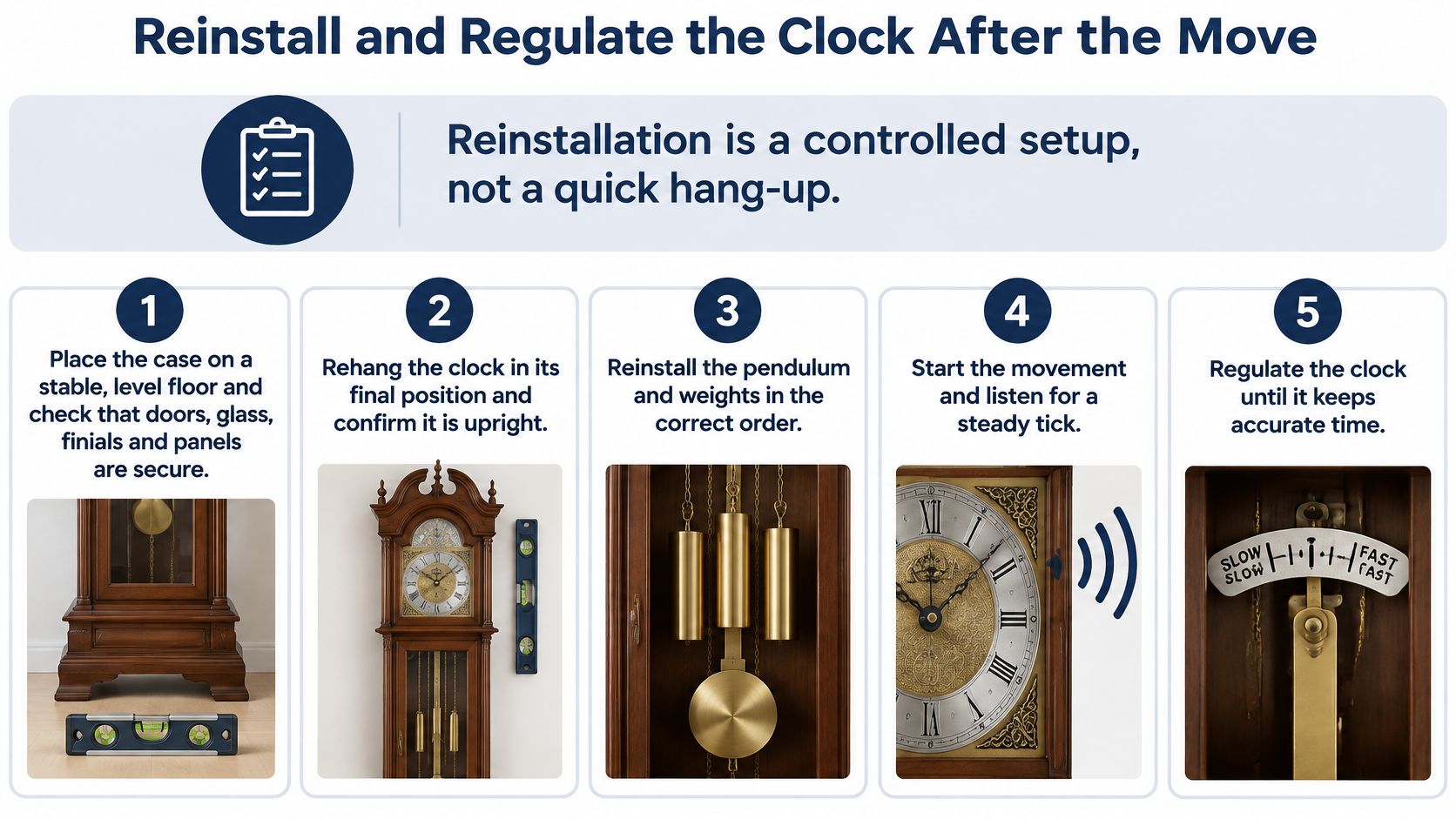
Reinstallation is a controlled setup, not a quick hang-up. Leave the component boxes closed until the case is in its final position and you've checked it for transport damage.
Wolves Removals' grandfather-clock guidance supports a careful sequence of inspection, correct component replacement, and gentle restarting. Don't interpret a clock that starts ticking as proof that every part is correctly installed.
Inspect first, then reconnect
Set the case on a stable, level floor. Use a spirit level to check its position and confirm it doesn't rock. Inspect doors, glass, panels, finials, and joints before hanging heavy components inside a cabinet that may have loosened.
Follow the documented reassembly sequence. Use your photographs and the manufacturer's instructions to restore accessories in the appropriate reverse order. Don't remove every transport restraint at once if doing so would release an unsupported component.
Match weights to their recorded positions. Check each label against the photograph before hanging it, then confirm its hook is properly engaged. Guessing by appearance can put the wrong load on a train.
Restore chains and cables under control. Remove temporary retainers only when the relevant component is supported. If a cable has crossed, jumped its drum, or become tangled, stop rather than pulling it straight under load.
Inspect the suspension before hanging the pendulum. Look for an obvious bend, displacement, or damaged connection. Support the pendulum while attaching it so you don't accidentally transfer its weight through a misaligned fitting.
Start gently and listen. Give the pendulum a small impulse and listen for an approximately even tick and tock. Follow the model's beat-setting instructions, or have a specialist adjust it rather than bending parts experimentally.
Use the checklist as a setup overview, not a substitute for model-specific instructions.
Separate beat adjustment from time regulation
An even beat and accurate timekeeping aren't the same adjustment. First establish stable operation in the final location, then compare the clock against a reliable time reference before making small, documented regulation changes.
Temperature, humidity, floor level, and cabinet position can affect operation. Adjusting repeatedly while those conditions are changing makes it harder to identify what needs correction.
Stop signal: If the clock rubs, stops repeatedly, or makes an unfamiliar mechanical noise, don't force it or keep restarting it.
A clock specialist is particularly useful at this stage for valuable antiques, cable-driven movements, and clocks that were unreliable before the move.
Decide Whether to Move Your Clock Yourself
Consider DIY only for a sound, non-antique, weight-driven clock when you understand its preparation procedure, have capable helpers, and have confirmed a clear route. Truck rental is only a transport expense, not the cost of specialist preparation or repair.
Reported costs for moving a grandfather clock
Option | Reported cost | Best fit |
|---|---|---|
Rent a truck and move it yourself | TSI Shipping reported $19.99–$29.99 per day for a 10–17-foot truck in 2026. | A straightforward local transfer with suitable helpers and equipment. |
Local clock transportation | A Yahoo Local article reported $200–$500 in 2025. | Clock-only transport arranged separately from the household move. |
Professional clock move, including local service | Professional Grandfather Clock Movers and Shippers reported $400–$1,600 in 2025, with local moves under 50 miles often about $400. | A professional clock-move quote, not a whole-household price. |
Specialty handling during long-distance relocation | National Van Lines reported $300–$700 in 2026. | Long-distance planning where specialty handling is a distinct charge. |
These are reported figures, not interchangeable packages or Webster Moving Co. prices. Route, access, season, and included mechanical work can change the quote.
Make the specialist handoff explicit
Arrange specialist assessment for:
Unknown or valuable movements, especially antiques with uncertain service history.
Damaged construction, including loose joints or fragile painted and glass components.
Uncooperative fittings, such as a pendulum that won't detach normally.
Unclear transport provisions, including missing locks specified for that model.
The British Antique Dealers' Association care guide advises disconnecting weights and the pendulum, and notes that longer-distance travel may require movement removal. That decision belongs to a horologist or conservator, not someone improvising during loading.
Movers handle the route and cabinet; specialists handle mechanical uncertainty. Put movement removal, reinstallation, and regulation responsibilities in writing, even when arranging full-service movers.
At Webster Moving Co., we're locally owned in Round Rock and fully licensed and insured. Write down the clock's dimensions and warning signs, then request a quote identifying it as a specialty item rather than ordinary furniture.
Webster Moving Co. handles furniture protection, loading, transportation, and unloading, with packing services available when you need additional help. Visit Webster Moving Co. to request a no-obligation quote, and include photos of your clock, access details, and any mechanical work you're arranging with a clock specialist.
Comments