
Piano Mover Austin: Safe Relocation Guide
You've found the right house for the piano, but the route from the current room to the truck is still uncertain. The front door may be wide enough while the hallway turns too sharply. An apartment freight elevator may accept the cabinet but leave no room to rotate it. A short drive may also expose the instrument to heat, rain, or unstable storage conditions that affect tuning after delivery.
A safe move starts before the crew arrives. For those looking for a piano mover in Austin, the important questions concern the instrument's dimensions, the complete load path, property coordination, and climate control. The piano isn't ordinary household freight, and the lowest quote may not account for the work required to protect flooring, walls, staircases, elevators, and the instrument itself.
Table of Contents
The Reality of Moving Pianos in Greater Austin - Why ordinary furniture methods fall short
Assessing Your Instrument and Property Access - Build the route before the estimate
Managing Texas Heat and Climate Acclimatization - Control exposure during the move
Navigating Apartments and Suburban Relocations - Apartment and condo access - Suburban and new-construction routes
Evaluating Mover Credentials and Transparent Pricing - What to verify before booking
The Reality of Moving Pianos in Greater Austin
Austin's housing turnover creates a broad range of piano-moving situations. The U.S. Census Bureau recorded 790,390 residents in Austin in 2010 and 961,855 in 2020, an increase of 171,465 people, or approximately 21.7%, and estimated 1,002,632 residents in 2025. The city's Census QuickFacts profile also lists 456,113 households for 2020–2024, with a median owner-occupied home value of $555,300 and median gross rent of $1,729.
Those figures matter because each household type creates a different access problem. A piano may move from a detached home into an apartment, from a condominium into a newly built subdivision, or into temporary storage while a closing or construction schedule changes. A historic property may have narrow entries and uneven floors. A new home may offer open interiors but still have unfinished surfaces, construction traffic, or a long approach from the truck.
Why ordinary furniture methods fall short
A sofa can often be tilted, dragged carefully, or temporarily disassembled. A piano has a rigid cabinet, fragile internal action, delicate finishes, and weight concentrated through casters or other small contact points. Handling errors can affect both the instrument and the property around it.
Austin's regional expansion adds another layer of scheduling pressure. Between July 2024 and July 2025, Travis County added 16,197 housing units, representing 2.4% growth and ranking seventh among U.S. counties for housing-stock increases during that period, according to the City of Austin's population and housing milestone report. The broader metro added 31,897 housing units, with Travis County accounting for 51%, Williamson County 24%, Hays County 17%, Bastrop County 6%, and Caldwell County 2%.
That geography connects piano moves with routes involving Round Rock, Georgetown, Cedar Park, Leander, Pflugerville, Kyle, and San Marcos. The practical lesson is simple: distance alone doesn't determine difficulty. The access route, property rules, surface protection, and timing usually matter more than the miles between addresses.
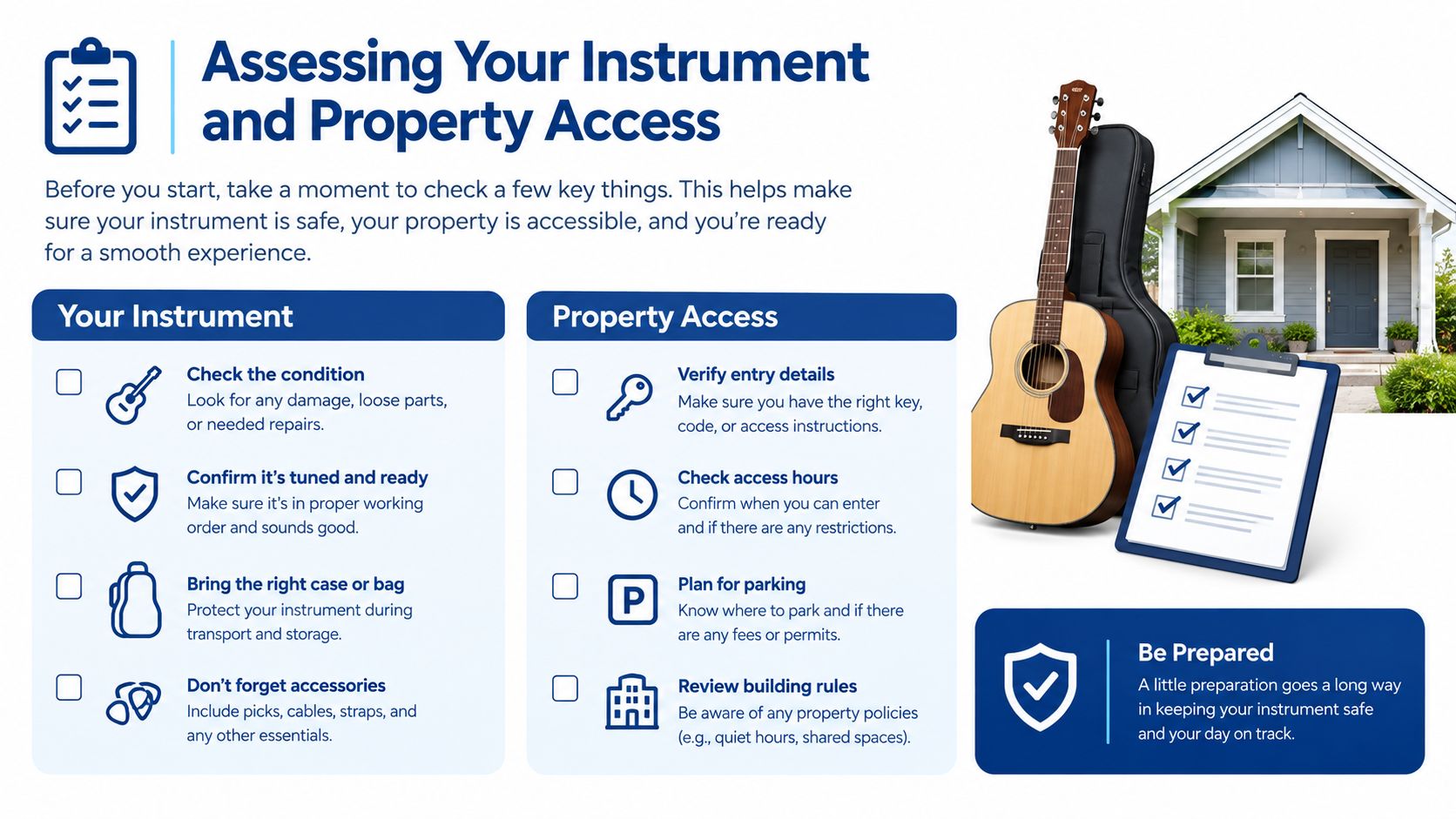
Assessing Your Instrument and Property Access
Treat the move as a geometry and load-path problem. Before requesting a quote, identify the exact instrument and document every point where the crew must turn, lift, lower, roll, or protect a surface.
Representative Steinway specifications show why the model matters. Uprights can weigh about 604–650 pounds, while grand pianos range from approximately 610 pounds for a Model L to 990 pounds for a Model D-274. The D-274 is about 107.75 inches long and 61.75 inches wide, according to Steinway specifications compiled by ProPiano. Those dimensions affect crew size, equipment, turning space, and whether the planned route is feasible at all.
Build the route before the estimate
Start with the piano:
Record the identity: Note the make, model, type, dimensions, finish, and any visible damage before the crew handles it.
Check removable parts: Ask whether the legs, pedals, lyre, music desk, or other components can be removed safely.
Photograph the route: Capture the instrument's current position, all doors, stairs, landings, thresholds, driveways, and truck access points.
Then measure the property. Doorway width by itself isn't enough. Record hallway width, ceiling clearance, stair width, landing depth, turn radius, floor transitions, elevator-door dimensions, elevator-cab dimensions, banister conditions, and the distance from legal parking to the entrance. Note whether a door can be removed and whether building management permits that work.
A piano can be rotated through some narrow openings, but rotation doesn't remove the need to verify its maximum width, turning radius, ceiling clearance, and stair conditions. Its weight also creates concentrated point forces, so the crew needs to plan floor protection and avoid relying on assumptions about what a surface can tolerate.
Practical rule: A written estimate should separate ordinary carrying from specialty rigging. If the quote doesn't describe stairs, elevators, narrow turns, protective materials, and possible contingencies, the scope is incomplete.
A useful comparison is the planning required for a piano versus other heavy specialty items. The same discipline described in this guide to safe gun safe moving applies here, but a piano adds fragile internal components, a larger vulnerable finish, and climate-related settling after transport.
Managing Texas Heat and Climate Acclimatization
A piano can arrive without a visible scratch and still need careful post-move attention. Its wooden soundboard and other structural components respond to humidity. Moisture absorption causes expansion, while drying causes contraction, changing soundboard geometry and string tension.
That's why a short drive isn't automatically a safe drive. The instrument may pass through a conditioned home, a hot loading area, a vehicle, a storage unit, and another conditioned room in a single relocation. Each transition can affect pitch and the way wooden components settle, especially when outdoor dwell time is long or the piano sits in direct heat.
Control exposure during the move
A professional plan should address the environment, not just the padding. Load the piano as late as practical, keep it protected from direct sun and rain, secure it properly, and unload it promptly. The crew should minimize waiting on exposed driveways, loading zones, or open truck ramps.
For storage and POD moves, ask specific questions:
Pickup window: When will the piano be loaded, and how long might it remain exposed outdoors?
Vehicle procedure: How will the instrument be padded, secured, and positioned during transit?
Storage conditions: Will the storage space be conditioned, and how long is storage expected to last?
Delivery environment: Where will the piano sit in the new room, and will it be near an exterior door, vent, or direct sunlight?
A stable room environment near 45–50% relative humidity is a practical target cited by piano-service sources. After relocation, Austin-area technicians commonly recommend allowing roughly two to four weeks for acclimatization before tuning, as explained in this Austin piano relocation and tuning guidance.
The tuning appointment should be planned after stabilization, not treated as an immediate finishing touch. Keep the instrument away from exterior doors and HVAC outlets, and tell the technician whether it spent time in storage, a POD, or a long-distance vehicle. Climate risk is part of the move scope, even when the cabinet looks perfect.
Navigating Apartments and Suburban Relocations
An upright moving into a single-family home in Round Rock presents a different problem from a grand moving through a downtown Austin condominium. The suburban route may involve a long driveway, a sloped approach, new flooring, or an active construction site. The condo route may depend on a freight elevator reservation, loading-zone access, building approval, and a precise time window.
Apartment and condo access
Apartment planning starts with the building, not the truck. Confirm the freight elevator's door and cab dimensions, reserve the elevator, ask about padding requirements, and establish where the truck can legally stop. Management may require proof of insurance, a certificate of insurance, a specific loading entrance, or advance approval for hallway protection.
A grand piano adds another constraint because its length changes how the crew uses the elevator and approaches corners. If the cab is technically large enough but leaves no turning space, the crew may need a different entry plan. Measure the full route from the truck to the room, not just the elevator itself.

Suburban and new-construction routes
A detached home usually offers more maneuvering room, but that doesn't eliminate risk. Long driveways increase carrying distance and exposure. Newly finished homes may have unprotected flooring, narrow temporary access, landscaping that limits truck placement, or construction materials blocking the intended route.
For moves connecting Austin with communities such as Georgetown, Leander, Kyle, or San Marcos, coordinate both properties before booking. Confirm the destination's occupancy status, driveway access, gate restrictions, and any closing or construction dependencies. A piano shouldn't be the item that discovers the house isn't ready.
The best plan matches the crew and equipment to the property type. Apartment moves are often governed by building rules and elevator geometry. Suburban moves are often governed by approach distance, surface protection, and site readiness.
Evaluating Mover Credentials and Transparent Pricing
The cheapest quote isn't automatically the lowest-cost decision. A piano can damage a wall, floor, stair edge, elevator interior, or vehicle if the crew lacks the right equipment or route information. A low estimate that excludes specialty handling can become expensive once the crew encounters stairs, tight landings, a long carry, or an unusable elevator.
Ask for a written scope that identifies the instrument, origin and destination, access conditions, crew requirements, equipment, protective materials, and possible contingencies. The quote should make clear whether the work involves ordinary carrying, a piano board, padded straps, stair equipment, disassembly, additional personnel, or alternate-entry planning.
What to verify before booking
Licensing and insurance: Confirm that the company operates with the required state or federal credentials and carries insurance appropriate for both the piano and the property.
Relevant experience: Ask whether the assigned crew handles uprights, grands, stairs, elevators, storage moves, and difficult access routes.
Property protection: Verify how floors, thresholds, walls, elevator interiors, and door frames will be protected.
Written pricing: Require clear explanations for stairs, long carries, waiting time, parking constraints, disassembly, storage, and special equipment.
Condition documentation: Photograph the piano and nearby property before loading, then review the delivery condition before the crew leaves.
Local review histories can help, but reviews shouldn't replace operational questions. A company may have strong general moving feedback without demonstrating that it can assess a piano's load path. Use a resource such as this Austin movers evaluation guide as a starting point, then ask the estimator to explain the specific route in practical terms.
A transparent quote is part of the protection plan. It shows whether the mover has understood the job before anyone lifts the instrument.
Webster Moving Co. is one local option that lists licensed and insured specialty-item handling, residential and commercial moves, packing, storage, POD work, and service across Greater Austin and Central Texas. Compare those capabilities with other qualified movers, and choose the company that can document the plan rather than only promise careful handling.
Your Step-by-Step Booking and Preparation Plan
Good piano moves are decided in sequence. Start with information, then confirm access, then schedule handling and post-move care.
Collect instrument details. Record the make, model, type, dimensions, finish, condition, and removable parts.
Map both routes. Measure doors, halls, stairs, landings, elevators, turns, thresholds, driveway conditions, and truck access.
Request a specific estimate. Send photographs and measurements, and ask the mover to state crew size, equipment, protection, and contingencies in writing.
Coordinate property rules. Reserve freight elevators, confirm loading zones, notify building management, and check parking or access restrictions.
Prepare the environment. Clear the route, protect valuables near the path, reduce outdoor waiting, and keep the destination room away from direct heat and HVAC airflow.
Schedule stabilization and tuning. Tell the technician about transit, storage, and climate exposure, then arrange tuning after the piano has settled.
Begin the process early enough to resolve access problems before moving day. If the route includes a narrow stair landing, balcony, constrained elevator, steep approach, or uncertain structure, request an on-site assessment instead of relying on a phone estimate. For broader relocations that include packing, furniture, storage, or a POD, review how a full-service moving plan can coordinate those tasks around the specialty item.
The right preparation turns a piano move from a lifting task into a controlled operation. You'll know what the crew is moving, which route they'll use, how the property will be protected, and when the instrument should be tuned.
Webster Moving Co. provides licensed and insured residential, apartment, commercial, storage, POD, and specialty-item moving services across Greater Austin and Central Texas. For a route-specific piano estimate that accounts for access, protection, and scheduling, visit Webster Moving Co. and request a no-obligation quote.
Comments