
Gun Safe Moving Without the Back Pain or Damage
You're standing in front of a safe that looks like a tall filing cabinet, trying to decide whether a rented dolly and a few friends can handle it. Then you find the manufacturer's weight, or try to tilt it, and realize the move is less like shifting furniture and more like controlling a dense steel load through your home.
That distinction matters. Gun safe moving involves concentrated weight, awkward geometry, limited handholds, stairs, thresholds, and a center of gravity that can shift at the worst moment. It also involves a separate legal question: moving an empty safe is one job, while transporting the firearms and ammunition that belong inside it is another.
Table of Contents
Why a Gun Safe Is Not Just Heavy Furniture - The controlled-load mindset
Surveying Your Home Before Anyone Lifts Anything - Measure the route as a system - Don't confuse a floor rating with a route assessment - Separate the firearm decision from the safe decision
Prepping the Safe and Choosing the Right Equipment - Choose capacity with a margin - Treat door removal as a technical decision
Moving Day Technique for Stairs Corners and the Truck Bed - Keep the load controlled - Stairs require a different standard - Load and unload without creating a second hazard
When to Hand the Job to Licensed Safe Movers - Compare the job, not just the hourly rate - A simple hire-it-out test
Your Gun Safe Moving Checklist and Final Word - Before the move - On moving day - At delivery
Why a Gun Safe Is Not Just Heavy Furniture
A small personal safe may weigh roughly 100 to 150 pounds, while a standard residential model can weigh 300 to 500 pounds. Large or fire-rated units may reach 500 to 1,000 pounds or more, according to this guide to gun-safe and heavy-item moving. A safe can occupy no more floor area than a household cabinet yet impose several times the load of a normal appliance.
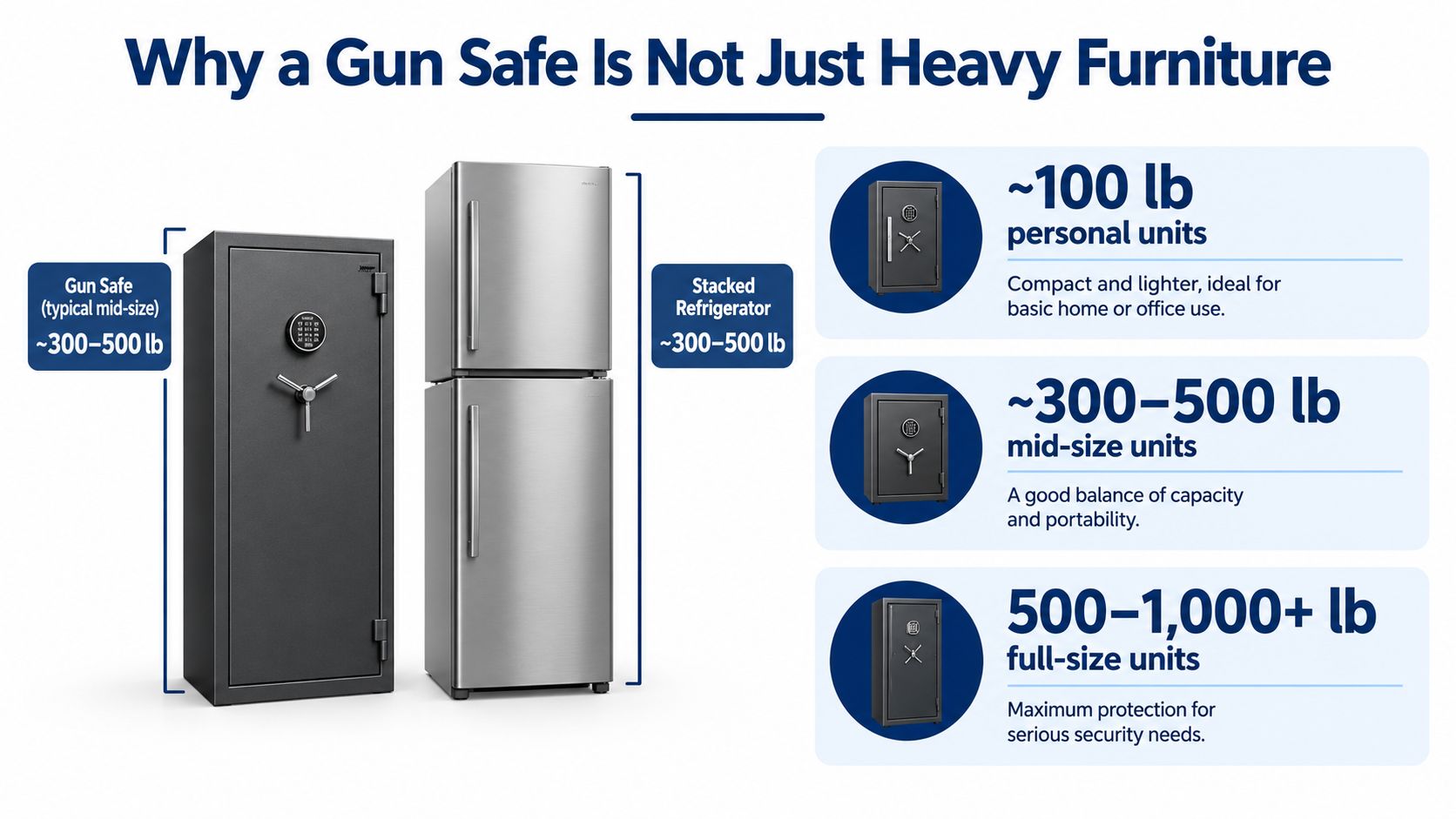
The reason isn't always obvious from the outside. Fire-resistant designs developed in the 1820s, and safe designs from the 1850s used thick steel and plaster to improve fire resistance. Those materials increased protection, but they also created the dense, unforgiving loads movers must control today. Size alone is a poor estimate of difficulty because the body, door, fire lining, shelves, and internal hardware all affect weight and balance.
A practical risk check starts with the manufacturer's exact unloaded weight and dimensions. A small safe on a clear ground-level route may be manageable for an experienced DIYer with appropriate equipment. A larger unit, an upper-floor destination, a narrow hallway, or any stair section changes the decision quickly.
Practical rule: If you can't describe the safe's weight, route, equipment capacity, and final placement before anyone lifts, you aren't ready to move it.
The controlled-load mindset
A safe move should be engineered as a controlled-load operation. That means surveying the path, emptying the safe, selecting equipment with adequate capacity, protecting the building, assigning crew roles, and deciding in advance what happens at every threshold and landing.
The move itself may be short. The planning can't be improvised. Before requesting a quote or renting equipment, review specialty-item moving services and compare the safe's actual requirements with the mover's experience handling stairs, tight spaces, and finished flooring.
Surveying Your Home Before Anyone Lifts Anything
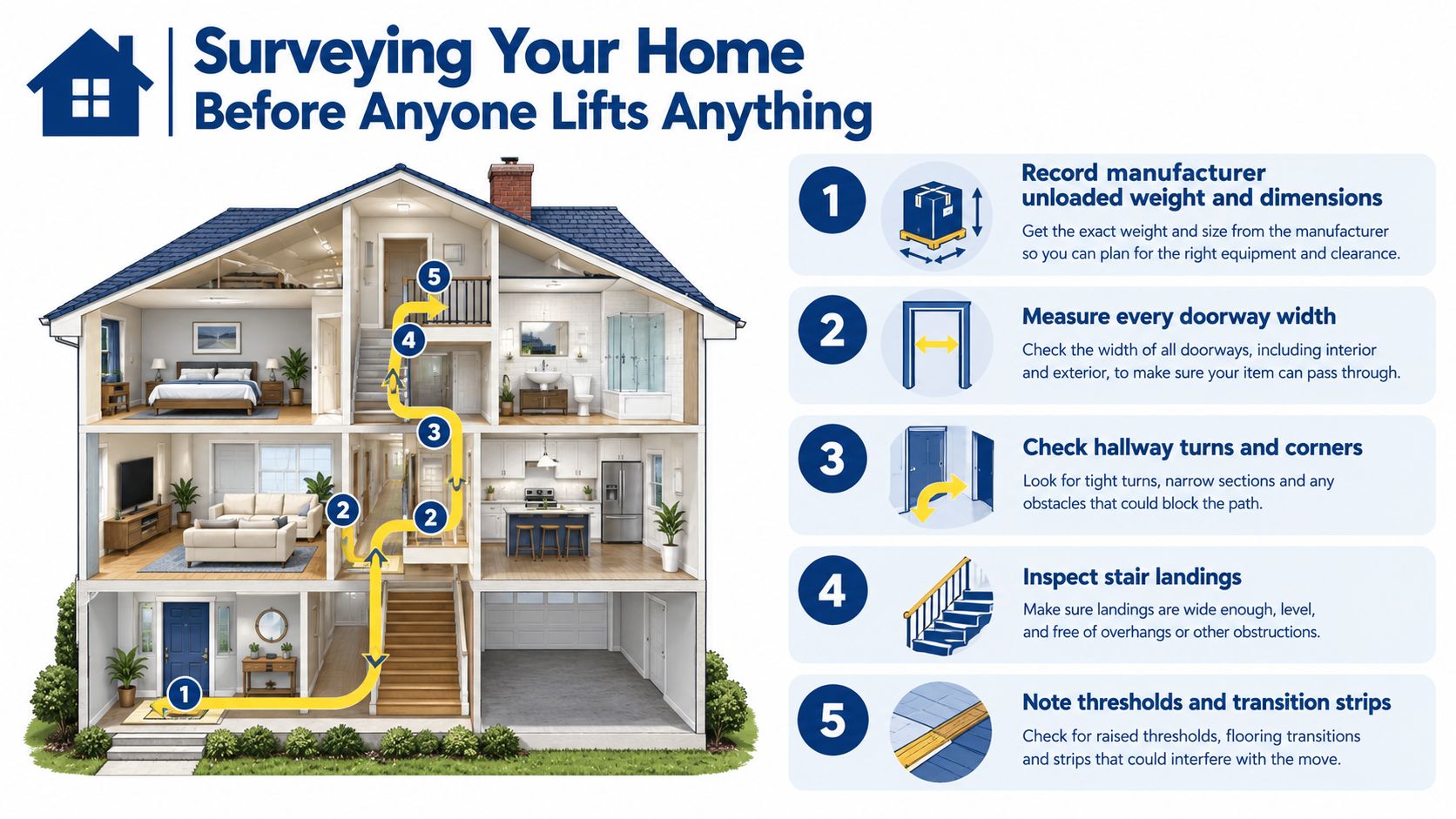
The most useful safe-moving tool is often a tape measure used before moving day. Record the manufacturer's unloaded weight, exterior dimensions, handle or hinge projections, and whether the safe is anchored to the floor. Don't rely on a remembered model name or an estimate such as “around 500 pounds.” The exact load determines the dolly, straps, vehicle, crew, and route plan.
Measure the route as a system
Measure more than the front door. A safe may clear the entrance and still fail at a hallway turn or stair landing. Write down:
Door openings: Measure width and height with the door open as far as it will go, including trim and hardware that restrict the usable opening.
Hallway turns: Record the inside corner, outside corner, ceiling height, and the space needed for operators to control the dolly.
Stair sections: Measure tread width, stair width, riser height, landing depth, overhead clearance, and the approach at both ends.
Thresholds: Note raised transitions, floor strips, uneven concrete, carpet edges, and any place where the dolly wheels could catch.
Truck access: Confirm driveway slope, parking position, liftgate clearance, loading space, and the distance between the door and vehicle.
Compare every measurement with the safe's dimensions plus working space for the dolly and operators. A route that fits the steel box but leaves no room to steer isn't a viable route.
Don't confuse a floor rating with a route assessment
Homeowners often ask whether a floor can “hold” a safe, then look for one universal pounds-per-square-foot answer. That shortcut misses the important variables: total load, contents, dolly footprint, concentrated wheel loads, floor framing, wall location, turns, and whether the safe must be tilted.
Residential design loads are commonly cited at 40 pounds per square foot for many rooms and 30 pounds per square foot for sleeping areas. Stairs may support roughly 100 to 200 pounds per square foot, but those broad figures don't replace an evaluation of the actual framing and placement, as explained in this gun-safe weight and floor-placement guide.
Place unusually heavy safes near a bearing wall or corner only after the route and structure have been assessed. If the destination is an upper floor, the safe is exceptionally heavy, or the framing is uncertain, ask a qualified structural professional to evaluate the placement. A moving crew can control the load, but it shouldn't guess about structural capacity.
Separate the firearm decision from the safe decision
Before moving day, use a written decision path:
Unload the safe completely. Remove firearms, ammunition, shelves, organizers, and other removable contents.
Inventory firearms separately. Keep a record of what is being transported and who will possess it.
Check the destination rules. State and local requirements may differ, especially across state lines.
Notify the moving company in writing. ATF guidance says a person relocating out of state may transport lawfully possessed firearms with household goods, but the moving company must be notified and applicable laws must be checked. Review the ATF guidance on relocating with firearms.
Check NFA requirements. Certain National Firearms Act items require prior ATF approval before interstate transport, subject to destination-state and local law.
Choose the lawful handoff. Moving an empty safe doesn't give a mover legal authority to transport firearms, and mover notification isn't the same as legal permission.
The safest operational choice may be to move the empty safe while the owner independently transports firearms in accordance with applicable law.
Prepping the Safe and Choosing the Right Equipment
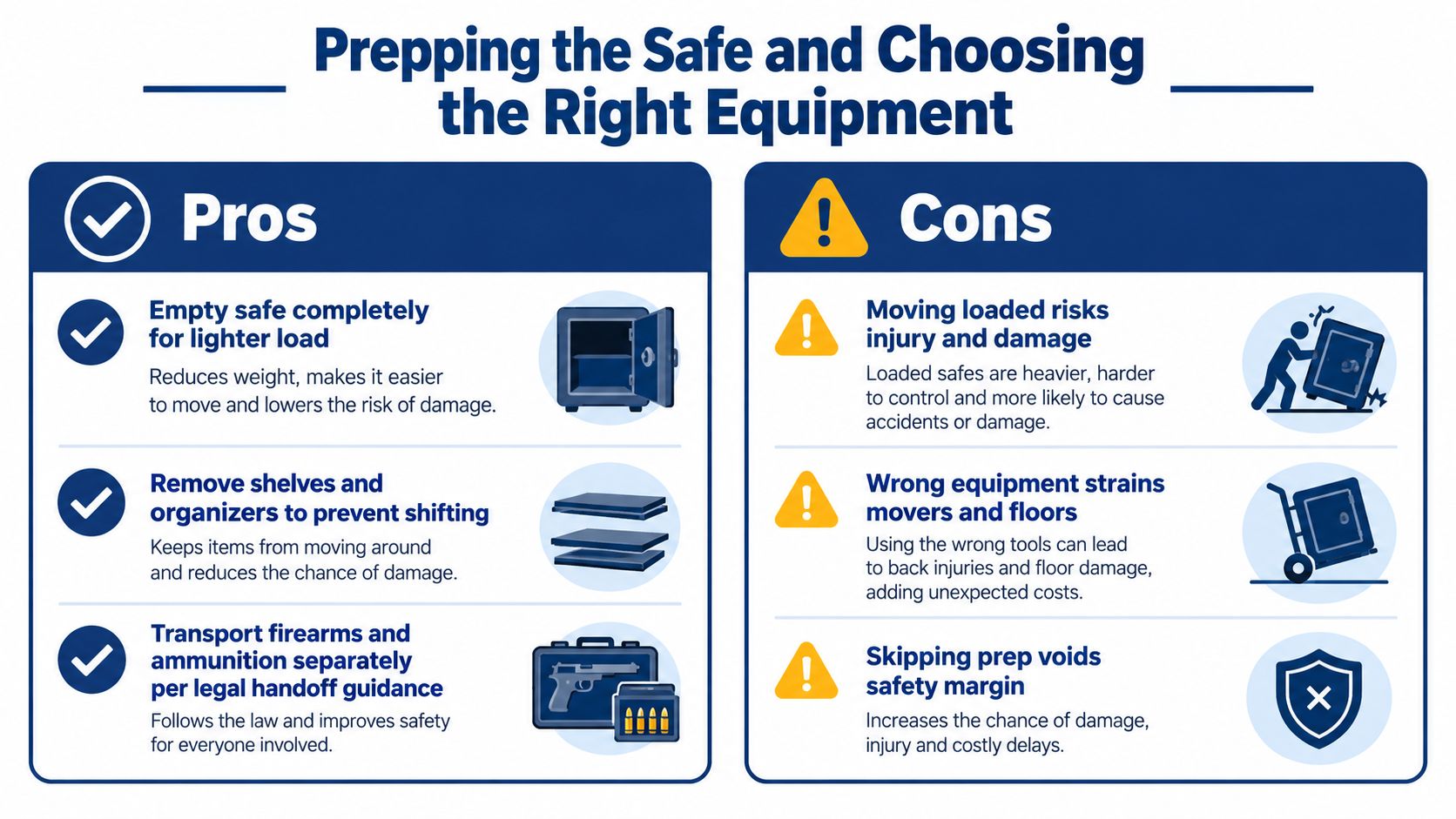
A gun safe usually gets into trouble before it ever reaches the dolly. Loose shelves slide, door pockets swing, and a half-cleared interior shifts the center of gravity at the worst moment, usually when the safe is tipped back or eased over a threshold. Empty it completely. Firearms, ammunition, shelves, organizers, trays, dehumidifiers, and anything else that can move should come out before the crew starts.
Then secure what stays put. Lock the door, tape it closed without sticking adhesive to painted or finished surfaces, and wrap the body with moving blankets and corner protection. Keep straps on the strongest part of the cabinet body, not over handles, keypad housings, or trim that can bend. Protect finished floors and walls, and tell the crew about anchors, stairs, elevators, and unusual surfaces before equipment arrives, or hand that prep work to professional packing and protection services.
Choose capacity with a margin
Safe-moving equipment has to do more than lift the published weight. It has to control a tall, dense box with a high center of gravity and limited handholds.
Use equipment that gives you working margin:
Stair-rated appliance dolly or powered stair climber: The rated capacity should exceed the measured load by a clear margin. A dolly that only matches the safe's weight on paper leaves no room for tilt, straps, or route friction.
Rated ratchet straps: Strap around the body at a reinforced section and keep the safe tight to the dolly frame.
Moving blankets and corner protection: Protect door frames, walls, flooring, and the safe's finish.
Control line or tether: Add separate control anywhere the route slopes or the load could start to run.
Liftgate and vehicle tie-downs: Verify that the liftgate, truck deck, and anchor points are all rated for the actual load.
A standard household hand truck is often the wrong tool. It may roll across a garage slab with an empty refrigerator, but a safe asks more from the frame, wheels, toe plate, and operator control.
Treat door removal as a technical decision
Removing the door can make a big difference, but it is not an automatic first step. In many large residential safes, the door accounts for a substantial share of the total weight. That can make the body easier to handle, but only if the manufacturer permits removal and the route improves because of it.
The trade-off is straightforward. You may reduce the body weight, yet you also create a second heavy component that can injure someone, damage flooring, or twist hinges and boltwork if it is handled casually. A removed door is still a heavy load, and it needs the same level of control as the safe body.
Follow the manufacturer's instructions exactly. Support the door before pulling hinge pins or lifting, pad and move it as its own load, and then reassess the safe body's balance, width, anchor points, and path. Some safes become less predictable once the door is off because the balance changes more than people expect.
If the manual is unclear, stop there. Incorrect disassembly can damage the lock, hinges, door alignment, or internal boltwork, and those repairs are expensive. Reinstall and test the door only after the body is in place, leveled, and anchored.
Moving Day Technique for Stairs Corners and the Truck Bed
The safe should move at the speed of the person controlling it, not at the speed of gravity. Its rigid box shape, high concentrated mass, limited handholds, and shifting center of gravity magnify small errors. OSHA materials-handling guidance reports that sprains and strains account for more than 40% of injuries involving days away from work, back injuries account for more than 20% of nonfatal occupational injuries, and overexertion cases account for more than 25% of lost-workday cases. These figures aren't specific to gun safes, but they explain why mechanical assistance and trained coordination matter, as documented in OSHA materials-handling safety guidance.
Keep the load controlled
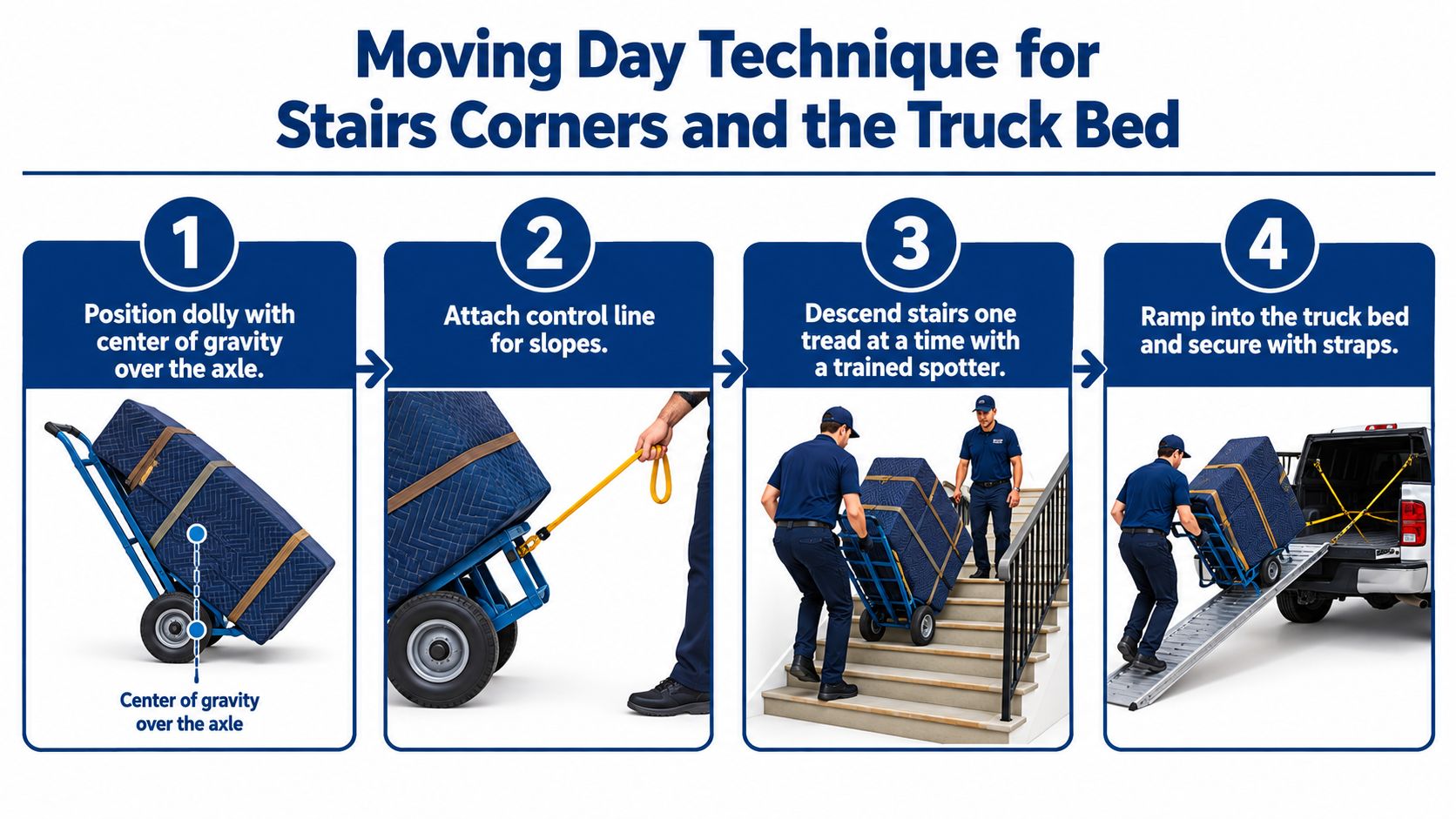
Position the safe so its center of gravity stays over the dolly axle. Strap it around the body, check that the wheels and frame are rated for the measured load, and assign one person to direct movement. On slopes, connect a separate control line or tether so the dolly doesn't become the only point of control.
At a doorway, square the dolly before crossing the threshold. Move slowly over transition strips, pause when wheels contact the obstruction, and keep operators clear of pinch points. At a corner, don't swing the safe blindly. One operator controls the dolly while spotters watch the wall, ceiling, floor, and clearance behind the load.
Stairs require a different standard
On stairs, use a stair-rated appliance dolly or powered stair climber. A trained lead operator should control the movement while spotters maintain visibility and communication. Move one tread at a time, pause at each landing, and stop immediately if the load shifts, a strap loosens, or a wheel loses stable contact.
Never put someone in the fall path below an unsecured safe. Don't rely on several people lifting the box by hand, and don't let a rented dolly run free while someone tries to catch it. If the team can't maintain controlled contact and a clear escape path, the route has exceeded the available equipment and experience.
Load and unload without creating a second hazard
At the truck, use a suitable liftgate or controlled ramp system. Keep the safe upright unless the manufacturer or qualified mover has planned another orientation, position it against a structurally appropriate part of the vehicle, and block it so the base can't slide or roll.
Use rated straps connected to proper vehicle anchoring points. Add blocking where needed, then test the load by applying controlled pressure before the truck moves. At delivery, reverse the process: clear the destination, position the safe, level it, anchor it where planned, and only then reinstall or test the door and boltwork.
When to Hand the Job to Licensed Safe Movers
DIY can make sense for a small personal safe on a short, flat, unobstructed route when the owner has verified the weight, selected correctly rated equipment, and understands the technique. It stops making sense when the consequences of a tip exceed the team's ability to control it.
Use a professional specialty mover when any unit exceeds roughly 400 pounds, the route includes an upper-floor origin or destination, or there's any stair section. Those are practical escalation conditions because a tip, crush injury, wall strike, or structural overload becomes substantially harder to manage, as described in this safe-moving escalation guide.
Compare the job, not just the hourly rate
A proper quote should identify the actual work:
Quote item | Why it matters |
|---|---|
Safe move itself | Separates the base handling from access complications |
Stairs and long carries | Reflects additional control, distance, and labor requirements |
Disassembly and reassembly | Clarifies whether door or handle work is included |
Difficult access | Covers tight turns, thresholds, elevators, or unusual approaches |
Temporary storage | Prevents confusion if the safe can't go directly to its destination |
Ask whether the crew has moved safes before, what dolly or stair equipment it uses, how it protects finished surfaces, and whether the written estimate reflects the actual route. A company that quotes from a model number alone may not have enough information to plan responsibly.
For Central Texas homeowners, Webster Moving Co. is a locally owned and operated company based in Round Rock, serving Greater Austin and Central Texas with licensed, insured crews, written estimates, and specialty-item handling. Its packing and moving services can be considered alongside other qualified local options, provided the scope clearly addresses the safe's weight, route, equipment, and final placement.
A simple hire-it-out test
Hire the move when you can't confidently answer all of these questions:
Load: What is the exact unloaded weight, and is the safe anchored?
Route: What are the narrowest openings, sharpest turns, stair measurements, and thresholds?
Equipment: Does the dolly have a sufficient rating margin, and does the truck have proper lifting and tie-down capacity?
Crew: Who controls the load, who spots, and what happens if the route becomes unstable?
Destination: Can the floor and planned placement be evaluated by someone qualified when needed?
If one answer is unknown, postpone lifting. A written survey and a specialist quote cost less than discovering the missing answer after the safe has tipped.
Your Gun Safe Moving Checklist and Final Word
A safe move becomes manageable when every decision is made before the load leaves the floor.
Before the move
Confirm the load: Verify the manufacturer's unloaded weight and dimensions.
Empty the cabinet: Remove firearms, ammunition, shelves, organizers, and loose contents.
Survey the route: Measure doors, turns, landings, stairs, thresholds, and truck access.
Check placement: Evaluate the destination floor and escalate structural questions when needed.
Confirm equipment: Use a rated dolly, straps, protection, and capacity margin.
On moving day
Secure the door: Lock or tape it closed according to the manufacturer's guidance.
Protect surfaces: Cover finished floors, corners, walls, and door frames.
Assign roles: Establish a lead operator, spotters, and a clear stop command.
Control every transition: Move slowly across thresholds and one tread at a time on stairs.
Secure the truck load: Use blocking and rated straps connected to proper anchor points.
At delivery
Position deliberately: Place the safe where the route and floor assessment support it.
Level and anchor: Complete those steps before loading contents.
Test the hardware: Check the door, lock, and boltwork after reassembly.
Document condition: Record floor condition and any pre-existing damage.
The two central rules are simple: assess before you lift, and treat firearm transport as separate from moving an empty safe. A locked safe isn't a compliance solution. If your safe is small and the route is straightforward, careful DIY may be reasonable. If the load, stairs, floor, or equipment creates doubt, calling a specialist is the practical choice.
Webster Moving Co. offers specialty-item handling for gun safes, including route planning, protective materials, and controlled movement through tight spaces, stairs, and delicate flooring across Greater Austin and Central Texas. Visit Webster Moving Co. to request a no-obligation estimate and provide the safe's weight, dimensions, access details, and destination placement before move day.
Comments