
Full Service Movers: Scope, Cost, and When to Hire
The most popular moving advice is to hire full service and let the professionals handle everything. That can save your back and your time, but it doesn't automatically lock in the final bill, and “licensed and insured” doesn't necessarily mean a damaged possession will be replaced at its full value.
The useful question isn't just whether you want help. It's which tasks you're handing over, what the written estimate covers, and how the company will handle valuable items if something goes wrong.
Table of Contents
What Full Service Movers Actually Mean - Three levels of moving help - Local and interstate moves have different rules
Tasks Inside a Full-Service Move - Packing is a choice, not an assumption - The household still has a few jobs
What Can Change a Full-Service Quote - Understand the estimate before comparing it - Audit the scope line by line
Default Liability for Valuable Items - Separate protection from insurance - Decide item by item
When Full Service Beats Partial Help - Match the crew to the situation - Partial help still solves a real problem
What Full Service Movers Actually Mean
Say you're moving from a house in Round Rock to a new home across town. A full-service crew can protect furniture, load it, transport it, and unload it in the rooms you choose. Packing and unpacking may also be available, but those tasks can be optional services rather than part of the basic move.
Hiring full service is a little like hiring a restaurant kitchen instead of buying groceries and cooking yourself. You're paying for labor and coordination, not just access to a truck. But the final bill still depends on the work that's been agreed upon and the conditions the crew encounters.

Three levels of moving help
At one end, you do it all: pack, rent or borrow a vehicle, load, drive, and unload. The next level is labor-only or partial help. You pack and identify what's being moved, and a crew loads and unloads those listed belongings.
With full service, the company takes on more of the move, coordinating the crew and transport and handling furniture from the rooms at your old home to the rooms at your new one. Packing or unpacking can expand that scope further, if you choose it and include it in the estimate.
That distinction matters because “full service” doesn't have one universal task list. Ask which specific jobs are included, what counts as an add-on, and whether the written estimate matches the work you expect.
Local and interstate moves have different rules
The Federal Motor Carrier Safety Administration's overview of interstate household-goods regulation estimates that approximately 35 million American households move each year, while about 600,000 moves involve hiring a moving company for an interstate relocation. For interstate household-goods moves, movers must have federal operating authority and follow requirements concerning registration, estimates, delivery, release of goods, and consumer information.
Moves within Texas are primarily subject to state rules instead. In either case, look for clear paperwork, an understandable scope, and a documented explanation of the company's responsibilities. The practical next step is to identify which crew tasks you need, then test how the estimate handles changes and whether partial help would cover the hardest part.
Tasks Inside a Full-Service Move
Start by matching the service level to the actual work. This table separates what you'd do yourself from what a crew may take on. Confirm the details with the mover, especially packing, specialty items, and access arrangements.
Task | DIY move | Labor-only or partial | Full service | Full service plus packing |
|---|---|---|---|---|
Planning and inventory | Household | Limited to items listed | Walkthrough, crew size, and time | Same, plus packing scope |
Packing and materials | Household buys and packs | Usually customer-packed | Optional add-on | Crew packs with materials |
Furniture protection | Household supplies | Pads and wrap on items moved | Pads, stretch wrap, secure loading | Same protection plus packed cartons |
Loading | Household | Crew loads listed items | Crew loads the household | Crew loads packed household |
Truck and transport | Rental or borrowed vehicle | Company truck for the job | Company truck door to door | Company truck door to door |
Unloading and placement | Household | Crew unloads listed items | Crew unloads and places furniture | Crew unloads, places, and can unpack |
Stairs, elevators, parking | Household solves access | Crew needs access details | Planned into the move | Planned into the move |
Pianos, safes, large appliances | Often not realistic | Only if crew accepts the item | Specialty handling when booked | Specialty handling when booked |
Storage or POD loading | Household | Can be the whole job | Available as a scoped service | Available with packing |
Packing is a choice, not an assumption
A crew that loads and transports furniture isn't necessarily packing every cupboard. You might choose full packing, ask for help with fragile or difficult rooms, or have everything boxed before move day. If you want movers to pack, specify which rooms or belongings are included and whether packing materials are part of the scope.
Unpacking is a separate detail to confirm, too. Webster Moving Co.’s unpacking service can include placing items where they belong and removing packing materials, so the home is more ready for move-in. That's different from unloading cartons at the doorway.
Furniture protection is part of the moving process, not a substitute for describing the move accurately. Webster Moving Co. includes moving pads, stretch wrap, and other standard furniture-protection equipment as part of its process. Tell the mover about a piano, safe, antique, or large appliance during planning, rather than expecting the crew to handle a specialty piece without advance arrangements.
The household still has a few jobs
The crew needs usable access. Clear driveways and entrances, share gate codes and elevator details, and confirm that boxes are packed and labeled if packing isn't included. An adult over 18 must be present at pickup and delivery for Webster Moving Co. moves.
Apartment moves need particular care in the estimate. A stairwell, long hallway, reserved elevator window, or restricted loading area can change how the crew plans its work. Mark the table's rows that match the services you want, then ask the mover to put those tasks and access conditions in writing.
What Can Change a Full-Service Quote
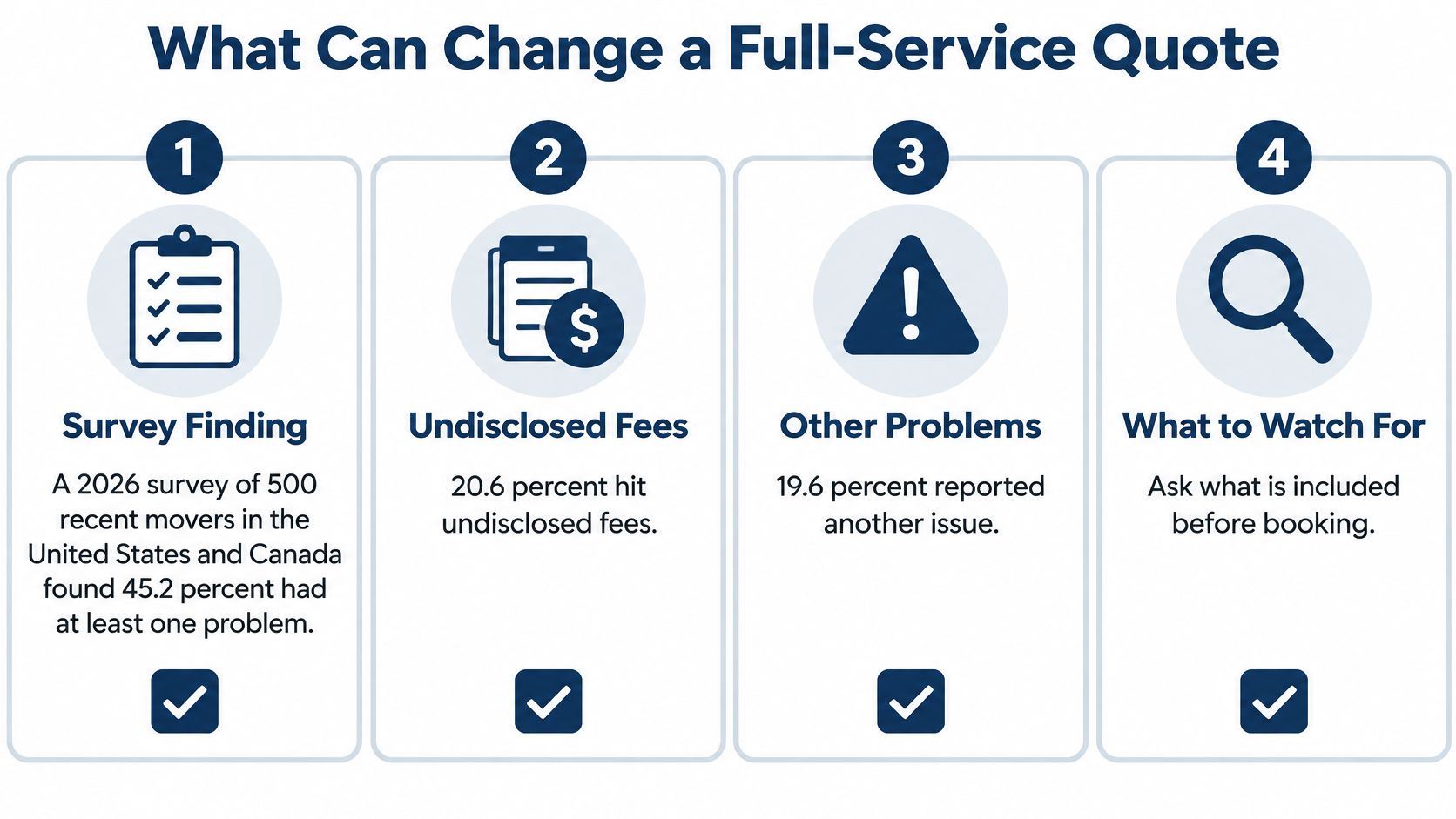
A polished quote can still leave room for disagreement if it doesn't describe the job precisely. In a 2026 survey of 500 recent movers in the United States and Canada, 45.2 percent reported at least one problem; 20.6 percent experienced undisclosed fees, and 19.6 percent said the final price was significantly higher than the quote, according to the ConsumerAffairs survey report.
Understand the estimate before comparing it
A binding estimate fixes the price for the inventory and conditions stated in the agreement. A non-binding estimate is a projection that can change under the terms of the contract, such as when the recorded inventory or access conditions differ from the actual job. Don't infer which kind you have from the hourly rate. Ask what events permit a revised price and how the company documents an approved change.
A local hourly move may take longer when there are extra stairs, a long carry, or a delay accessing an elevator. Long-distance estimates may be based on weight and distance, with additional charges for services or access conditions. In either case, the headline rate alone won't tell you what the move will cost.
Trigger | How the bill moves | Lock this in writing |
|---|---|---|
More boxes or furniture than inventoried | Hours or weight rise | Room-by-room inventory and photo list |
Stairs, long carry, or no elevator window | Extra labor time | Floor count, carry distance, elevator reservation |
Parking limits or a shuttle truck | Second truck or waiting time | Loading zone, shuttle yes or no, who pays wait time |
Packing added on move day | Materials plus packer hours | Full, partial, or customer-packed, with material list |
Storage or a POD | Extra handling and dates | Load date, storage site, unload date |
Waiting for keys, an elevator, or a customer | Billable standby | Grace period and the hourly standby rate |
Specialty item not on the estimate | Extra crew or equipment | Piano, safe, antique, or appliance named with protection option |
Cancellation or date change | Fee or lost deposit | Notice window and refund rule |
Payment method | Card fee or cash rule | Accepted methods and when the balance is due |
Audit the scope line by line
Send the mover a room-by-room inventory and photos, then ask the estimate to identify the crew size, minimum hours, travel charges, packing scope, materials, storage or POD handling, access conditions, cancellation terms, and payment rules. For an apartment, include the floor, elevator reservation, parking restrictions, and distance from the door to the loading area. For a house, note obstacles such as a steep driveway or a long path to the truck.
Webster Moving Co. helps determine crew size, equipment, and estimated time for larger household moves based on the home and belongings. Its pricing approach is intended to be straightforward, rather than drawing customers in with a low hourly rate followed by unexpected charges.
For a local cost comparison, the guide to the average cost of a local move for a three-bedroom house can help you understand what to compare, but judge your own quote by its written scope. Ask for two written estimates using the same inventory and access details. Compare minimum hours, travel charges, materials, waiting time, and any shuttle or storage fees line by line.
A new box, another flight of stairs, or same-day storage can change the agreed job. Have the company document the change and its price before the work proceeds. Scope clarity and change-order rules, not the phrase “full service”, are what make a quote easier to evaluate.
Default Liability for Valuable Items
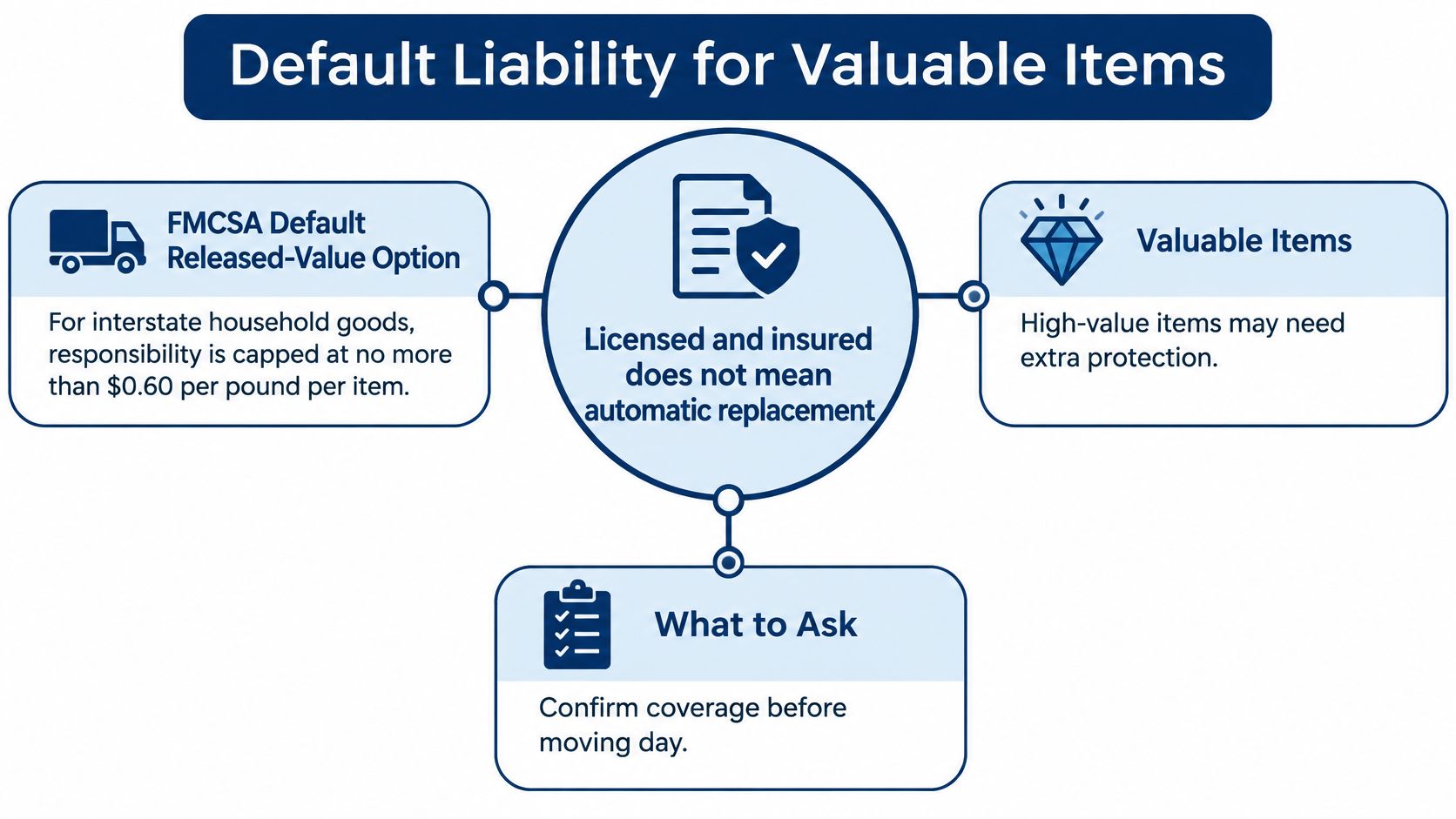
For interstate household goods, the Federal Motor Carrier Safety Administration says the default released-value option limits a mover's responsibility to no more than 60 cents per pound per article, as explained in its guide to moving liability protection. At that rate, a 50-pound television or appliance could have a baseline liability of only $30, even if replacing it would cost much more.
Separate protection from insurance
“Licensed and insured” doesn't mean every damaged item will automatically be repaired or replaced at its purchase price. Mover liability is the responsibility described in the moving paperwork. Full-value protection is a different option, with terms that may include a deductible, exclusions, or limits. Ask what applies to your move and get the answer in writing.
Your homeowner or renter policy is another separate matter. It may not cover belongings in transit, so check the policy rather than assuming it does. A mover's cargo insurance generally protects the mover's business; it isn't the same as choosing the level of protection available to you.
Owner-packed boxes and belongings with pre-existing damage can also complicate a claim. Photograph valuable items before loading, keep receipts and serial numbers, and make sure specialty pieces are identified in the estimate with the protection option that applies. At delivery, check items before signing and write down visible damage or missing pieces on the delivery paperwork.
Decide item by item
The default per-pound formula can be a poor match for a piano, safe, antique, artwork, television, or large appliance. List these items separately and ask what protection option applies to each, including any exclusions for owner-packed items. Webster Moving Co.’s crews are trained professional movers with experience handling specialty moves that require extra planning and care, including pianos, safes, and large furniture.
Using pads and wrap can help protect belongings during handling, but it doesn't change the liability terms in your contract. If you're arranging packing help, Webster Moving Co.’s pack and unpack service is one option to discuss while you clarify which items need special handling.
Before move day: Confirm the protection option on your paperwork, not after a scratch appears.
When Full Service Beats Partial Help
Choose full service when the volume, access conditions, or deadline would overwhelm a household crew. Choose partial help when the belongings are already packed and the hard part is moving a few heavy pieces.
Situation | Better scope | Why |
|---|---|---|
Few heavy pieces, already packed, short local hop | Partial labor | Crew time is the only hard part |
Studio or one-bedroom, ground floor, flexible date | Partial or small full crew | Low volume, simple access |
Three-bedroom or larger house on a lease deadline | Full service | Room count, crew size, and hours need a plan |
Apartment with stairs, elevator, or parking limits | Full service with access plan | Logistics, not just muscle |
Piano, safe, antique, or oversized appliance | Full service, item named | Extra hands and protection |
Senior downsizing or assisted-living move-in | Full service, often with packing | Sorting plus a community time window |
Move across Texas | Full service, door to door | Transport, timing, and claims |
Office that cannot close for long | Full service on a set window | Downtime costs more than labor |
Match the crew to the situation
In a 2023 Census historical mobility series, 53.5 percent of movers in 2022 moved within the same county, a pattern that makes access planning and local coordination important for many moves. The U.S. Census Bureau's geographic mobility series measures whether someone lived in a different residence one year earlier, not whether they changed neighborhoods.
Consider a three-bedroom-or-larger home in Round Rock or Hutto with a lease deadline. The household may need packing options, a suitable crew, and a plan for the home through delivery. Webster Moving Co. handles full-house moves for three-bedroom, four-bedroom, and five-plus-bedroom homes, with the crew, equipment, and estimated time planned around the size of the move and its contents.
Now take a North Austin apartment with a reserved elevator, a long hallway, and limited loading space. A crew needs those details before move day, along with any furniture that must be disassembled and reassembled. It's a planned labor job, not a favor for friends with a pickup. Apartment access and loading arrangements should be included in the estimate.
A senior downsizing move into assisted living in Leander can involve sorting and packing as well as a community move-in window. Full service may suit a move where several tasks have to fit into the same schedule. Webster Moving Co. provides senior and assisted-living moves, including downsizing and coordination with senior communities.
Partial help still solves a real problem
If everything is boxed and only a sofa, bed, or other large furniture remains, paying for packing may make little sense. A crew can handle the heavy lifting and transport without taking over the entire household's move. Webster Moving Co. also handles loading and unloading jobs, which can fit a smaller move or a storage and POD job. Its loading and unloading service is relevant when the household has already handled most of the packing and planning.
A short local move can still need a crew. For example, someone moving just a few large pieces a short distance may want help because the furniture is awkward or difficult to lift safely. A reader described hiring movers for a small job when only large furniture remained, noting that the crew was fast and careful.
If replacing a damaged sofa or missing a key handover would cost more than the labor bill, buy the fuller scope.
Confirm Scope Before You Book
Use this checklist to turn a conversation into a clear written plan.
List the inventory. Name every room and call out a piano, safe, antique, or large appliance. A detailed list helps the mover size the job.
Choose the service level. Say whether you want full service or partial help, and specify whether packing and unpacking are included.
Share access details. Report stairs, elevator reservation times, gate codes, parking limits, and long carries before the estimate is finalized.
Get the terms in writing. Confirm whether the estimate is binding or non-binding. Check crew size, minimum hours, travel, materials, storage, cancellation, and payment terms.
Choose protection for valuable belongings. Ask which valuation option applies and keep photos, serial numbers, and receipts.
Prepare for arrival. Confirm an adult will be present at pickup and delivery, and clear entrances, driveways, and elevators.
Don't book from an hourly teaser until the written scope matches the home you have. For Central Texas households, Webster Moving Co. is fully licensed and insured and can provide a no-obligation written estimate by phone at 512-751-0893 or through its quote form. Short-notice moves may be accommodated depending on crew availability.
Tell Webster Moving Co. what you're moving, how the home can be accessed, and whether you need packing, transport, or help with only the heavy pieces. Visit Webster Moving Co. to request a written estimate and compare the proposed scope with the work your move requires.
Comments