
Moving Small Loads: Options, Costs, and Smart Strategies
You've got a couch in the hallway, a handful of boxes by the door, and a mover quote that somehow still feels too high for “not that much stuff.” That's the small-load trap. People think the bill should shrink with the pile, but in real jobs the price usually turns on access, timing, and the cost of getting a crew and truck to your door, not just on box count.
Small-load moving is not a quirky side category. It's part of normal household mobility, and the Census Bureau reported that 8.7% of people changed residences during 2022, statistically close to 8.4% in 2021, with many of those moves happening inside familiar local markets rather than across state lines U.S. Census Bureau mobility data. If you're moving a studio, loading a POD, or hauling one heavy item across Austin, you're in the mainstream. The mistake is treating that job like a miniature full-house move.
The right way to think about moving small loads is simple, access first, volume second. If the building is tight, the schedule is rigid, or the quote hides fees for stairs and long carries, a “small” job can get expensive fast. If you read the quote line by line and plan the access before move day, you can usually avoid the bill shock that catches people off guard.
Table of Contents
Why Small Loads Are a Different Kind of Move - The real job is getting through the building
What Counts as a Small Load and Why Pricing Breaks Down - Fixed costs don't shrink just because the load does - Define the move before you request numbers
Four Realistic Options for Moving Small Loads - Dedicated service is for control, not just convenience - Shared transport is for flexibility - Containers and freight serve different jobs
Reading an Itemized Quote Without Getting Burned - The lines that usually matter - A clean-looking estimate can still be the expensive one
The Access-First Booking Timeline - Lock the building rules first - Measure the largest item, not the average item - Build in delay time - Use the timeline as a booking checklist
Why Small Loads Are a Different Kind of Move
A small load often looks easy until someone tries to do it. A studio worth of furniture, a few boxes from a one-bedroom, or a single oversized piece can be heavier on logistics than on volume. That's because the move isn't just about what's in the truck, it's about whether the truck can get to the door, whether the movers can work fast, and whether the building will let them in on time.

The real job is getting through the building
A small move can be simple on paper and annoying in practice. Elevators, parking reservations, tight hallways, stairs, and loading zones decide how long the crew is on site. A ten-item move on the fifth floor can take more coordination than a larger ground-floor job with open access.
Practical rule: if the truck can't park close, the quote should get more careful, not more optimistic.
That's why the term moving small loads should make you think about constraints, not just furniture count. In Austin and the surrounding cities, renters, students, remote workers, and people moving a few heavy or sentimental items all run into the same pattern. The volume is small, but the operational friction is what drives the headache.
The useful question is not “How much stuff do I have?” It's “How hard will the property make this move?” If you keep that lens, you'll ask better questions, compare smarter options, and stop assuming the lowest-looking estimate is the actual price.
What Counts as a Small Load and Why Pricing Breaks Down
A small load is a partial shipment. In practical terms, it's usually a studio, a one-bedroom, a few pieces of furniture, or a handful of items that don't justify a full-house operation. It can also be a single large item like a piano, safe, or sectional that needs movers, blankets, straps, and a truck even though the inventory is light.
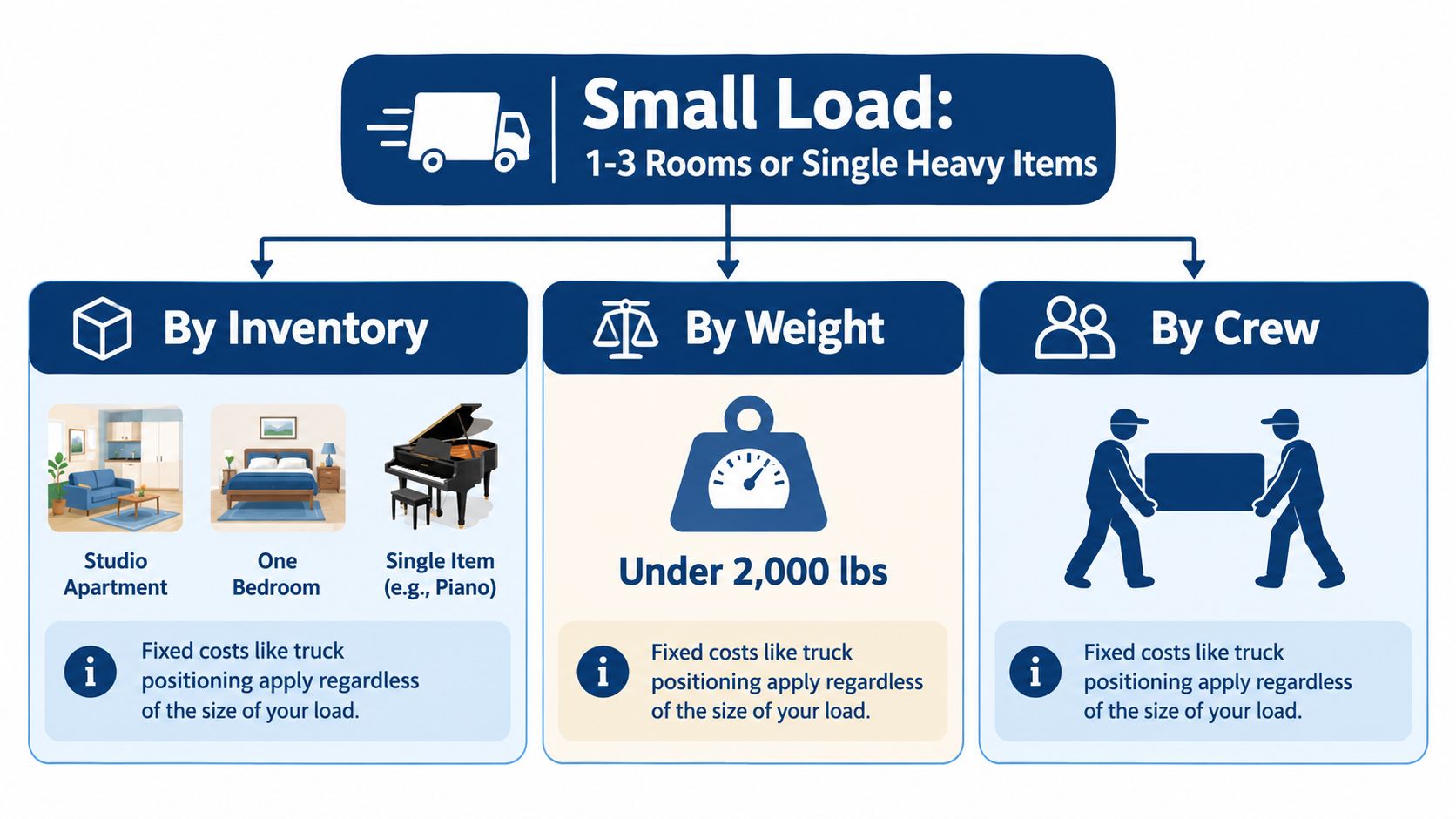
Fixed costs don't shrink just because the load does
Moving companies still pay for truck positioning, crew minimums, fuel, and the return trip when the job is done. Those costs exist whether the truck is half full or almost empty. That's why a smaller shipment can cost more per item or per pound than a bigger one.
One recent analysis says a 500-mile studio move may cost about $1,200, while a full-home move over the same distance may cost about $3,800 move cost analysis. The point isn't that small always means cheap, it's that the unit economics can get ugly fast when the truck, crew, and travel time stay mostly the same.
Consider it akin to a rideshare minimum fare. A short trip still has a base charge, even if you only ride for a few minutes. Small-load moving works the same way. You're paying for the truck, the crew, and the logistics floor, not just the visible pile of boxes.
Define the move before you request numbers
Count the boxes. Measure the furniture. Note the stair flights, long carries, and building rules. If you can't describe the load clearly, the quote you get back will be vague too. That's how people end up comparing estimates that don't cover the same work.
The smartest small-load customers ask for itemized pricing that separates labor, travel, access issues, and materials. That is the only way to compare real offers instead of polished headlines.
Four Realistic Options for Moving Small Loads
Choose from four paths. The right one depends on how fast the items need to arrive, how fragile they are, and how much handling you're willing to tolerate. The wrong one is usually the option that looks cheap until the hidden trade-offs show up.
Option | Typical Price Range | Scheduling | Handling | Best Fit |
|---|---|---|---|---|
Dedicated small-load move | Usually quoted as a job with labor and access factors | More precise | Direct, lower handoff risk | Apartment moves, tight deadlines, fragile items |
Shared-load or consolidated transport | Usually lower headline price than a dedicated truck | Wider delivery window | More handling and more handoffs | Flexible timelines, longer-distance partial loads |
Portable storage container | Depends on container and labor | Flexible for loading, less flexible for final delivery | Good if packed well, but still needs labor | Home loading, staged moves, temporary storage |
Parcel or freight shipping | Varies by item and service level | Fixed shipping windows or terminal timing | Best for boxed or durable pieces | Individual items, smaller furnishings, business gear |
Dedicated service is for control, not just convenience
If your move has stairs, a narrow access path, or a building that enforces move windows, dedicated service usually makes the most sense. You get one crew, one schedule, and one chain of handling. That matters when the item is valuable, awkward, or sentimental.
Shared transport is for flexibility
Consolidated shipping can reduce the bill, but only if you can live with a wider delivery window and extra handling. It's a trade, not a hack. If a customer expects a narrow arrival time or delicate white-glove handling, this option becomes the wrong tool fast.
Containers and freight serve different jobs
Portable containers work when you want control over loading and can manage the labor. Freight makes sense for individual items that can be boxed, wrapped, or palletized without special furniture handling. For readers who want help with loading and unpacking labor, this packing and unpacking service guide is a useful place to compare how labor changes the final job.
Choose the option that matches your access and your tolerance for delay. The cheapest route on paper is often the wrong route for a lease deadline or a building with strict move-in rules.
Reading an Itemized Quote Without Getting Burned
An itemized quote tells you what the mover is charging for. A total estimate only tells you what they hope you won't question. For small jobs, that difference matters because a few access charges can swing the bill hard.
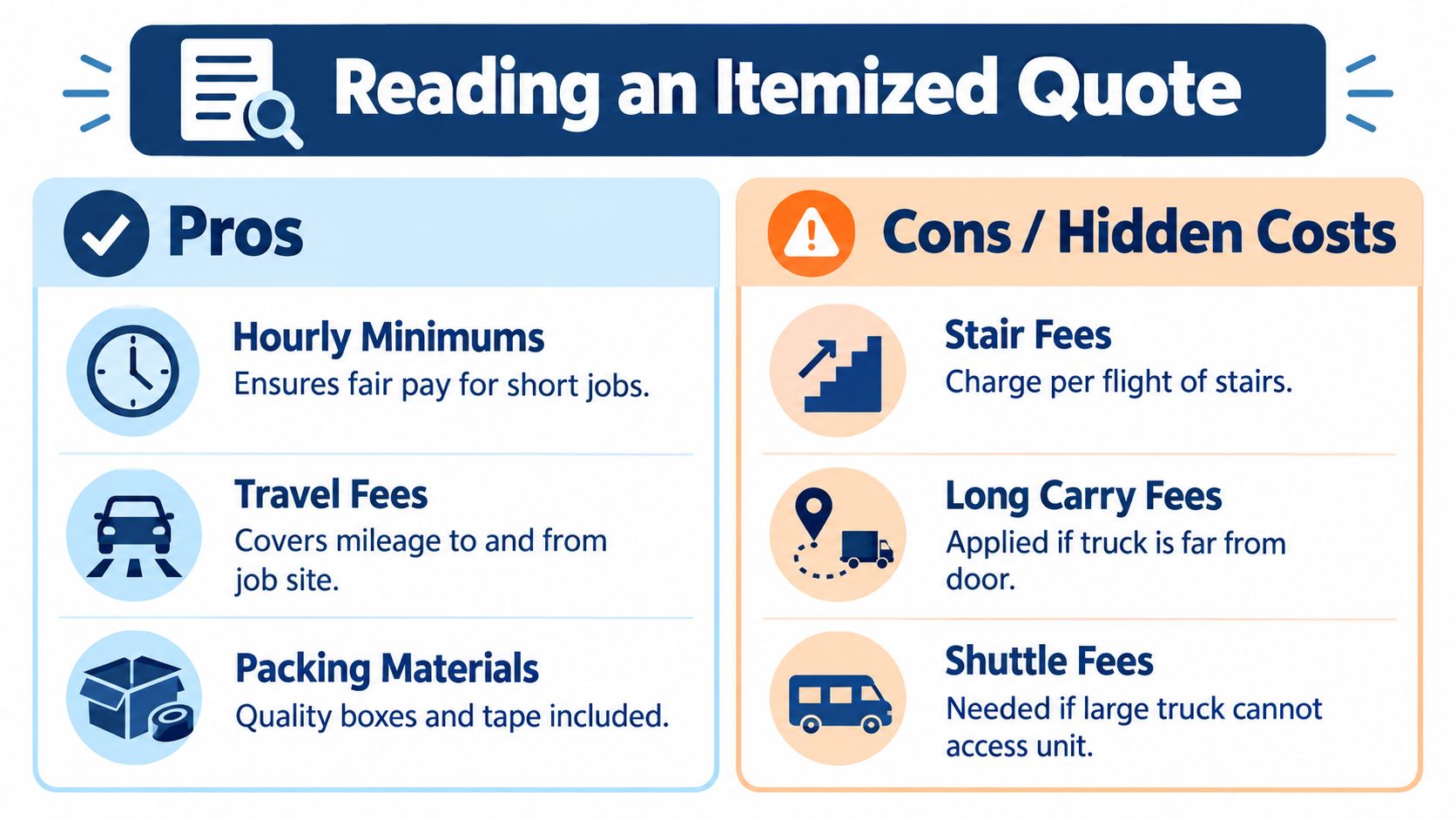
The lines that usually matter
Look for hourly minimums, travel fees, packing materials, stair fees, long carry fees, shuttle fees, and any access surcharge tied to the building. The first three are normal cost centers. The last three are where small-job estimates go sideways.
If the truck can't park close enough, the movers may need extra time to move items by hand. If the building won't allow the full truck at the dock, a shuttle fee can appear. If the movers have to climb several flights or wait on an elevator, labor climbs even though the inventory doesn't.
A clean-looking estimate can still be the expensive one
Two identical apartment moves can price very differently if one has easy elevator access and the other involves stairs and delays. That's the part many customers miss. They compare the topline number, then act surprised when the final invoice reflects the actual work.
Simple rule: don't compare quotes until every line item is matched side by side.
When a mover says “starting at” or gives you one number without access details, assume the quote is incomplete. Ask what happens if the crew has to wait, if the truck can't park close, or if the largest item has to be carried farther than expected. Those questions are not annoying. They're how you avoid a bad booking.
The Access-First Booking Timeline
For small-load jobs, the calendar matters as much as the inventory. Apartment rules, parking, elevator access, and insurance paperwork often decide whether the move feels smooth or messy. One guide to apartment moving notes that many managed properties want reservations about three to four weeks ahead and may ask for a certificate of insurance several days before move day apartment moving guidance.
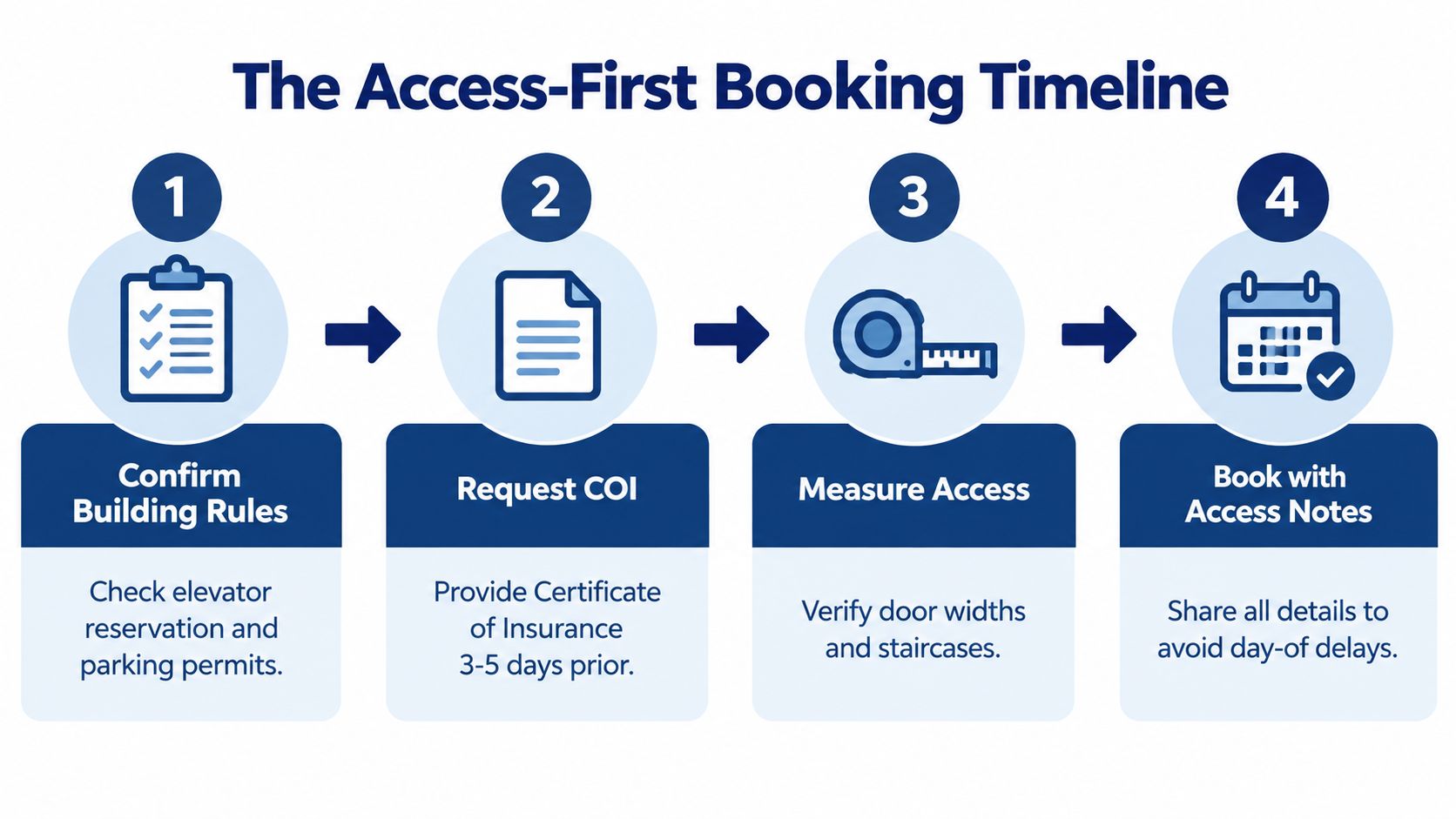
Lock the building rules first
Confirm elevator reservations, loading dock rules, parking permits, and move-hour restrictions before you book the truck. If the building wants specific insurance wording, get it early. If they need it in the manager's name, don't guess.
Measure the largest item, not the average item
A lot of customers worry about box count and forget the one piece that causes trouble. Measure the tallest dresser, the widest sofa, or the heaviest appliance against the doorway and elevator opening. If the item doesn't fit, the job changes immediately.
Build in delay time
A mover can do everything right and still lose time to an elevator queue or a building that's slow at the desk. That's why access notes belong in the booking, not in a passing phone call. For local service in the Austin area, this short-distance mover guide is relevant when the trip is small but the access story is not.
Use the timeline as a booking checklist
Confirm access rules early: Ask about parking, dock rules, and elevator windows before you lock a date.
Send the COI promptly: Don't wait until the week of the move.
Share item dimensions: The mover needs the size of the problem pieces, not just the number of boxes.
Flag every bottleneck: Tight corners, long hallways, stairs, and no-parking zones change the plan.
If you book by access first, price second, you'll make fewer mistakes. That's the order that holds up on move day.
Two Small-Load Scenarios in Central Texas
A Round Rock renter called about a studio move from a second-floor apartment. The inventory wasn't huge, a bed, a sectional, boxes, and a few small pieces. The quote that mattered wasn't the one with the prettiest headline, it was the one that accounted for the reserved elevator window and two flights of stairs on the exit side. The final lesson was blunt, the stair flight cost more than the box count ever would have.
A different family in the Austin area had a POD dropped in the driveway before closing day. They didn't need a full truck, they needed labor that could load the container quickly and correctly before the house changed hands. The quote that worked included loading help, container access, and enough time to manage the furniture safely. What decided the job wasn't inventory volume, it was whether the crew could work within the closing deadline.
Those are the jobs that get mispriced when the customer talks only about stuff. In both cases, the core issue was not “how much” but “how hard to access” and “how fast to finish.”
If you're reading this from a similar setup, use those two examples as a filter. Ask what part of the move creates friction, stairs, elevator time, driveway access, or a hard deadline. Then make the quote answer that problem directly.
Why the Cheapest Headline Price Often Isn't
Small-load customers get tempted by the lowest number because the job looks simple. That's the wrong reflex. A shared-load or freight option can absolutely save money, but only if you can tolerate the trade-offs in timing, handling, and convenience.
The cheapest quote may also come with more handoffs. More handoffs mean more chances for damage, more uncertainty about delivery, and more room for storage fees if the shipment doesn't line up cleanly with your schedule. If the job is sensitive, rushed, or tied to a lease move-out, those trade-offs matter more than the sticker price.
If you need the items on a specific day and you can't absorb delays, pay for control instead of chasing the lowest number.
For partial loads, the right metric is total cost of the move, not just the transportation line. That includes the time you spend waiting, the risk you carry, and the extra labor the building forces onto the job. If you want a broader look at labor-heavy moving help, this movers-and-packers resource is useful for understanding how service level changes the job.
Your Small-Load Booking Checklist
Use this every time you request a quote for a partial move. Count the inventory, measure the biggest items, and note every access issue before you call. Then ask for an itemized estimate that separates labor, travel, stairs, long carries, and any building-related charge.
Prep the load list: Write down furniture, box counts, and any bulky item that could slow the crew.
Read the quote line by line: Compare minimums, travel charges, and access fees, not just the final total.
Handle building access early: Confirm rules, parking, elevator reservations, and insurance wording before move day.
Match the option to the job: Choose by access and timeline first, price second.
That's the whole game. Small loads don't get cheaper just because they're small, they get cheaper when the access is clean, the timeline is realistic, and the quote is honest.
If you want a crew that handles apartment moves, POD loading, storage moves, and specialty items in Greater Austin and Central Texas, Webster Moving Co. can scope the job and give you a no-obligation estimate. Visit Webster Moving Co. to compare your access details, timeline, and load size before you book.
Comments