
Packing Services Near Me in Austin: What to Ask First
Anyone shopping for packing help can usually answer one question roughly and the second one not at all. How much of the house needs to be in a box by Friday is a guess. Who owns the problem when a box arrives dented, or when the count at delivery doesn't match the count at pickup, is a mystery.
That gap is what separates a real packing plan from a promise of careful wrapping. Promises cost nothing and prove nothing. A written scope, a numbered box inventory and a condition record taken before the first roll of tape does the actual work, because those are the documents that settle an argument three weeks later. Local packing support around Austin runs on the same logic, and the sequence matters more than the adjectives on a website.
Table of Contents
What Packing Services Near Austin Actually Cover
Moving is routine rather than rare. In 2025, 11.6% of U.S. residents moved to a different residence, down from 11.8% in 2024, according to the U.S. Census Bureau's American Community Survey. Most of that traffic stays close to home. Census data on movers shows 55.3% moved within the same county and another 23.7% moved between counties in the same state, which means 79.0% of all movers never crossed a state line.
That is why "Packing Services Near Me" is really a local question. The work is to wrap, box, label and stage belongings so they survive a drive across town, and it's a different job from what happens on moving day. Packers prepare the contents. Movers protect furniture, carry, load and transport.
Level | Who Packs | What Is Covered | Best Fit |
|---|---|---|---|
Self-packing with supplies | You | Boxes and tape supplied or sourced; crew moves only what is packed | Budget moves with time to spare |
Partial packing | Crew packs selected rooms or fragile items | Kitchen, closets, breakables or art; you pack the rest | Renters or families with a few tight deadlines |
Full packing | Crew packs the whole home or office | Room-by-room packing, labeling, materials and a box list; unpacking if booked | Busy households, tight lease windows, large homes |
Unpacking only | Crew unpacks at the destination | Placing items, removing packing materials, leaving the home move-in ready | Movers who packed the home themselves |
Read those rows as different transfers of risk rather than different price points. Partial packing is the level most households need, because the kitchen and the fragile rooms carry almost all the breakage exposure while bedrooms and closets are forgiving. Full packing buys time, not just labor, and it's the right call when nobody in the household can take a day off.
We run full and partial packing before moving day, plus unpacking that places items where they belong, removes the packing materials and leaves the home move-in ready. What a full-service booking should bundle is materials, room-by-room packing, a room label on every box, a running box list and unpacking if it's booked.
The first decision you make, before you compare a single price, is how much of the home or office the crew packs. That choice moves an estimate further than any other variable, because it sets labor hours, material volume and the number of items the crew is accountable for at delivery.
Questions to Ask Before You Book an Estimate
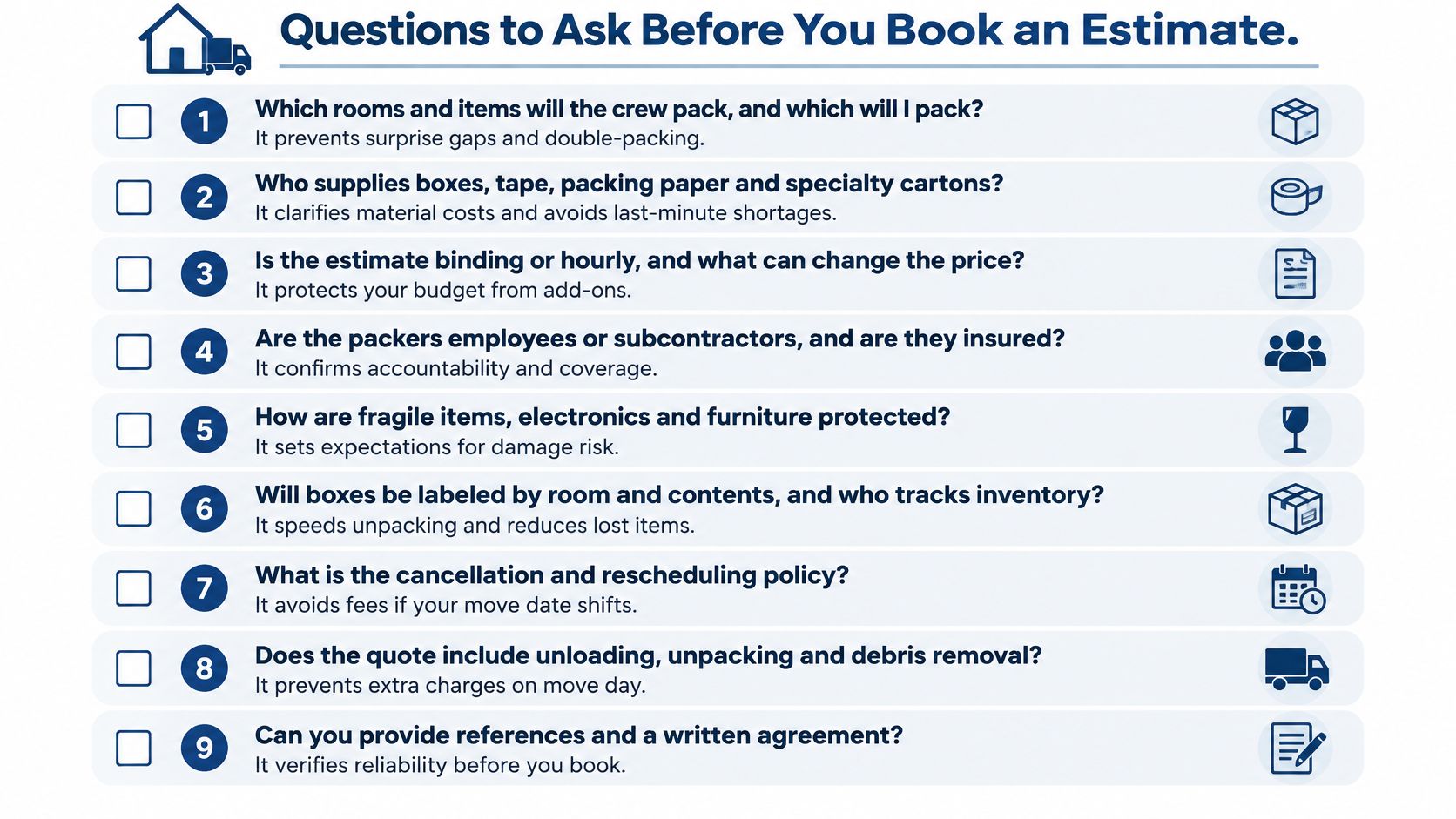
A quote is only as good as the conversation behind it. These nine questions convert a vague assurance into a scope you can compare against another company's scope, line by line.
Which rooms and items will the crew pack, and which will I pack? A written split prevents both gaps and double-packing, where two people wrap the same closet.
Who supplies boxes, tape, packing paper and wardrobe boxes, and how many of each are included? Materials are the line item most likely to reappear as an add-on at the door.
Will fragile or high-value items be photographed before wrapping? A photo taken before the paper goes on is the only neutral record of the condition you handed over.
How are boxes numbered and tracked, and can I confirm the count on delivery? A numbered list turns "where is the coffee maker" into a two-minute lookup instead of a search through forty cartons.
Which items are excluded, such as cash, jewelry, plants or hazardous materials? Every company keeps a list, and hearing it during the quote beats hearing it at the curb.
Is unpacking included or priced separately? Unpacking is a second labor event with its own hours, so it belongs on its own line.
How are stairs, elevators, parking limits and long carries charged? Access is the biggest structural cost driver in a city with as many walk-ups and garages as Austin.
What happens if a box arrives unsealed or an item is damaged? You want the claim steps, the evidence required and the timeline in writing, not summarized verbally.
Will the estimate be written and itemized? A single total can't be compared to anything and can't be disputed later.
We offer free, no-obligation quotes through a short form on the website, which means you can request a written scope before committing to a date. The useful move is to collect answers from two providers and read the two scopes side by side, question by question, rather than comparing the bottom line.
Compare the exclusions, not the totals. Two quotes that differ by a few hundred dollars often differ because one of them assumed you'd handle the garage.
Should You Pack Yourself or Hire Help
A 2025 survey of 2,500 people across all 50 U.S. states found that 38% used professional movers while 62% completed a do-it-yourself move, according to Move.org's state of moving survey. Those shares describe what households chose. They don't say which choice worked out.
The decision comes down to circumstances, and a handful of triggers settle it quickly.
Two weeks or less on the clock. At that point every evening is already spoken for, and a partial pack is the difference between leaving calmly and loading a truck at midnight.
Heavy or delicate pieces. A piano, a gun safe or an antique dresser needs technique and equipment a borrowed hand truck doesn't provide.
A date that can't slip. Lease end dates and closing dates don't negotiate, and a missed walkthrough costs more than the packing labor.
Limited physical capacity or no time off work. Recovery from surgery, a newborn, a job without leave: all of these make a crew cheaper than the alternative.
A large home or a full office. Four or more bedrooms, or a business with a file room and a server rack, is a multi-day job done alone.
Long carries and stairs. Three flights and a distant parking spot turn a two-hour pack into an all-day event.
Think of it the way you'd think about a flat tire. Changing it yourself is entirely doable with a jack, daylight and patience. Hiring help is the pit crew version. You pay for speed and for someone else's hands on the wrench, and the premium is worth it when the clock is the main constraint.
Take a family in a four-bedroom house with a move date eleven days out. They pack the home office and kitchen themselves over two weekends, then book partial packing for the fragile bedroom items and the living room. They skip labor on the boxes they can handle and pay for the rooms where a broken piece would hurt most.
Hire help for the items where a mistake costs the most, and pack the rest yourself when time allows.
Boxes, Materials and Load Planning
Box size follows load, not convenience. U.S. EPA figures report 33.3 million tons of corrugated boxes generated in 2018, with about 32.1 million tons recycled and a reported 96.5% corrugated-box recycling rate, per the EPA's container and packaging data. A correctly sized carton is cheaper to move and easier to recycle, and sizing is a decision you make before anyone picks up tape.
Box Type | Typical Contents | Load Guidance |
|---|---|---|
Small box | Books, files, dishes, small appliances | Keep dense items here to control gross weight |
Medium box | Kitchen items, toys, shoes, bedding | Balance weight and avoid overfilling |
Large box | Linens, pillows, clothing, lightweight décor | Use only for low-density items |
Wardrobe box | Hanging clothing | Keeps garments on hangers; check height clearance at doors |
Divided or specialty box | Glassware, stemware, small electronics | Wrap each piece; mark the box fragile and show orientation |
Double-wall carton | Heavy or fragile contents | Use for items that concentrate load or need extra protection |
Reusable plastic tote | Repeat moves, records, bulky soft goods | Stack with care; confirm lid fit before loading |
Books in a large carton is the classic error, and it fails in two ways at once. The box blows out at a corner, and whoever lifts it risks a back injury. Linens in a small carton is the opposite mistake: you burn three boxes and twice the tape on things that weigh nothing.
Counting is simpler than many expect. Start with the largest room, count shelf and closet contents, then add roughly one tenth for the items nobody remembers until the night before. If you want a fuller method, the guide to how many moving boxes you need breaks the count down room by room.
Two planning pieces pay for themselves. The essentials box holds medications, chargers, documents and basic kitchen supplies, and it travels with you rather than the truck. For offices, color-coded labels by department cut misplacement during staged unloading. Every label should carry five things:
Room name, using the destination room, not the current one
Contents category, such as kitchen, bedding or books
Fragility flag, written on two sides
Orientation arrows for anything that must stay upright
Box number, matched to the running inventory
How a Packing Day Runs From Walkthrough to Unpacking
A packing day has a rhythm, and the jobs that go badly are usually the ones that skipped a step near the front. Here's the sequence a well-run day follows.
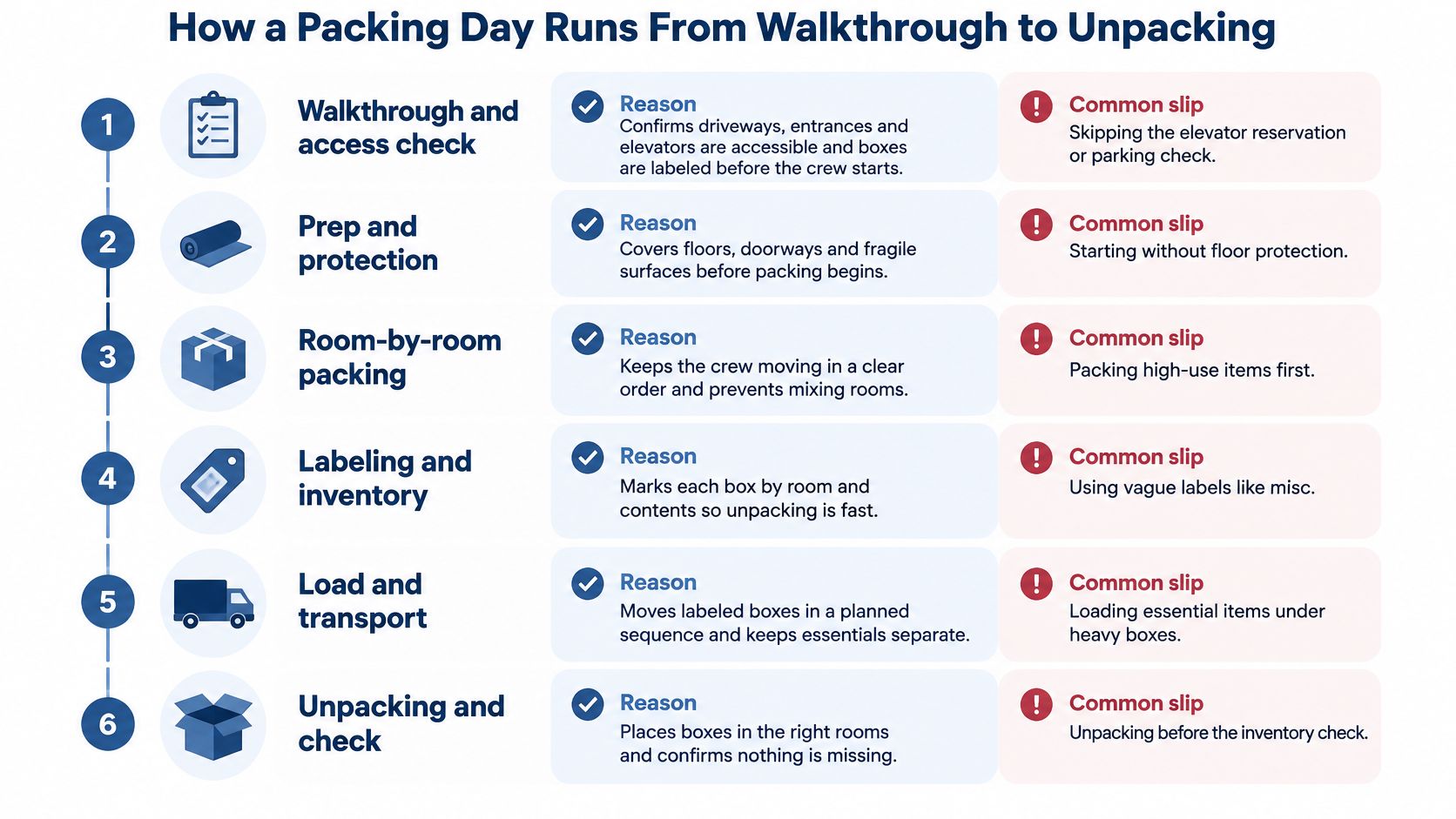
Walkthrough and access check. The crew lead walks the home before a single box is opened, confirming driveways, entrances and elevators are accessible, that boxes get labeled before the move, and that someone over 18 is present at pickup and delivery. Skipping the elevator reservation is the most common and most expensive slip in this step.
Protection and materials first. Moving pads, stretch wrap and other standard furniture-protection equipment are part of our process, and the crew uses high-quality materials and proven techniques to keep belongings secure, organized and protected. Floors and doorways get covered before packing starts, because a scratch on a hardwood floor is harder to fix than a scratch on a carton.
Room by room, least-used rooms first. The spare room and the garage go before the kitchen, so the household keeps functioning while the day runs. Heavy items go into smaller boxes, fragile items get cushioning and orientation arrows, and the recurring slip is the overfilled box that bulges at the seams.
Number and label every box. Each carton gets a room, a contents category, a fragility flag and a number recorded on the inventory. That number is what makes the delivery count checkable instead of approximate.
Protect and load. Ask whether heavy cartons are kept apart from fragile ones and whether the load is secured to reduce shifting. A fragile box under three heavy ones is a claim waiting to be filed.
Transport and unload by room. Boxes land where they'll be opened rather than in a pile by the front door, which is what keeps a two-hour unpack from becoming a two-day one.
Unpack if it's booked. Items go where they belong, packing materials come out, and the count gets checked against the inventory before the crew leaves. Checking after the truck pulls away is the slip that costs people.
A well-run day leaves three things in your hands: numbered boxes, a clear path from the truck to each room, and a signed inventory at delivery. Everything else is pleasant but not protective.
Protecting Belongings and Documenting Damage Claims
Packing is an engineering problem before it's a labor problem. ISTA testing, the packaging standard framework described by UL Solutions, identifies four distribution hazards: shock, vibration, compression and atmospheric exposure. Protection has to match the failure mode.
Cushioning isolates fragile items from shock. Void fill stops an item moving inside its carton. A rigid outer carton resists the stacking pressure of everything above it. Sealed, conditioned packing is what protects moisture-sensitive goods and electronics.
Damage shows up at three distinct points, and each leaves different evidence. Faulty packing shows up as items loose inside an intact box. Transport damage shows as crushing, puncture or water marks on the outside. Unloading damage shows as a box that was sound at the door and dented at the top of the stairs. Knowing which one you're describing is what makes a claim resolvable.
A consumer-protection review of moving complaints found unclear quotations, delays and compensation for damaged belongings as recurring complaint categories, and recommended that providers explain special charges, delivery expectations and compensation procedures at the time of quotation while documenting valuable or fragile items before packing, per the Hong Kong Consumer Council's moving-complaint analysis. The lesson travels: careful packing is not a marketing promise you can audit. A paper trail is.
Stage | What to Record | Who Keeps It |
|---|---|---|
Before packing | Walkthrough notes, pre-existing damage, valuable items | You and the crew lead |
During packing | Numbered box inventory, fragile and high-value labels | Crew and you |
At loading | Condition photos of furniture, mirrors and boxes | You |
In transit | Any incident report from the crew during the move | Crew lead and provider |
At delivery | Box count check and unpacking condition notes | You and the crew lead |
After delivery | Written damage claim with photos and inventory references | You and the provider |
We're fully licensed and insured, and the details behind that coverage are worth requesting in writing before the move, including the claim steps and who to call. The practical checklist looks like this: photograph valuable and pre-existing-condition items before wrapping, keep the numbered inventory somewhere other than the truck, and note condition at delivery before signing anything.
Practical rule: document before the first box is taped, not after a problem appears. A photo taken at 8 a.m. costs nothing. A dispute opened three weeks later costs weeks.
If you'd rather work from a single list, the prep checklist for movers covers what to have ready the day before the crew arrives.
Austin Renters and Apartment Move Windows

Renters drive the local market. A 2026 report citing Census data found that 49.1% of renters in the Austin–Round Rock–San Marcos metro had moved during the prior year, the highest turnover rate among the 55 largest U.S. metros, with apartment occupancy around 86% to 88% and 73% of units offering concessions, per KXAN's reporting on Austin's rental market. The national pattern points the same direction. 22.9% of renters moved between 2015 and 2016, against 5.0% of homeowners, according to the Census Bureau's mover-rate analysis.
Take an illustrative case. A renter in Round Rock holds a third-floor walk-up, exactly one elevator reservation, a loading zone that allows thirty minutes and a move-out inspection two days after the truck leaves. Nothing about that scenario rewards the cheapest box price.
The questions to settle with the crew before the day arrives are operational, not cosmetic. Can the packing be finished around the elevator booking? How are boxes staged when loading space is limited to a narrow window? Can the crew pack only the kitchen, the closets and the fragile items? Who coordinates move-out cleaning, inspection and key return so the unit is empty and clean on time? What happens if the destination unit isn't available for several hours?
Webster Moving Co. handles apartment moves and works with stairs, elevators, parking restrictions, furniture disassembly and reassembly, and other building logistics. We also ask apartment customers to share details about stairs, elevators, loading areas, gate codes and parking restrictions in advance, because a plan that ignores them fails on the day.
The economics favor planning over price. Building windows, stair charges and lease penalties routinely cost more than the difference between a partial pack and weeks of evening work.
Compare the three levels on the dimensions that matter here: time, access and risk. Self-packing saves money if you have a flexible lease and a ground-floor unit. Partial packing buys back the fragile rooms when the elevator slot is short. Full packing makes sense when the inspection is two days out and nobody can leave work.
A practical timeline works like this. Two weeks out, confirm access, gate codes and elevator rules with the building. Ten days out, pack non-essentials first and clear anything you're donating. The week before, reserve the elevator and the loading zone in writing, and confirm the move-out inspection slot. Our apartment movers guide covers the building-side coordination in more detail.
If the destination unit isn't ready for several hours, don't idle the crew. Finish packing and labeling at the origin, stage numbered boxes only in a holding area the building permits, and keep the essentials box with you. Start unpacking once access is confirmed.
Confirm Your Packing Plan and Request an Estimate
A packing plan is only reliable when the labor and the paperwork match. Before booking, turn the estimate into a written scope that identifies what gets packed, what stays with you, what is excluded, how box counts and item condition will be recorded, and what happens if something is damaged.
Inventory the risky items. Count rooms and list anything fragile, heavy or high value, including pieces that need additional planning such as a piano, a safe, an antique or large furniture.
Pick a packing level. Use the four levels and the decision triggers above. Partial packing is the usual answer for households with time for bedrooms but none for the kitchen.
Request a free, no-obligation estimate through the quote form or by calling 512-751-0893. Bring the nine questions with you, and ask for the estimate to cover timing, crew needs and materials.
Confirm the written scope and responsibilities. Review the packing level, rooms and items covered, exclusions, labeling expectations, condition records and damage-claim steps. Make sure driveways, entrances and elevators are accessible, all boxes are properly packed and labeled before the move, and someone over 18 is present during pickup and delivery.
Book the date early. Webster Moving Co. can often accommodate short-notice moves depending on crew availability, but asking early protects the slot you want.
The answers you get back are worth more than a general assurance of careful packing. A clear written plan gives you a record to check against the finished work.
Webster Moving Co. covers the practical side of that plan: full or partial packing before moving day, high-quality materials and proven wrapping techniques, unpacking that places items where they belong, removes packing materials and leaves the home move-in ready, and licensed, insured crews serving Austin, Round Rock, Cedar Park, Georgetown, Leander and the surrounding Central Texas communities. If you want the scope confirmed before moving day, bring the nine questions to the estimate. Visit Webster Moving Co. to request your free, no-obligation quote and lock in your date.
Comments