
Moving Company Cost: Prices, Factors and How to Estimate
The average U.S. moving cost was $1,035 in 2024, according to a Forbes Advisor survey of 1,000 adults who had moved within the previous two years, a national benchmark rather than a quote for your home.
Your real number depends on inventory, services, timing, travel, and how the mover structures the estimate. Two quotes with the same hourly rate can land very different totals if one omits stairs, packing, or specialty items. For a Greater Austin household, check the written scope, what could change the price, and how much cash is due at delivery.
Table of Contents
The Factors That Push a Quote Up or Down - Workload and access - Service choices and timing
How Moving Companies Structure Their Prices - Read the billing rules, not just the rate
Binding and Non-Binding Estimates in Practice - A cheaper estimate can create more uncertainty - Compare financial exposure
How to Get an Accurate Estimate Step by Step - Prepare the information - Request, compare, and retain
Hidden Costs and Cash Due at Delivery - Separate the moving bill from transition expenses - Plan for available cash
Valuation Coverage and Red Flags to Avoid - Check the documents behind the quote - Insurance isn't a substitute for clear terms
Get a Written Quote Before You Book - Verify who you're hiring
Typical Moving Costs by Home Size
The $1,035 national benchmark for 2024 comes from a Forbes Advisor survey of 1,000 adults who had moved within the previous two years. It isn't a full-service price guarantee or a bedroom-specific estimate.
Home size gives you a starting point for describing a move, but bedroom count doesn't tell the mover how much work you'll need. A lightly furnished house and a house with a workshop, packed garage, and overflowing closets require different plans.
Full-service estimating guide by home size
Home size | Crew and time planning | Long-distance pricing basis |
|---|---|---|
Studio or one-bedroom | Assign the crew after reviewing furniture, boxes, and building access | Written inventory, shipment size, route, and requested services |
Two-bedroom | Include disassembly, packing needs, and loading access in the labor plan | Shipment size plus transport and accessorial services |
Three-bedroom | Review every room, garage, patio, and storage area before scheduling labor | Complete household inventory and destination conditions |
Four-bedroom | Plan equipment and staffing around furniture volume and heavy items | Shipment size, specialty handling, and any storage |
Five-bedroom or larger | Build a whole-house crew plan from a detailed survey | Complete shipment assessment and a written service scope |
These are estimating rules, not published price bands. Reliable bedroom-specific ranges require comparable information about location, distance, packing, and access. Without that information, a table of dollar amounts can create false confidence.
At Webster Moving Co., we handle full-house moves for three-bedroom, four-bedroom, and larger homes with experienced crews and equipment. We build the plan around the actual household rather than assigning a price from bedroom count alone.
Budgeting rule: Use home size to organize your quote request. Use a complete written estimate to decide what you can afford.
If a quote seems unusually high or low, check whether it includes the garage, outdoor furniture, packing, and difficult access before assuming the price is wrong.
The Factors That Push a Quote Up or Down
A move works more like a taxi fare with loading work attached than a simple mileage calculation. A short trip with difficult loading and a long wait can require more paid work than a longer trip with straightforward access.
Start with the amount being moved. Furniture dimensions, box counts, shipment weight, and occupied truck space help the mover choose equipment and plan labor. Item count alone isn't enough: a dining chair and a safe aren't interchangeable pieces.

Workload and access
Crew size and working time come next. Disassembling beds, wrapping furniture, navigating narrow hallways, loading securely, and placing items at the destination all take time. A smaller crew doesn't automatically mean a cheaper total if the job takes longer.
Distance matters through travel between addresses and the transportation arrangements. But access can change the workload before the truck even leaves:
Stairs and elevators: Identify the floor, staircase layout, elevator reservation, and building restrictions.
Parking and loading: Explain where the truck can stop and how far movers must carry belongings.
Gates and shared spaces: Supply access instructions and any requirements for protecting common areas.
For apartment moves, we ask customers to tell us about stairs, elevators, loading areas, gate codes, and parking restrictions so we can plan accordingly.
Service choices and timing
Packing adds work and materials. Pianos, safes, antiques, and other specialty items may need different equipment or handling arrangements. Storage and POD moves also need a clear loading, unloading, and scheduling scope.
Timing deserves attention without assuming a particular month guarantees a discount. The U.S. Bureau of Labor Statistics moving, storage, and freight expense index ranged from 190.913 in January 2024 to 206.798 in October 2024, a spread of about 8.3% relative to January. That's a combined market indicator, not a predicted change in your individual quote.
Check your date against peak moving season considerations, then request pricing for the date you intend to book. If you're flexible, ask whether another available date would change the proposed plan or price.
How Moving Companies Structure Their Prices
Pricing structure | How it is billed | Best fit | Main risk |
|---|---|---|---|
Hourly | Crew time under stated clock rules, plus disclosed travel and fees | Local moves with a clear scope | Comparing rates without comparing crew size or billable time |
Flat rate | Fixed price for a stated inventory and listed services | Moves with a stable, documented scope | Added items or work may require revised pricing |
Weight-based interstate | Shipment weight priced under the mover's applicable tariff | Interstate household moves using this structure | Actual shipment weight may differ from the projection |
Accessorial add-ons | Separate charges for services such as packing, storage, or difficult access | Moves needing work beyond transportation | A service may be absent from the initial quote |
The billing method and the estimate type aren't the same thing. Billing explains how the mover calculates charges. The estimate explains what price commitment the mover is making for the listed work.
For interstate household-goods moves, federal household-goods regulations require a written estimate covering transportation, accessorial services, and advance charges. Those federal rules shouldn't be treated as a universal description of how every Texas-only local move is billed.
Read the billing rules, not just the rate
With hourly pricing, confirm when the clock starts and stops, whether travel is billable, and what crew the rate includes. Ask how delays, additional labor, and any minimum charge are handled. Don't assume loading-to-unloading time is the only paid time.
A flat rate is useful when the inventory and service list are stable. The important question is what happens if you add furniture, request packing, or change the destination. A fixed price needs a fixed description of the job.
With weight-based pricing, understand how the shipment is weighed and how the tariff applies. With accessorial charges, check whether the services appear as separate amounts or are included in a stated total.
At Webster Moving Co., we provide straightforward pricing with no hidden fees. The purpose is to let you evaluate the whole moving plan rather than react to an attractive hourly headline.
If you're supplying the truck or container yourself, labor-only moving is a different scope from transportation plus loading and unloading. Compare those offers only after separating who supplies the vehicle, equipment, and transport.
Binding and Non-Binding Estimates in Practice
A binding estimate fixes the price for the quantities and services listed. It gives you predictability for that defined scope, not permission to add unlimited work at the same price.
A non-binding estimate projects the expected charges rather than guaranteeing the final bill. For interstate household moves, the FMCSA's estimate guidance explains that a mover generally can't require more than 110% of a non-binding estimate at delivery, although legitimate additional charges may still be payable later.

A cheaper estimate can create more uncertainty
Say you're moving from an upstairs apartment. One mover's quote includes the staircase, packing fragile kitchenware, and the carry from the loading area. Another quote looks cheaper but describes only furniture transportation.
Those aren't equivalent offers. Before comparing totals, give both movers the same inventory and access description, then require the same services in writing.
A lower non-binding estimate isn't necessarily a lower final price. A binding estimate is useful only when its inventory and service list describe the move you're actually making.
For a binding arrangement, added belongings or services may require a new estimate or another revised agreement. Resolve changes before loading rather than relying on a verbal promise while the crew is working.
An unlisted staircase also deserves careful handling. There's a difference between a customer adding a service and a mover failing to record a condition that was already disclosed. Keep your photos, messages, and survey notes so the written record shows what both parties knew.
Compare financial exposure
Think about both price certainty and cash availability. A non-binding estimate may expose you to a higher final charge even when the amount collectible at delivery is restricted. A binding estimate may make planning easier, but only after you confirm that packing, access, and other requested work are included.
Don't treat a delivery-payment protection as a universal ceiling on the entire move. Likewise, don't assume every added charge is justified merely because the mover calls it an extra.
Before choosing, ask for plain answers to these questions:
Estimate status: Is this explicitly binding or non-binding?
Included scope: Which items, locations, and services does it cover?
Changes: How will additions or changed conditions be documented and approved?
Settlement: What amount is expected at delivery, and what could be billed afterward?
The decision rule is simple: identify the price commitment before comparing the price.
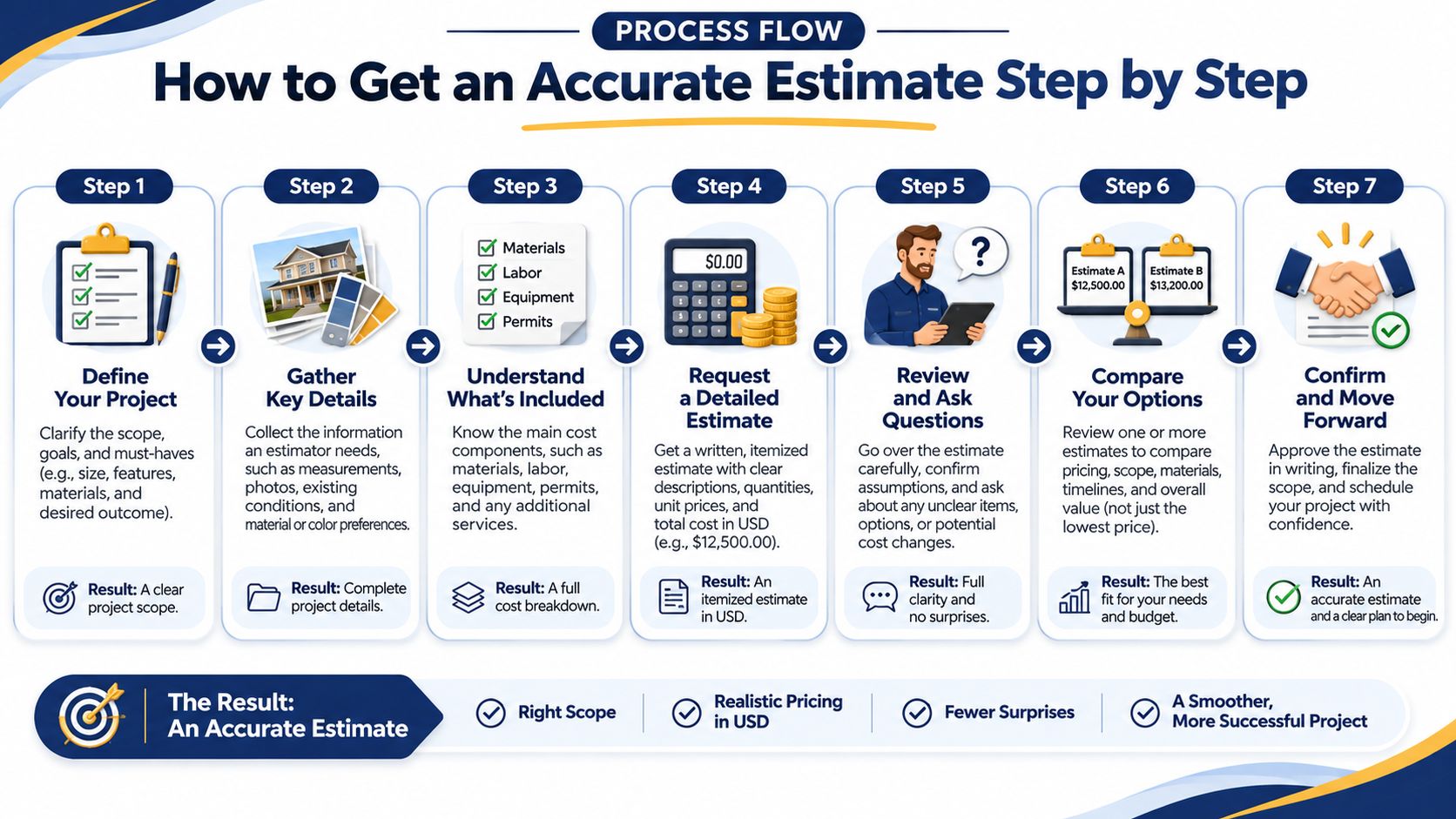
How to Get an Accurate Estimate Step by Step
Build the quote from observable details, not a guess about how full your house feels. The FMCSA's consumer rights and responsibilities booklet provides a framework for documenting interstate transportation and additional services in a written estimate.
Prepare the information
Make a room-by-room inventory. Use a spreadsheet or phone checklist for furniture, boxes, appliances, and heavy items, and mark anything that stays behind. Include closets, the garage, patio, attic, and separate storage so the mover isn't planning from an incomplete household.
Record access at both addresses. Photograph stairs, tight turns, entrances, and the route from the likely truck position to the door; record elevator reservations, parking limits, and gate instructions separately. Destination access matters just as much as pickup access because unloading requires its own plan.
Identify special handling and packing. Name pianos, safes, antiques, fragile pieces, and furniture that needs disassembly, then specify full-home, partial, or room-by-room packing. We offer packing from individual rooms and fragile belongings through full-home preparation, so describing your preference helps us scope the work correctly.
Request, compare, and retain
Submit a detailed quote request. Our short website form provides a free, no-obligation way to request an estimate, and you can also contact us by phone or email. We provide an upfront estimate based on your move details so you know what to expect before moving day.
Compare equivalent written scopes. Put labor, travel, materials, packing, storage, valuation, and cancellation terms beside one another in a comparison sheet. A blank line isn't evidence that a service is included, so resolve omissions before choosing.
Confirm additions and payment arrangements. Request written treatment of potential extra work and confirm the expected delivery payment and accepted payment methods. This prevents a payment-method problem from becoming an unloading problem.
Save the complete agreement. Keep the signed estimate, inventory, order documents, and approved changes together, with an accessible copy on your phone. Written records let you check a later invoice against what you authorized.
Before submitting: Walk through the property with your inventory open. Check behind doors and inside storage spaces rather than relying on memory.
An omitted garage or off-site storage unit can change the job substantially. Other avoidable slips include showing only pickup access, leaving packing undecided, comparing incomplete scopes, and approving a change without keeping a copy.
Hidden Costs and Cash Due at Delivery
Your mover's quote isn't your entire relocation budget. Even a correctly priced move can strain your finances if you're also paying for temporary accommodation, storage, and overlapping housing.
The FMCSA's Ready to Move brochure advises consumers to compare at least three movers or brokers and put promised services and charges in writing. It also addresses complaints involving movers holding shipments for additional money, which makes payment documentation a practical safeguard rather than mere paperwork.
Separate the moving bill from transition expenses
Use distinct budget categories so you don't mistake a low transportation quote for a low total relocation cost:
Mover charges: Transportation, labor, packing, materials, and any contracted accessorial services.
Storage and container expenses: Storage periods, POD holding charges, and separately arranged handling.
Housing overlap: Rent or mortgage overlap and temporary accommodation if access dates don't align.
Household setup: Cleaning, utility deposits, and other costs of making the new home usable.
Personal disruption: Pet boarding, childcare arrangements, or unpaid time away from work.
Some storage or container work may appear in the mover's contract. Record it only once rather than assuming it's always separate.
A useful planning formula is written mover estimate + a deliberately chosen contingency + transition expenses. Set the contingency according to unresolved risks, such as uncertain possession dates or an unconfirmed storage period, rather than applying an unsupported universal percentage.
Plan for available cash
A budget can balance on paper while leaving you short on delivery day. Note which payments occur before pickup, which are due at delivery, and which belong to other providers.
Understanding upfront moving costs helps you distinguish booking expenses from later settlement. Confirm accepted payment methods before loading, and keep the agreement and payment receipts accessible during delivery.
If a payment dispute arises, ask for an itemized explanation and retain the relevant messages and documents. The lowest advertised quote isn't necessarily the lowest-cost move if unclear scheduling or missing services leave you paying for extra accommodation and storage.
Valuation Coverage and Red Flags to Avoid
A price estimate doesn't, by itself, explain what happens if belongings are lost or damaged. Valuation coverage concerns the mover's liability, and it deserves a separate review from the transportation rate.
Request the written coverage terms, including whether the quoted arrangement uses released-value protection or another available valuation option. Confirm how compensation would be calculated, what exclusions apply, and whether selecting different protection changes the price. Don't assume a declared value guarantees reimbursement under every circumstance.
Check the documents behind the quote
Compare valuation terms alongside the service scope. Keep descriptions and photographs of valuable or unusually fragile belongings, and disclose them before the agreement is finalized.
Treat these situations as reasons to investigate before booking:
No meaningful inventory review: Ask how the mover assessed the shipment if nobody reviewed its contents through a walkthrough, video, photographs, or a detailed inventory.
An unexplained low quote: Request the missing labor, transport, access, and packing details rather than assuming the discount is genuine.
Payment pressure: Seek written terms if you're asked for full payment or cash before the move, especially when the request conflicts with the estimate.
Missing identification: Obtain the company's legal name and applicable registration or license details.
Rushed signatures: Read every document and resolve blank fields before signing.
Insurance isn't a substitute for clear terms
Ask for evidence of relevant insurance and understand what it covers. General business insurance, vehicle coverage, worker-related coverage, and protection for your shipment aren't interchangeable.
We're licensed and insured as a Texas moving company. Still, you should understand the shipment-specific terms in your moving documents rather than treating a licensed-and-insured statement as a complete explanation of compensation.
A credible quote should leave you able to explain both what the move costs and what protection you've selected.
Get a Written Quote Before You Book
Book only after you have a complete written estimate, understand its price commitment, and know the expected payment arrangements. A friendly conversation is useful, but it isn't a substitute for a document that describes the work.
Use this checklist as a final review rather than another opportunity to compare headline rates:
Price commitment: The estimate's status is clear, with understandable change procedures.
Household scope: Every moving location and relevant storage area appears in the inventory.
Access plan: Both properties' stairs, elevators, loading areas, and restrictions are recorded.
Packing and special items: Responsibilities, materials, and unusual handling are specified.
Storage or POD work: Handling, scheduling, and any holding arrangements are documented.
Protection: Valuation terms and any separately priced options are clear.
Booking terms: Cancellation conditions and scheduling expectations are available in writing.
Payment: You know the expected delivery amount, timing, and accepted methods.
Verify who you're hiring
Match the business name on the estimate to its registration details. Check the applicable state and federal records for the service being offered, and ask questions if the paperwork identifies a different company from the one you contacted.
We hold TxDMV No. 010210868C and USDOT# 4470107, and we're fully licensed and insured. Those identifiers give you concrete details to check rather than relying only on a logo or advertisement.
To discuss your inventory, access conditions, and moving date, call 512-751-0893 or email sales@webstermoving.com. Our office hours are Monday through Friday, 8:30am to 5pm, and Saturday and Sunday, 9am to 3pm.
Keep your preferred date, addresses, inventory, and packing preferences ready when you contact us. If something remains undecided, identify it openly so it can be resolved before the crew plan is finalized.
A good estimate passes a straightforward test: you can explain every listed cost to a spouse, roommate, or colleague without guessing what's included.
We offer free, no-obligation quotes built around your inventory, access conditions, packing needs, and specialty items. Visit Webster Moving Co. to request an upfront estimate and put a clear moving plan in writing before you book.
Comments