
What Is Upfront Cost? a Moving Cost Guide for 2026
Upfront cost is the amount a customer must pay or commit before a moving service begins, including deposits, base charges and mandatory fees. If you budget only for the hourly labor rate, are you budgeting for your move?
People ask what is upfront cost because the first number they see rarely matches the cash they need ready. A useful budget separates what you commit at booking, what you pay on moving day, and what could still change. Once those three buckets are clear, you can compare quotes fairly and avoid stacking deposits in the same week without a plan.
Table of Contents
What Upfront Cost Means for Your Move
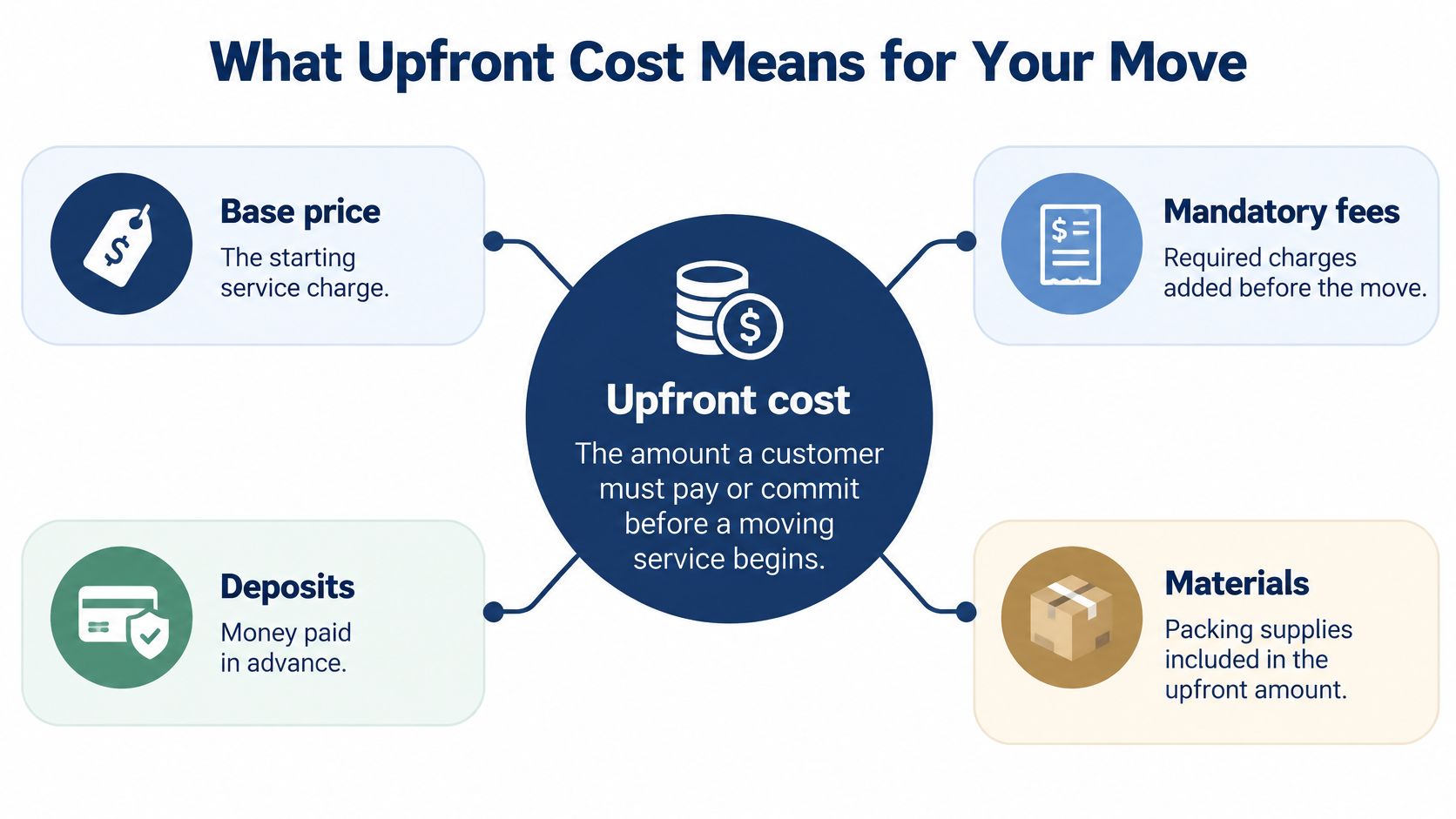
Upfront cost is the amount you must pay or commit before receiving, using, or completing a product or service. For a move, that can include the base price, mandatory fees, deposits, required materials, setup charges, and other unavoidable expenses known at the beginning.
Think of a hotel. The nightly rate isn't the total you see at checkout once taxes and required charges are added. A moving company's hourly rate works the same way, and it isn't your full starting budget.
The Federal Trade Commission report on dark patterns states that businesses should include unavoidable and mandatory fees in the upfront advertised price. Presenting an artificially low price and revealing required charges later can mislead consumers.
Upfront Is Not the Same as Total
Upfront cost concerns what must be paid or committed at the start. Your total moving cost can include later adjustments during delivery, storage, or completion. Optional services such as full packing or temporary storage can stay separate when they're optional, but they should be labeled that way before you commit.
Charge | When it is due | Upfront or later |
|---|---|---|
Booking deposit or card hold | When the job is confirmed | Upfront, for large or long-distance jobs |
Labor and truck charges | Paid at completion of the move | Quoted upfront, paid later |
Packing materials, if ordered | At ordering | Upfront |
Stairs, long carries and access conditions | Priced in the estimate when known | Upfront if stated in writing |
Extra labor, time or equipment | Found on moving day | Later, after adjustment |
Final balance | Completion of the move | Later |
Practical rule: Treat an upfront estimate as your complete initial budget, not as the labor rate alone.
Do three things before you book. Identify every required charge, label optional add-ons separately, and ask for the total in writing with included services, exclusions, and mandatory charges named.
Budgeting Cash Due Before Moving Day
Your mover's invoice is only part of the cash you need. Money that never appears on that invoice often falls due in the same week, and that's where moves break down financially.
Two Kinds of Starting Cash
Separate moving-company upfront charges from housing-related move-in cash. The first group includes a booking deposit or minimum charge and packing materials if you order them. The second group can include a security deposit, application fee, first month's rent, utility deposits, storage or POD charges, parking or elevator reservations, and insurance-related costs.
That timing clash matters. The National Low Income Housing Coalition's 2025 renter survey found that security deposits, application fees, and move-in fees challenged 19.1% of recent movers and 39.0% of people who considered moving but did not, and 62.1% of these "almost movers" said they ultimately could not afford to move.
Use dollar benchmarks as a sanity check, not as your quote. Lemonade's 2024 Moving Insights Report found that Americans who had moved within the previous five years budgeted an average of $1,379 for physical moving components and $1,062 for fees. Zillow's 2024 renter survey found 87% of recent U.S. renters reported paying a security deposit, with a median deposit of $750 among those who paid one. A quote covering only truck and crew leaves that deposit, first month's rent, and fees unfunded.
A Simple Worksheet
Sort every cost into three columns. Pay before moving day holds deposits and reservations, pay on moving day holds the final moving balance, and possible post-move charges holds corrections or agreed extras.
Cost | When it is due | Paid to |
|---|---|---|
Moving company deposit | Before moving day, when required | Mover |
Security deposit | Before move-in | Landlord |
Application fee | When applying | Landlord or property manager |
First month's rent | Before move-in | Landlord |
Utility deposits | Before service starts | Utility providers |
Storage or POD charges | Before loading | Storage or POD provider |
Elevator or parking reservations | Before moving day | Building management |
With us, a valid credit card or deposit may be required to confirm large or long-distance jobs, so confirm that amount early. Then confirm landlord, utility, storage, and building-management costs directly with each provider. A competitively priced move can still be unaffordable when several unrelated deposits become due simultaneously.
How Upfront Estimates Turn Into Final Bills
We provide an upfront estimate based on the details of your move so you know what to expect before moving day. That estimate is built from what you tell us about the home or office, the items, the access, and the timing.
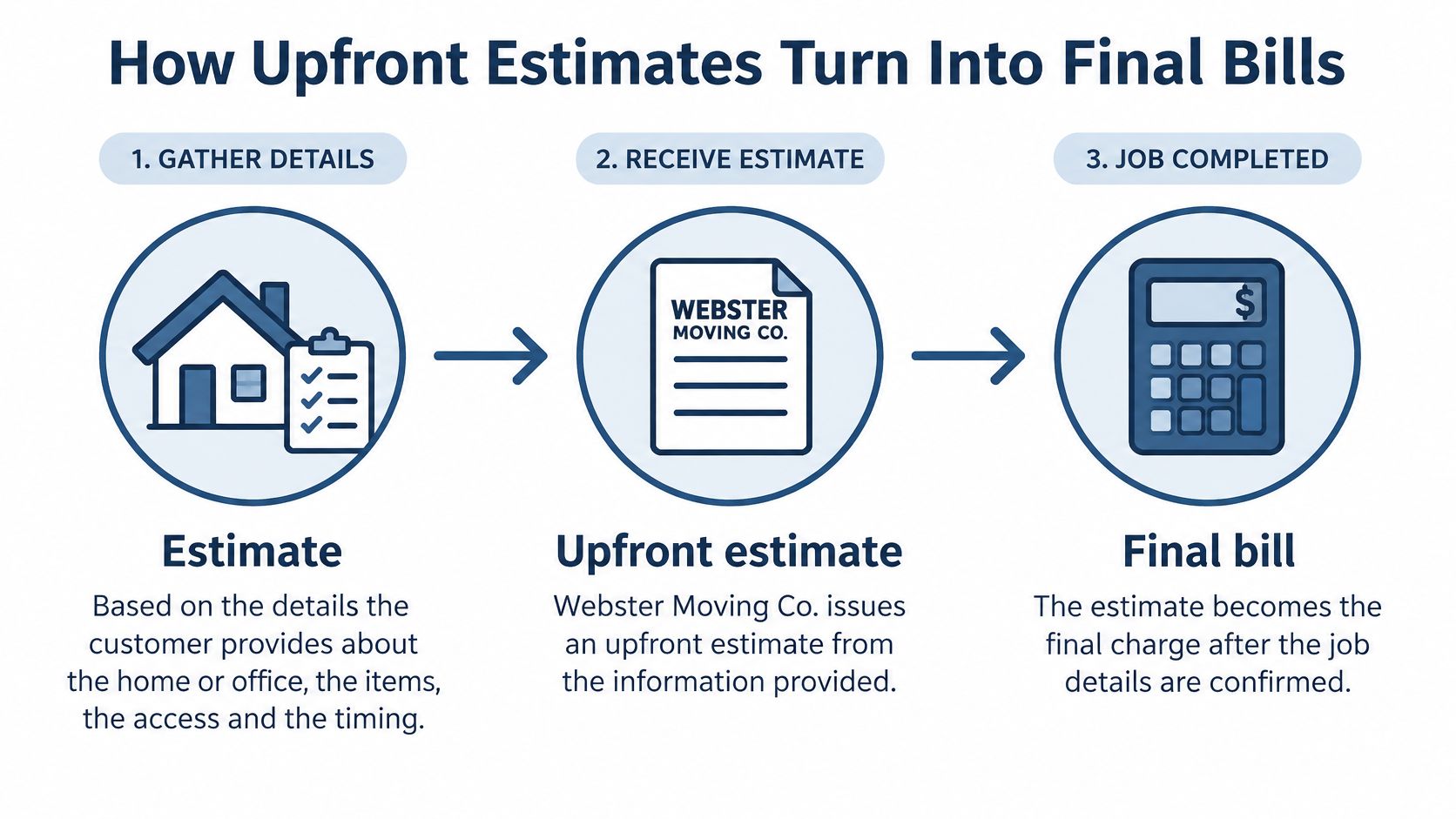
Booking: Get any deposit or card hold amount and its refund terms in writing.
Estimate: Read the included services, exclusions, and assumptions, especially if you're considering full-service movers to handle packing and transport together.
Moving day: Our crew may adjust for extra labor, time, or equipment when the load is larger than described or access is harder than expected.
Completion: Payment is due upon completion unless otherwise agreed in writing, and we accept major credit cards, checks, and electronic payments.
After the move: Compare the itemized final invoice against your estimate line by line.
Estimates are based on information you provide, so an unlisted staircase or extra room is the usual reason a bill changes. An extra charge needs a clear reason and your approval before we do the extra work.
Checking a Quote for Hidden Fees
Can you trust the lowest quote? Not always. A low hourly rate can hide minimum billing time, travel time, access fees, and specialty-item charges that appear later.
Consumers notice that pattern across services. The Reviews.org 2025 consumer trust survey found that 84% of surveyed U.S. internet customers said all fees should be included in advertised pricing, while 59% felt misled by pricing or terms and hidden fees were the leading surprise, reported by 53%.

We provide honest, straightforward pricing with no hidden fees, unlike movers who lure customers with low hourly rates and add unexpected charges later. Even so, any quote is only as complete as the inventory and access information you give, so ask in advance what would trigger a change order.
Nine Questions Before You Book
Question to ask | Why it matters | What to request in writing |
|---|---|---|
Is a labor minimum included? | Low hourly rates can hide a minimum billing time | Minimum hours and billing increments |
Is travel time included? | Travel can add billable time | Travel time and where it starts |
Are stairs, long carries and elevators priced? | Access adds labor on moving day | Access conditions stated in the estimate |
Are bulky or specialty items covered? | Pianos, safes and large appliances may need extra crew | Charge for each specialty item |
Are packing supplies included? | Materials are often billed separately | Itemized supply list |
Is storage or POD loading included? | Loading and unloading may be a separate service | Scope of loading and unloading |
What valuation coverage applies? | Protection levels affect what you pay | Valuation options and their costs |
What are the cancellation terms? | Deposits may be lost if you cancel | Refund and notice rules |
Are taxes included? | Taxes raise the final total | Tax line on the estimate |
If a mover can't itemize the total, treat that number as incomplete. Don't use it as your budget ceiling.
How Upfront Cost Plays Out in Real Moves
Say you're leaving a North Austin apartment. Your estimate should name crew and truck plus planned coordination for the elevator, long hallways, parking restrictions, and limited loading areas. We handle apartment moves in North Austin with that coordination built into the plan, and each condition should be written into your quote.
A household move from Hutto to Dallas, Houston, or San Antonio looks different. We handle those moves and destinations throughout Texas, and the deposit requirement, travel time, and possible extra labor matter more than hallway distance. If you're comparing a house move, checking the average cost of a local move for a 3-bedroom house helps you see what a fuller estimate includes.
Storage and POD moves hinge on scope. Your estimate must name professional loading and unloading of the container, plus any local repositioning, or you'll assume work is included when it isn't. A specialty move for a piano or safe may need extra crew or equipment priced separately, item by item.
Senior and downsizing moves often include furniture disassembly and reassembly and moves into or out of storage. Office relocations add desks, equipment, and file transport within a scheduled window.
Move type | Covered by the upfront estimate | What can change the bill |
|---|---|---|
Apartment move in North Austin | Crew, truck, and planned elevator, hallway and parking coordination | Long carries, parking restrictions or limited loading areas |
Household move from Hutto to Dallas, Houston or San Antonio | Door-to-door transport and scheduled crew | Deposit requirement, extra travel time or extra labor |
Storage or POD move | Professional loading and unloading of the container | Additional handling or local repositioning |
Senior or downsizing move | Scheduled crew with furniture disassembly and reassembly | Added furniture or changed access on moving day |
Specialty item move | Handling for pianos, safes or antiques named in the quote | Extra crew or equipment for a specific item |
Office relocation | Desks, equipment and file transport within a scheduled window | Added equipment or after-hours scheduling |
Consider two estimates with the same headline total. One lists access conditions, specialty items, and exclusions, and the other gives a single number. Only the first is a reliable budget, because you can see what happens if conditions change.
Get an Itemized Quote Before You Book
Request an itemized, no-obligation quote before you book. We offer free, no-obligation quotes through a short form on our website, with phone and email available for scheduling questions.
Gather your inventory: List rooms, item counts, and specialty items such as pianos, safes, or appliances.
Note access details: Write down floors, stairs, elevator reservations, parking limits, and loading distance.
Test the written quote: Run it against the nine questions above, especially labor minimums, travel, and packing supplies, and compare it with what a moving truck quote alone would leave out.
Confirm change conditions: Ask what permits a change, then confirm the deposit amount, accepted payment methods, and cancellation terms before signing.
Agree the approval rule: Get in writing that no extra charge is added without your approval.
Keep the quote, your checklist answers, and that approval rule together for comparison with your final invoice. You're ready to book when you can tick off a written total, a named list of exclusions, and a signed rule for any extra charge.
Know your starting cash before you commit to a date. Webster Moving Co. provides upfront, itemized estimates with honest, straightforward pricing and no hidden fees, so you can plan deposits, move-in cash, and your final balance with confidence. Visit Webster Moving Co. to request your free, no-obligation quote today.
Comments