
Labor Only Moving Costs and When to Choose It
The U.S. Bureau of Labor Statistics occupation page counted an estimated 3,008,300 workers in the occupation "laborers and freight, stock, and material movers, hand" in May 2023. That group spans warehouses and terminals as well as homes, and its size makes a point worth understanding before you budget: carrying, staging, and placing goods is skilled physical work that households regularly pay for on its own.
Labor only moving is one way to buy exactly that. You hire trained people to load or unload while you supply and drive the truck or container, so the crew's bill covers work done at the curb and inside the home. Angi's 2023 moving survey puts the $1,692 average local move in a different category, a fuller local move that bundles in the truck and the driving.
The arrangement also splits responsibility in a way worth writing down. The customer typically owns the truck, the fuel, the parking, and the insurance that covers goods in transit, while the crew's scope covers the items only while they are on site. Knowing where one person's job ends and the other's begins prevents most disputes later.
Three questions settle which setup fits your job. Can you drive and park the vehicle, can you insure goods on the road, and is the hardest part the stairs, the hallway, or the heavy furniture? Answer those in writing before you compare prices.
Table of Contents
What Labor Only Moving Costs You - What you still pay for in each moving setup - What changes the labor bill
Loading and Unloading Without the Truck - What's usually included - What's excluded by default
Stairs Heavy Pieces and Crew Size - Three paths that change the crew
Damage Insurance and Who Is Responsible - Who is responsible on a labor-only move
How to Hire and Prepare in Greater Austin - A hiring sequence you can use this week
What Labor Only Moving Costs You
Labor only moving is paying trained people to carry, load, unload, and place household goods while you rent or own the truck, trailer, or portable container and handle the drive. You're not buying transportation. You're buying the part where a sofa has to clear a doorway, a dresser has to turn on stairs, and boxes have to sit in the truck so they don't crush each other.
That middle choice exists because many households already move themselves. A 2025 Move.org survey of 2,500 Americans found that 62% completed a do-it-yourself move, while 38% used professional movers, for moves made in 2024. Labor-only help sits between asking friends to carry a sectional and hiring one company to pack, drive, and unload.
What you still pay for in each moving setup
Setup | Who supplies the truck | Costs that stay with you | Best fit |
|---|---|---|---|
Rental truck, labor only | You rent and drive | Rental, fuel, mileage, parking, and transit insurance plus crew time | A local move you can drive yourself |
Portable container or POD | Container company delivers it | Container rental and delivery, crew paid to load or unload one site | Storage between homes or a staged move |
Short heavy-item job | Your vehicle or a borrowed truck | Drive time and any rental, crew paid for a small set of bulky pieces | A few items left after you packed the rest |
Full-service local move | The moving company | One quote that can include truck, crew, and often basic protection | You want one party to transport the goods |
Read the third column before you judge a quote. A labor price can look small because the rental counter, fuel, tolls, and parking sit on separate receipts. Add those lines beside the crew charge, then compare the total with keeping one company on the whole job.
National averages help with that comparison only if you use them for what they measure. The Angi 2023 moving survey and cost analysis reported an average U.S. local moving cost of $1,692 and an average long-distance moving cost of $4,401. Those figures cover more than loading labor, so don't treat either one as the price for two people to load your rental truck.
What changes the labor bill
Five levers usually move the final number, and none requires you to guess an hourly rate from an article.
Crew size: More people cost more per hour but can finish a heavy load faster and make team lifts possible.
Hours on site: Unpacked rooms, repeated trips, and disassembly extend the clock.
Travel between addresses: If the same crew loads in one place and unloads in another, their travel has to appear somewhere.
Stairs or long carries: Distance from door to truck matters as much as room count.
Specialty pieces: Pianos, safes, and large appliances need planning, equipment, and sometimes extra hands.
For apartment budgets, compare that full stack with the figures in this guide to apartment movers cost before you reserve a truck. Write crew time, rental and mileage, fuel and tolls, and parking or permits on separate lines. If a line is blank, you haven't priced the move yet.
How Labor-Only Crews Price a Job
No single published rate in this guide sets your bill. Your price comes from a written quote built around crew size, time, access, and the items named in the scope. The model matters because it decides who carries the risk if the job runs long.
Pricing model | How the bill is set | Cost to confirm | Best fit |
|---|---|---|---|
Hourly crew rate with minimum | Billed per crew hour on site | Hourly rate and minimum hours stated in the quote | Short jobs with predictable hours |
Flat job rate | Fixed price after walking the path | Total price tied to named items, stairs, and access | Scoped jobs with known item count |
Block booking | Half-day or full-day window | Price per block, travel charged on its own line | Multi-room loads you schedule around the truck |
Specialty-piece add-on | Surcharge per awkward item | Fee per piano, safe, or large appliance | One heavy item among standard goods |
Packing or protection add-on | Written line item if included | Packing price named separately from loading | Partial packing without full service |
Crew size and hours drive hourly and block pricing. Stairs, elevators, and long carries push a flat rate up because the crew prices the hardest path, not just the furniture list. Travel between addresses should not hide inside a vague total.
Quote check: If the minimum hours, travel charge, and overtime rule aren't written down, you don't yet have a comparable price.
Get those three terms, then place truck rental, fuel, and parking beside the labor total. Only then can you compare the result fairly with a full-service quote for the same addresses and dates.
Labor Only Moving Versus Full Service
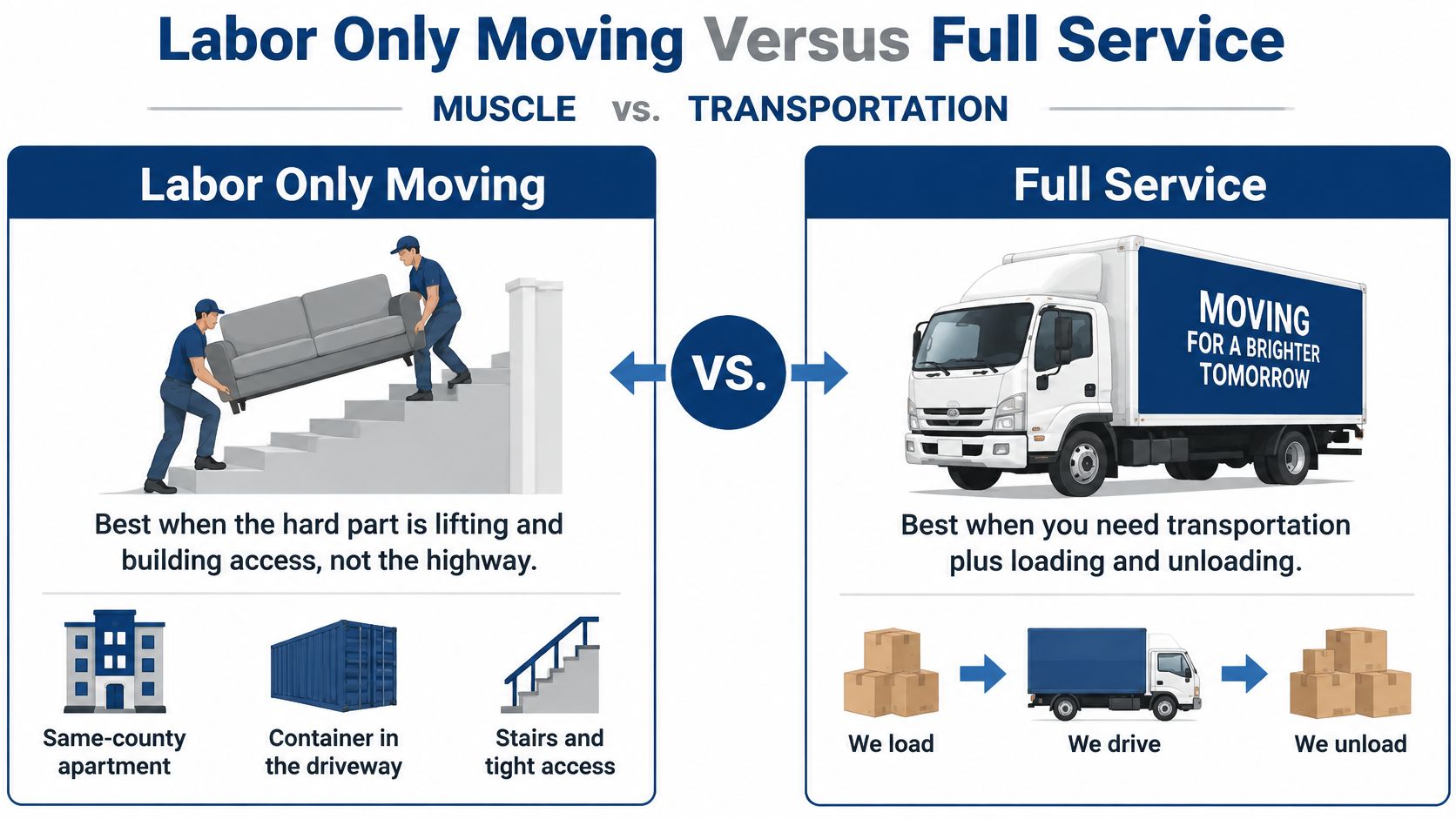
The two models split along a responsibility line. Labor-only means the crew answers for your goods on site, while you own the truck, fuel, parking, and whatever happens on the road. Full service puts all of that under one contract, so the same company lifts, drives, and answers for goods in transit.
Decision point | Labor-only moving | Full-service move |
|---|---|---|
Transportation | Customer rents, borrows, or books a container and drives or arranges delivery | Company truck and driver are part of the job |
Packing | Usually the customer, unless packing is added | Packing can be full, partial, or left to the customer |
Time control | You set the truck window and the crew works around it | One schedule covers load, drive, and unload |
Risk on the road | Your rental or personal auto policy covers goods in transit | Carrier cargo rules and the mover's valuation apply in transit |
Best situation | Local load or unload, POD, or a few heavy pieces | Whole household, long distance, or a tight move-out deadline |
Most moves stay close to home, and that is what makes the customer-drive model realistic. A same-county apartment still has stairs, elevator bookings, tight turns, and heavy furniture, but a short drive is something you can make yourself. A container in the driveway follows the same logic: the container company handles the road leg, and you need people at one or both ends.
The liability split follows that same boundary. If a dresser leg cracks in the stairwell, the crew's responsibility applies. If boxes shift in a truck you rented and drove, the claim runs through your rental or personal auto policy, not the crew. Full service moves that boundary to the destination curb, because the mover's valuation covers goods while they ride in the company truck.
Choose full service when distance, a lease deadline, a multi-room household, or transit risk leaves no slack for picking up and returning a rental. If you want one accountable party from first box to final room, review what full-service movers include before you split the job.
Labor-only pros: You control the truck window and buy only the help you need. Labor-only cons: You carry transit insurance, driving, and any rental late fees.
Full-service pros: One party handles packing, scheduling, and goods in transit. Full-service cons: The total price is higher and you have less say over the truck window.
Loading and Unloading Without the Truck
Say you rent a truck on Saturday morning and park it outside a second-floor apartment. The crew arrives, walks the route, pads doorways, carries furniture down, and builds a stable load. You close the door, drive across town, and meet the same crew or another crew to unload. That handoff at the curb or container is the whole service.
The crew is the pit team, not the driver. They do the intense work while the vehicle is stopped, but they don't supply the vehicle or take it on the road.
What's usually included
Carrying and loading: Moving items from rooms to the truck or container and stacking them for a stable load.
Basic disassembly and reassembly: Beds, table legs, and similar pieces when that work is agreed in advance.
Home protection while inside: Care around floors, walls, and doorways during the carry.
Placement at destination: Setting items in the rooms you name if the crew is booked at both ends.
What's excluded by default
Don't assume the labor quote covers the truck, fuel, tolls, rental insurance, driving, long-term storage, or packing every drawer. Packing becomes crew work only when a packing add-on is written into the scope. If boxes are still open when the crew arrives, loading slows down and hourly jobs cost more.
Greater Austin access details belong in the quote request, not in a frantic call on move day. Tell the company about stairs, elevator reservations, long hallways, gate codes, and tight loading zones in apartments from Round Rock through central Austin. We ask customers for stairs, elevators, loading areas, gate codes, and parking restrictions so we can plan accordingly, and that request protects your rental window too.
A sound load also needs a final check before you drive. Heavy pieces should sit low and balanced, empty gaps should be filled so items can't tip into them, and straps or the container door should be checked with the lead mover. Once you leave, the hourly crew isn't there to fix shifting cargo.
For a clear starting point, use a loading and unloading service scope that names both addresses, the vehicle or container, and the rooms involved. Paste this into your request: "Please quote loading only, unloading only, or both ends, and state crew size, hours, travel, packing, and exclusions in writing."
Stairs Heavy Pieces and Crew Size
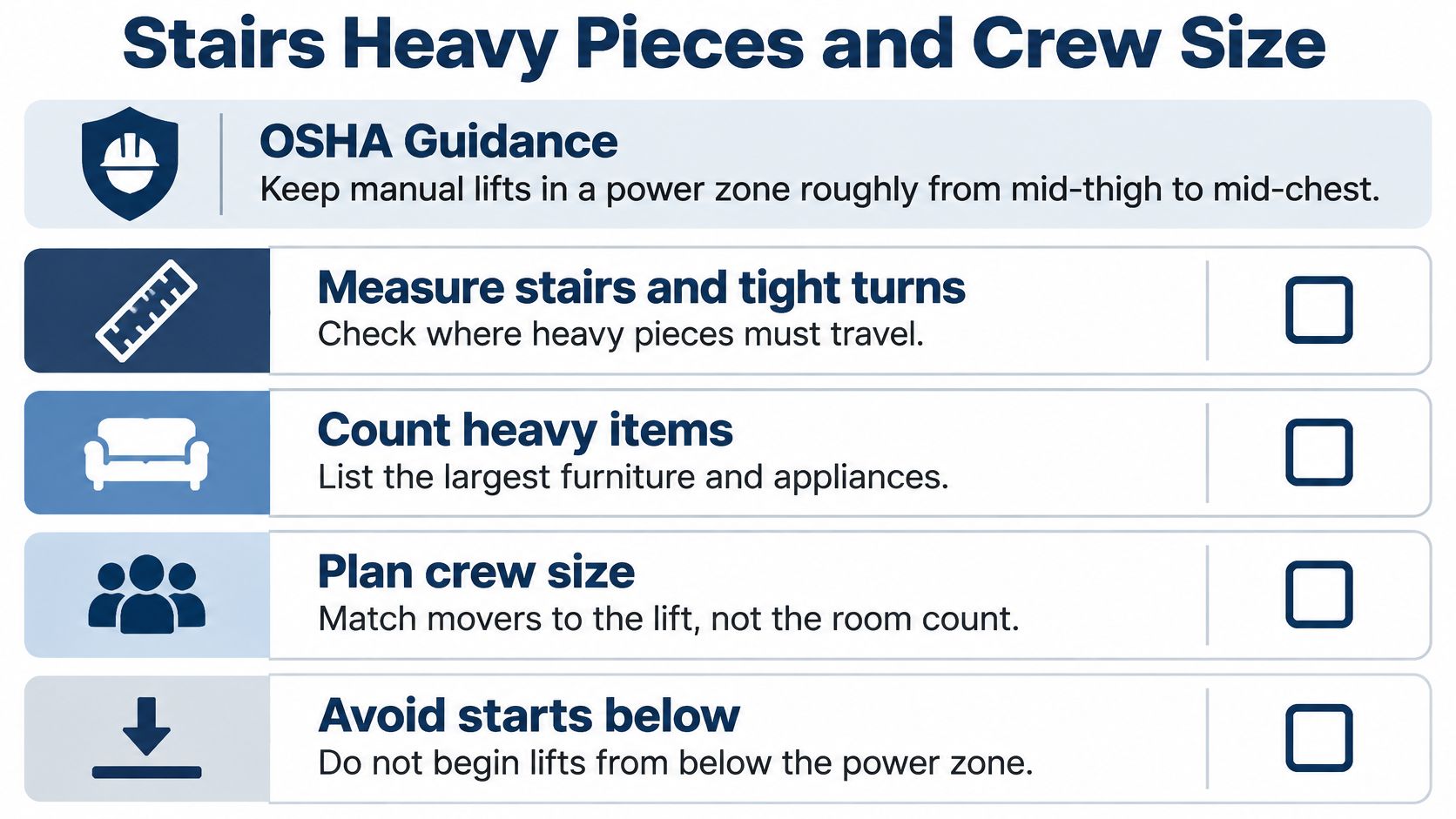
Crew size is a lift plan, and bedroom count alone won't produce one. Safe carrying follows a few simple rules: keep the load between mid-thigh and mid-chest, avoid lifts that start near the floor or finish above shoulder height, and bring in a second person whenever a piece is heavy or awkward to grip. Those rules explain why two homes with identical furniture counts can need different crews.
Weight alone doesn't decide difficulty. Shape, grip, stairs, and repetition change the lift. A compact box carried once across a flat living room is a different job from that same box lifted off the floor, held away from the body, and carried down two flights again and again.
Three paths that change the crew
A one-bedroom walk-up can need careful staffing if a sofa must turn on a landing. One person can't keep the piece close, protect the wall, and watch the steps at the same time. A team lift lets movers tilt, pause, and reset their grip without dragging the frame.
A driveway POD looks simpler because there are no stairs, but repeated carries and a ramp change the work. Heavy cartons should be staged at accessible heights where possible, and a hand truck can turn many small lifts into controlled rolls. The crew still has to distribute weight and reduce voids inside the container.
A piano, safe, or large appliance should never be treated as a test of strength. Bulky dimensions can prevent a secure grasp even before weight is considered. Dollies, ramps, straps, and enough people to guide each side are the controls, and crews experienced with specialty items plan those lifts before the piece leaves the room.
A quote should describe the hardest lift path, not only count the items at the start of it.
Putting the lift plan in writing matters for the same reason the rest of a labor-only scope does: it defines what the crew agreed to handle on site. If the written plan names the piano, the stair flights, and the crew assigned to them, there's no dispute later about whether that piece was part of the job. Webster Moving Co. sizes the crew, equipment, and estimated time against the home and its belongings, and any company you hire should be willing to state the same in writing.
The edge case matters too. A small item count can still call for two or three movers when one piece is awkward, the carry is long, or the safest grip would push the load outside that mid-thigh to mid-chest zone. Measure the tightest doorway and turn before booking, count the stair flights, and note where the truck or container will sit. Then approve a plan rather than hoping the room count produces the right team.
Damage Insurance and Who Is Responsible
Who pays when a labor-only crew loads your rented truck and something breaks? That question doesn't have one automatic answer. Labor-only coverage is less standardized than full-service moving coverage, and the crew never becomes the carrier just because its members placed goods in the vehicle.
The Extra Space Storage comparison of full-service and labor-only movers describes labor-only coverage as less standardized than full-service moving coverage. Its responsibility split is the key point: the customer typically controls the truck, transportation, fuel, parking, and rental insurance, while the crew's responsibility may be limited to damage caused during loading or unloading.
Who is responsible on a labor-only move
What goes wrong | Who usually bears it | What to get in writing |
|---|---|---|
Item damaged while carried or loaded | The crew if the damage happens during their handling | Valuation limit, exclusions, and the claims deadline |
Floor, wall, or elevator damage | Crew general liability when their work causes it | Certificate of insurance and building protection rules |
Worker is injured | The company's workers' compensation, not the customer's health plan | Proof that the crew are employees or covered subcontractors |
Goods shift or break after the truck leaves | Customer rental or personal policy, because the crew is not the carrier | Rental damage waiver limits and what it excludes |
Truck is late, ticketed, or returned damaged | Customer, who controls the rental contract | Arrival window versus your rental pickup and return times |
Read the third row carefully if price shopping tempts you toward uninsured help. You need to know whether the people lifting in your home are covered by the company that sent them. A low cash price is not a saving if an injury or elevator repair becomes an argument about who employed the crew.
A rental-truck damage waiver and a mover's general liability policy address different risks. The rental product concerns the vehicle and transit events under that contract. General liability concerns damage the crew's work causes to property. Buying one doesn't replace the other, and neither automatically pays full replacement value for every household item.
Prepare the claim record before anyone lifts a box. Photograph existing scratches on furniture, floors, and appliance corners. Note building rules for elevator pads and reservations, ask for proof of general liability and workers' compensation, and ask for the claims deadline in days. Don't assume a carrier timetable applies to a job where you controlled the truck.
Apartment and container jobs in Greater Austin deserve extra attention because elevators, loading docks, common areas, and tight container placement create risks that hourly-rate ads rarely mention. Refuse a verbal "we're insured." Keep the written responsibility split with your quote, rental contract, and move-day photos.
How to Hire and Prepare in Greater Austin
Start with the facts a crew needs to price the work fairly. A room count alone won't tell them whether a king bed must go down a switchback stairway or whether the truck can park near the door.
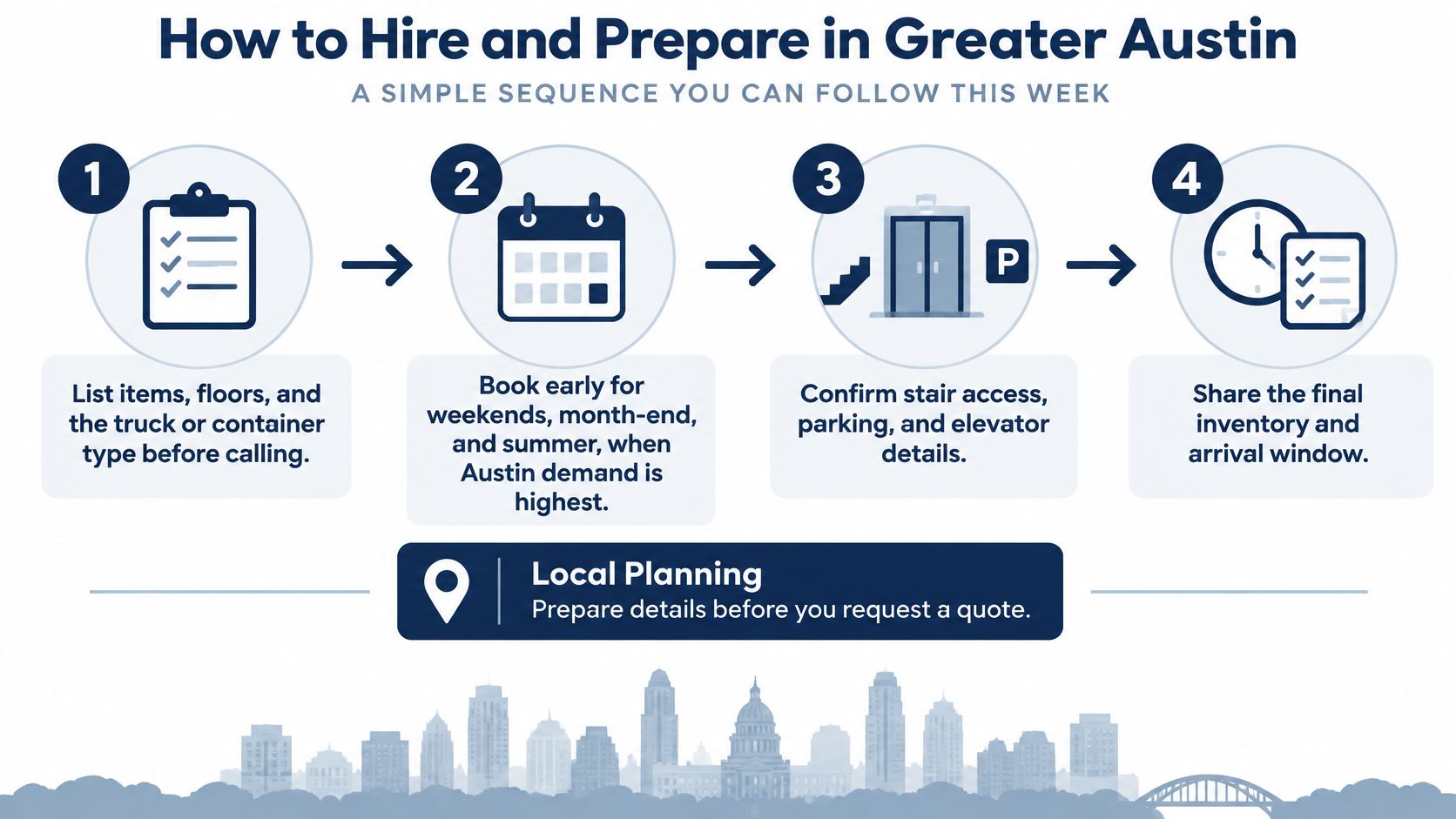
A hiring sequence you can use this week
List items, floors, and transport: Write down the heaviest pieces, number of rooms, stair flights, and whether you'll use a rental truck, trailer, or portable container.
Book the date early: Weekends, month-end, and summer stack up across Austin, so reserve the crew before those windows fill.
Demand a complete written quote: It should name crew size, hourly or job rate, minimum hours, travel time, included protection, and exclusions.
Confirm licensing and insurance: Ask for the documents you need, then send elevator times, gate codes, parking limits, and the exact loading spot.
Put transport in place first: Reserve the rental or container so it arrives before the crew, because paid movers shouldn't spend the first hour waiting for keys.
Walk the load on arrival: Show the lead mover fragile pieces, agree where heavy items go, and photograph pre-existing marks.
Keep driver items with you: Hold the truck keys, rental paperwork, fuel card, and payment method, since the crew doesn't drive your vehicle.
If packing stays with you, finish and seal boxes before the start time. Clear the path from each room to the door, empty dresser drawers unless the crew agrees otherwise, and set aside medicines, chargers, documents, and valuables in your own car. Small delays multiply when two or three paid movers are waiting for decisions.
Labor-only crews work across Greater Austin, including Round Rock, North and South Austin, Cedar Park, Georgetown, Pflugerville, and nearby cities. Availability is still crew by crew and date by date, not a citywide guarantee. Treat any quote that won't name minimums, travel, or exclusions as incomplete, even if the opening price sounds attractive.
Ready means transport, access, boxes, and decisions are settled before the crew's clock starts.
That preparation gives you two useful numbers. You'll know the labor price for a defined job, and you'll know the separate cost of controlling the truck yourself. With both on paper, the final choice becomes practical rather than emotional.
Choose Labor Only or a Full Austin Crew
Book labor only moving if you already control a truck or container, the move is local, and you mainly need people to lift, load, and place goods safely. You'll direct the schedule and accept the driving, parking, fuel, and transit protection. That trade works well for a POD, a short apartment hop, or the last heavy furniture after you've moved the easy boxes yourself.
Book a full Austin crew if you want the company to transport the load, add packing, or stand behind the goods on the road. It's also the cleaner choice when a lease deadline, a large household, or a long drive makes a rental pickup and return one problem too many. Use the setup and responsibility tables to test your situation rather than asking which option wins for everyone.
For readers in Greater Austin and Central Texas, Webster Moving Co. of Round Rock is a locally owned, licensed, and insured option that can scope either a small furniture job or a fuller household move. Webster Moving Co. offers free, no-obligation quotes through a short form on its website. Webster Moving Co. recommends booking as early as possible, particularly for weekends, the end of the month, and the busy summer moving season, and it can often accommodate short-notice moves depending on crew availability.
Send your item list, both addresses, stairs or elevator notes, parking details, and whether you're supplying the truck. Ask for the labor-only price and a full-service price for the same scope, then compare them after adding rental, fuel, tolls, and insurance to the labor-only side. Do that before you reserve the rental, while changing course is still free.
You can call 512-751-0893 during published contact hours to ask which scope fits your addresses and timeline. The right answer is the one that assigns every lift, mile, and damage risk to a named person before move day.
Send Webster Moving Co. your item list, addresses, access notes, and truck or container plan for a free, no-obligation quote that separates labor-only help from a full crew. Visit Webster Moving Co. to request the written comparison before you reserve your rental, especially if your date falls on a weekend, at month-end, or during summer.
Comments