
How to Get Furniture Through a Door Without Damage
The sofa is halfway off the truck, the door is fully open, and the arm is already kissing the jamb. The listing said 32 inches. The gap in front of you looks smaller, and the hallway turns before you can straighten the piece.
That is how most furniture damage starts. The width printed on the slab is not the gap you can use, and the doorway is not the only pinch on the path. A bookcase that clears the frame still needs ceiling height to tip upright. A dresser that fits the unit door still has to clear the elevator, the stair landing, and whatever the building will let you use.
The checks below are the ones that decide a move before anyone lifts: clear opening, the whole route, which parts come off, how to pivot, and when forcing a piece is the wrong call. If the numbers do not pass with room to spare, stop. A cracked frame or a gouged wall costs more than a second trip.
Table of Contents
Measure the Clear Opening and the Whole Route
The number that decides whether furniture goes through is the clear opening, not the width printed on the door or in a product listing. The 2024 International Building Code, as SizeMarker explains it, specifies a minimum clear opening of 32 inches (813 mm) for required egress doors. That figure is the usable passage after the frame and hardware, not the slab. A nominal 32-inch door can give you less than 32 inches once hinges, stops, trim, or the door leaf eat the gap.
Open the door fully and measure the narrowest point between the stop and the opposite side of the frame. Then measure the item at its maximum width, depth, height, and diagonal, including cushions, feet, handles, and any wrap that stays on. The diagonal matters because a tilted sofa or cabinet enters corner first while the opposite corner rotates through the frame. Hallways, stairwells, landings, elevators, and tight turns can be tighter than the door. Compare every orientation with every choke point.
A worked fit check
Say the sofa is 34 inches wide and 22 inches deep. Carried flat, it fails a 30-inch clear opening. On its side, that 22-inch depth can pass if you still have spare room for a blanket and a hand. If the narrowest dimension does not clear with spare room, plan disassembly or another route. Pushing is how you scar the wall and the piece.
Older homes change the starting numbers. Make Your Flat notes that buildings from before the mid-20th century commonly used interior doors of about 26 to 28 inches, while later housing more often used 30 to 32 inch interior doors and 36 inch front doors. A 26-inch nominal doorway may provide only about 24.5 inches of clear opening, and a 32-inch clear opening offers roughly 7.5 inches more passage width. That difference can decide whether a modern sofa, refrigerator, bed frame, or bookcase passes assembled.
Tall pieces add a second problem. Tipping a bookcase, headboard, or cabinet needs ceiling height and landing space past the doorway, even when the width looks fine.
Measurement | How to Take It | Pass Rule |
|---|---|---|
Clear opening width | Door fully open, measured at the narrowest point between the stop and the frame | The item's narrowest dimension must fit with spare room |
Clear opening height | Floor to the top of the frame, minus hinges and hardware | Item height when tilted must clear the frame |
Item width, depth and height | Include cushions, feet, handles and any wrapping | Use the largest figure in each direction |
Item diagonal | Corner to opposite corner along the longest line | Compare with the opening when the piece tilts |
Hallway and turns | Narrowest width on the full route, including landings | Route width must exceed the item's rotated size |
Stairs and elevator cab | Tread, landing, cab width and cab depth | Item must enter and turn within these limits |
Practical rule: Write the numbers down before move day. Door width, frame depth, ceiling height, corridor width, stair turns, elevator cab width and depth, and every removable part. That list tells you whether to take the piece apart, pad it, use a wider entrance, or stop.
Which Parts to Remove and How to Protect Them
Legs, drawers, doors, shelves, and rails usually shrink the profile more than any tilt. Take a part off only after you know it comes off safely and you know how it goes back on. Subtract those parts from the measurement only after you have confirmed the remaining piece passes in that shape.
Furniture | Usually removable | Protect with |
|---|---|---|
Sofa or sectional | Legs, loose cushions, reclining parts | Moving blanket and stretch wrap on the arms |
Bed frame | Rails, slats, headboard, footboard | Wrap rails and bag the hardware |
Dresser or chest | Drawers, mirror, feet | Padded blanket, drawers taped shut |
Wardrobe or cabinet | Doors, shelves, crown molding | Corner guards and wrapped doors |
Mattress | None | Mattress bag and plastic wrap |
Dining table | Leaves, legs, glass top | Corner guards, glass wrapped separately |
Door on hinges | Hinge pins, door leaf | Cover the frame and floor |
Hardware and padding
Bag the screws, bolts, and hinge pins in one labeled bag per piece, then tape that bag to the item it belongs to. A second bag "somewhere in the truck" is how a bed frame sits on the floor for a week. Wrap each piece in a moving blanket. Run stretch wrap over arms and corners so the blanket stays put. Stick corner guards on the jambs you will brush, and lay runners on finished floors.
A queen bed is the clearest example. Separating the rails from the headboard gets the pieces through faster than wrestling the whole frame, but the slats still need wrap or they scrape the walls on the way past. If you are taking a bed apart for the first time, the sequence in how to dismantle a bed keeps the hardware with the right rail.
Protection is part of the fit. A wrapped sofa is wider than the bare one, so measure the wrapped version, not the showroom number. If the padded piece no longer clears with spare room, take more off or change the route. Do not squeeze the blanket thinner by force.
How to Angle and Pivot Furniture Through a Door
The main problem is the maneuver path, not whether the furniture is narrower than the door. ItemFits puts it plainly: measure the narrowest usable clearance at every stage, including trim, hardware, the hallway, stair turns, ceiling height, the elevator opening and cab depth, and the landing you need to rotate. Include cushions, handles, feet, blankets, and packaging. Subtract a part only after disassembly is safe.
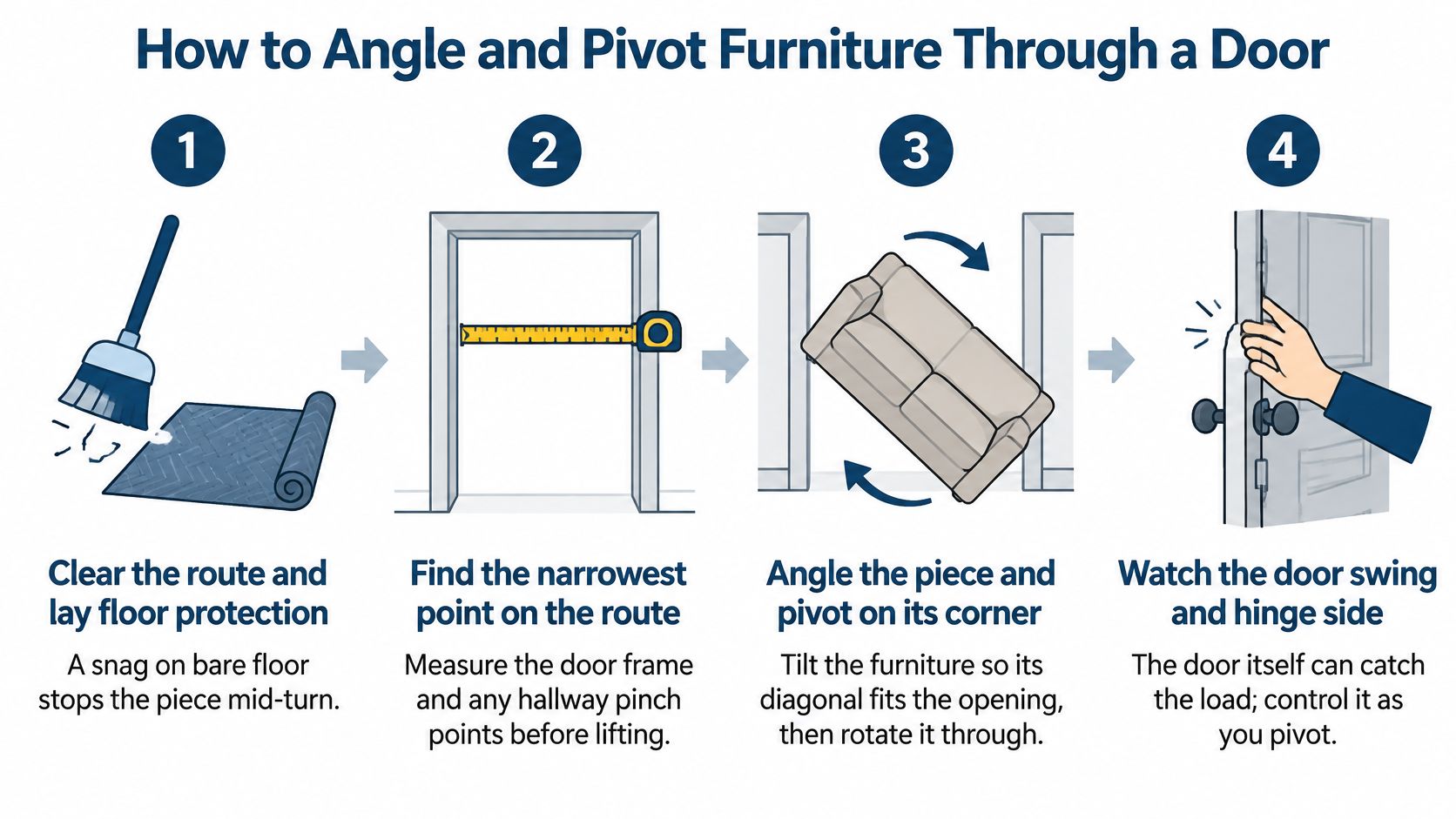
Work the pivot in this order. Each step has a reason, and each has a slip that stalls the piece.
Clear the route and lay floor protection first. A snag on bare hardwood stops the piece mid-turn, and restarting from a stall is when knuckles and jambs get hit. The slip is starting the tilt on an unprotected floor.
Find the narrowest point on the whole route, whether that is the door, a turn, or a stair landing. The slip is measuring only the door you are standing in.
Choose the smallest-profile orientation, usually on its side or lengthwise, using the diagonal you already took. The slip is carrying the piece square because that is how it sat in the room.
Lead with the corner most likely to clear the frame. The trailing corner rotates through after the lead is past the jamb. The slip is feeding both ends at once.
Pivot at the jamb, not on the floor, and tilt only after the leading edge is clear. Pivoting on the floor scrapes the finish. Tilting too early bends the frame.
If the piece stalls, stop. Do not force it. Take the door off its hinges or remove legs and frames, then retry. Removing a door or a window is not automatically the best fix. It can open the gap and still leave too little turning room, and it can damage walls and hardware.
Set the piece down in the target room and check that you can get it back out the same way before you start the next item. The slip is declaring victory while the piece is still wedged.
If the rotation fails on paper, the piece goes back, gets hoisted by a crew set up for it, or gets a professional look before moving day. "Turn it on its side" is not a plan.
How to Lift Safely with a Team
Treat this as a controlled awkward-load lift, not a strength test. For a sofa or cabinet, use at least two trained handlers when the object is long, unstable, or blocks the carrier's view. One person cannot see the jamb and the floor at the same time.
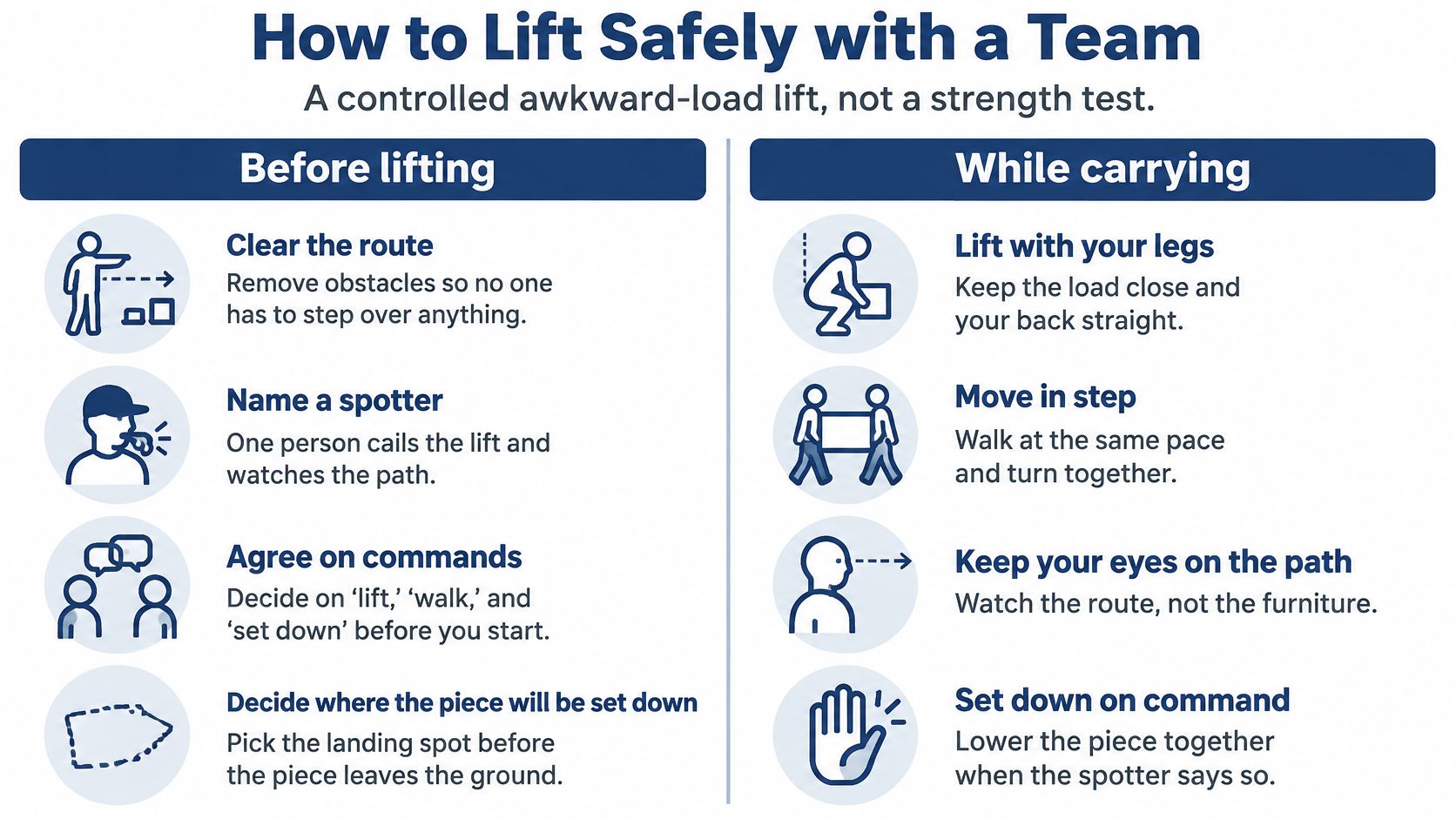
Before anyone grips the piece, clear the route, name a spotter, agree on the words you will use, and decide where the item will be set down. "Lift," "walk," and "down" are enough if everyone uses the same words. While you carry, keep the load close to the body, face the direction of travel, and do not twist. Cal/OSHA's ergonomic materials flag horizontal reach from the spine, vertical travel, trunk twisting, grip quality, and how often you handle the load as the variables that drive injury risk. A handle that slips is a common way a controlled carry turns into a drop.
Straps, tips, and the stop
A shoulder strap or a furniture strap helps with a bulky piece, and a dolly helps on flat ground. Neither one makes an unsafe route or a bad grip safe. If you are moving an appliance on a dolly, the setup in how to use an appliance dolly belongs on level floors and at the truck, not as a substitute for a stair plan.
Tip and rotate only on a spoken command. Keep hands clear of pinch points between the item, the jamb, the floor, and the ceiling. Never drag an unprotected piece across finished flooring. Never lift a heavy item from a low squat while you twist through the doorway. If the load will not stay close and controlled, stop. Extra labor or a cart is safer than improvising the last few feet.
Apartment and Condo Access Rules That Block Move Day
The sofa cleared the living room door. Then the passenger elevator turns out to be too small, or the building will not let a large delivery use it, and the move stalls in the lobby. A fit at the unit door does not mean the building will let the piece in.
Check the rules before you book the crew. Service-elevator reservations, the loading entrance, allowed move windows, freight-elevator limits, parking rules, and who has to approve the move all sit upstream of the doorway. One building's move-in policy requires large deliveries to use the service elevator and service entrance rather than passenger elevators. Many furniture retailers also restrict stair-only deliveries on higher floors, so confirm the seller's delivery limits before the truck is booked. No amount of tilting or disassembly fixes a delivery the building never approved.
Get management approval in writing before you schedule movers. In Greater Austin apartments, condos, and mixed-use buildings, that approval is easy to miss until the truck is at the curb. Ask for the allowed move window, which entrance the crew should use, and whether the building needs a certificate of insurance from the mover.
What the crew needs from you
Tell the mover about stairs, elevator size, loading areas, gate codes, and parking restrictions so the plan matches the building. Webster Moving Co. asks for those details on apartment moves for that reason. You also need the driveway and entrance open, boxes packed and labeled, and someone over 18 present at pickup and delivery.
Elevator reservation: The reserved window plus the cab's width and depth, measured against your largest piece.
Loading rules: Which door, which dock, and whether padding is required in the halls.
Paperwork: Insurance or a certificate if the building asks for one, plus allowed hours.
The bill if access fails: Confirm who pays for a second trip when the elevator was never booked.
Furniture placement is a coordination problem as much as a carrying problem. If you are sorting those building rules for a local rental, the guidance for apartment movers lines up with what management usually wants before a truck arrives.
What to Do When a Piece Fails the Fit Check
When a piece fails, work the options from the cheapest change to the one that replaces the item. Each option has a pass rule and a limit. Skip ahead only when the cheaper step is already impossible.
Try another orientation first. Rotate it, carry it lengthwise, or bring it in on the diagonal with the leading corner clearing the frame. It passes if that new profile clears with spare room. It fails if the piece has to bend or if the trailing corner still hits.
Remove what is in the way, then remeasure. A door leaf, legs, drawers, rails, or a shelf can come off if you already know they go back on. It passes only after you measure what is left, including wrap. It does not pass just because the door is leaning in the hall. A wider hole with no room to turn is still a fail, and a window hoist is a specialty job, not a Saturday project.
Check a wider entrance. A patio or balcony door can beat the interior door, but only with building permission and a landing the crew can stand on. No permission, or no safe place to stand, and this option is closed.
Change the item. A knock-down or modular version of the same piece, or a smaller model, beats forcing the original. It passes when each section clears on its own. It fails if the "modular" piece still has a rigid sleeper frame that will not come apart.
Change the delivery. Ask the seller whether it can arrive in parts or be assembled in the room, and confirm who pays if it has to go back. I would start with this call before you pay for a return truck.
Any option that risks the walls, the frame, or the piece means you stop and get a professional assessment before moving day.
Decide Whether to DIY or Hire Movers
Move it yourself when the piece passes with spare room in its narrowest orientation, the route has no stairs or tight turns, two capable adults are available, and the building needs no approval. Hire movers when it fails the clearance check, needs to come apart and go back together, is heavy solid wood or glass, must go up several floors, or the building requires a service elevator or a reservation.
Answer four questions on the spot.
Does it fit without a heroic tilt? Spare room in the narrowest orientation, not a maybe.
Can two people hold it the whole way? Close to the body, no twist, a clear view.
Is the route clear from the truck to the room? Floors protected, turns measured, landings empty.
Has the building approved the move? Elevator, hours, and parking already settled.
Any no means you hire help or you replan the route. Do not split the difference with one more shove.
If you hire, send the measurements, the route notes, and the building rules with the request so the crew can plan access instead of discovering the stair turn at the door. Webster Moving Co. handles apartment moves and can work with stairs, elevators, parking restrictions, furniture disassembly and reassembly, and the rest of the building logistics that stall a DIY carry. A free, no-obligation quote is available through a short form on the website once those details are in hand.
Webster Moving Co. plans furniture moves around the route, from tight doors and stair turns to elevator rules and pieces that have to come apart. If the fit check says the sofa, bed, or cabinet should not be forced, our crews in Greater Austin can handle the disassembly, the padding, and the carry. Visit Webster Moving Co. and send the measurements with your quote request so the plan matches the building before move day.
Comments