
How to Use an Appliance Dolly Safely, Step by Step
The fridge is out of the alcove, the washer hose is still damp, and a two-wheel dolly is the only tool between you and a tight Greater Austin stairwell. The hallway looks clear until the hinge side of a bedroom door and a short landing eat the space you counted on. How to use an appliance dolly well is a route decision first. Strength does not add clearance, and a flat-floor rating does not turn into a stair rating because you are careful. I would measure the doorway, the landing, and the printed capacity, then make a go, equip, or hire call before anyone tilts the load.
Table of Contents
Prepare the Appliance and Route Before You Lift - Disconnect, empty, and measure
Match the Dolly Rating to the Route - Read the lowest number that matches the path
How to Load, Tilt and Strap the Appliance - The load sequence - After you let go
Stairs Need a Spotter and a Stair Rating - One step, then the next
Protect the Appliance, Floors and Doorframes - Set it upright and leave it
Prepare the Appliance and Route Before You Lift
A fridge already tipped onto a dolly, door swinging open, is how a short roll becomes a dented panel and a scratched jamb. Tape that door and finish the prep before the wheels move.
Disconnect, empty, and measure
Kill the utilities first. Unplug power, shut off the water, and disconnect gas on a range. Drain washer hoses. A dangling line snags the frame the moment you tilt.
Empty anything that can shift. Pull shelves, drawers, crisper bins, and door racks. Tape refrigerator doors shut so they cannot swing into a wall.
Measure the box and every pinch point. Record height, width, and depth, handles included. Then measure the narrowest doorway, the hallway pinch, and the landing. Note the hinge side, because a door that swings into the path steals the clearance you thought you had.
Add hidden weight. A drum still full of water, or bottles left on a shelf, sits on top of the empty appliance weight. If the number is fuzzy, estimate high.
Clear the floor. Rugs, cords, pet bowls, and raised thresholds catch a toe plate and yank the handle out of line.
Inspect the dolly. Check toe-plate height, strap weave, ratchet action, tire pressure, and loose bolts. Replace a frayed strap before the move, not halfway down the hall.
Get a second adult. That person spots doors and guides the top of the load. In an apartment, ask the manager about elevator pads and floor protection before you reserve the car.
Go or no-go: If the appliance does not clear every pinch point with a few centimeters to spare, stop. Change the route, pull a door only if the maker allows it, or change the equipment.
Match the Dolly Rating to the Route
Mode | Rated capacity | Use it when |
|---|---|---|
Flat floor, four wheels | 1,200 lb | Level, short moves on smooth flooring |
Two wheels, tilted | 600 lb | Level ground only, short tilt distance |
Continuous stair-climbing belts | 400 lb | Stairs; use this stair rating, not the flat-floor figure |
Powered stair climber (350-lb model) | 350 lb | Heavy stair moves needing controlled lift and lower |
Your appliance | Weigh or estimate high | Compare that weight with the lowest rating your route uses |
Read the lowest number that matches the path
A representative appliance-truck manual rates one commercial truck at 1,200 lb on four wheels, 600 lb on two wheels, and only 400 lb when its continuous stair-climbing belts are in use. Those ratings assume evenly distributed loads under controlled conditions. An off-center fridge or a top-heavy stack can be unsafe well under the number on the handle.
Use the lowest rating that applies to your route. The 1,200 lb headline is a flat-floor figure. Once the belts meet the stairs, 400 lb is the number that counts. A separate powered stair-climber manual describes a 350-lb model built for controlled lifting and lowering, which is a different machine from a standard two-wheel truck.
Find the weight on the data plate, usually inside the door or on the back panel, then add food, water, or a full drum. Round up if the plate is missing or painted over. A side-by-side fridge, a commercial range, or a cast-iron-backed unit can blow past a standard two-wheel dolly even when the catalog weight looks friendly. The same capacity check applies to dense pieces such as a gun safe.
Common failures are an undersized toe plate, loose straps, top-heavy balance, and a sharp turn while the load is tilted. If the appliance sits above the stair rating for the route you have, change equipment or bring a crew. Do not force the move on the flat-floor number.
How to Load, Tilt and Strap the Appliance
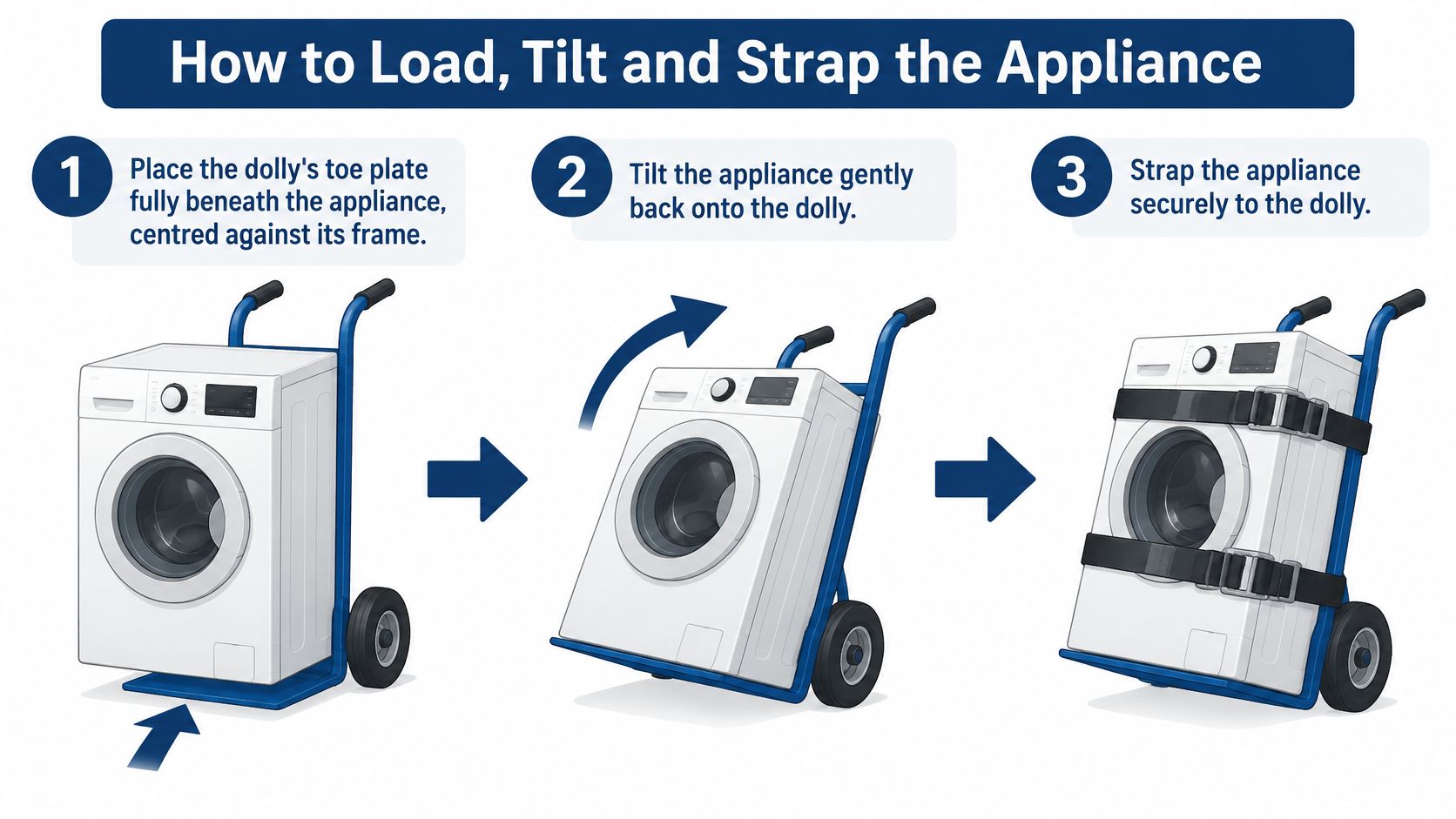
Early appliance dollies were built so the machine's own weight helps lift it onto the plate. A U.S. patent filed on August 21, 1961, and issued as US3169780 describes a dolly for stoves, washing machines, dryers, and similar appliances, with one-person operation as a design goal. The frame, toe plate, balance point, and straps still do that job together. An improvised cart does not.
The load sequence
Seat the toe plate fully. Slide it under the appliance, centered on the frame, so the weight sits on the plate and not on the lip. A plate that only catches the front edge kicks out when you tilt.
Let the appliance come back onto the dolly. Tip it gently and let its weight help raise it. Hauling it up with your arms fights the design and strains your back for no gain.
Strap a strong section. Wrap the belt around the cabinet frame, not a plastic skin, a door handle, or glass. Ratchet until the unit cannot slide or rotate on the plate.
Balance over the axle. Tilt the dolly back slowly with both hands on the handle. Stop when the weight leaves your arms and sits on the wheels. If you are still holding the full load, you are short of balance, or you have tipped past it.
Walk with your eyes on the path. Move slowly and turn wide. A sharp turn while tilted is the usual tip, because the center of gravity swings outside the wheels.
Clear each threshold square. Stop, lift the toe plate just enough to hop the lip, and roll straight over. Keep the strap tight so the cabinet cannot shift when the front wheels drop.
Lower in reverse. Ease the dolly forward until the appliance stands, slide the toe plate out, then release the straps. Rushing this step slams the cabinet onto the floor.
After you let go
Check the appliance and the floor for new scuffs. Confirm the unit stands steady with your hands off the handle. If it rocks, the floor is out of level or a foot is bent, and you fix that before you walk away.
Stairs Need a Spotter and a Stair Rating
A dolly that rolls fine on a kitchen floor does not make a staircase safe. Stairs add rollback, pinch points, and a downhill load that level rolling never produces.
A stair-climbing dolly patent issued in 1970 describes wheel groups on a common axis with one-way clutch bearings that allow forward rotation and stop the wheels from spinning backward. That hardware exists because the central hazard is uncontrolled rollback when you pause or lose control. Treat an ordinary two-wheel dolly as a floor tool. Use a stair-rated or powered model for a heavy refrigerator, commercial equipment, or a narrow stairway, and keep a second trained person on the load.
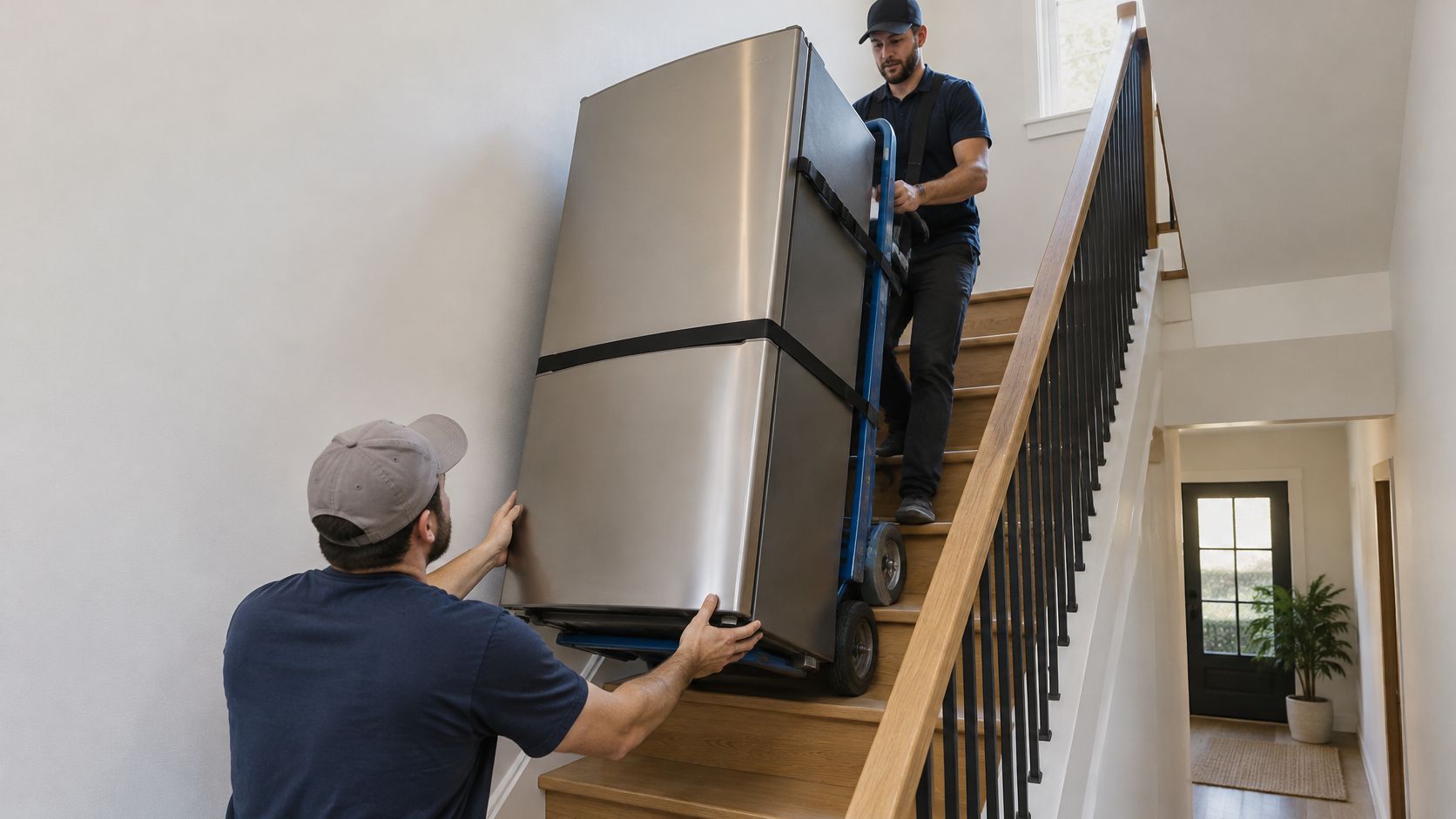
Older Central Texas stairwells add hinge clearance and a landing that may not take the full depth of a fridge. The same access planning that matters for apartment moves applies here. Measure appliance width against stair width and any tight turn before the first step.
One step, then the next
Clear landings and pad the edges. A board or a carpet runner keeps belts from chewing the nosing.
Place the spotter. That person watches clearances, doors, and handrails, and calls the next tread.
Meet each riser square. Engage the belts at the stair edge and creep forward. Do not lift and drop the load onto the next step.
Keep the tilt toward you. Climb or descend one step at a time, weight over the axle, facing the direction of travel. A firm grip beats speed. Friction alone will not hold the load if you pause.
Stop on the first fault. A loose strap, a shifting cabinet, a lost view of the path, or a belt that misses the edge means you set the load and fix it.
Never stand downhill of a load you are not actively controlling.
Going down, lower one tread at a time with the belts engaged. The second person guides the bottom while you control the top. If the appliance is over its stair rating, or the flight is long and steep, a powered stair climber or a trained crew is the safer call.
Protect the Appliance, Floors and Doorframes
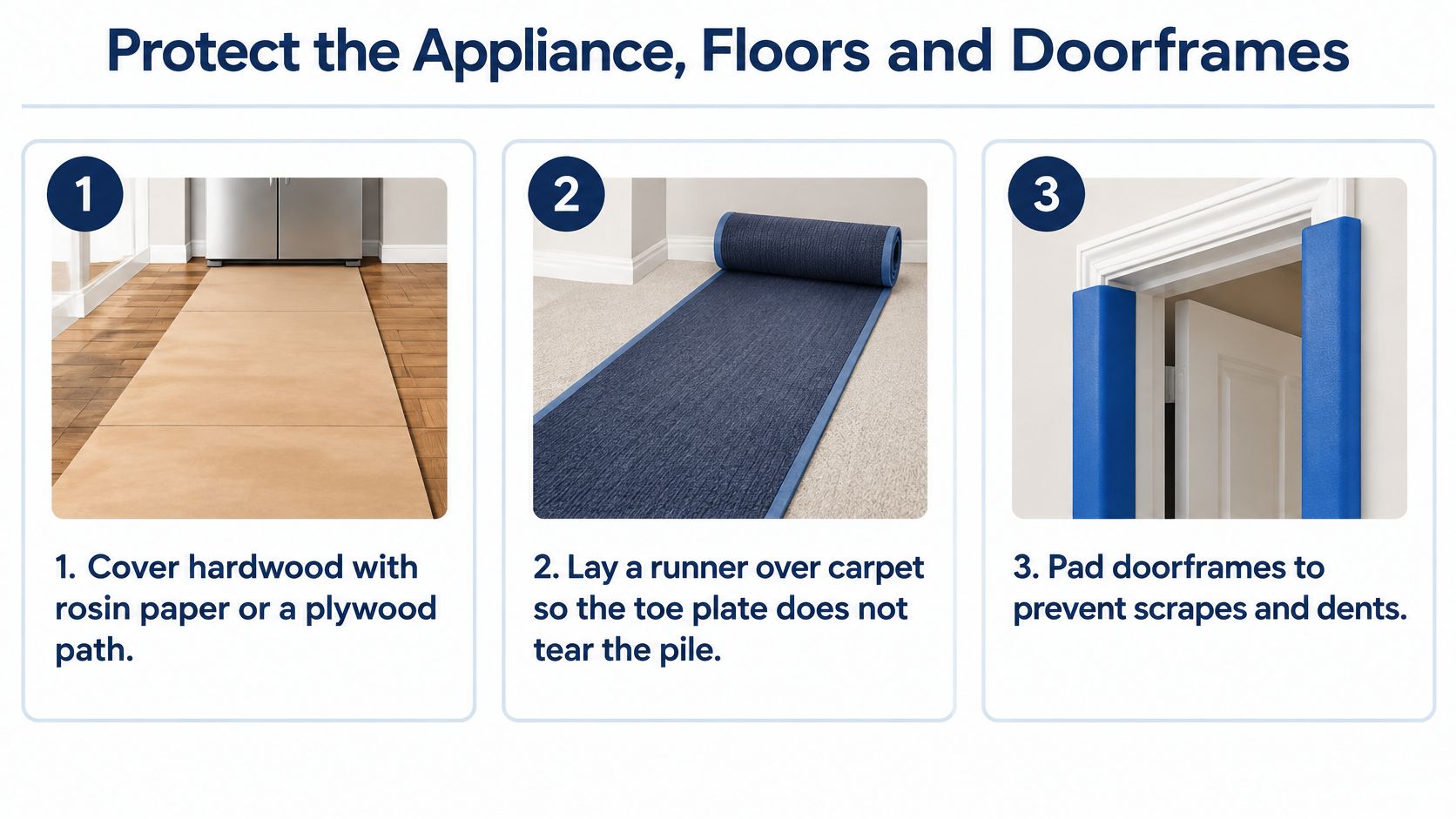
Most of the damage on these moves is a corner strike, not a dropped appliance. Pad the contact points before the first roll.
Hardwood: Lay rosin paper or a plywood path so wheels and the toe plate do not scratch the finish.
Carpet: Put down a runner. A bare toe plate tears the pile, then grabs and jerks the handle.
Doorframes and corners: Hang moving blankets at every turn. The appliance edge, not the dolly frame, is what gouges the paint.
Cords and hoses: Tie them up high so they cannot wrap a wheel and lock the dolly mid-roll.
The cabinet: Fit corner protectors on the frame and run straps over padding, never across a glass door or a painted front panel.
Lips and saddles: Do not drag the bottom rail across a threshold. That skins the rail and chips the flooring edge.
Set it upright and leave it
Keep a refrigerator upright while you move it. Laying it flat can let oil leave the compressor. If a side carry is the only way through a door, follow the maker's transport side. Once it is standing again, leave it upright for several hours before you plug it in so the oil can settle back where it belongs.
Walk the route the day before and mark the three spots that usually get hit, the front door, the hallway corner, and the last threshold. Pad those before the first lift, not after the first scar.
Decide Between a Dolly, a Stair Model or a Crew
Situation | Right setup | Why |
|---|---|---|
Level route, no steps, appliance within four-wheel rating | Standard dolly and one spotter | Flat-floor rating covers the load |
Few stairs, appliance within stair rating, workable stairwell | Stair-rated dolly with belts and two adults | Belts and a spotter keep each step controlled |
Appliance above stair rating or a long, steep flight | Powered stair climber or professional crew | Stair rating and control matter more than strength |
Apartment with elevator and limited loading area | Dolly plus building coordination | Protects common areas and meets access rules |
Run that test in order, and stop at the first row that matches.
Go with a standard dolly when the path is level, the weight sits inside the four-wheel rating, and one spotter can guide the top without losing sight of the corners.
Equip with a stair-rated dolly and a second adult when the flight is short, the weight is inside the stair rating, and the stairwell is wide enough for the load plus hand clearance.
Hire a powered stair climber or a crew when the appliance is over that stair rating, the flight is long or steep, or you cannot measure the turns with confidence.
Having a dolly does not make the stair move safe. The route, the rating, and a second person decide it.
In an apartment, confirm whether a dolly is allowed in the halls, whether the elevator is reserved, and whether the loading zone is tight. Webster Moving Co. asks for stairs, elevators, loading areas, gate codes, and parking limits up front so the plan matches the building. If the test says hire, request a free, no-obligation quote and include those details. Our loading and unloading service pairs dollies, hand trucks, and straps with the appliance and the actual route, which is the point of choosing gear before moving day.
Webster Moving Co. moves household appliances across Greater Austin and Central Texas with licensed, insured crews who plan for stairs, elevators, and tight landings. If your route fails the go-or-equip check, we can scope the crew, the stair gear, and the floor protection before moving day. Visit Webster Moving Co. to request a free, no-obligation quote and tell us about the stairs, the elevator, and the parking limits.
Comments