
Piano Movers Austin: Costs, Options, and Safety Tips
Your family's upright piano is still upstairs in your North Austin home, and the move is scheduled for Saturday. The staircase is narrow, the front door looks tighter than you remember, and you're wondering whether the household moving crew can handle it.
The safest plan starts before anyone lifts the piano and ends after it has adjusted to its new room. Choosing piano movers in Austin means considering the instrument, the route, the paperwork, and the care it will need after delivery.
Table of Contents
Piano Moving Options in Austin Compared - Is the piano the main job? - When the truck isn't the whole service
Piano Weight and Size Decide the Crew - Why shape matters as much as weight - What to send before the estimate
What Drives Piano Moving Prices in Austin - Why a generic starting price isn't enough - Read the assumptions before the total
Confirm Coverage and Crew Before You Book - Get the coverage answers in writing - Make a condition record before departure - Confirm the people and access plan
Moving and Settling a Piano Safely - Prepare the route and instrument - Control the move and transport - Finish with placement and aftercare
Why Austin Pianos Need Specialized Movers
A piano is a tuned wooden instrument under tension, and treating it as a heavy cabinet is where damage begins. Inside the case sit strings, a soundboard, a pinblock, and an action built from small, carefully aligned parts. An impact that leaves a dresser with a cosmetic scratch can crack a pinblock or knock an action out of adjustment.
Austin holds instruments whose importance runs well past their replacement value. The Butler School of Music at the University of Texas describes the Johnson family's Steinway & Sons Model M, built in February 1929, which entered the school for preservation and limited salon-style concerts. Touring instruments face the opposite challenge: repeated professional transport rather than a single permanent relocation.
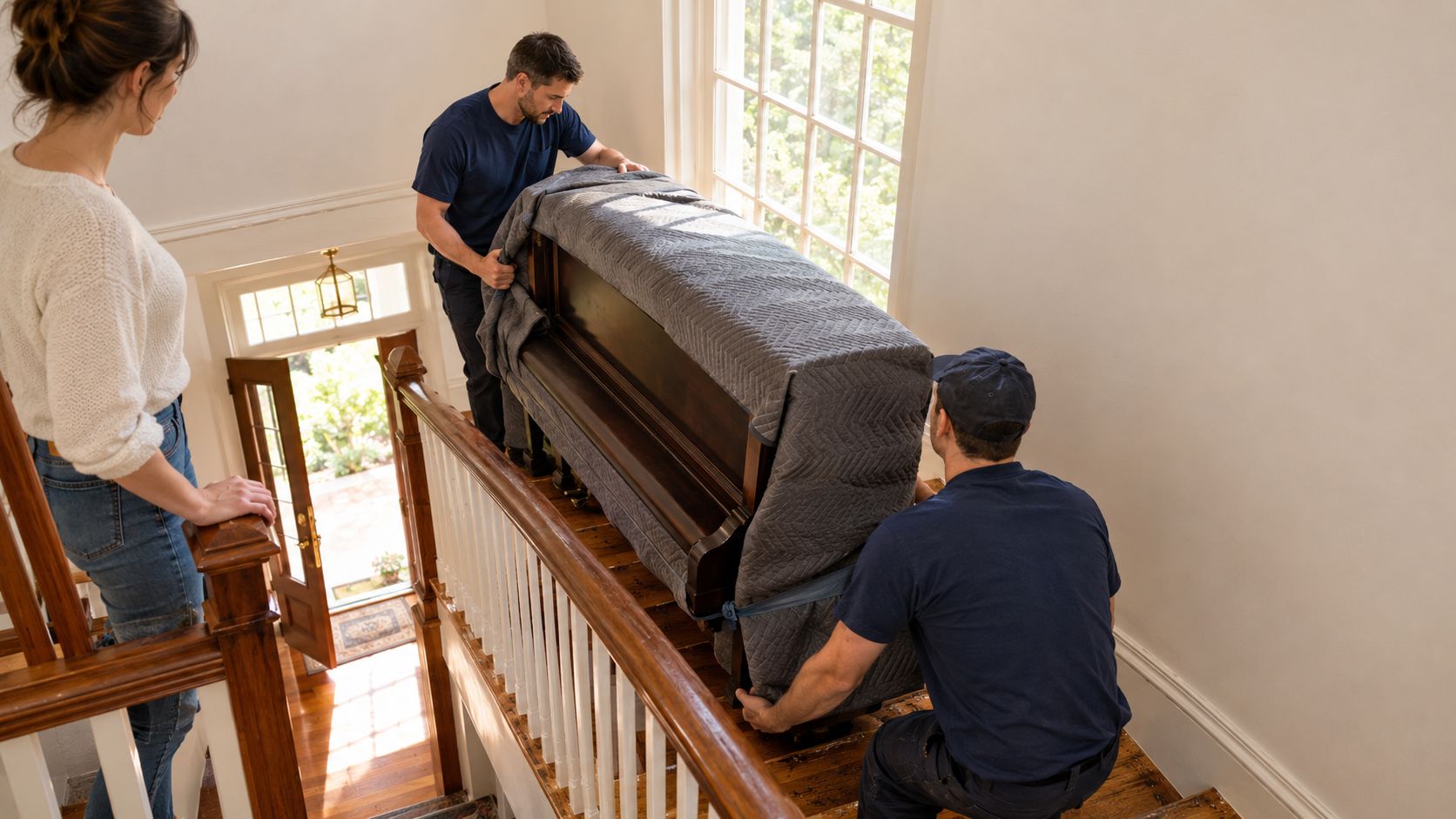
Your family piano may carry no public history, but its construction deserves the same deliberate planning. A move works best when you treat it as the start of the piano's care cycle rather than a single trip. Before departure, photograph the instrument's condition and confirm the mover's coverage in writing. After delivery, let the piano acclimatize to its new room's temperature and humidity before scheduling a tuning, because the soundboard continues to shift as the wood settles.
The decisions that matter concern actual weight and geometry, climate exposure, and paperwork completed before the truck arrives. Those details determine whether a crew arrives prepared and whether you hold a useful record if a problem appears afterward.
Piano Moving Options in Austin Compared
Option | What It Includes for a Piano | Relative Cost | Best Fit |
|---|---|---|---|
DIY with rented dolly and helpers | Rented equipment and helpers; no professional piano handling or automatically included piano-specific coverage | Lowest initial cash outlay; greatest owner-managed risk | Small digital piano on a clear ground-floor route |
General household movers with piano as an extra item | Household crew, padding, and special-item handling if accepted | Mid-range comparison category | Upright with straightforward ground-floor access |
Specialty piano movers | Piano board or skid, straps, trained handling, and disassembly and reassembly when needed | Generally higher than basic household handling | Grands, stairs, tight access, historic or high-value instruments |
Full-service household move including the piano | Piano transported with household belongings, with packing options | Bundled household price; request a separate piano line | Whole-home relocation with confirmed piano capability |
Storage or POD transfer with piano | Container loading and unloading, plus separately arranged storage | Adds storage and additional handling costs | Piano waiting for a new home or leaving storage |
These are relative service categories, not Austin price quotes. A difficult upright move can require more work than a straightforward grand relocation.
Is the piano the main job?
That question helps distinguish a specialty assignment from a household move. A digital keyboard with a removable stand may fit into an ordinary move after careful packing. An acoustic console still requires load-rated equipment and a crew that understands its balance, even without stairs.
For a general mover, consider an upright leaving a home through a wide doorway onto a level driveway. Ask for the handling method to be included in the scope rather than assuming that accepting the booking confirms piano expertise.
A grand coming down a turning staircase is a different assignment. It calls for piano-specific planning, support equipment, and trained disassembly where appropriate.
When the truck isn't the whole service
A full-service move can simplify scheduling when the piano and household are going to the same address. Confirm who handles the piano and whether other cargo will remain separated from its protected surfaces.
For a container move, professional loading and unloading addresses the handling stage, not automatically the storage environment or transport coverage. Check whether the container and storage arrangement are appropriate for an acoustic instrument.
A DIY move is only inexpensive if the piano, the property, and the helpers all remain unharmed.
Write down the piano type, the access route, and whether storage is involved. Those answers are more useful than choosing an option solely by its advertised starting price.
Piano Weight and Size Decide the Crew
A digital keyboard and an acoustic grand place very different demands on a moving crew. Weight helps determine equipment capacity, while the piano's shape and the route determine how the load can be controlled.
Piano Type | Example Model | Approximate Weight | What It Changes |
|---|---|---|---|
Digital piano | Yamaha P-145 | 11.5 kg (25 lb), excluding a separate stand | Protect the keyboard and connections; a piano board usually isn't needed |
Console upright | Yamaha U1 | Approximately 502 lb | Load-rated dolly, straps, floor protection, and a route-specific crew |
Baby grand | Varies by make and size | Check the manufacturer's listed specifications | Measure the case; trained removal of legs and pedal assembly may be needed |
Concert grand | Yamaha CFX | Approximately 1,069 lb | Larger crew, heavy-duty equipment, route survey, and planned disassembly |
The Yamaha P-145 specifications list its weight as 11.5 kg (25 lb), excluding a separate stand. The U1 and CFX figures are model examples, not estimates for every instrument of a similar type. For a baby grand, weight varies by make and size, so use the manufacturer's listed specifications when planning equipment.
Why shape matters as much as weight
An upright has a tall, narrow cabinet and a high center of gravity. Its small casters aren't a substitute for a moving dolly, especially over thresholds or uneven surfaces. On stairs, an uncontrolled tilt can make the load unstable.
A grand has a broad, irregular case supported by vulnerable legs. Its lyre, the assembly supporting the pedals, is not a lifting point. Trained movers may support the body on a padded piano board after removing components in a controlled sequence.
“Baby grand” describes a size category, not a precise weight. Two pianos with similar dimensions can still call for different equipment and crew plans.
The same planning principles apply to moving a gun safe: equipment capacity, concentrated floor loads, and a workable route all affect how a heavy item can be moved safely.
What to send before the estimate
Provide measurements and photographs so the crew can assess the piano and the full path:
Instrument identity: Make, model, and photographs of the piano and identification plate.
Case dimensions: Upright height or grand length, plus overall width.
Openings and turns: Clear doorway widths, hallway restrictions, and tight corners.
Stair details: Width, turns, landing dimensions, surface condition, and handrail restrictions.
Elevator information: Door opening, interior dimensions, capacity, and booking requirements.
Outdoor access: Thresholds, gravel, slopes, soft ground, and parking-to-entry distance.
Crew size depends on more than weight. The same instrument may need a different handling plan on a straight, level route than on a confined staircase.
Ask the written estimate to identify the piano type and the anticipated board, dolly, ramps, straps, and disassembly work. Keep that record with your move paperwork, then allow the instrument time to adjust to its new surroundings before arranging tuning.
What Drives Piano Moving Prices in Austin
Price Driver | What Adds Work | What the Quote Should Explain |
|---|---|---|
Piano type | Greater mass, awkward case shape, delicate components | Instrument category and handling scope |
Stairs and floors | Controlled lifting, landings, turns, surface protection | Stair access at both addresses |
Elevator and parking | Reservations, waiting, long carries, restricted loading | Access assumptions and waiting charges |
Distance | Driving time and transport coordination | Local or longer-distance transport scope |
Disassembly and reassembly | Supporting the case and removing and reinstalling components | Included work and responsible crew |
Storage | Additional transfers and environmental requirements | Storage arrangement, duration, and handling |
Season or short notice | Limited scheduling choices and crew availability | Booking conditions and any scheduling surcharge |
The same piano can produce different quotes because the route changes the job. Say an upright leaves a ground-floor room through a wide patio door. Move that instrument from an upstairs room with a tight landing instead, and the crew must solve a different handling problem before reaching the truck.
A useful estimate therefore starts with the instrument and both addresses, not just the driving distance.
Why a generic starting price isn't enough
Without a documented local rate schedule and a route assessment, a dollar range would be a guess. Ask for an estimate based on your actual access conditions rather than treating an advertised minimum as the likely final bill.
Separate the transport budget from the piano's care budget. Moving labor, storage, insurance or valuation choices, and a later technician visit may be separate arrangements. Knowing who supplies each service prevents an apparently complete quote from leaving important work unplanned.
Distance also matters beyond mileage. A longer route requires a clearer plan for stops, overnight custody, and protection between buildings and vehicles.
Budgeting rule: Compare quotes with the same piano, access details, handling scope, and storage assumptions.
Read the assumptions before the total
A fair written quote should identify the piano separately, even when it travels with household belongings. It should describe the access factors used to prepare the estimate and explain how changes to those conditions affect the charge.
Look for clear answers to practical questions. Does the scope include removing and reinstalling the grand's legs? Is a reserved elevator assumed? Does the truck have an approved loading position, or will the crew carry the instrument from the street?
Storage deserves its own explanation. Ask for the duration, handling stages, environmental arrangement, and release process in writing. A quote that covers delivery into storage doesn't necessarily cover retrieval and final placement.
You can reduce avoidable work by supplying accurate photos, clearing access, and arranging building permissions early. Don't remove difficult stairs or narrow turns from the description to obtain a lower estimate. The crew will still have to manage them.
Confirm Coverage and Crew Before You Book
Being insured doesn't tell you what a piano claim would pay. A certificate may confirm that a policy exists without establishing whether your instrument, its replacement value, or a particular cause of damage is covered.
The distinction between impact damage and environmental damage deserves attention. Champion Risk's piano and specialty mover insurance guidance identifies questions about named perils versus all risks, per-item limits, climate exclusions, and damage to the surrounding property.

Get the coverage answers in writing
Ask these questions before scheduling:
Covered causes: Does protection apply only to listed causes of loss, or more broadly subject to exclusions?
Instrument limit: What is the maximum applicable payout for this piano?
Environmental exclusions: Are temperature, humidity, gradual deterioration, or storage-related losses excluded?
Premises damage: How are damaged floors, stairways, walls, and doorframes handled?
Customer responsibility: What deductible or other out-of-pocket amount applies?
Crew and custody: Who handles the piano, and which coverage applies during loading, transport, storage, and unloading?
Don't treat liability insurance, cargo coverage, and a contractual valuation option as interchangeable. Ask the mover or insurer to explain which document governs each potential loss and how to report it.
Make a condition record before departure
Prepare a file you can retain after the move:
Serial number: Photograph the identifying number and record the make and model.
Dated photographs: Capture the case, legs, pedals, keyboard area, and existing marks from several angles.
Existing defects: Note loose components, sticking keys, finish damage, or known structural concerns.
Replacement value: Keep an appraisal or other support for the value you declare.
Request the certificate of insurance and written exclusions before committing. A problem may become apparent after delivery, particularly when storage or extended transport complicates the history of exposure.
Confirm the people and access plan
Our crews have experience with moves requiring additional planning and care, including pianos, safes, and large furniture. For apartment moves, we ask about stairs, elevators, loading areas, gate codes, and parking restrictions so we can plan accordingly.
When comparing local movers, ask who will supervise the piano handling, how the team will manage the route, and what equipment the assignment requires. Experience should translate into a specific plan, not just reassurance.
Request a written, itemized quote with the piano listed separately, then call 512-751-0893 before the move date to confirm the crew and access details.
Moving and Settling a Piano Safely
The following steps describe what a coordinated professional move should address. They aren't instructions for improvising a stair move with untrained helpers. If the planned route or equipment proves unsuitable, stop and reassess before the piano is committed to a turn or descent.
Prepare the route and instrument
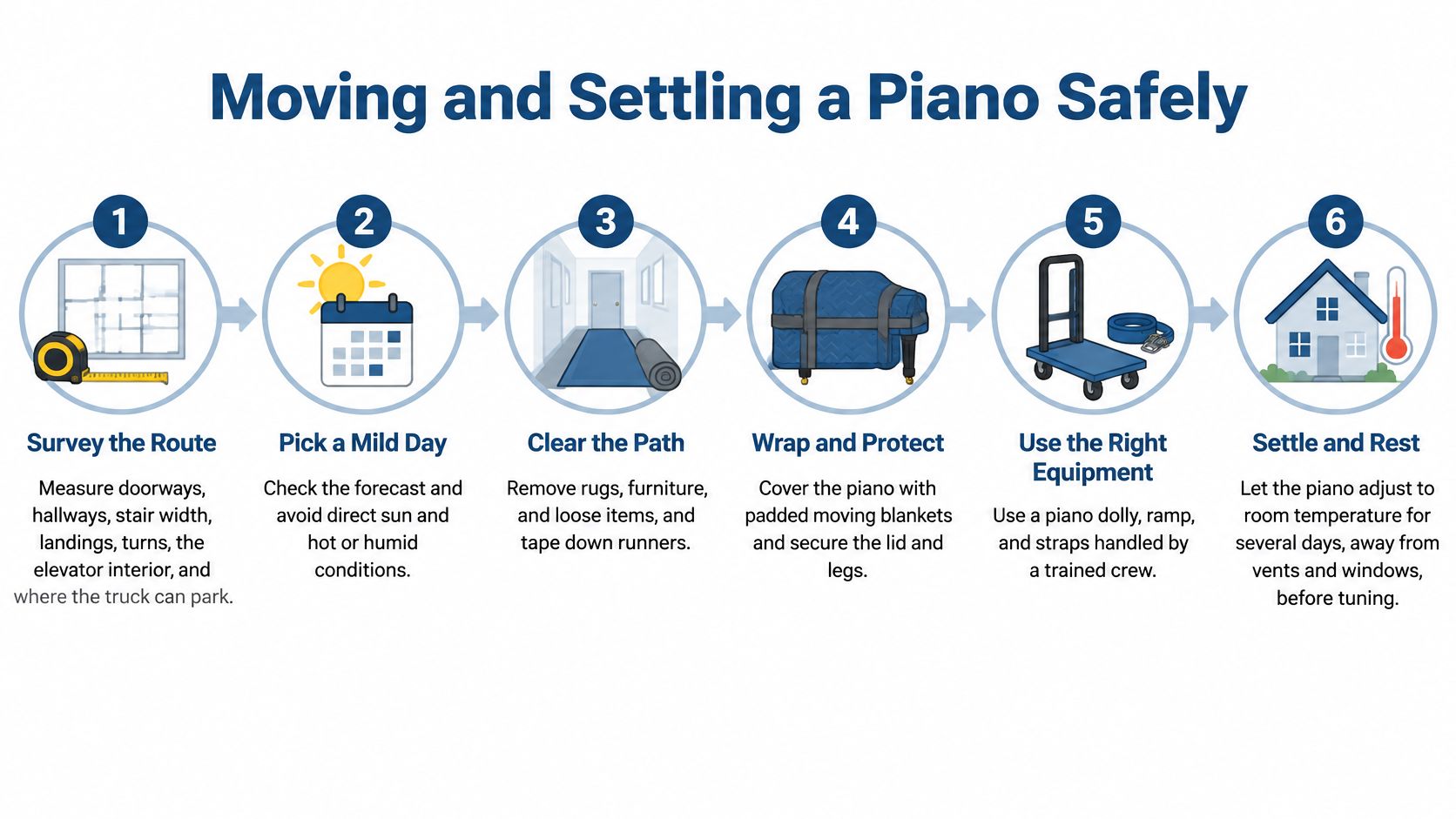
Survey the entire route. Check the measured path against actual conditions at both properties. Open doors fully, confirm elevator availability, and verify the truck's loading position. A suitable doorway doesn't solve a tight turn immediately beyond it. Discuss any uncertain stair or floor condition before work starts. A moving crew can plan handling, but suspected structural weakness may require assessment by a qualified building professional.
Choose favorable weather where scheduling allows. Check the forecast for rain, heat, and abrupt changes. Identify a shaded staging position and have weather protection ready before the piano comes outside. If the date can't change, reduce avoidable waiting. The truck, ramp, protective materials, and receiving room should be ready before the instrument leaves its indoor environment.
Clear and protect the path. Remove objects from the lid, loose rugs, small furniture, and anything that could obstruct the crew's footing. Keep children and pets away from the handling area. Have the crew secure the lid and fallboard appropriately and remove detachable accessories where needed. Don't force an unfamiliar lock or place adhesive tape directly on the finish. Protect vulnerable corners and floors with secured coverings that won't bunch beneath the equipment.
Support the piano with suitable equipment. The crew should check the condition and load rating of the board, dolly, ramps, and straps. Padding protects surfaces, while the board or skid supports the instrument during the planned handling sequence. Never lift by the pedals, lyre, or unsupported legs. For a grand, trained movers must support the body before removing components. Keep removed hardware organized so reassembly doesn't become a search for missing fittings.
Control the move and transport
Use a coordinated handling sequence. The crew leader should explain commands and stopping points before movement begins. Nobody should try to catch a slipping piano or stand beneath an uncontrolled load. Upright stair handling requires controlled balance and a route-specific restraint method. Grand handling requires secure attachment to its board and suitable ramp access. The crew should stop if a ramp shifts, a strap loosens, or a landing doesn't provide the expected clearance.
Secure the instrument inside the truck. The piano needs restraint to suitable vehicle anchor points, not blankets and nearby furniture alone. The crew should prevent rolling, shifting, and contact with other cargo. An upright generally travels upright; a grand may travel on its supported side on a piano board. The correct position follows the instrument and equipment plan, not a blanket rule that every piano must remain on its legs.
American Van Lines' piano-moving guidance identifies approximately 65–75°F and 40–55% relative humidity as generally favorable conditions for piano components and finishes.
These are care targets, not a promise that every vehicle can hold a precise environment throughout loading. Ask what environmental protection the actual transport arrangement provides.
Wood can absorb moisture and swell, contributing to sticking keys and sluggish action. Abrupt drying can contribute to cracking and loose tuning pins. Keep rain off the instrument and avoid leaving it on hot pavement or in direct sun while other belongings are handled.
Finish with placement and aftercare
Unload, reassemble, and inspect before the crew leaves. Choose a location away from supply vents, direct sunlight, windows, and exterior-wall temperature swings where practical. Leave appropriate access for playing, cleaning, and technician service. Have the crew complete any agreed reassembly and compare the delivered condition with your photographs. Record visible damage promptly, but don't assume an unfamiliar sound proves transport damage. A technician may need to distinguish an existing issue from an environmental or mechanical change.
Log the arrival date and use a room thermometer and hygrometer to watch conditions. Aim for a steady indoor environment rather than abrupt heating or air-conditioning changes.
Carroll's piano-moving advice recommends roughly two to four weeks of acclimatization before tuning. Treat that as a planning window, not a universal deadline: an independent piano technician should set the schedule for your instrument, its journey, and the new room.
If keys stick, the action feels different, or tuning drifts noticeably, contact the technician rather than adjusting internal components yourself. Share the arrival date, any storage period, room conditions, and your notes about what changed.
The useful endpoint isn't merely an empty truck. It's a piano placed safely, a documented condition check, and an owner who knows what to monitor and whom to call.
Webster Moving Co. provides household relocations, storage and POD moves, and specialty handling for pianos across Greater Austin and Central Texas. Visit Webster Moving Co. to request an estimate, and include your piano's make and model, access photographs, and any storage plans so the move can be scoped clearly.
Comments