
Moving in the Rain: Proceed, Pause or Cancel
The radar shows a green band sitting over Central Texas on the Friday before your move, and the truck is booked for eight the next morning. Your lease ends Sunday, the elevator is reserved for a two-hour window, and every message in the family group chat asks a version of the same question. The question that matters isn't whether you can move in the rain. You usually can. It's whether this particular rain turns your move into an unsafe one.
Those are different problems with different fixes. A wet move is a logistics job: slower pace, more wrapping, a longer day, a bigger bill on an hourly crew. An unsafe move is a decision nobody made the night before, when there was still time to reschedule without a penalty, a lost elevator slot or an argument with a leasing office.
Table of Contents
Rain Conditions That Decide Whether to Move
Light rain almost never cancels a move. Floodwater does. The mistake families and office managers make is treating all rain as one condition, so they either push through a dangerous morning or cancel a workable one and lose their loading dock reservation for nothing. The decision depends on what the rain is doing to roads and building access, not on how hard it looks from the kitchen window.
Condition | Decision | Action |
|---|---|---|
Light rain, dry walkways, passable roads | Proceed | Standard wet-weather controls |
Steady rain, wet ramps, stairs or driveway | Proceed with extra care | Covered staging, extra crew time, footing spotter |
Lightning, high winds or severe-weather warning | Pause | Stop exterior carries until the warning lifts |
Visibility worsening on the route | Delay | Hold departure and recheck the route |
Flooding on road, driveway, bridge or entrance | Cancel or reroute | Reschedule or use an alternate route |
A light shower during loading is normal weather. Crews wrap for it, lay runners for it and keep working. What moves you into the second row is when the surfaces stop gripping: wet plywood ramps, painted concrete steps, a sloped driveway shedding water across the path where furniture has to travel.
Route risk is not hypothetical either. The Federal Highway Administration's guidance on rain and flooding reports that approximately 75% of weather-related vehicle crashes occur on wet pavement, while 47% occur during rainfall. That's ordinary precipitation degrading tire grip and visibility, not hurricanes.
Flooding sits in a separate category entirely. Flood safety guidance from the National Weather Service advises people not to drive through flooded roads, and during an evacuation to secure the home and disconnect utilities when instructed. A loaded truck crossing six inches of moving water over a low bridge is not a delayed move. It's an emergency waiting for a form.
Run the check the night before, not the morning of. Pull the hourly forecast for your actual loading window, watch the radar loop for storms building west of the route, and check for closures between the old address and the new one. Write down which row of the table you're in, and tell everyone involved.
Building Access Checks Before Moving Day
Wet weather exposes every weak point between the truck and your front door. The time to find those weak points is a dry afternoon two weeks out, on foot, with a notepad.
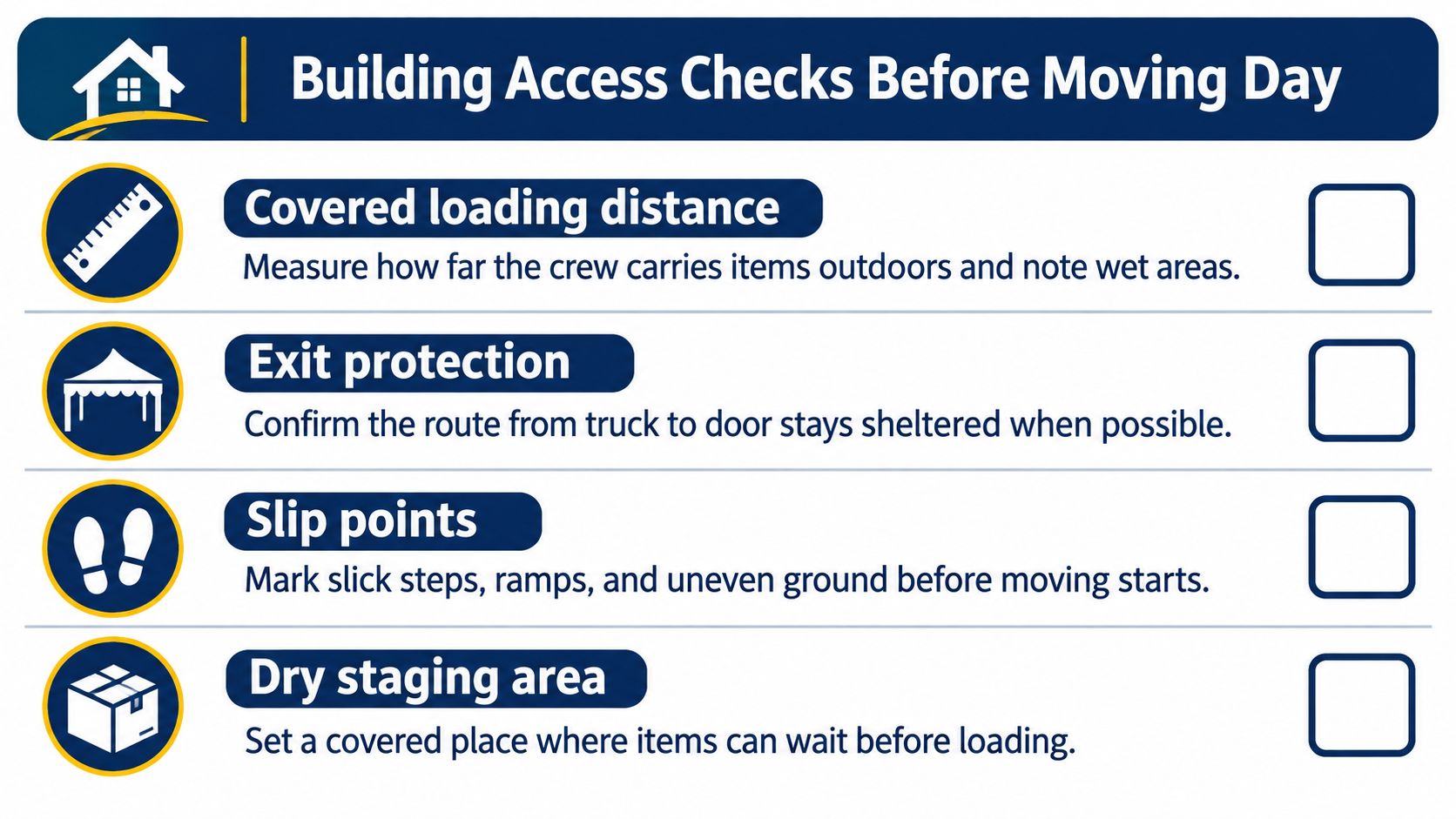
The walk-through, in order
Covered loading distance. Walk from where the truck will park to the threshold and count the feet that are open to the sky. That number tells you whether you need a canopy, a longer staging plan or a different parking spot.
Elevator status and booking. Confirm the freight car works, that it's reserved for your window, and whether pads are already hung. A dead elevator on a rainy day means stairs, and wet stairs under a dresser are how people get hurt.
Traction on ramps, stairs and curbs. Find the low spots where water pools, the smooth concrete aprons and the metal thresholds. Mark them so mats go down there first.
Parking and the loading zone. A truck parked two hundred feet away because of a permit rule doubles the time every box spends in the weather. Settle the zone with the property manager or the city before the morning.
Gate codes and building hours. Get codes, fobs and access windows in writing. A crew standing in a downpour waiting on a call back is the most avoidable delay of the day.
Shared hallways and lobbies. Ask whether floor runners are permitted and who mops afterward. Some buildings want a certificate of insurance before a crew touches the lobby.
Dry staging space. Pick the interior spot closest to the exit that can hold wrapped furniture and loaded boxes, such as a garage bay or covered porch.
Apartment and condo moves are where this pays off most, since you rarely control the hallway, the elevator or the parking. For apartment moves with tight access, Webster Moving Co. asks customers to share details about stairs, elevators, loading areas, gate codes and parking restrictions so the crew can plan around them instead of discovering them in the rain.
Take dated phone photos of the whole route on the walk-through, including the truck spot, and send the notes to the crew lead before moving day.
Protecting Belongings, Floors and Crew on Wet Ground
A wet day finds the weak points in a packing job fast. Cardboard wicks water up from the bottom corner of a stack, upholstery holds damp against a wooden frame, and the smooth concrete apron by the door becomes the most dangerous six feet of the entire move.
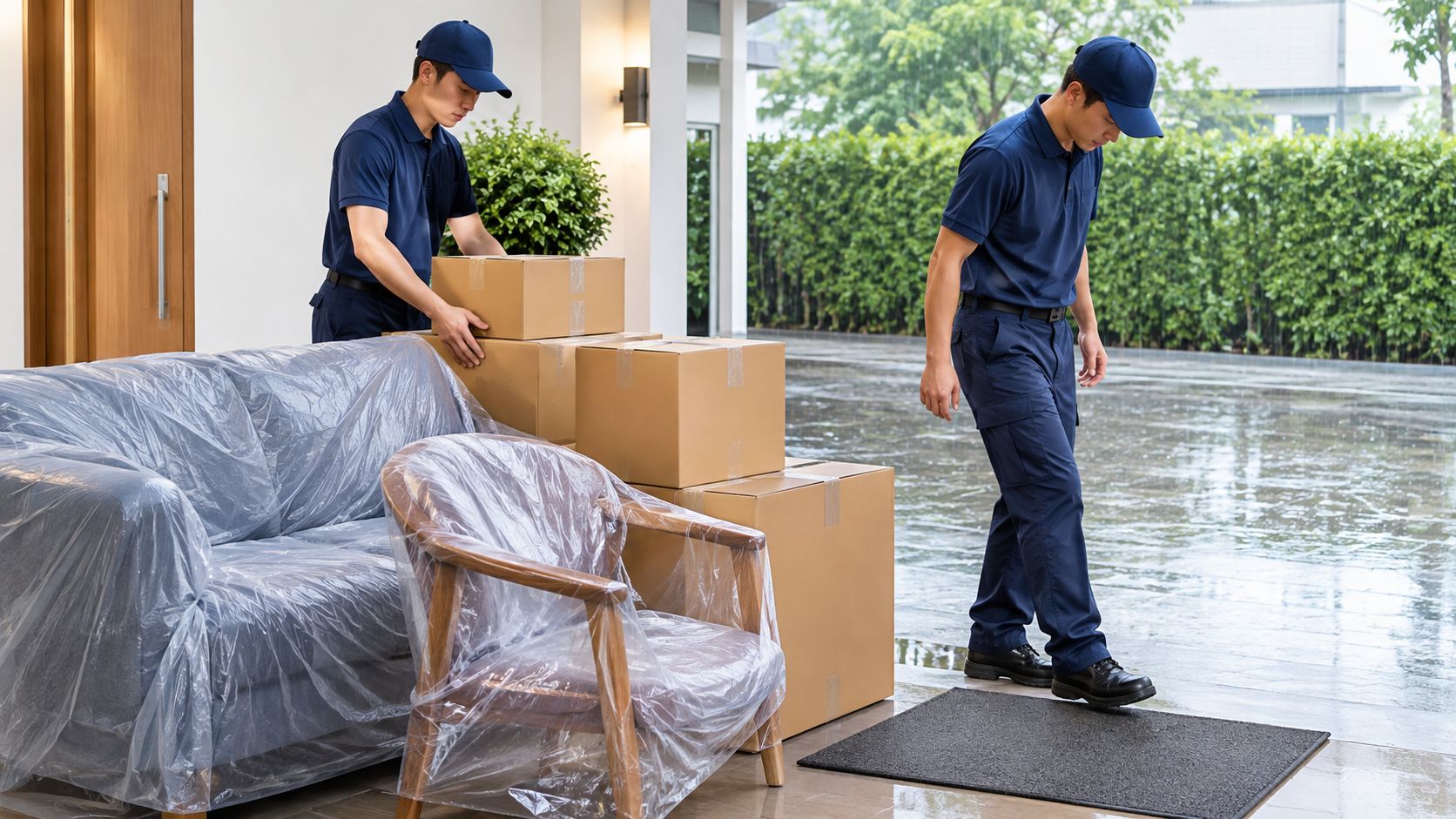
Run the work in this order and the moisture has fewer chances to win.
The sequence that keeps water out
Build the dry zone before anything is wrapped. A garage bay, carport, covered porch or lobby vestibule near the exit. Boxes and furniture wait there, never on a wet driveway or an exposed walkway, because every minute outdoors is a minute of soak.
Wrap in three layers, in this order. A waterproof cover goes on first so rain never reaches the finish, moving pads go over that to cushion corners and edges, and stretch wrap over the top holds the whole package tight and sheds water. Lift a corner at load time and check for condensation before it goes in the truck.
Get cardboard off wet ground. Pallets, plastic sheeting or a dry dolly, every time. Soaked corrugate loses its stacking strength in minutes and a collapsed bottom box takes the ones above it down.
Seal and label, then separate the sensitive items. Electronics, files and photographs travel in sealed plastic bins or in your own vehicle, not in the truck's dampest corner.
Lay the floor route before the first box moves. Runners along the full indoor path and absorbent mats at each threshold, since shoes and appliance dollies track water across hardwood and tile within the first ten trips.
Wipe, air dry, set aside. Before loading, dry anything with surface moisture and set aside anything still damp. A wet item sealed inside a truck for a hundred miles is how mold starts.
Crew controls that matter more than tarps
Slip-resistant footwear is a requirement for anyone carrying, not a suggestion, and mats or textured surfacing belong at every transition: curb to ramp, ramp to truck bed, doorway to hall. Assign one person to watch footing while others carry, because a mover with a dresser blocking his view will not see the wet step that ends his day.
The scale of that hazard shows up in workplace figures. The slip and fall risk guidance published by Nationwide cites a National Floor Safety Institute estimate that 80% of slips occur on wet floors, and OSHA-related safety reporting attributes roughly 12,000 deaths and more than 30,000 disabling injuries annually to falls. Those are broad workplace numbers, not moving-specific rates, and they don't promise any particular reduction on your job. They do explain why hazard elimination beats careful walking.
Practical rule: if the person carrying can't see their own feet, the load waits until someone clears the path.
The most common mistakes are dull, and they repeat on job after job: smooth-soled sneakers, rainwater pooling at an un-matted doorway, oversized items carried alone, and the assumption that a short outdoor carry is low risk. Short carries are where most slips happen, because nobody slows down for ten feet. Pause handling entirely when visibility, lightning, flooding or surface conditions make the route unsafe, fix the hazard, then restart. Loading and unloading is its own discipline, and the loading and unloading service approach is built around that stop-and-fix rhythm rather than speed. Webster Moving Co. uses high-quality materials and proven techniques to keep belongings secure, organized and protected during packing, which is where most of this protection gets decided.
Securing the Truck and Cargo on Wet Roads
Wet pavement lowers friction, and a rough road on top of that amplifies any load that wasn't braced properly. A van that felt solid on a dry test drive can shift a stack two inches on a rain-slicked expansion joint. Securement is a calculation, not a feeling.
The planning rule from the cargo securement guide published by the Texas Department of Insurance is at least one tiedown for each 10 feet of cargo, with a minimum of two even on shorter loads.
Cargo length | Minimum tiedowns | Recheck point |
|---|---|---|
Up to 10 ft | 2 | Within the first 50 miles and after bad weather or rough roads |
10 to 20 ft | 2 | Within the first 50 miles and after bad weather or rough roads |
20 to 30 ft | 3 | Within the first 50 miles and after bad weather or rough roads |
30 to 40 ft | 4 | Within the first 50 miles and after bad weather or rough roads |
Tiedowns are the floor of the standard, not the whole job. The sequence is to calculate each item's weight and center of gravity, distribute mass evenly front to back and side to side, block or brace against sliding and rolling, choose straps, nets, dunnage and edge protection rated for the load, then restrain cargo in forward, rearward, lateral and upward directions. For interstate commercial vehicles, the same guide notes FMCSA requirements that cargo be firmly immobilized or secured, with each securement system's aggregate working load limit at least one-half the weight of the cargo group.
The mass matters on the road. FMCSA crash statistics by road surface record 568 fatal crashes involving large trucks on wet pavement in 2020, equal to 12.8% of fatal large-truck crashes that year. Dry pavement still accounts for most fatal crashes because most driving happens on it, but a loaded truck needing extra braking distance is exactly the scenario those wet-surface numbers describe.
Recheck the load within the first 50 miles, and again after any stretch of bad weather or rough road. Straps stretch when they get wet.
The failures repeat: trusting friction alone, skipping edge protection where a strap crosses a sharp table corner, leaving gaps between pieces that then slide into each other, and never re-tensioning straps after wet handling. On a POD or container load, the same logic applies with less room for error, so packing a POD for a wet-weather load means loading heavy, sealed items first and bracing against the walls.
Documenting Water Damage and Protecting Your Claim
Water damage claims are settled on paperwork, and the paperwork starts before the first box moves. A carrier will pay for a water-stained sofa if you can show it left the origin dry. It won't if the only evidence is a phone call three weeks later. So the record gets built on the day.
Start with dated photos and a short video of furniture, boxes, floors and any pre-existing damage, including the exterior where the truck parks and the doorway where water pooled. Note the condition of every large or fragile item at pickup and make sure the inventory reflects it, because a vague line item like "sofa" protects nobody. Keep the signed inventory, your estimate and any written notes about rain, access problems or a stop-work decision together in one place.
At delivery, inspect each item before you sign, and write any damage on the delivery paperwork at that moment. Not later by phone. Not after the crew leaves.
Ask about transit coverage. Check whether your homeowners or renters policy covers property in transit, and get the answer before moving day.
Ask for the claim window. Request the company's claim process and the written notice deadline in advance, because that deadline is set in the contract, not negotiated later.
Record the pause. A documented stop-work decision for lightning, flooding or unsafe surfaces protects you too, since it shows the move was paused for a stated reason rather than rushed.
Finish with a one-page folder, paper or digital, holding the photos, the inventory, the estimate and the company's contact details. When the claim question comes up, you open one file instead of rebuilding a timeline from memory.
Confirm Your Rain Plan Before Moving Day
The last 48 hours are about locking in decisions you've already made, not making new ones in the rain.
Check the forecast twice. Two days out, then again two hours before the crew arrives. Use the table from the top of this guide to name your row out loud.
Confirm building access in writing. Elevator reservation, gate codes, loading zone, HOA rules. An email thread beats a verbal promise.
Book as early as you can. Webster Moving Co. recommends booking as early as possible, particularly for weekends, the end of the month and the busy summer moving season, because a rainy-day slot is much harder to move once the calendar fills.
Ask about short notice. If the forecast turns, short-notice moves can often be accommodated depending on crew availability, and it's worth a call before you panic-reschedule.
Get the terms on paper. Ask directly how the company handles wet weather, what happens during a pause, any fee for a weather-related cancellation, and who decides when a move is paused.
The one thing worth insisting on is a written decision rule, agreed by everyone with a stake in the move.
Write your three rules on a single page: what conditions mean proceed, what means pause, what means cancel. Share it with your partner, your property manager and your crew lead. Then confirm the crew and the time window in writing. Office hours for that call are Monday through Friday from 8:30am to 5pm, and Saturday and Sunday from 9am to 3pm.
A wet forecast doesn't have to derail your move, provided the go, pause or cancel call gets made deliberately rather than at 7:45 on moving morning. Webster Moving Co. plans Central Texas moves around real access conditions, from apartment elevator windows in North Austin to long-distance routes out of Round Rock, with trained crews, protective materials and clear written estimates before the truck ever rolls. If rain is in your forecast, call the team, share your building details and lock in a plan for the day. Visit Webster Moving Co. to request a no-obligation estimate and get your wet-weather moving plan confirmed in writing.
Comments