
Best Way to Move a Hot Tub: 7 Methods Compared for 2026
The moving truck is outside, your backyard spa is still full, and someone finally measures the side gate. The tub won't clear it in its current position. Even if it did, nobody has confirmed how to disconnect the power, support the shell, or get it onto the truck without damaging the cabinet.
That's why the best way to move a hot tub depends on the access route, not just the distance to your next home. A clear patio calls for different equipment than a winding staircase. A fenced backyard may require a lift, while a move across Central Texas adds loading, restraint, and delivery planning.
Every method starts with an empty, safely disconnected spa. Hiring professionals doesn't make transporting a filled tub acceptable, and booking movers doesn't automatically include electrical work or permission to occupy the street.
Before choosing equipment, identify the actual obstacle: weight, narrow clearance, stairs, blocked ground access, or road transport. Then confirm who handles electrical isolation, destination preparation, and any building approvals or permits. These options often work together rather than compete with one another.
Table of Contents
1. Professional Hot Tub Moving Service - Define the job before accepting the estimate
2. Drain, Disconnect, and Dismantle (DIY Method) - Remove accessories, not structural parts
3. Dolly, Furniture Slider, and Ramp Method - Choose the path before the wheels
4. Crane or Hoist Lift Method - Plan the lift and the street footprint
5. Stair-Climber and Hand Truck Method - Confirm that the staircase is a usable route
6. Truck and Liftgate Transport Method - Check the liftgate as carefully as the truck
7. Hybrid Method With Partial Disassembly and a Staged Move - Disassemble only where the design allows
Choosing Your Route Without Moving-Day Surprises - Match the equipment to the obstruction - Finish the planning before booking the move
1. Professional Hot Tub Moving Service
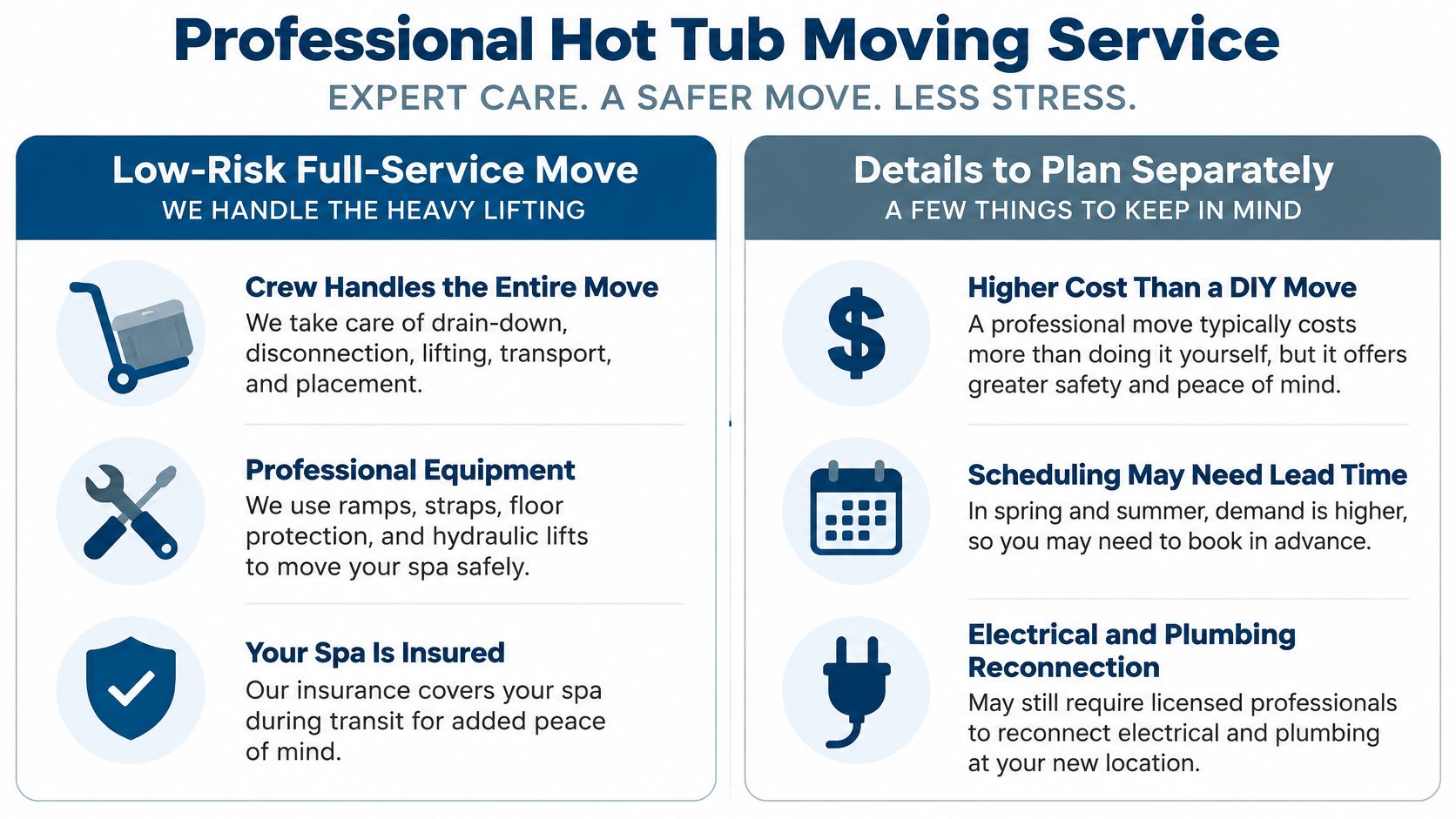
Best for complex access, heavy shells, and moves requiring coordinated handling. A specialty crew can plan the route, protect the spa, position handling equipment, and manage loading and delivery. Draining, electrical work, crane service, and recommissioning must be explicitly included rather than assumed.
The weight alone explains why ordinary furniture-moving assumptions don't work: The Home Depot's hot tub moving guide estimates that a small, empty two- or three-person spa can weigh about 500 pounds, while a larger empty model accommodating up to six people can weigh about 1,000 pounds. Get the manufacturer's actual dry weight before anyone selects equipment.
Define the job before accepting the estimate
Say a Round Rock family needs a spa moved through a narrow side yard and into a truck. The useful quote describes the transport orientation, ground protection, loading equipment, and destination access, not merely a crew arrival window.
Use a written scope to settle:
Preparation: Who drains the tub, removes accessories, and arranges qualified electrical disconnection?
Handling: Which equipment suits the shell and each access restriction?
Coverage: What liability and cargo protection applies, including exclusions and claims procedures?
Reinstallation: Does delivery end at placement, or include separate technician coordination?
When coordinating full-service movers, keep those specialty tasks distinct from the household move. We provide trained movers and specialty-item handling, but the spa and its access requirements need to be included in the inventory for scope confirmation.
Professional handling costs more than providing your own labor. It becomes the stronger choice when an improvised move could leave the tub stranded halfway through the route.
2. Drain, Disconnect, and Dismantle (DIY Method)
DIY preparation can reduce paid labor, but it doesn't turn electrical work into a homeowner task. This approach suits an owner who can prepare the spa carefully and has a realistic, equipment-supported plan for moving the empty shell.
Start by identifying whether the spa is cord-connected or hardwired. Shut off the correct breaker or disconnect, prevent accidental reenergizing, and arrange a licensed electrician for hardwired disconnection. Dark controls and inactive jets aren't proof that wiring is safe to touch.
The Spruce's hot tub moving guide treats draining, electrical disconnection, and handling preparation as separate parts of relocation. Keep that distinction in your plan: doing the packing yourself doesn't qualify you to open electrical equipment.
Remove accessories, not structural parts
For a Cedar Park patio relocation, the owner could handle drainage and pack the cover, steps, filters, and removable headrests. An electrician handles the hardwired connection, while the handling crew receives a dry, documented spa.
Drain responsibly: Confirm local disposal requirements before directing treated water onto the property or toward a drain.
Clear residual water: Use a wet/dry vacuum where the manufacturer permits, keeping moisture away from electrical components.
Document connections: Photograph accessible labels and attachment points without opening energized equipment.
Pack separately: Label accessory hardware and protect the cover from bending.
The labeling discipline used when learning how to dismantle a bed is useful, but a spa's bonded plumbing and structural frame aren't furniture joints.
Practical boundary: Save money on preparation you can do safely, not by improvising electrical disconnection or unsupported lifting.
3. Dolly, Furniture Slider, and Ramp Method
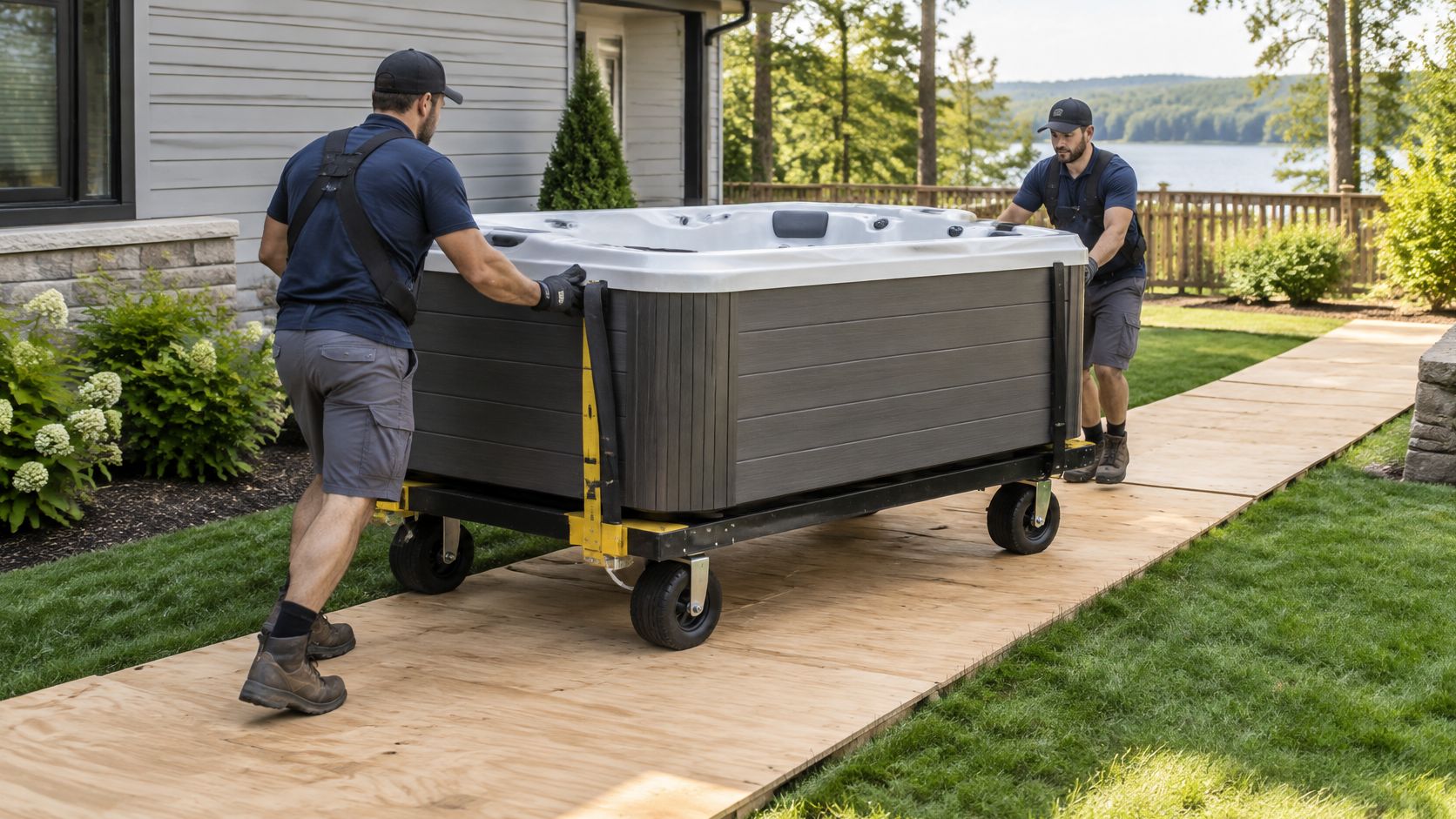
A spa already sitting beside a clear, firm patio route may not need elaborate lifting equipment. A purpose-built spa dolly or appropriately rated machinery dolly can make a same-property relocation manageable without turning it into a carrying job.
Say a Georgetown homeowner wants the tub moved from an old patio to a nearby replacement pad. The crew can establish a protected rolling path, secure the empty shell to suitable equipment, and move it without loading a truck. The challenge is keeping every transition stable, including thresholds, paving joints, and changes in slope.
OSHA's materials-handling guidance emphasizes sufficient clearance through doorways, aisles, and turns when materials are moved mechanically. Measure the spa in its approved transport orientation, then account for the dolly and room for operators to control it.
Choose the path before the wheels
Furniture sliders have a narrower role than a spa dolly. They may assist controlled repositioning over a smooth, protected surface when suitable for the load, but they aren't a substitute for load-rated rolling equipment across a yard.
Support the structure: Place equipment beneath the manufacturer-approved base or supporting platform, not cabinet trim or plumbing.
Build a stable route: Use suitable load-spreading boards or runners over vulnerable surfaces. Loose plywood doesn't make wet ground dependable.
Rate the ramp: Confirm its capacity, support, width, attachment, and working angle.
Control movement: Secure the tub to the dolly with padded, appropriate restraints and stop before each transition.
The trade-off is simplicity versus terrain tolerance. This method works best when the route stays firm and predictable; steep slopes, unstable soil, and awkward steps call for a different plan.
Never try it with water in the spa, and never put a helper downhill as the emergency brake.
4. Crane or Hoist Lift Method
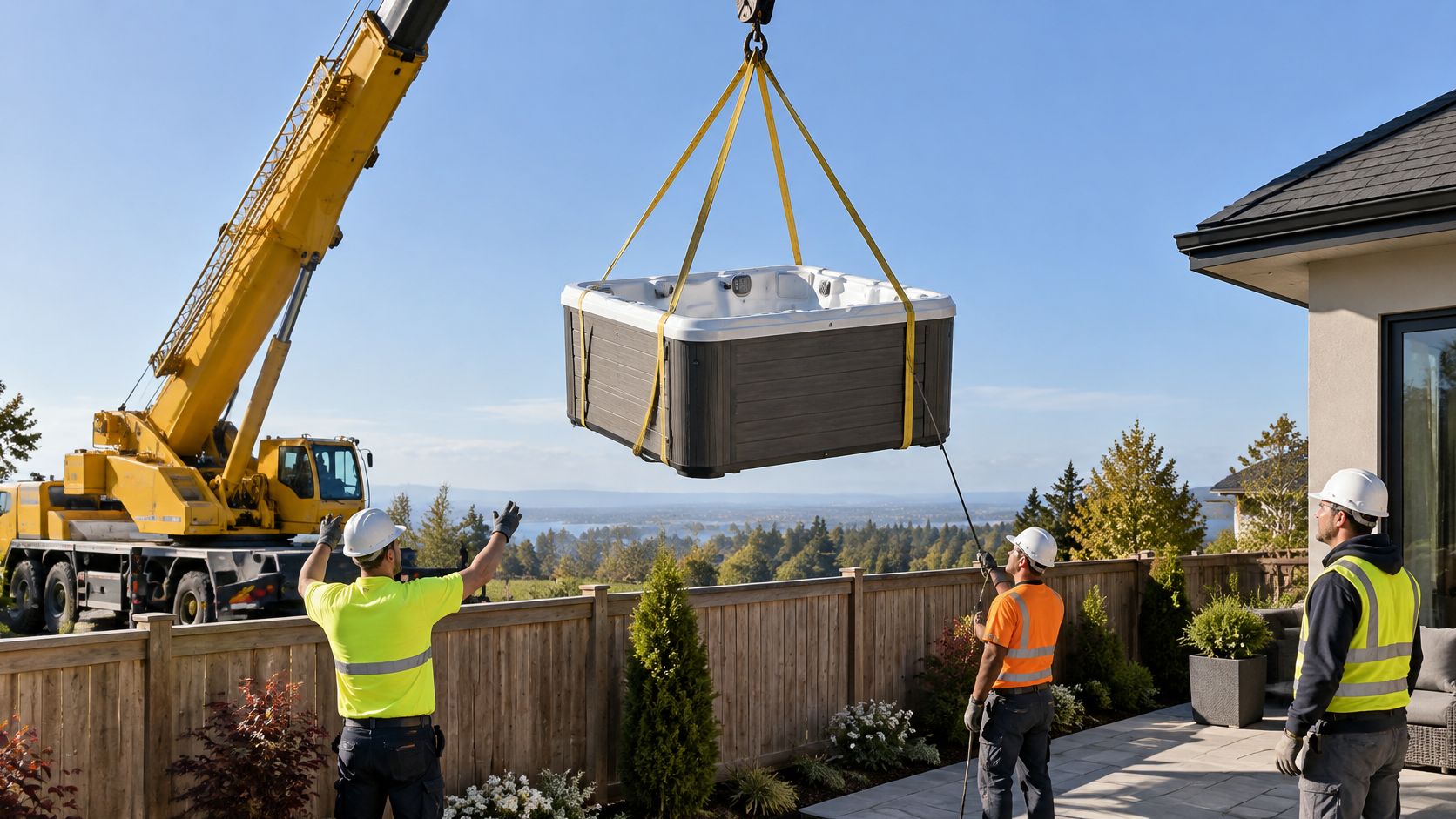
A crane solves a blocked route, not an inconvenient measuring job. When a spa can't pass through a gate or around permanent structures, lifting it over the obstruction may avoid destructive removal work.
For example, a North Austin homeowner might have a backyard enclosed by fencing and landscaping, with no usable ground route to the driveway. A crane contractor can assess whether the empty spa can be lifted safely from its current position to the transport vehicle.
Plan the lift and the street footprint
OSHA's ergonomics guidance recommends mechanical equipment whenever possible for heavy or unstable loads and notes that handling capacity depends on the load's size, shape, and conditions, not weight alone. For a crane, the operator must evaluate the actual lifting configuration, including reach, rigging, and setup conditions.
Manufacturer-approved rigging is essential. Don't assume lifting straps can wrap around the acrylic rim or attach to cabinet panels, and don't treat a general-purpose hoist as interchangeable with a professionally planned crane lift.
Before scheduling:
Check overhead hazards: Identify utility lines, branches, roof edges, and the full travel path.
Confirm setup space: Establish where the vehicle and stabilizers can stand without damaging unsupported surfaces or underground services.
Resolve permissions: Ask the local permitting authority whether street occupation, sidewalk closure, or traffic control approval applies.
Prepare the landing: Verify the receiving pad or engineered deck before the lift.
Nobody should stand beneath the suspended spa or between the load and a fixed obstruction.
Crane work adds mobilization, rigging, and potentially traffic-control costs. Compare that complete scope with an approved ground-access alternative, and allow for weather-related rescheduling.
5. Stair-Climber and Hand Truck Method
Stairs are a specialist handling problem, not a reason to add more helpers around a standard hand truck. A powered stair-climbing dolly may work for an empty spa only when its dimensions, weight distribution, approved support position, and the staircase itself suit the equipment.
Consider a San Marcos renter with a compact spa on an upper-level terrace. Before reserving a stair dolly, the crew needs to establish whether the shell can pass through the doorway, rotate on the landing, and remain supported throughout the stair movement.
Confirm that the staircase is a usable route
Stair width alone isn't enough. Measure headroom, landing depth, turns, door swings, handrails, and the space required for operators. Confirm that the stairs and landings can support the concentrated handling loads, especially where their condition or construction is uncertain.
For apartment coordination, our apartment-moving services include planning around stairs, elevators, loading areas, and parking restrictions. Share those details in advance, together with photographs of the complete spa route.
Equipment suitability: Use a stair-climbing system approved for the load and its operating orientation.
Building permission: Confirm loading hours, common-area protection, and whether the proposed route is permitted.
Operator positions: Keep people clear of crush zones and out of the path of a descending load.
Stop conditions: Reject the route if the shell can't turn without losing support or clearance.
Protecting walls with corner guards won't solve an unsafe landing or an unsuitable stair machine. Where available, an approved freight elevator or an exterior lift may provide a more controllable alternative.
The attraction is avoiding a crane. The limitation is unforgiving geometry: a spa that clears the doorway may still be impossible to turn safely onto the stairs.
6. Truck and Liftgate Transport Method
For a move from Austin to Dallas, getting the spa out of the backyard is only part of the job. Truck transport solves the road-distance problem, while the equipment at each property solves access and loading.
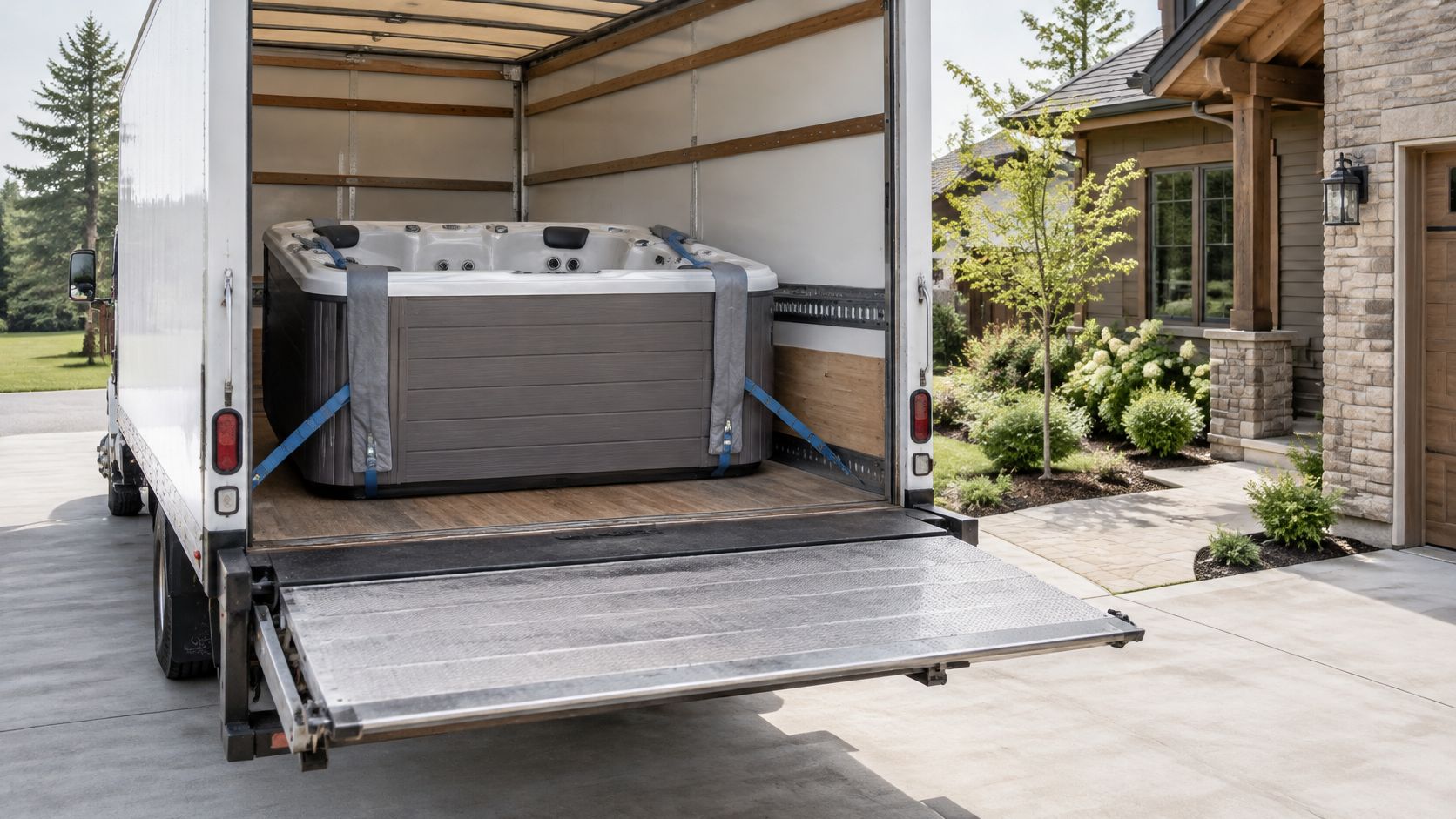
A box truck, flatbed, or suitable trailer can carry an empty spa when payload, cargo dimensions, support, and restraint arrangements are appropriate. Choose the vehicle around the load plan rather than assuming the truck carrying your furniture will also accommodate the spa.
Check the liftgate as carefully as the truck
A liftgate's advertised capacity doesn't answer every loading question. The platform must accommodate the supported load, and the operator must account for the dolly, load position, and equipment instructions.
A ramp needs the same scrutiny. A broad spa on a narrow or poorly secured ramp can become unmanageable even when the truck has enough payload capacity.
Support underneath: Keep the spa on an approved structural surface or purpose-built platform.
Restrain to anchors: Use rated restraints attached to suitable vehicle anchor points, with padding at contact areas.
Protect vulnerable parts: Keep pressure off controls, acrylic edges, plumbing, and decorative panels.
Plan load distribution: Position the spa according to axle loading and securement needs, not a blanket rule to load it first.
Document condition: Photograph the shell and equipment bay before loading and after unloading.
Enclosed transport offers weather protection; an open trailer may simplify loading but requires appropriate protection without trapping loose material against the shell. Either way, household goods mustn't lean against the tub.
The delivery crew also needs a usable unloading position. A well-secured journey doesn't help if the destination driveway can't accommodate the planned vehicle.
7. Hybrid Method With Partial Disassembly and a Staged Move
A hybrid move assigns different tasks to the people and equipment best suited to them. The owner handles accessible preparation, an electrician isolates the supply, a handling crew moves the shell, and a spa technician completes any approved component work.
This is useful when no single method solves the whole route. A Leander homeowner, for example, might pack accessories, have the empty shell moved through the yard on a spa dolly, use truck transport between homes, and arrange separate electrical reconnection.
Disassemble only where the design allows
Removing a cover or detachable step can reduce bulk without disturbing the spa's working systems. Removing pumps, heaters, jets, or cabinet sections is a different decision and should follow manufacturer guidance with qualified technical help.
A molded shell generally doesn't become narrower because you remove its accessories. If the gate clearance is the problem, stripping components may add labor and leak risk without creating a usable route.
Worthwhile trade-off: Use partial disassembly to remove a genuine obstruction or protect a vulnerable component, not simply to make the spa look lighter.
Keep the handoffs organized:
Record condition: Photograph accessible components, labels, and attachment points before removal.
Group hardware: Store fasteners in labeled bags with the associated part's packing.
Protect openings: Have the technician cap or otherwise protect disconnected systems appropriately.
Keep records together: Move the owner's manual, warranty documents, and component inventory with the spa paperwork.
Name the next task: Specify who completes placement, inspection, reconnection, and startup.
Staging can control costs when the owner takes on safe preparation. It can also increase coordination costs if crews arrive before the electrician finishes or before the destination is ready.
The best hybrid plan reduces difficult handling. It doesn't create extra disassembly merely to divide the work among more people.
How the seven hot tub moving methods compare
Item | Relative Cost | Best For | Main Risk |
|---|---|---|---|
Professional Hot Tub Moving Service | Higher cost | Heavy tubs, difficult access, and full-service moves | Higher price; reconnection may require separate professionals |
Drain, Disconnect, and Dismantle (DIY Method) | Lower cost | Owners who want flexible scheduling and can prepare the spa safely | Electrical hazards, injury, or plumbing damage from incomplete draining |
Dolly, Furniture Slider, and Ramp Method | Low equipment cost | Short, ground-level moves of empty or light spas | Tipping on uneven ground; unsuitable for stairs or filled tubs |
Crane or Hoist Lift Method | Highest cost | Tight or elevated locations inaccessible by ground | Weather delays, overhead hazards, or unstable crane setup |
Stair-Climber and Hand Truck Method | Moderate cost | Empty spas on interior stairs or in multi-story buildings | Injury or property damage on steep, narrow, or winding stairs |
Truck and Liftgate Transport Method | Moderate to high cost | Long-distance moves and enclosed transport | Shifting or cracking if the spa is not secured properly |
Hybrid Method: Partial Disassembly and Staged Move | Moderate to high cost | Large or built-in spas with multiple access challenges | Lost parts or reassembly errors |
Choosing Your Route Without Moving-Day Surprises
Start with the question that rules out every transport option: Is the spa still filled or electrically connected? If so, stop handling preparations until it's safely isolated and completely drained. No dolly, crane, or larger crew makes that shortcut acceptable.
Electrical safety deserves its own scheduled scope. The U.S. Consumer Product Safety Commission's pool and spa electrical-safety guidance addresses the dangers of electricity around water; arrange qualified hardwired disconnection and code-compliant reconnection rather than treating them as incidental moving tasks.
Match the equipment to the obstruction
Choose a route using the actual shell dimensions and manufacturer-approved handling position:
Clear, firm ground: Consider a spa dolly and protected rolling path.
Stairs or landings: Require an equipment-specific assessment, including structural support and turning clearance.
Blocked ground access: Compare approved access changes with a professionally planned crane lift.
Travel between properties: Add a suitable truck, loading system, and securement plan.
Mixed obstacles: Combine methods with clearly assigned handoffs.
Check permissions before reserving equipment. Building management may control elevator access and loading hours, while the local authority can establish whether the proposed street setup or electrical work needs a permit or inspection. Property approval and municipal permission aren't interchangeable.
Finish the planning before booking the move
The destination must have a level, load-bearing surface, suitable service access, and an electrical installation ready for the qualified installer. Restore covers, barriers, and access controls after placement, and follow the manufacturer's inspection, filling, and startup sequence.
Take these actions before moving day:
Get written quotes: Separate transport, preparation, lifting, and technical work.
Confirm electrical scope and coverage: Record who reconnects the spa and what insurance applies.
Book early: We recommend early scheduling, especially for weekends, month-end dates, and summer moves.
Document every part: Keep route photographs, condition photos, labels, and component records together.
Once both homes' access points are known, crews can determine suitable staffing, equipment, and estimated timing. The best way to move a hot tub is the plan that remains controllable from its original pad to its final supported position.
Webster Moving Co. offers residential relocations, packing, and specialty-item handling across Greater Austin and Central Texas. Visit Webster Moving Co. for a free, no-obligation quote, and include your spa's model, dry weight, dimensions, and access photos so we can assess the requested handling scope and any separate specialist needs.
Comments