
Piano Mover Austin TX: Costs, Services and Credentials
Hiring a piano mover in Austin, TX typically cost about USD 150 to USD 1,100 in 2025, with the price driven by piano type, distance and access difficulty. That spread is why two neighbors can get very different quotes for what sounds like the same job.
You've probably got a closing date, a lease deadline or a new room picked out, and the piano is the one piece you can't load with friends and hope for the best. It's heavy, it's top heavy in the wrong places, and the finish marks if a strap slips. The useful question isn't just what a truck costs. It's whether the crew has measured the route, planned the building access and thought about where the piano will sit once it arrives.
Table of Contents
Piano Mover Costs in Austin at a Glance
A piano move in Austin can start near USD 150 and reach USD 2,000 for a baby grand, depending on the instrument, distance, access and equipment. Listings on Airtasker's Austin piano moving page put typical jobs at USD 150 to USD 1,100 in 2025. Treat that as a broad range for common moves, not a guaranteed quote or a ceiling for grand pianos.
Austin Piano Move Cost References From 2025 to 2026
Scenario | Reported cost (USD) | Source | What changes the price |
|---|---|---|---|
Lugg base fare, Austin | 26 to 152 | Vehicle and crew option; base assumes 5 miles and 15 minutes of labor | |
Lugg estimated average | 50 to 222 | Lugg Austin page, 2026 | Vehicle and crew option |
Portable digital piano | 260 to 530 | Instrument weight and labor time | |
Baby grand piano | 1,030 to 2,000 | Movers.com estimator, 2026 | Weight, stairs and equipment |
Typical Austin piano move, all types | 150 to 1,100 | Airtasker listings, 2025 | Piano type, distance and access difficulty |
Unusually difficult move | from about 550 | Specialized equipment required | |
Piano storage | 75 per month | Piano Wrangler, 2025 | Months the piano waits while the new home isn't ready |
The Lugg base fare is a starting price, not the typical cost of a completed piano move. Its Austin page lists fares from USD 26 to USD 152 and estimated averages from USD 50 to USD 222, based on just 5 miles of driving and 15 minutes of labor. A longer carry, stairs, or a difficult landing turn can add time and cost beyond those assumptions.
Instrument size shifts the quote. Movers.com's Austin estimator puts a portable digital piano at USD 260 to USD 530 and a baby grand at USD 1,030 to USD 2,000. The wider range for a grand reflects its weight and the equipment and labor its handling may require. For an unusually difficult move requiring specialized equipment, Piano Wrangler lists a starting price of about USD 550, with storage at USD 75 per month.
When comparing a quote with cheap movers in Austin, TX, ask what the price includes. Confirm whether stairs, long carries, equipment and placement in the destination room are included or billed separately. The lowest base fare may not cover the work your home requires.
Before requesting a quote, have the piano type or model, the distance between addresses, and the stairs or elevator details at both locations ready. Those details help the crew estimate labor and equipment rather than guess from a short description.
How Piano Size and Weight Change the Price
Size and weight set the crew size, the equipment list and how slowly a turn has to happen. A piano isn't priced like a couch because its mass sits in a cast iron plate and a long rim, not in a frame you can tilt any way you like.
Steinway Grand Piano Dimensions and Weights
Model | Length | Width | Weight |
|---|---|---|---|
Steinway Model M (medium grand) | 5 ft 7 in (170 cm) | 57 3/4 in (147 cm) | 603 lb (274 kg) |
Steinway Model B (classic grand) | 6 ft 11 in (211 cm) | 58 in (148 cm) | 802 lb (364 kg) |
Steinway Model D (concert grand) | 8 ft 11 3/4 in (274 cm) | Not listed in reference | 1,064 lb (483 kg) |
Those reference values come from Steinway's Model M specifications, which list the Model M at 603 lb, the Model B at 802 lb and the Model D at 1,064 lb. They create two planning problems in Austin homes. The first is concentrated floor loading, because hundreds of pounds rest on small contact points while the piano is on its legs, on a skid or being rotated. The second is restricted turning clearance, because length, not width, usually decides whether a hallway turn works.
Take a hypothetical Model B that has to turn from a hallway into a living room. The crew can't swing it like a table. They rotate it in small movements on a skid, with extra hands steadying the rim while one person calls each move. That control adds labor and time to the quote, even if the total distance inside the house is short.
Measure first: A doorway that clears the piano but not the piano on its skid isn't a clear route.
Grands need controlled orientation changes because the long rim and uneven internal mass shift the load as the instrument tilts. Practical controls include a properly rated piano board or skid, multiple independent straps and padded contact points. Uprights and digital pianos aren't in the table because their dimensions vary by brand and model, so send the exact model or your own measurements instead of a category name alone.
Before you call a piano mover in Austin, TX, measure the piano's length, width and height, then the narrowest doorway and hallway, the stair turn and the elevator interior. Note landing space too, since that's where rotations happen. Room count tells a crew very little. A small apartment with a grand and one tight turn can need more crew time than a larger house with an upright and a straight path to the truck.
What a Full Piano Move Includes
A full service is a sequence, and each step exists because something specific goes wrong without it.
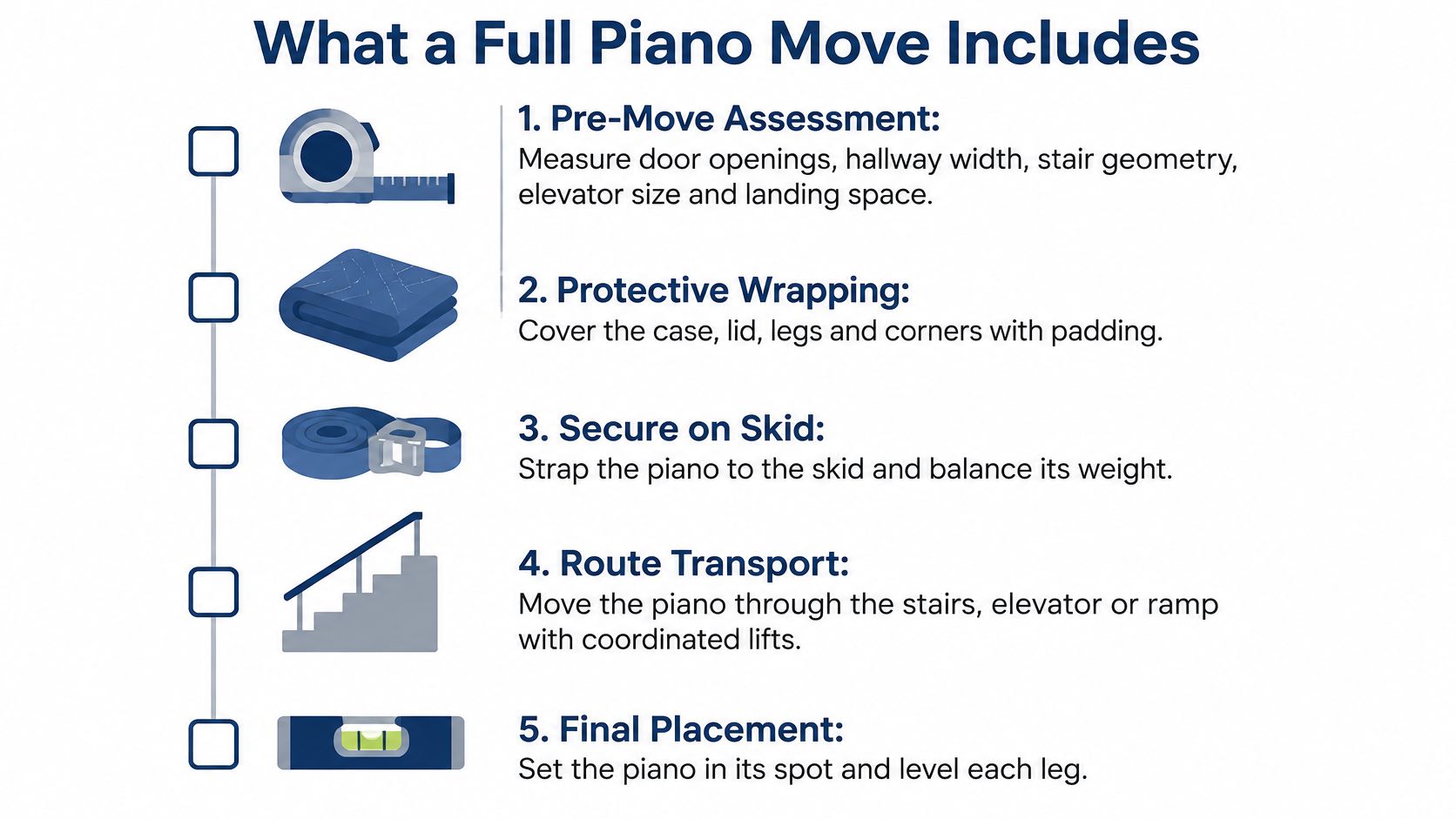
The Crew Sequence
Pre-move assessment: We measure door openings, hallway width, stair geometry, elevator size and landing space, and record the piano type and whether a truck ramp or liftgate is needed.
Protection: Finished floors, stair edges, walls, door jambs and elevator interiors are isolated, because a dropped wheel or shifting skid can put hundreds of pounds through one small contact point.
Equipment setup: The piano goes on a properly rated board or skid with multiple independent straps and padded contact points.
Team handling: One person directs movement with standardized verbal commands so pushes line up instead of fighting each other.
Route control: The travel path stays clear, the piano is staged at workable heights where possible, and work stops if clearance proves inadequate.
Load and placement: The crew secures the piano for transport, sets it where you want it, and documents any damage on the spot during a post-move check.
That team approach matches manual handling practice. Piano handling involves lifting, lowering, pushing, pulling, carrying, holding and restraining loads, and CCOHS guidance on manual materials handling recommends keeping loads close to the body and work near waist to elbow height. It also supports mechanical assistance and team-controlled movement over individual lifting. Nobody should be proving strength under one corner of a grand.
Ask about the items people forget. Does the quote include removing legs and pedals on a grand? Does it cover stairs, a second floor or a long carry from the curb? A piano quote and a general furniture quote aren't interchangeable, because the assessment, skid, straps and stop-work rule are the service.
Credentials and Insurance to Verify Before Booking
Before a piano crew arrives, confirm who is responsible for the instrument and what the paperwork covers. Webster Moving Co. is locally owned and operated, has served Central Texas since 2011, and has over 15 years of experience. The company is licensed and insured as a Texas moving company. Ask Webster directly for its current license numbers and certificate of insurance before booking, then check that the company name on the documents matches the name on your quote.
A certificate shows that insurance exists, but it does not explain how a damaged piano would be valued. Ask whether the move uses a declared value for the instrument or general cargo limits, and request the valuation terms in writing. A piano may be worth more than nearby household furniture, so clarify the coverage before the crew begins work.
Ask for the license numbers, insurance certificate and written valuation terms before booking. If the paperwork does not match the company handling your move, get an explanation before confirming.
Reviews can help you assess a mover after the paperwork checks out. Look for recent feedback that specifically describes piano moves, stairs or careful handling. General furniture-moving praise may not tell you how a crew plans for a piano. For broader guidance on choosing the best movers in Austin, TX, compare service details and documentation, not just ratings.
Ask who is assigned to the move and whether the crew has handled pianos before. Get the company's license numbers, certificate of insurance and written valuation statement directly from the mover. Keep those documents with your quote, so you can refer to the agreed coverage if a question comes up during or after delivery.
Apartment and Building Access to Arrange Early
Most apartment residents assume access is a simple choice between stairs and an elevator. Then a grand reaches a third-floor unit, the passenger elevator won't take the piano on its skid, and the move hinges on details only the resident and the building know. Building approval, not muscle, is where these jobs stall.
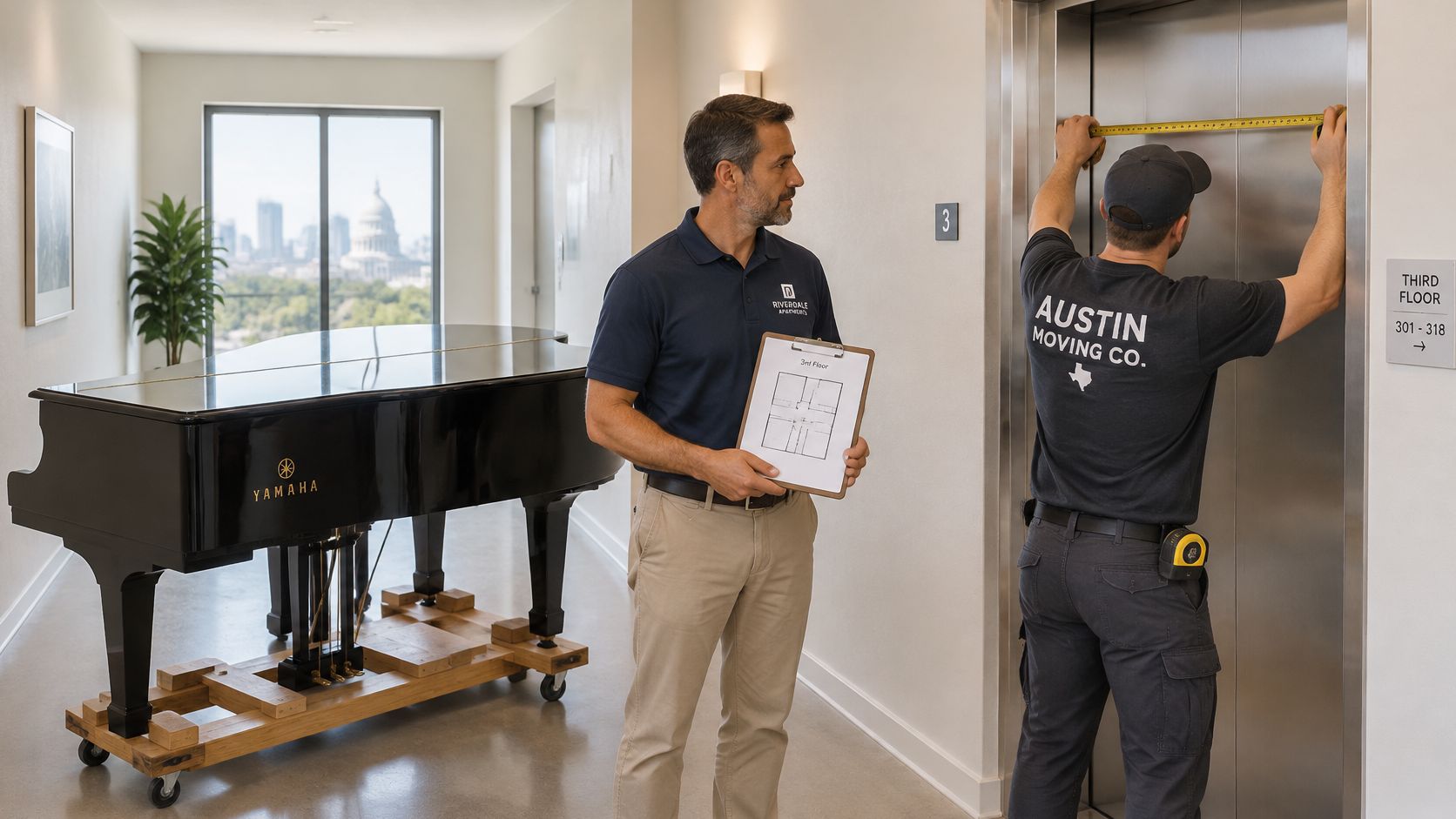
For apartment moves, we ask customers to let us know about stairs, elevators, loading areas, gate codes and parking restrictions so we can plan accordingly. Add the building-specific details that cause delays:
Elevator rules: Whether the building restricts pianos on passenger elevators, and the interior dimensions of any freight elevator
Reservations: How far ahead the freight elevator or loading dock can be reserved, and for how long
Property protection: Whether lobby flooring, hallway corners or elevator interiors need padding or coverings
Curb and parking: Where the truck can legally sit during loading, and who reserves that space
Property management usually controls elevator reservations, parking, curb space and certificates of insurance. Don't assume you need a city piano permit. The City of Austin's relocation-permit page concerns moving entire structures, not ordinary household pianos, so generic advice to get a city moving permit can send you to the wrong office. The permissions that matter are usually property management and right-of-way logistics.
Ask for the building's rules in writing a week or more ahead. Send them to your piano mover in Austin, TX with the piano's measurements, the skid dimensions and the planned route, so problems surface while there's time to solve them. It's the same planning that drives apartment movers cost on ordinary moves, with less room for error. Skip it, and the failure looks predictable: a crew standing in a lobby, piano on a skid, while someone tries to reach a building manager who isn't answering.
Where Webster Serves Greater Austin and Central Texas
Coverage is easiest to check in groups. In North Austin, we serve The Domain, North Burnet, Wells Branch, Tech Ridge, Great Hills, Anderson Mill and Jollyville, among other neighborhoods. We've served South Austin for over 15 years. Nearby cities include Round Rock, Georgetown, Cedar Park, Leander, Pflugerville, Liberty Hill, Hutto, Kyle and San Marcos.
In Cedar Park, coverage reaches areas near FM 1431, Lakeline Boulevard, Parmer Lane and 183A. We're based in Williamson County, which helps with scheduling in the northern suburbs. That regional spread matters because Greater Austin keeps adding homes well outside the city core, and a piano move often starts in one jurisdiction and ends in another.
Growth explains the demand behind that map. U.S. Census Bureau QuickFacts recorded Austin at 790,390 residents in 2010 and 961,855 in 2020, an increase of 171,465 people or 21.7%. The same source placed Austin at 1,002,632 residents on July 1, 2025, and counted 444,426 housing units in 2020. More households means more moves into new builds, apartments and established homes, each with different stairs, elevators and driveway access.
Confirm your exact neighborhood rather than relying on the city name, since service can reach some streets in a suburb and not others. Send both the origin and destination addresses when you request a quote, because a workable route is part of the coverage decision. Then ask us to confirm crew availability for your date by phone or email.
Keeping the Piano Stable After Delivery
Careful loading doesn't remove the biggest long-term risk. Where the piano sits afterward does more to its tuning and wood over time than a careful ride across town can protect against. Treat placement and humidity as part of the move, not an afterthought.
Manufacturer guidance recommends roughly 40% to 60% relative humidity, with 35% to 70% described as a tolerable range, and warns that extreme or repeated temperature and humidity changes can harm the instrument, according to Schimmel's piano care guidance on maintaining value. Austin makes that band harder to hold than it sounds. Hot summers, air-conditioning cycles, sudden weather changes and older homes with uneven climate control all swing indoor readings. A piano moved from a cooled apartment into a house that sat closed during a sale can land in a different climate on the same afternoon.
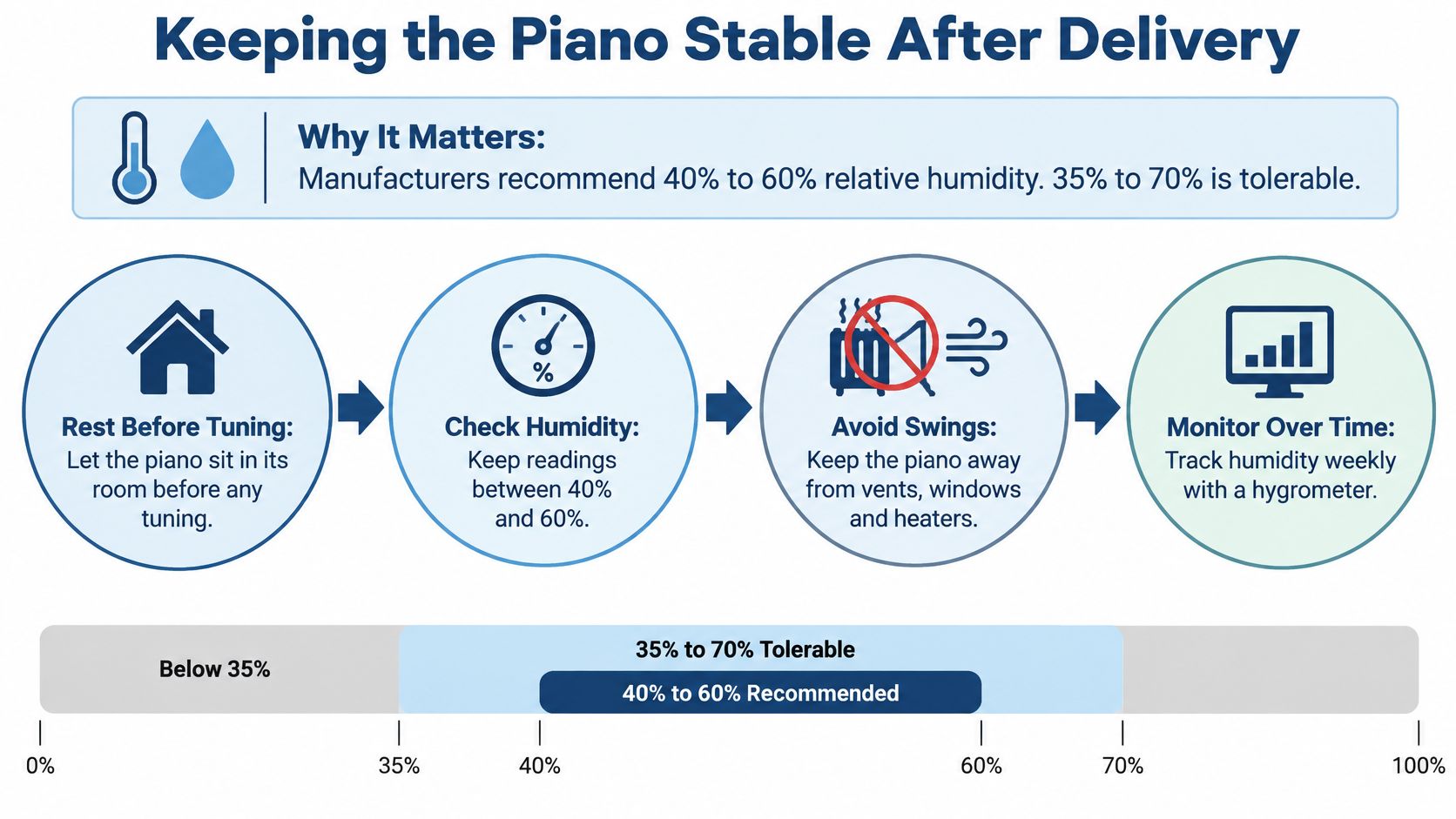
Placement Steps After Delivery
Choose the room: Pick a spot away from exterior walls, windows, exterior doors and garages, where conditions change slowest.
Clear heat and sun: Keep the piano out of direct sun and away from supply vents and heaters that blow dry or hot air across the case.
Measure the air: Place a hygrometer near the instrument and log readings for several days, looking for the 40% to 60% band.
Let it acclimate: Wait before scheduling a tuning, and ask your technician how long to wait for your home's conditions.
Book the technician: Schedule tuning once readings settle, so the work isn't undone by a still shifting room.
Some movers can coordinate a tuner, but the crew can't set your acclimation time. That call belongs to a piano technician who knows the instrument and the room. Ask at booking who supplies a hygrometer and whether tuner coordination is available, so the handoff doesn't end at the front door.
The plan changes with the building. New construction can still be drying out, apartments with shared walls inherit a neighbor's climate habits, and climate-controlled storage is only as steady as its actual readings. In each case, measure first and place accordingly.
Confirm the Move and Request a Written Quote
Before requesting a quote, gather the details that determine the crew, equipment, and route: the piano type and model, its measurements, both addresses, stairs or elevators at each location, any storage needs, and your preferred date. Send photos of tight turns, stair landings, and entryways. Clear access details help identify issues that could change the plan or price.
Contact Webster Moving Co. at 512-751-0893, sales@webstermoving.com, or 309 W Main St, Suite 118, Round Rock, TX 78664 to request a quote. The company's crews have experience handling moves that need extra planning and care, including pianos, safes, and large furniture. Ask specifically how the piano will be protected, carried, and placed, rather than relying on a general household-move description.
For moves from Austin to Dallas, Houston, San Antonio, or other destinations in Texas, confirm access at both addresses and how the piano will be secured during the longer drive. Delivery planning should include where the instrument will sit, particularly in a new home or apartment where room conditions may still be settling.
Before booking, ask for the price and its assumptions in writing. The quote should list the included items and specify what access conditions the price covers, such as stairs, equipment, and long carries. Ask for the company's insurance certificate as well, and confirm it identifies the mover.
Send the model, addresses, and access details when you contact Webster Moving Co. Request written confirmation of what the quote includes and what could change the price. You can also start with the company's website.
Comments