
Moving Companies Kyle TX: Licensed Movers Compared
Kyle had just 2,256 residents in the early 1990s, according to the Texas State Historical Association's Kyle history. That small-town baseline helps explain why a Kyle move today needs more planning than finding someone with a truck.
When comparing moving companies in Kyle, TX, treat licensing, written estimates, and claim procedures as cost-control tools. A low price doesn't tell you whether the crew can handle your staircase, whether travel time is included, or what happens if furniture arrives damaged. The better comparison starts with the work you need and ends with terms you can keep.
Table of Contents
Kyle Moving Services Compared by Move Type - Match the service to the actual work
How to Verify a Mover's License and Insurance - Make the checks before loading starts - What an incomplete answer means
Reviews and Red Flags Worth Checking Before You Hire - Read small-job reviews closely - Watch for gaps you can verify
How to Request and Compare Estimates Step by Step - Build a scope every mover can use - Compare totals only after comparing scope
Protecting Your Claim After Damage or a Billing Dispute - Document damage while the evidence is clear - Separate a disputed bill from an unexplained bill
Book Your Kyle Mover Once the Estimate Is Written - Turn the quote into a confirmed plan
Kyle Moving Services Compared by Move Type
Move type | Who it fits | What the company covers |
|---|---|---|
Residential house move | Homeowners moving within Kyle or nearby cities | Complete moving service for homes with 3 or more rooms |
Apartment or condo move | Renters with stairs, elevators, or limited parking | Stair and elevator planning, parking coordination, and common-area protection |
Packing services | Households or offices short on time | Materials and careful item wrapping for transit |
Storage and POD moves | Moves that use a container or a storage gap | Professional loading and unloading, plus local repositioning |
Long-distance Texas move | Moves from Central Texas to Dallas, Houston, or San Antonio | Door-to-door transport with coordinated scheduling |
Office or commercial relocation | Small and midsize businesses | Desks, equipment, and file transport with scheduled move windows |
Senior and assisted living move | People downsizing or moving into or out of a community | Packing, downsizing, furniture moving, and senior community coordination |
Specialty item handling | Pianos, safes, antiques, or large appliances | Careful handling of bulky or delicate pieces |
Webster Moving Co. provides these services across Central Texas. Our service area includes Kyle, San Marcos, Hutto, Pflugerville, Round Rock, Georgetown, Cedar Park, Leander, and North and South Austin. Start by confirming that both your pickup and delivery addresses fall within the intended service route, especially when combining local work with transport elsewhere in Texas.
Match the service to the actual work
Say you're leaving an apartment with a reserved elevator and a distant loading space. The apartment row is your starting point, but the estimate also needs the elevator window, hallway length, parking instructions, and furniture that needs disassembly. We handle stairs, elevators, parking restrictions, and furniture disassembly and reassembly as part of apartment-moving logistics.
A full house with heavy furniture needs a different plan. List which pieces go upstairs, which doors are narrow, and whether you want packing completed before loading begins. Our full-service moving guide can help you distinguish complete moving support from a smaller handling job.
Service categories can overlap. A senior move may also involve packing, storage, and an antique cabinet. An office relocation may need a separate packing plan for equipment and files rather than treating everything as ordinary boxes.
Practical rule: Choose the main move type first, then add the tasks that change the crew's equipment, preparation, or schedule.
Don't select full packing because you're worried about fragile items. Partial packing can be the more practical choice when you can box clothing and books yourself but want help with dishes or delicate pieces. Conversely, arranging loading alone won't solve a preparation problem if the kitchen is still unpacked when the truck arrives.
Before calling, decide which row best describes your move and which access details the crew needs. Those answers are more useful than a bedroom count alone.
How to Verify a Mover's License and Insurance
Credential | Where to verify | What it tells you |
|---|---|---|
TxDMV registration | Check published No. 010210868C against the live TxDMV record and contract | An active certificate establishes authority for paid household-goods transport in Texas |
USDOT number | Compare published number 4470107 with company information and vehicle markings | Identifies the operating carrier federally, but doesn't replace the Texas registration check |
Liability insurance | Review the insurance filing and written proposal | Shows the carrier's liability protection and applicable limits |
Cargo coverage | Request a written explanation from the mover | Identifies coverage relating to belongings and the claim terms |
Texas requires carriers transporting household goods for compensation to register regardless of vehicle size and maintain active insurance filings; the Texas Department of Motor Vehicles registration guidance lists minimum liability coverage of $300,000 for carriers with a gross, registered, or rated weight below 26,000 pounds, plus household-goods cargo coverage of $5,000 for loss on one vehicle and $10,000 for aggregate losses involving multiple shippers.
Those figures are screening benchmarks, not a promise that every damaged item will be replaced at its purchase price. Carrier insurance and the mover's contractual responsibility to you aren't interchangeable. Ask how the written terms apply to your belongings, including exclusions, valuation, and the process for reporting damage.
Make the checks before loading starts
Confirm the active certificate. Search the TxDMV record using the published registration number. Check the legal operating name rather than relying on a logo or an advertisement.
Match the company across documents and equipment. Compare the certificate information with the contract and truck markings. If a different name appears, get a clear explanation before handing over your belongings.
Request the protection terms in writing. Ask for an explanation of liability versus cargo coverage and keep it with the proposal. A verbal assurance that everything is insured doesn't explain how a claim will be evaluated.
Active operating authority depends on continuing insurance filings. A lapse can undermine the carrier's lawful authority and leave you uncertain about which coverage supports a claim. That's why checking current status matters more than seeing an old certificate image.
Webster Moving Co. is a licensed and insured, locally owned company based in Round Rock, not a Kyle-based office. We've served Central Texas since 2011, and our published credentials provide a starting point for independent verification.
What an incomplete answer means
An unfamiliar vehicle or a paperwork mismatch deserves clarification, not an immediate assumption of fraud. The useful question is whether the business can document who is transporting your goods and under what authority.
If a mover can't produce a verifiable certificate or explain its coverage, don't authorize loading. Pause the move, keep the correspondence, and choose a carrier whose identity and protection terms you can establish. A scheduling inconvenience is preferable to discovering an authority problem after the truck has departed.
Reviews and Red Flags Worth Checking Before You Hire
Our published review profile includes 400+ online reviews across platforms, including 125+ five-star Google reviews. Those totals give you material to examine, but the useful evidence is in the details, not just the rating.
Read reviews for three things: whether the final bill followed the estimate, how the company responded to damage, and how the crew handled the work. A specific account of protecting doorways or resolving a disputed charge tells you more than a sentence of generic praise.
Read small-job reviews closely
One customer described hiring us to move only the large furniture they didn't want to maneuver themselves. They praised the crew as fast, careful, and personable, and considered the price fair. That example, included among our customer moving reviews, illustrates why a small job can still reveal handling quality and communication.
It doesn't establish what your move will cost. Different access, inventory, and service requirements make that a separate question.
Watch for gaps you can verify
No written estimate: The mover wants you to commit without documented scope and charges.
No inventory discussion: A phone price arrives without questions about furniture, boxes, or access.
Missing carrier identification: The business can't provide registration details for verification.
Cash demanded before a contract: A large upfront cash request comes without written terms.
Unexplained protection: Nobody can distinguish liability terms from cargo coverage.
Unmarked equipment: The truck's connection to the contracted carrier isn't explained.
No physical address: You can't establish where the business operates or receives correspondence.
Green signals include a published address, working phone and email, and a consistent company identity on the paperwork and equipment. Our service history since 2011 is another reference point you can check, not a substitute for current documentation.
Check more than one review platform. Compare recurring descriptions of communication and problem resolution, and read the company's responses to criticism as carefully as the praise.
How to Request and Compare Estimates Step by Step
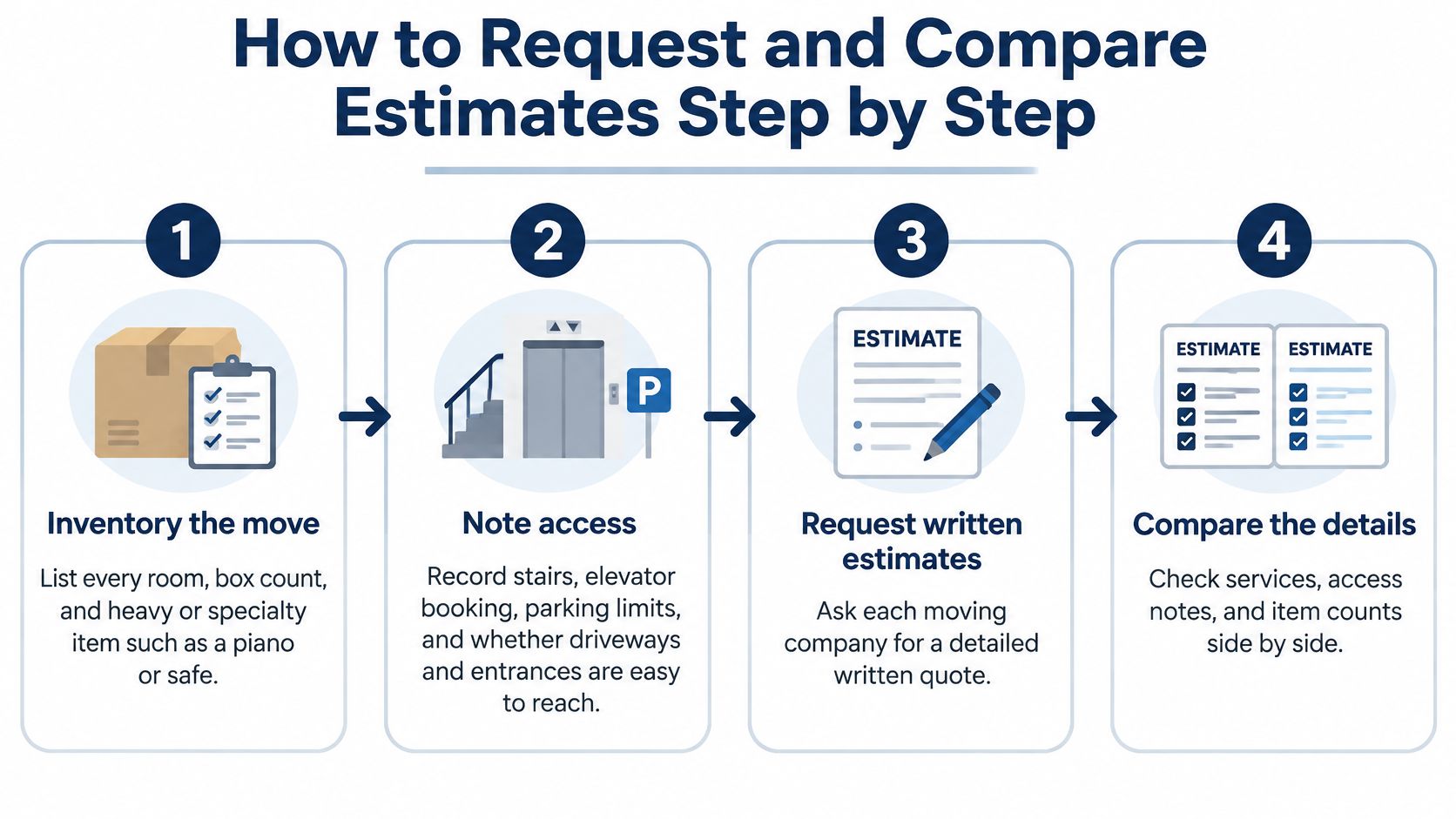
A useful estimate describes the job well enough that you and the mover are pricing the same work. Inventory size, access time, distance, packing materials, specialty handling, and storage requirements all affect the scope. A quote that omits them gives you little basis for comparison.
Build a scope every mover can use
Inventory the move. List every room, your expected box count, and heavy or specialty items such as a piano, safe, or large appliance. Include garage, patio, and storage contents, since leaving these out creates an incomplete job description.
Record access at both addresses. Note stairs, elevator reservations, parking limits, long carries, and narrow entrances. We require accessible driveways, entrances, and elevators, so resolve building permissions and obstructions before move day rather than assuming the crew can work around them.
Set a date window and identify the move type. Tell us whether you're arranging a house, apartment, office, or senior move, and explain any fixed handover or community access times. Distinguish a preferred date from a deadline you can't change.
Request a written, no-obligation estimate. Contact us at 512-751-0893, email info@webstermoving.com, or use our online quote form. Send the same inventory and access description to every company you're comparing so a lower total does not reflect omitted work.
Establish the estimate's status. Ask whether it's binding or nonbinding, what assumptions it uses, and what circumstances could change the amount. Request possible additional charges in writing, since a nonbinding estimate can change and an added task can alter the agreed scope.
Compare the work line by line. Check crew size, truck provision, packing materials, stair or elevator time, specialty handling, and any storage days. Our moving truck quote guide offers additional preparation guidance, but the decisive document is the proposal for your actual move.
Confirm your preparation responsibilities. We require boxes to be properly packed and labeled, with someone over 18 years of age present at pickup and delivery. If you're purchasing packing services, establish which items the packing crew will prepare and which remain your responsibility.
Compare totals only after comparing scope
A smaller crew may have a lower hourly charge but need longer to complete the same carrying work. A quote that includes packing materials may look higher than one that leaves materials outside the total. Neither comparison is meaningful until you know what each proposal includes.
Use a simple worksheet with each company in a column and each service in a row. Mark anything missing as not stated, then get a written answer rather than filling in the gap yourself.
A cheaper estimate isn't a saving if it prices a different move.
Before paying a deposit, the signed estimate should identify the operating company, pickup and delivery locations, inventory or scope, scheduled window, pricing basis, payment terms, and conditions for changes. It should also explain cancellation terms and how damage or billing issues are handled. Don't accept a blank charge field with an assurance that someone will complete it later.
Protecting Your Claim After Damage or a Billing Dispute
Step | Deadline | Who acts |
|---|---|---|
Written claim for damage or billing dispute | Within 90 days of delivery | Customer |
Acknowledgment of the claim | Within 23 days of receiving the claim | Mover |
Settlement offer | Within 90 days | Mover |
TxDMV mediation request | Generally within 35 days after an unsatisfactory response or denial, or after 90 days without a response | Customer |
The deadlines above come from the TxDMV household-goods moving guide, which also explains that movers must provide a written proposal before loading. Treat the claim process as formal correspondence, not an extension of a phone conversation.
Document damage while the evidence is clear
Say a sofa arrives with torn upholstery. Photograph the tear, the whole sofa, and any relevant wrapping or nearby damage before signing the delivery receipt. Record the condition on the delivery paperwork, keep a copy, and submit a written claim promptly rather than waiting for informal promises to turn into a resolution.
Describe the item, the damage, the delivery details, and the remedy you're requesting. Attach supporting photographs and retain proof that the mover received your claim. If you speak by phone, follow up in writing with a factual summary.
Keep these records together:
Signed written proposal: Include attachments, amendments, and any authorized changes.
Inventory and loading photographs: Preserve images that show the item's condition before transport.
Delivery condition notes: Keep your annotated receipt and photographs taken when the damage was discovered.
Receipts and supporting costs: Retain packing-material receipts and relevant repair or replacement documentation.
Correspondence: Save emails, messages, claim submissions, and the mover's responses.
Separate a disputed bill from an unexplained bill
Question any charge that differs from the estimate or goes beyond its stated terms. Identify the specific line item and ask the mover to explain the contractual basis for it. A difference isn't automatically improper if you authorized additional work, so include any change approval when assessing the bill.
For example, distinguish a charge for packing you requested during loading from an unexplained fee that never appeared in the proposal. Your written scope and correspondence make that distinction easier to establish.
Keep the remedy clear: A claim asks the mover to resolve your loss or billing dispute. A regulatory complaint reports conduct for the agency to review.
Pursue the written claim with the mover when you're seeking compensation or a billing adjustment. Consider a TxDMV complaint when you believe the carrier violated applicable rules, and use the mediation process when appropriate for an unresolved dispute. Don't assume a complaint replaces your claim or pauses its deadlines.
Licensing and insurance don't guarantee a smooth resolution. Clear evidence, a specific request, and attention to deadlines put you in a stronger position than repeated undocumented calls.
Book Your Kyle Mover Once the Estimate Is Written
The U.S. Census Bureau's Kyle QuickFacts records 28,016 residents in 2010, 45,697 in the 2020 Census, and an estimated 69,917 on July 1, 2025, with 53.0% growth from the 2020 estimate base. That expansion helps explain the importance of planning household relocations and crew capacity in Kyle, but it doesn't establish whether a particular moving date is available.

Request the estimate while your date still has some flexibility. If your lease, closing, or community admission fixes the date, state that constraint immediately. Don't assume a crew is reserved just because you've discussed availability.
Turn the quote into a confirmed plan
Gather the job details: Send your inventory, access notes, and date window together so the proposed work is clear.
Complete the carrier checks: Confirm the operating identity, registration, and insurance before accepting the proposal.
Make the booking explicit: Get written confirmation of the agreed services, schedule, and payment terms.
We're based in Round Rock and serve Kyle, along with nearby Central Texas communities. Our trained, professional movers handle home, apartment, packing, storage and POD, senior, and office moves. A company doesn't need a Kyle office to serve your address, but its starting location makes travel-charge clarity important.
Before signing, check the estimate's binding status, compare its included work against competing proposals, and read the written damage terms. Make sure any final inventory changes have been incorporated rather than left in a separate text message.
For scheduling or terms questions, call 512-751-0893, email info@webstermoving.com, or contact our office at 309 W Main St, Suite 118, Round Rock, TX 78664. Send the details first so the conversation can focus on the actual job.
The cheapest quote isn't the strongest choice when it leaves charges or responsibility unclear. Choose the proposal that documents what the crew will do, what you'll prepare, and how changes will be handled.
Webster Moving Co. offers Kyle-area home, apartment, office, senior, packing, storage and POD, and specialty-item moving services. Visit Webster Moving Co. to request a no-obligation estimate, and include your inventory, access details, and preferred date window so we can scope your move in writing.
Comments