%20copy-01_edited.jpg)
Moving Company Cedar Park TX: Your Local Guide
You're moving out of a Cedar Park home next weekend, and the plan already looks shaky. The truck needs to reach a narrow cul-de-sac, the apartment manager wants an elevator reservation, and the HOA still hasn't confirmed whether your mover's insurance certificate is on file. Meanwhile, school traffic is building around the same time your crew is supposed to arrive.
That's how a straightforward local move turns into a late start, extra carrying, and a larger bill. Distance matters, but access, timing, approvals, and labor hours usually decide whether a Cedar Park move runs smoothly. This guide takes the dispatcher's view of hiring a moving company in Cedar Park, TX, with practical advice for homeowners, renters, and small businesses.
Table of Contents
Moving in Cedar Park Starts With Understanding the Local Market - The approvals can control the schedule - Traffic and curb access affect labor
Why Cedar Park Drives a Steady Moving Demand - Demand follows the calendar - What this means for your booking
Services a Cedar Park Moving Company Typically Offers - Residential moves - Apartment and condo moves - Packing and specialty handling - Commercial relocations
What Actually Drives the Cost of a Cedar Park Move - The four cost drivers
Booking Around the Cedar Park School and HOA Calendar - Use a reverse timeline
How to Verify a Cedar Park Mover Is Licensed and Insured - Run the licensing checks - Review the business, not just the star rating
Booking and Move-Day Workflow for a Cedar Park Home - Build the booking record - Prepare the property
Choosing the Right Cedar Park Mover for Your Situation - Match the crew to the move
Moving in Cedar Park Starts With Understanding the Local Market
A family near Lakeline may have a short drive to the new house and still face a difficult moving day. The truck might not fit close to the garage, the subdivision may have limited curb space, and a school pickup window can slow the approach. A renter near the 183A corridor faces a different problem, with an elevator booking, loading zone, gate code, and leasing-office approval all controlling when the crew can work.
The mistake is treating Cedar Park as a simple point-to-point move. Local dispatchers have to account for subdivision layouts, apartment rules, traffic patterns, stairs, driveway grades, and the time required to carry furniture from the truck to the door. A move that looks small on a phone call can become labor-heavy once the crew sees the actual access route.
The approvals can control the schedule
HOA and property-management requirements deserve attention before you request a quote. Ask who must approve the move, whether the community requires a certificate of insurance, whether the truck can use the main entrance, and whether the property has a restricted move-in window.
Apartment and condo jobs often depend on stair carries, elevator reservations, hallway turns, and parking placement, not just the number of rooms. Austin relocation guidance also highlights temporary truck permits, designated loading spaces, and the added work created when a truck can't stage near the entrance.
Practical rule: Give the mover photos of the driveway, parking area, stairs, elevator entrance, and narrowest passage before the quote is finalized.
Traffic and curb access affect labor
Cedar Park crews may need to work around school arrival and pickup periods, neighborhood congestion, and traffic approaching 183A. The dispatcher should know whether the truck can park directly outside the home or whether the crew will make a long carry from the street.
That information changes the crew recommendation and the arrival plan. It also prevents a common argument on moving day, when a customer expects the quoted labor time to cover an easy load but the crew discovers that every large item must travel a considerable distance.
The right question isn't only, “How much does a moving company charge?” Ask, “What will prevent the crew from working continuously once it arrives?” That answer usually explains the schedule better than mileage does.
Why Cedar Park Drives a Steady Moving Demand
Cedar Park has grown from a small community into a substantial suburban market connected to Greater Austin. The city was renamed Cedar Park in 1887, incorporated on February 24, 1973, and grew from 125 residents in 1970 to more than 3,000 by 1980. Its population increased from 26,049 in 2000 to 77,595 in the 2020 census, an addition of about 51,546 residents and roughly 198% growth over those two decades, according to the documented Cedar Park population history.
That expansion creates several kinds of moving work. Families move between established neighborhoods and newer developments, renters change apartments as leases turn over, and businesses adjust office space as the Austin region expands. The city reports 46 maintained parks, about 1,000 acres of city-owned parkland, and 34 miles of trails, details that reflect the scale of the built-out suburban environment described in the U.S. Census Cedar Park profile.
Demand follows the calendar
A moving company serving Cedar Park doesn't schedule every month the same way. Families often prefer school-break windows, while renters and businesses may have more flexibility. The most competitive dates tend to disappear first, especially when several households are trying to coordinate a closing, lease expiration, or school transition.
The neutral Cedar Park moving guide identifies mid-June through mid-August as the concentrated peak and recommends reserving summer dates four to six weeks ahead. Use that as a planning baseline, not as a reason to wait until the calendar becomes crowded.
Season | Months | Demand level | Typical lead time | Rate notes |
|---|---|---|---|---|
Winter | January to February | Quieter | Flexible dates are more available | Compare weekday options |
Spring | March to May | Building | Book before school-calendar demand intensifies | Access planning still matters |
Summer | Mid-June to mid-August | Peak | Reserve four to six weeks ahead | Popular dates have less flexibility |
Fall | Late August to November | Mixed | Plan around lease and school schedules | Midweek dates may be easier to secure |
What this means for your booking
Don't wait for a final closing date if you already know the likely week. Ask the mover about a tentative hold, cancellation terms, and what documents the property manager requires. If your date is flexible, offer a weekday or a mid-month option before asking for a discount.
Cedar Park's population is now above 80,000 by current local and independent estimates, while the 2020 census counted 77,595, so the market has continued to expand beyond the last decennial count. That sustained suburban scale supports steady demand for household moves, apartment relocations, and office transitions.
Services a Cedar Park Moving Company Typically Offers
A good moving estimate starts with the property, not a generic package. A single-family home in an established subdivision needs a different crew plan from an apartment near Lakeline Boulevard, and an office along Whitestone Boulevard has its own access and downtime concerns.
Residential moves
For a house, the quote should account for room count, garage and attic contents, stairs, driveway access, furniture that must be disassembled, and the amount already packed. A three-bedroom home with dense storage and heavy furniture may need more labor than a larger but sparsely furnished house.
Furniture disassembly and reassembly often make sense in older subdivisions with tighter rooms and doorways. Sectionals, beds, dining tables, cribs, and large cabinets may need to come apart before the crew can protect them and move them safely.
Apartment and condo moves
Apartment work is governed by the building. The leasing office may require a service elevator, a loading dock, a gate code, floor protection, and a certificate of insurance before the crew arrives. A customer who provides only the address hasn't provided enough information for a reliable estimate.
Tell the mover about every stair flight, elevator restriction, parking limit, and move-in window. If the truck must remain at a distant loading area, the crew may spend a meaningful part of the job carrying rather than loading.
Packing and specialty handling
Packing can be full-service, partial, or limited to fragile rooms such as kitchens, offices, and display cabinets. The customer can also pack independently and hire labor for loading, unloading, or a portable container. For a detailed look at what professional packing can include, review Webster Moving Co.’s packing services.
Specialty items require direct discussion before booking:
Pianos and safes: Confirm the item type, weight, stairs, turns, and final placement.
Antiques and fragile pieces: Ask about padding, wrapping, inventory notes, and photo documentation.
Gun safes: Identify the safe by name and disclose its location, access path, and destination.
Large appliances: Confirm whether disconnection, protection, and reconnection are included.
Storage moves: Clarify whether the crew loads a container, unloads it, or both.
Commercial relocations
Office moves need an access plan that protects business continuity. A dispatcher may recommend early-morning, evening, or weekend work when loading would interfere with building operations or traffic along a busy corridor.
Some services are commonly bundled, such as trucks, basic protection, loading, transport, and unloading. Packing, storage, specialty handling, long carries, and furniture assembly are often quoted separately. Read the line items before comparing providers.
What Actually Drives the Cost of a Cedar Park Move
The final price is mostly a labor equation. A larger home creates more inventory, but stairs, long carries, packing rework, and restricted access determine how quickly the crew can process that inventory.
The 2026 Cedar Park dataset reports local moves under 100 miles at $427 to $3,438 overall, with multi-bedroom homes ranging from $1,282 to $3,438. The same Austin-area pricing source reports averages of about $402 for labor-only moves and $1,062 for full-service moves in its dataset, as detailed in the Austin moving cost guide.
The four cost drivers
Home size affects the load count and the number of crew-hours. A formal inventory is especially useful for three-bedroom and larger homes because garages, attics, patios, and storage rooms can change the job substantially.
Access friction includes stairs, elevators, narrow streets, long carries, limited parking, and loading docks. Austin-area guidance commonly treats a long carry as an add-on when the truck can't park within roughly 75 feet of the entrance, with reported surcharges in the tens to low hundreds of dollars.
Packing scope changes both preparation time and risk. Industry guidance attributes about 40% of damage claims to improper packing and wrapping, while claims and damage payouts run around 1% to 3% of gross revenue for typical movers. Those figures support a practical decision: careful packing is a risk-control measure, not just a convenience.
Timing affects availability and sometimes pricing. Summer and month-end dates are harder to staff, while a flexible weekday can give the dispatcher more options.
Cost driver | Austin-area benchmark |
|---|---|
Local move under 100 miles | $427 to $3,438 overall |
Multi-bedroom local move | $1,282 to $3,438 |
Labor-only average | About $402 |
Full-service average | About $1,062 |
Long-carry threshold used in local guidance | Roughly 75 feet |
Long-carry surcharge reports | Tens to low hundreds of dollars |
Ask whether the quote includes travel, fuel, materials, wrapping, floor protection, heavy-item handling, storage loading, and waiting time. You don't need every provider to use the same pricing model, but you do need the same job assumptions.
If you're loading a portable container or need a crew to reposition one, compare the scope carefully with storage and POD moving services. A low hourly rate isn't a low total price if the crew lacks the equipment or access information needed to finish efficiently.
Booking Around the Cedar Park School and HOA Calendar
The calendar creates the bottleneck before moving day. Families often target school-break periods, and apartment renters must fit their move between lease expiration, landlord approval, elevator availability, and deposit rules.
The concentrated summer period runs from mid-June through mid-August, and neutral local coverage recommends booking summer dates four to six weeks ahead. HOA or property-management certificates of insurance may require five to seven business days, so send the request as soon as the mover is selected.

Use a reverse timeline
Start with the possession or lease deadline, then work backward.
Several weeks before the move: Choose the likely date, request written estimates, and identify whether the property requires a COI or approved vendor.
After selecting the mover: Request the certificate of insurance and send it to the HOA, landlord, or property manager.
Before the property's document deadline: Reserve the elevator, loading dock, parking area, or gated entrance.
Before move day: Confirm the move window, gate code, truck restrictions, contact person, and cancellation terms.
On the final confirmation call: Make sure the mover has both addresses, inventory notes, access photos, and the correct appointment time.
A midweek, mid-month move can reduce scheduling pressure because more crew options may be available. Don't assume it will automatically cost less. Ask for the difference in writing and compare the full scope, not just the hourly rate.
Renters should also confirm when keys are released, when the old unit must be empty, and whether the security deposit depends on a final inspection. A moving crew can't solve a lease conflict after the elevator window has expired.
How to Verify a Cedar Park Mover Is Licensed and Insured
A polished website doesn't prove that a moving company is properly registered. Before paying a deposit, verify the business through the relevant state and federal records and ask for insurance documentation that matches your move.
Run the licensing checks
For an intrastate Texas move, confirm the mover's active TxDMV household-goods carrier number through the state search. For interstate work, check the company's USDOT registration in the FMCSA Safer System. The business name, operating status, and contact information should make sense together.
Ask for a certificate of insurance sent by the mover or its insurance agent. Look for general liability and cargo coverage, then confirm whether the certificate can be issued to your HOA, apartment community, landlord, or commercial building.

Review the business, not just the star rating
Read recent reviews for details about punctuality, damage handling, communication, billing, and complex access. A large review count means more when the comments describe jobs similar to yours, such as apartment elevators, pianos, long carries, or office equipment.
Be cautious if the mover:
Avoids documentation: It won't provide license numbers, a written scope, or an insurance certificate.
Demands full payment upfront: The company won't explain deposits, cancellation terms, or final billing.
Uses a vague address: You can't identify a legitimate physical business presence in the service area.
Quotes by volume alone: The provider won't discuss stairs, parking, packing, furniture, or access.
Refuses a walkthrough: The estimate ignores visible complexity at the property.
You can complete these checks quickly if you have the company name and registration details ready. Don't book first and investigate later. The cheapest quote is useless if the mover can't meet the building's insurance requirements or arrives without the equipment your inventory demands.
Booking and Move-Day Workflow for a Cedar Park Home
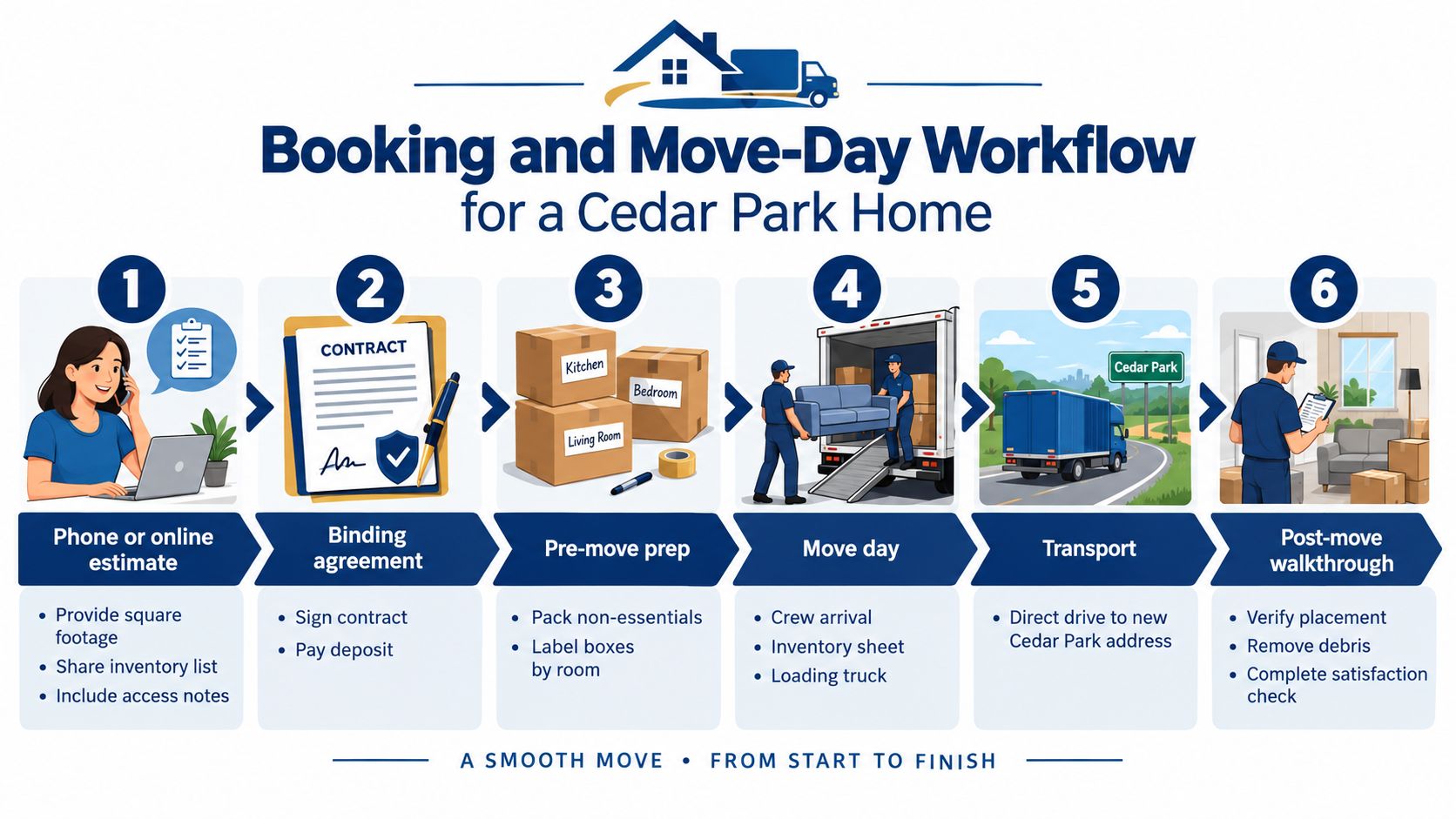
The smoothest moves follow a documented handoff from customer to dispatcher to crew. Every missing detail becomes a question on moving day, when questions cost time.
Start the quote with exact addresses, room counts, inventory, and access notes. Mention stairs, elevators, narrow streets, sloped driveways, gated entrances, long carries, heavy items, packing needs, and any HOA or lease restrictions. Send photos when the approach is difficult to describe.
Build the booking record
The estimate or agreement should identify the crew plan, truck plan, rates, included materials, packing scope, deposit, cancellation terms, and likely access charges. If your HOA requires insurance paperwork, get the certificate before the community deadline rather than assuming the mover will handle it automatically.
A good dispatcher also confirms whether the quote is based on a virtual walkthrough, an inventory list, or an on-site inspection. If the customer adds a garage, storage room, piano, or packed kitchen after the estimate, the labor plan may need revision.
Prepare the property
Before the crew arrives:
Label rooms clearly: Use destination-room labels that match the inventory.
Finish nonessential packing: Leave daily-use items accessible, but don't leave loose contents in drawers or cabinets.
Reserve access: Confirm elevators, loading areas, parking, gate codes, and building contacts.
Protect pathways: Tell the crew about delicate flooring, tight turns, low ceilings, and fragile landscaping.
Separate essentials: Keep documents, medication, chargers, keys, and valuables with you.
On move day, the foreman should walk through the property, confirm the inventory, identify existing damage, and agree on the loading sequence. The crew should protect floors and walls, track time, and document unusual conditions.
At delivery, check room placement and the inventory before the truck leaves. If something is damaged, record it promptly and follow the mover's claims procedure. A final walkthrough catches misplaced furniture and missing boxes while the crew is still present.
Choosing the Right Cedar Park Mover for Your Situation
Choose the mover that matches the physical job, not the one with the lowest headline rate. A one-bedroom apartment with a clear loading area needs a different operation from a four-bedroom home with stairs, a piano, a safe, and a restricted subdivision entrance.
Match the crew to the move
Mover type | Best fit for | Key verification |
|---|---|---|
Small local crew | One-bedroom apartment or compact local move | Confirm access plan and minimum charges |
Larger residential team | Multi-bedroom home with substantial furniture | Verify crew size, inventory assumptions, and written scope |
Specialty-capable mover | Piano, safe, antique, or unusually heavy item | Ask about equipment, experience, padding, and placement |
Commercial moving team | Office, clinic, or small business relocation | Confirm after-hours scheduling, building rules, and downtime plan |
Labor-only crew | Customer-owned truck or portable container | Confirm loading sequence, protection, and container access |
Compare quotes using the same facts: addresses, room count, stairs, elevator rules, parking distance, packing scope, heavy items, storage, and desired date. Ask whether fuel, mileage, tape, blankets, floor protection, and specialty handling are included or charged separately.
A mover that documents the access plan and explains its assumptions is more useful than one that gives you a suspiciously low number. A quote that omits the driveway, elevator, or safe isn't a bargain. It's incomplete.
Review the company's customer feedback and moving reviews, then compare that information with the licensing and insurance checks above. You should see clear communication about arrival windows, billing, damage procedures, and property requirements.
Red flags are straightforward: full payment upfront, no physical local address, refusal to provide a COI, no written estimate, and a price dramatically below comparable bids. Choose the company that can explain how it will move your specific inventory through your specific property.
Webster Moving Co. provides residential and commercial relocations, packing, storage and POD moves, and specialty handling for items such as pianos and safes across Cedar Park and Greater Austin. Request a no-obligation estimate through Webster Moving Co. and include your access details, approvals, inventory, and preferred date so the crew plan reflects the job accurately.
Comments