
How to Move a Piano Safely in Central Texas
Upright pianos weigh 300 to 800 pounds, and grand pianos can exceed 1,000 pounds, so a piano move is a heavy-load logistics job, not ordinary furniture shifting. If you're staring at a hallway corner, a stairwell, or a narrow Austin apartment entry, the first mistake is assuming muscle solves it.
A safe move starts with respect for the weight, the shape, and the climate. In Central Texas, heat, humidity, and tight building access make the job harder than it looks from the curb.
Table of Contents
Understanding the Physics of Your Piano Move - Why the shape matters as much as the weight
Planning the Perfect Route Before Lifting - Measure the route like the piano has to fit the first time
Essential Equipment for Safe Transport - Professional gear versus household gear
Navigating Stairs and Tight Spaces - How the crew should handle the move
Post-Move Acclimatization and Tuning - What to do after the piano lands
When to Hire Professional Piano Movers - What a licensed crew adds
Understanding the Physics of Your Piano Move
The first surprise on a piano job is how quickly a “big piece of furniture” stops behaving like furniture. An upright piano usually sits in the 300 to 800 pound range, while baby grands commonly land between 500 and 650 pounds, and concert grands can exceed 1,200 pounds. Those numbers matter because the weight isn't spread evenly, it's concentrated in a rigid cabinet built around a cast-iron plate, soundboard, bridges, and high-tension strings.
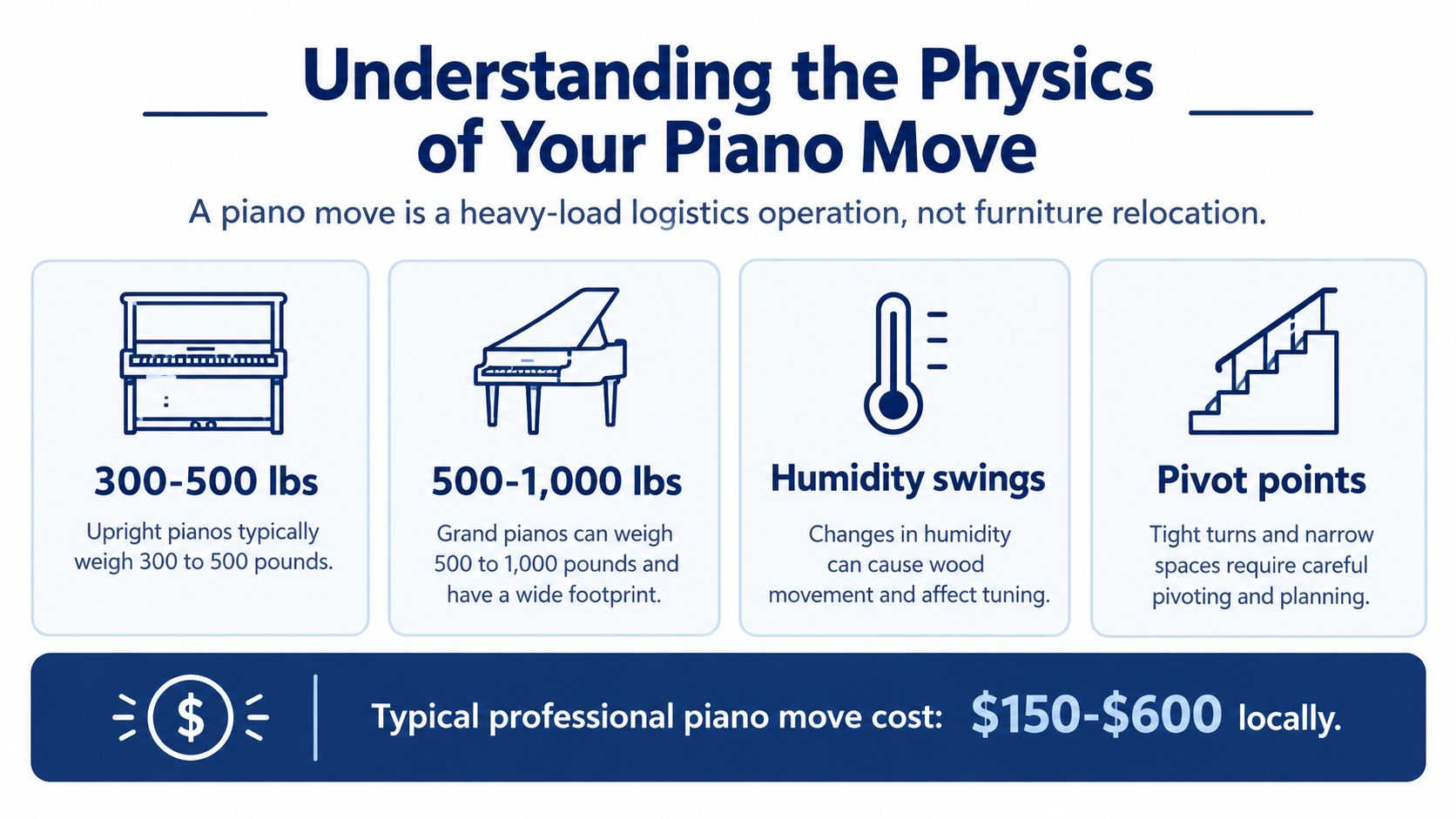
A Steinway description notes that the strings can carry up to 40,000 pounds of tension, which tells you why a hard impact or a bad pivot can turn into a costly repair instead of a minor scuff. Even if the cabinet looks sturdy, the internal structure reacts badly to twisting, sudden drops, or unsupported lifting. The piano may appear solid, but the inside is under constant stress.
Why the shape matters as much as the weight
Access is the other half of the problem. A concert grand can be more than 7 feet long, and even an upright can be awkward through a narrow hallway, stair landing, elevator, or apartment corridor. That's why a move a piano job in Austin or Round Rock often comes down to geometry, not brute force.
A piano is easiest to damage at the exact moment someone tries to “just angle it through.”
For homeowners and property managers, the risk isn't only the instrument. It's also concentrated floor load, wall and banister contact, and worker injury. That's why a written plan and protective materials are basic controls, not extras, and why specialty-item planning matters for anyone comparing moving options, including specialty-item handling.
Planning the Perfect Route Before Lifting
The best piano moves are won before anyone bends to grab a corner. Start with a route survey and write down the instrument type, dimensions, approximate weight, and center of mass, then measure every doorway, hallway, stairwell, landing, elevator opening, and ceiling restriction that the piano will pass through. Measure with trim, handrails, doors, and other obstructions in place, because nominal width and usable width are rarely the same thing.
Measure the route like the piano has to fit the first time
For a grand, include the tail swing, lid clearance, and turning radius. A cardboard or floor-plan template helps you see the turn before the piano commits to it, which is especially useful in older Central Texas homes where halls bend around odd angles or front entries pinch down near the steps. If the truck has to park far away, add the curb-to-truck path and sidewalk condition to the route survey too.
If you have to guess at a doorway, you don't have a route yet.
A practical sequence keeps the move from getting chaotic:
Clear and protect the path, including corners, thresholds, and floor transitions.
Secure the keyboard lid without putting tape on finished surfaces.
Pad the cabinet so the finish and corners don't take the abuse.
Attach approved straps before the piano leaves its resting spot.
Set the instrument on a rated dolly or skid, not whatever happens to be nearby.
The biggest mistake is treating doorway width as if it were usable width. That's how a move gets stuck, a finish gets scraped, or someone starts dismantling parts of the route under pressure. In apartment work, that problem shows up fast, so a careful apartment move plan is worth more than last-minute improvising.
Essential Equipment for Safe Transport
The tool list for a piano move isn't long, but it's specific. You need a weight-rated four-wheel piano dolly, thick moving blankets, heavy-duty straps, an appliance ramp for truck loading, and corner protectors. On stairs, the right setup changes again, because an ordinary furniture dolly isn't built for stair geometry or the stress of a vertical carry.
Professional gear versus household gear
A household dolly might roll a bookshelf across a flat floor. It won't control a piano's center of gravity on stairs, and it won't keep a baby grand steady while the crew loads it into a truck. A proper piano stair dolly, secure strapping, and coordinated handling are a different category of equipment entirely.
Practical rule: if the tool wasn't built for the load, don't ask it to save the day.
Stair moves also need enough people to control the balance. Specialist guidance recommends at least four people for an upright on stairs, with spotting and stabilization roles added around them. That's not about having extra hands for the sake of it, it's about keeping the load stable while the crew manages corners, landings, and step transitions.
Professional crews also arrive with the right protection for the truck and the route, along with climate-aware transport practices that matter in Central Texas heat. If you're comparing your own setup with a crew's, ask one simple question, what piano-specific equipment is on the truck? For fuller packing and protection on a broader household move, packing services can also keep the rest of the job from interfering with the piano itself.
Navigating Stairs and Tight Spaces
A piano move can feel manageable in a wide hallway, then turn messy at the first stair landing or doorway trim. That shift matters in Austin and Round Rock, where older apartment buildings, tight elevator banks, and narrow turns often decide whether the move stays controlled or starts fighting back. For apartment moves, the route usually matters as much as the lift.
How the crew should handle the move
One person needs to call each move so the team stays in rhythm. The pace should be slow and deliberate, with the piano lifted cleanly over thresholds instead of bumped against them. Any sudden pull can throw off balance and leave the crew correcting the load halfway through a landing.
Before the piano enters the stairwell, protect the walls, banisters, and corners. On a tight route, the team may also need to remove grand piano legs or the lyre, then reassemble those parts at the destination. That is not a field fix, it is part of the move itself.
A short measuring check helps before anyone lifts. Measure the narrowest doorway, the stair width, and the landing space, then compare those numbers with the piano's footprint and the turning radius the crew will need. A stairwell that looks workable at a glance can fail at the last corner if the landing is too tight to pivot cleanly.
Apartment logistics need the same attention. Parking access, elevator timing, and protection for shared areas should be settled before the crew starts, because hallway traffic and building rules do not leave room for improvisation. In multi-floor properties, that coordination keeps the piano, the walls, and the banister from competing for the same space.
Post-Move Acclimatization and Tuning
A piano can arrive without a scratch and still feel wrong. That's because transport and storage affect more than the finish, they affect humidity, tuning stability, and the action inside the instrument. In Central Texas, where heat and moisture can swing hard across seasons and between indoors and vehicle cargo spaces, that after-move period matters a lot.
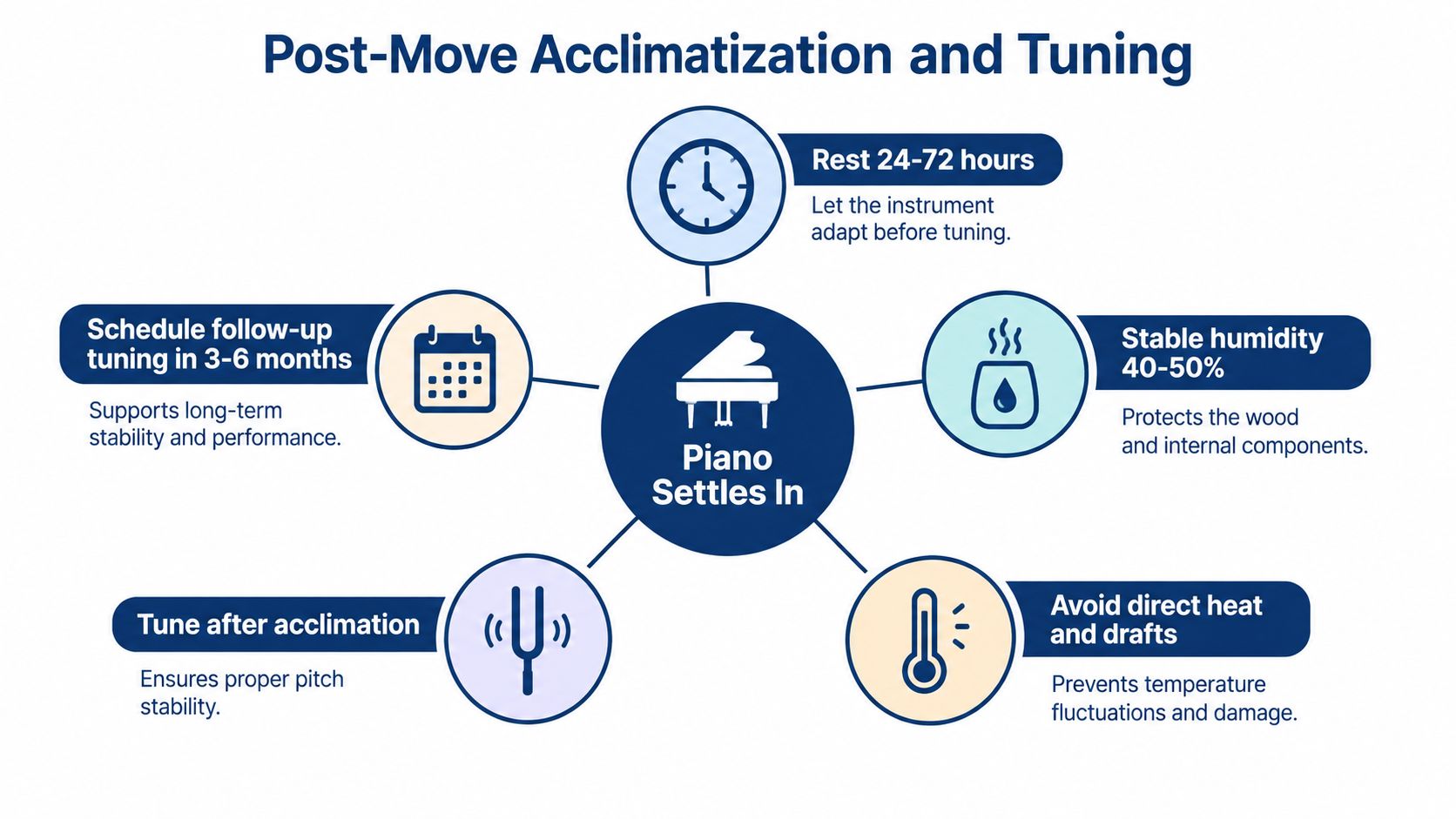
Manufacturer guidance recommends roughly 40 to 60% relative humidity with minimal fluctuation and warns that humidity changes can affect tuning and swell felt, leather, and wooden action parts. It also advises careful acclimatization after cold storage or transport. A specialist-storage source adds that humidity cycling can degrade the pin block and that a 10-percentage-point relative-humidity change may produce a 2 to 3% change in string tension, though the manufacturer guidance is the stronger reference point.
What to do after the piano lands
Place the piano away from direct heat and drafts, then let it acclimate before tuning. Use a hygrometer if you want to know what the room is doing instead of guessing. If the piano came out of a truck, garage, POD, or non-climate-controlled space, the safest assumption is that it needs time, not immediate tuning.
The practical mistake is tuning too early and then paying again after the instrument settles into its new environment. In humid months, the wood and action parts can respond slowly even when the cabinet looks perfect, so the player hears instability before they see any visible issue. If the piano still feels off after it acclimates, that's the point to involve a piano technician rather than chasing the tuning with repeated quick fixes.
When to Hire Professional Piano Movers
A short move across one floor in a roomy house can be manageable for a capable crew with the right gear. Once stairs, elevators, tight turns, long carries, or apartment rules enter the picture, the job stops being casual and starts becoming specialist work. That's especially true in Central Texas, where older homes, tight apartment corridors, and summer heat all work against a safe DIY attempt.
What a licensed crew adds
Licensed movers bring the equipment, the straps, the padding, and the loading process that a standard household move usually doesn't cover well. Webster Moving Co., based in Round Rock and serving Greater Austin and Central Texas, handles specialty items such as pianos with trained crews, and its site lists TxDMV No. 010210868C and USDOT 4470107. That matters because a piano move isn't just about strength, it's about controlling risk, protecting property, and knowing how to work inside cramped residential layouts.
If the move includes stairs, elevators, or a long carry, the safest decision is usually the one that keeps the piano off the floor and out of a rushed improvisation.
Professional help also reduces the chance that hidden access issues turn into damage, delays, or injury. When the crew already knows how to handle specialty items, you're not asking friends to learn on the fly in a stairwell. You're buying a controlled process instead of a gamble.
If you need a piano moved in Austin, Round Rock, or anywhere in Central Texas, Webster Moving Co. handles specialty-item transport with trained, licensed, and insured crews. They can help with the route, the equipment, and the careful loading that a piano demands, so visit Webster Moving Co. to request a quote and talk through your move.
Comments